Rail Heritage WA 1
Demographics
Region: South West
LGA: Harvey
Other names: Asquith Concession, Asquith Bridge, Long Gully Bridge
Industry: Timber
Open Street Map: -33.010278, 116.273889
What3Words: ///senior.contesting.gigs
Settled: 1948
Gazetted: N/A
Abandoned: 1961
Abstract
The history of Asquith is fundamentally linked to Western Australia’s crucial timber needs in the post-World War II era. Known officially as the Asquith Timber Log Falling Camp or the Asquith Concession, this site became active around 1952, replacing the exhausted timber fields near Banksiadale. Its existence hinged entirely on the construction of the Asquith Bridge (also known as the Long Gully Bridge), a substantial and rare curved timber trestle structure built by the Western Australian Government Railways (WAGR) between 1949 and 1952 to haul massive karri logs over the Murray River. The community’s purpose was brief, ending abruptly in 1961 after catastrophic bushfires destroyed the destination mill at Dwellingup. The bridge survived, serving later as a road and then a pedestrian path until it was tragically consumed by fire in 2015.
History
In the decades following World War II, Western Australia was hungry for timber. The great jarrah forests of the South West had been the economic backbone of the colony for generations, nurturing sprawling timber enterprises and rail networks since the 1870s. But by 1946, the accessible logs around the major WAGR (Western Australian Government Railways) operation at Banksiadale were pretty well cut out.
This is where the story of Asquith begins – not as a formal townsite, but as the essential lifeline for a new timber supply. Officially named the Asquith Timber Log Falling Camp, or simply the Asquith Concession, this area was located about 30 kilometres east of Harvey, roughly 60 kilometres away from the Banksiadale processing mill. The WAGR obtained this concession specifically to ensure new timber was available during a period when supplies were scarce. The timber operations here were run by the Millar Brothers.2 3 4 5 6
Building the Lifeline
To tap into the newly acquired forest resources at Asquith, the WAGR embarked on a significant railway expansion project in the late 1940s. It wasn’t a short trip; logs needed to travel from the concession all the way back to Banksiadale, a considerable distance for mid-century logging operations.7 8
The construction crew didn’t start from scratch, but they certainly put in the hard yards. They rehabilitated six kilometres of existing Banksiadale track and incorporated 42 kilometres of existing State Saw Mills rail line near Hakea. However, the remaining 17 kilometres of track leading directly into the Asquith Timber Permit area had to be built anew.9 10
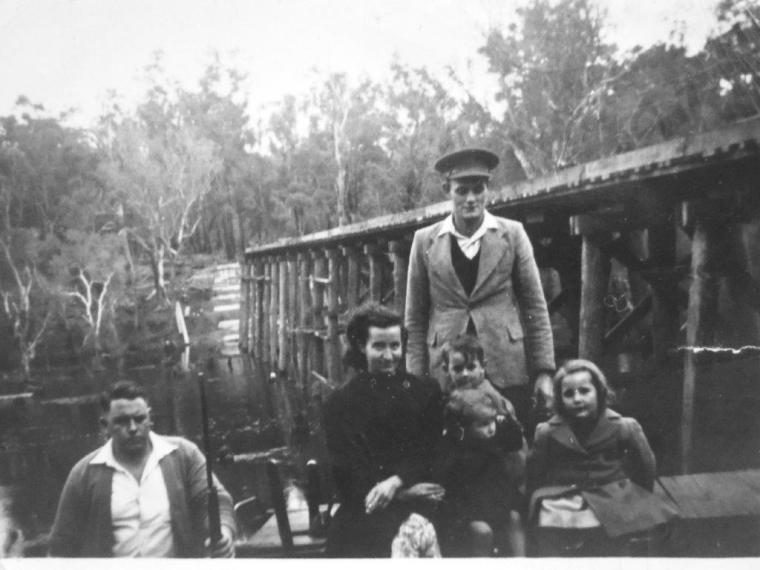
The single biggest headache on this route was the Murray River. WAGR engineers had to design a structure capable of handling heavy log loads and steam locomotives across a deep, wide valley prone to seasonal flooding.11 12
SLWA13
The Magnificent Asquith Bridge
The solution to the river crossing was the Asquith Bridge, sometimes also referred to as the Long Gully Bridge. This enormous wooden structure, built between 1949 and 1952, epitomizes the technical skill of the WAGR.14 15
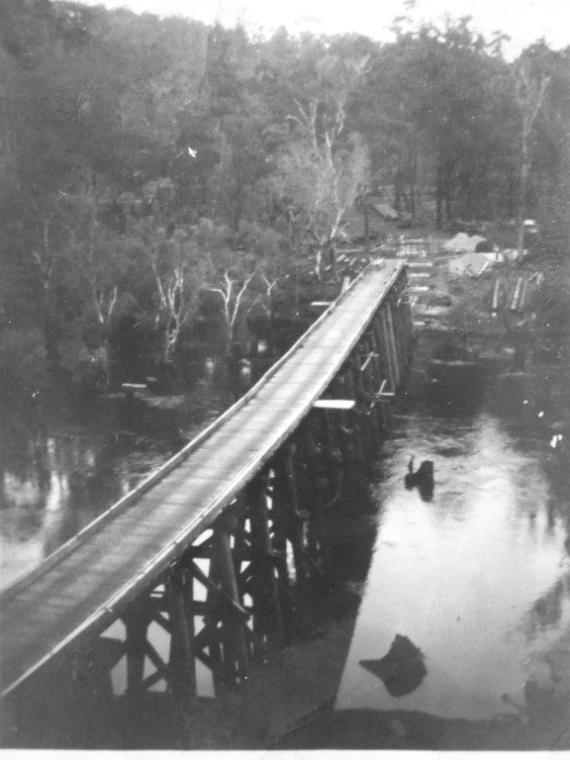
Standing 10 metres high and stretching 127.88 metres long, the bridge comprises 28 spans of timber trestle construction. It holds the distinction of being one of the most substantial timber railway bridges ever built in Western Australia, especially notable since its construction happened late in the twentieth century when steel and concrete were beginning to dominate bridge design.12 17
What really sets the Asquith Bridge apart visually and technically is its alignment: it runs straight for the first half, then curves gently in an arc towards the eastern bank as it reaches the northern embankment. This curved timber construction is considered a rare achievement for the state.18
SLWA19
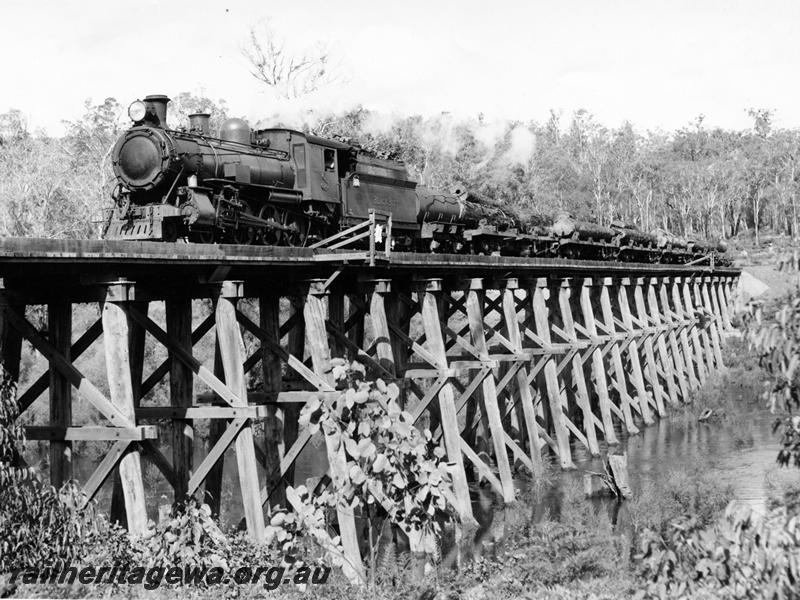
Once the railway and the bridge were completed, log hauling officially began on January 7, 1952. Logs harvested at the concession were hauled along the railway line, over the magnificent bridge, to the Banksiadale Mill for processing. Initially, the line used G class locomotives, which were later replaced by the larger C class engines to handle the demanding distance and steep grades. One of these powerful C class locomotives, named ‘Black Butte,’ was famously photographed crossing the bridge hauling log wagons around 1960.20 21 22 23
Life in the Bush Camp
The social aspect of Asquith centered purely around the industry. As a “log falling camp,” the workers (the log fallers) lived in a relatively isolated bush camp. Like many remote timber settlements, the concession provided basic facilities, including a boarding house.24
The economic and social landscape of the area depended entirely on the continued exploitation of the jarrah resources. However, this dependence proved precarious. The operations at Asquith were destined to be short-lived, spanning only about a decade.
Decline and Environmental Shock
The fate of the Asquith logging operation was sealed by a major environmental disaster combined with pre-planned government infrastructure development.
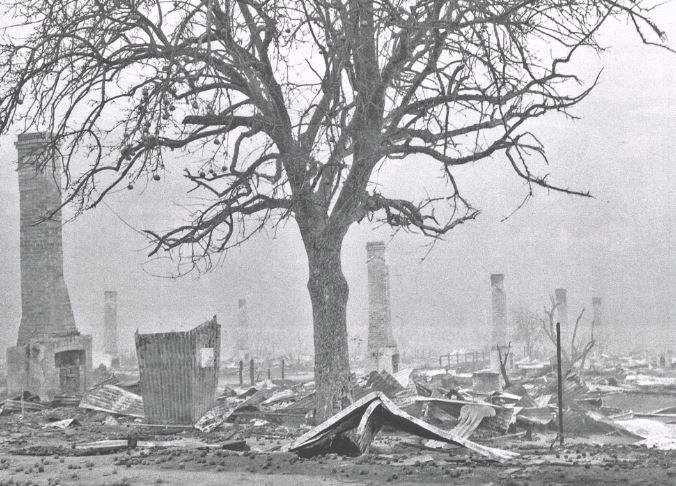
The Banksiadale-Asquith railway line operated steadily until early 1961. However, the massive Dwellingup fires swept through the region in late 1960 and early 1961, devastating the countryside and destroying the vital Dwellingup timber mill.25
Lost Perth26
Economically, rebuilding the Dwellingup mill was deemed unviable because the area was earmarked for flooding due to the construction of the new South Dandalup Dam. Without the processing mill, the vast railway network – including the line extending to Asquith – became redundant and the tracks were subsequently removed. This abrupt closure brought the Asquith logging industry to an end.27
A Heritage Survivor and Its Tragic End
After the WAGR abandoned the line, the ownership of the Asquith Bridge was transferred to the Forests Department (later Department for Environment and Conservation) in 1966. The structure was then repurposed for vehicles, primarily forestry department trucks.28
However, by the 1990s, the bridge was officially closed to vehicular traffic. Its sturdy construction ensured it found a second life serving a different purpose altogether: recreation and tourism. In 1997-98, the Asquith Bridge was incorporated into the famous Bibbulmun Track, a 965-kilometre walking trail extending from Kalamunda to Walpole. This shift highlighted the change in the local economy from resource exploitation to enjoying the natural environment.29 30
The bridge was highly valued for its historical significance and rarity, included in the Shire of Boddington’s Municipal Heritage Inventory and subsequently listed on the State Register of Heritage Places on an interim basis in 2006. Even decades after its original rail tracks were removed, it maintained high authenticity and integrity.31
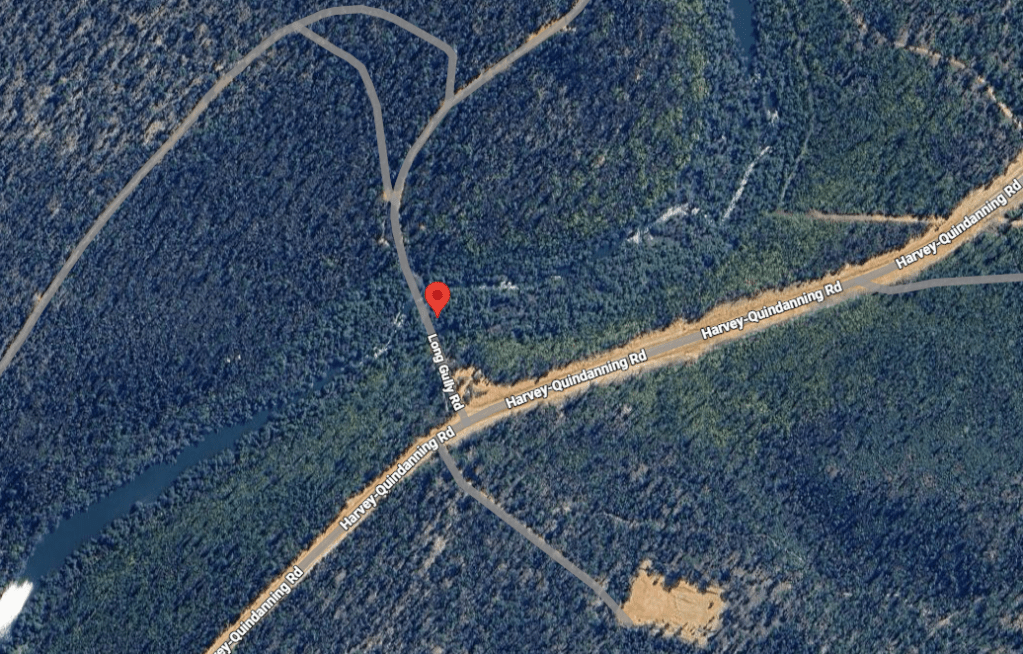
Despite surviving its operational years, the Asquith Bridge met a tragic end. The structure, located adjacent to Long Gully Road, was destroyed by a bushfire in 2015. This dramatic event brought a final close to the tangible relics of the short-lived but economically vital Asquith Timber Concession, leaving behind only the historical record of the ambitious infrastructure required to keep Western Australia supplied with timber in the mid-twentieth century.32
Timeline
- 1946: The Western Australian Government Railways (WAGR) obtained the Asquith Block timber concession (located 30 km east of Harvey) after timber stocks near Banksiadale were exhausted.
- 1948: WAGR planning commenced for the required railway line extension, including the complex crossing of the Murray River.
- 1949: Construction of the Asquith Bridge (also known as Long Gully Bridge) began over the Murray River.
- 1949–1952: The extensive 28-span timber trestle Asquith Bridge was constructed by the WAGR.
- January 7, 1952: Log hauling officially commenced on the new railway section, utilizing the Asquith Bridge to transport logs to Banksiadale.
- Early 1950s: Log hauling initially used G class locomotives, which were soon replaced by the more powerful C class, which were the largest steam locomotives ever used on an Australian timber railway.
- Early 1961: The Dwellingup timber mill was destroyed by fire.
- Early 1961: The railway line serving the Asquith concession ceased operation, leading to the eventual removal of the tracks.
- 1963: The Banksiadale mill itself burnt down and was not rebuilt.
- 1966: The Forests Department assumed ownership of the Asquith Bridge.
- Late 1960s – 1990s: The bridge was converted and primarily used for vehicular road traffic by forestry department vehicles.
- 1997–1998: Asquith Bridge was converted to pedestrian use and incorporated as an essential crossing point on the Bibbulmun Track.
- April 2000: Asquith Bridge is included in the Shire of Boddington’s Municipal Heritage Inventory, noted for its “Exceptional significance”
- April 6, 2006: The bridge was added to the State Register of Heritage Places on an interim basis.
- February 2015: The historic Asquith Bridge (Long Gully Bridge) was destroyed by a bushfire (the Lower Hotham fire)
Map
Sources
- Rail Heritage WA, n.d. P00897 CS class 270 “Black Butt”, trestle bridge, Asquith, hauling a log train. Retrieved on 24 Nov 2025 from https://www.railheritagewa.org.au/archive_scans/displayimage.php?album=search&cat=0&pid=898#top_display_media ↩︎
- Heritage Council, 2005. Register of Heritage Places – Assessment Document: Asquith Bridge 1. P.11. Retrieved 27 Nov 2025 from https://inherit.dplh.wa.gov.au/admin/api/file/f2f8dede-65e8-d3a1-1a7f-bfabcd5e3b81 ↩︎
- APA citation
TIMBER MILLS OF WESTERN AUSTRALIA. (1881, November 22). The West Australian (Perth, WA : 1879 – 1954), p. 6. Retrieved December 5, 2025, from http://nla.gov.au/nla.news-article2985935 ↩︎ - Dardanup Heritage Collective, 2025. Wellington Mills. Retrieved 5 Dec 2025 from https://dardanupheritagecollective.org.au/stories-of-places/wellington-mills/ ↩︎
- Wikipedia, 2025. Banksiadale, Western Australia. Retrieved 27 Nov 2025 from https://en.wikipedia.org/wiki/Banksiadale,_Western_Australia ↩︎
- Heritage Council, Asquith Bridge Assessment: p.4 ↩︎
- ibid, p.1 ↩︎
- Wikipedia, Banksiadale: refers to the importance of the rail network ↩︎
- Heritage Council, Asquith Bridge Assessment: p.4 ↩︎
- Morawa District Historical Society, n.d. A. Retrieved 27 Nov 2025 from https://morawamuseum.org.au/ghosttowns/A.pdf ↩︎
- Gunzburg, Adrian and Austin, Jeff, 1997. Rails through the bush: timber and firewood tramways and railway contractors of Western Australia. p.124 ↩︎
- Heritage Council, Asquith Bridge Assessment: p.1 ↩︎
- State Library of WA, n.d. Murray River crossing before the completion of the bridge, 1949. Retrieved 5 Dec 2025 from https://encore.slwa.wa.gov.au/iii/encore/record/C__Rb4658462 ↩︎
- Heritage Council of Western Australia, 2018. Asquith Bridge. Retrieved 5 Dec 2025 from https://inherit.dplh.wa.gov.au/Public/Inventory/Details/b340851f-25c3-4488-b5a1-25bfced80146 ↩︎
- WA.gov.au, 2006. Murray River bridge reaches heritage status. Retrieved 27 Nov 2025 from https://www.wa.gov.au/government/media-statements/Carpenter%20Labor%20Government/Murray-River-bridge-reaches-heritage-status-20060406 ↩︎
- Heritage Council, Asquith Bridge Assessment: p.1 ↩︎
- Shire of Boddington, 2025. The History of Boddington. Retrieved 27 Nov 2025 from https://www.boddington.wa.gov.au/live/about-boddington/history.aspx ↩︎
- Heritage Council, Asquith Bridge Assessment ↩︎
- State Library of WA, n.d. Asquith bridge under construction from top of pile driver, 1948. Retrieved 5 Dec 2025 from https://encore.slwa.wa.gov.au/iii/encore/record/C__Rb4658462 ↩︎
- Morawa: refers to Asquith Bridge ↩︎
- WA Now and Then, n.d. Ghost Towns Starting with ‘A’. Retrieved 27 Nov 2025 from http://www.wanowandthen.com/ghost-towns2.html ↩︎
- Gunzburg & Austin, p.124 ↩︎
- Wikipedia, Banksiadale: refers to Asquith Bridge ↩︎
- Morawa: refers to living conditions in the camp ↩︎
- Wikipedia, Banksiadale: refers to the 1961 fires ↩︎
- Lost Perth, 2014. …the long summer of 1961… Retrieved 5 Dec 2025 from https://www.facebook.com/share/1A7VegACF2/ ↩︎
- Wikipedia, Banksiadale: refers to the removal of the railways ↩︎
- Heritage Council, Asquith Bridge Assessment: p.6 ↩︎
- WA.gov.au, 2006:refers to Bibbulmun Track ↩︎
- Shire of Boddington, 2011. Municipal Heritage. p.16. Retrieved 5 Dec 2025 from https://www.boddington.wa.gov.au/documents/2121/municipal-heritage-inventory-2011 ↩︎
- Heritage Council, Asquith Bridge: refers to being heritage listed 2006 and the high degree of authenticity ↩︎
- Grace Millimaci, 2015. Bushfire claims historic bridge. Published in The West Australian on 8 Feb 2015. Retrieved 5 Dec. 2025 from https://thewest.com.au/news/wa/bushfire-claims-historic-bridge-ng-ya-223832 ↩︎
 People of Western Australia's Ghost Towns