Demographics
Region: Mid West
LGA: Cue
Industry: Mining
Other Names: Lake Austin, The Island Lake Austin, The Island, The Great Inland Marsh
Open Street Map: -27.421205858470962, 117.86162014043433
What3Words: ///carefully.paperweight.blanking
Settled: Abt. 1874
Gazetted: 1895
Abstract
This article provides a comprehensive historical narrative of Austin, a ghost town uniquely situated on an island within the shimmering salt lake of the same name in Western Australia’s Mid West. Known variously as Lake Austin, The Island, and the Great Inland Marsh, the community’s history is inseparable from the geographical anomaly of its 2×5 kilometre island setting. The narrative begins with Robert Austin’s harrowing 1854 expedition, which, despite catastrophic losses of livestock and the tragic death of young Charles Farmer, correctly identified the region’s massive auriferous potential.
The discovery of gold in the early 1890s by prospectors, including the Webb brothers, triggered a rush that saw hundreds flocking to the lake. The article examines the town’s social and economic peak following its 1895 gazettal, highlighting the resilience of its inhabitants who constructed rare dry stone ironstone huts, now heritage-listed, and established a diverse economy ranging from hotels to soft drink manufacturing.
Deep attention is given to the town’s genealogy through the records of the Lake Austin Island Cemetery, recounting the lives of figures like the miserly Jeremiah Cronin and the mining victim Willie Moate. It also explores the 1930 mystery of the skeletons discovered under a stunted gum tree, linked to the disappearance of prospectors Credgington and Bradbury in 1909. Finally, the piece discusses the environmental challenges of the lake and the economic shift that saw Austin fade into a silent museum of outback effort.
History
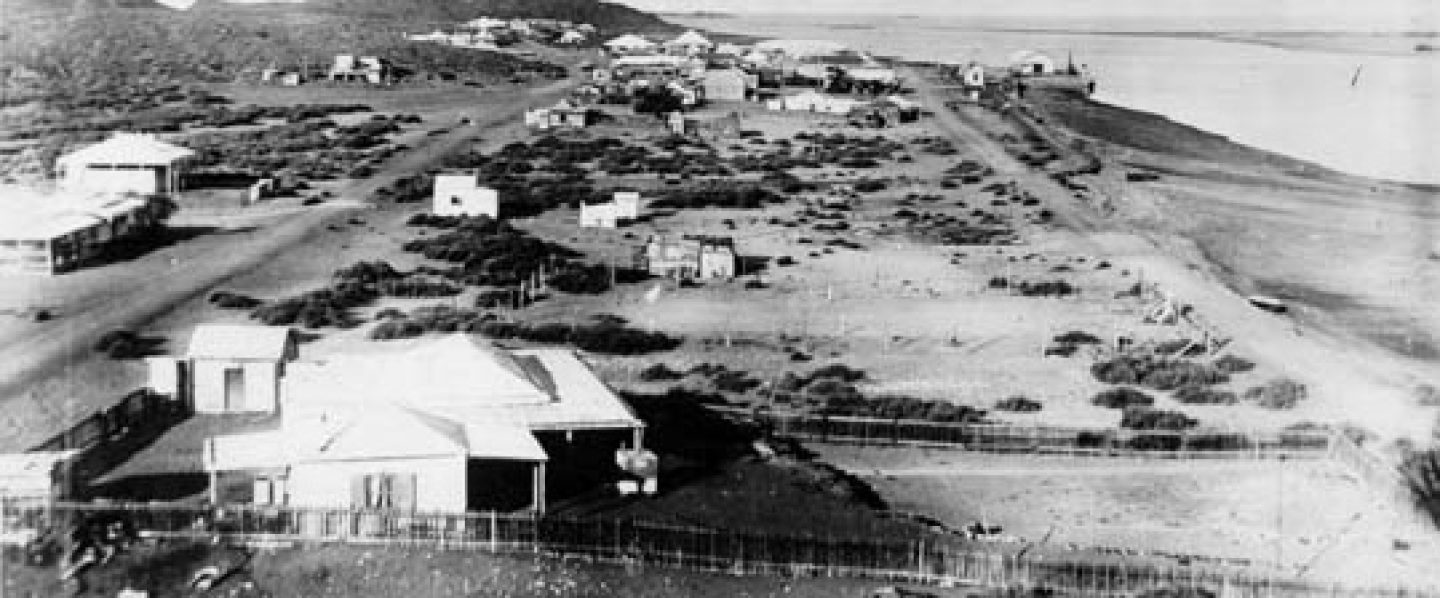
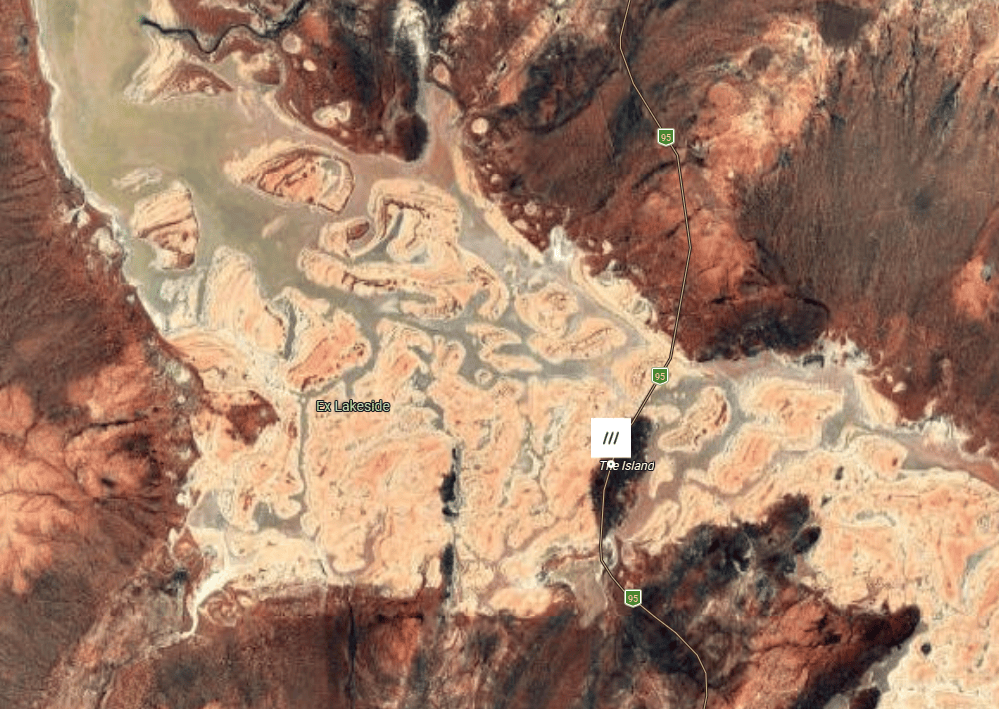
In the vast, shimmering expanse of the Murchison region, approximately 23 kilometres south of Cue, lies a geographical anomaly that once hosted a bustling centre of human ambition. Austin, known variously throughout its history as Lake Austin, The Island, and the Island Lake Austin, was a town born of gold and grit. It sat uniquely upon an island measuring roughly two by five kilometres, nestled within the heart of an ephemeral salt lake that covers nearly 14,000 square kilometres. To the casual observer today, the site offers little more than red sand, loose rocks, and the skeletal remains of ironstone buildings, but for the local historian and the genealogist, Austin is a rich repository of stories regarding survival, resourcefulness, and the relentless search for fortune.
Christine Harris 2026
The Vision of Robert Austin
The European history of the area begins not with a miner, but with a surveyor whose name would eventually be given to both the lake and the town. Robert Austin was born on New Year’s Eve in 1825 in Essex and arrived at Australind as a teenager in 1840. By 1854, his physical strength and energetic nature had seen him rise through the Surveyor-General’s Department to lead a critical expedition to explore the country between Perth and the Murchison River.2
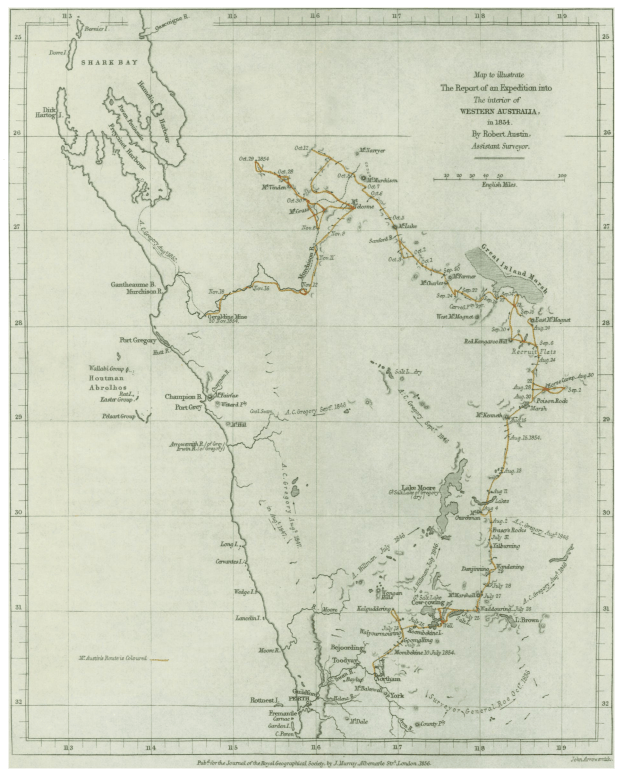
Austin’s 1854 journey was defined by “immense hardships”. The season was brutally dry, and the party was dogged by disaster. On 21 August 1854, several horses ate the toxic “poison bush” (Gastrolobium grandiflorum) and died in agony, permanently crippling the expedition’s movements. The most tragic human cost was the death of young Charles Farmer. While returning with a horse on 19 September, Farmer laid his gun in a bush while skinning a kangaroo; the hammer caught on a branch, discharging the weapon into his right arm. Despite Austin’s efforts to wash the wound with tepid water and apply linseed oil poultices, Farmer succumbed to his injuries on 27 September. He was buried at sunset, sewn in a blanket with his saddle for a pillow, in a grave where Austin carved “C. Farmer, 1854” with a chisel and tomahawk.4 5
When Austin first encountered the massive salt lake that would bear his name, he was unimpressed by the immediate environment, naming it the Great Inland Marsh and describing the surrounding country as “very indifferent”. However, his professional eye noted something that would change the course of Western Australian history. The geological features, he reported, indicated “probably one of the finest goldfields in the world”. Despite his detailed reports and the insistence of his captured native guide that they would all die if they pushed further into the waterless waste, Austin’s claims were largely ignored for decades. He eventually left Western Australia for Queensland, where he had a distinguished career as an engineer and sergeant-at-arms, but the “auriferous zone” he identified at Lake Austin remained waiting for the next generation of pioneers.6
The Rush to “The Island”
The silence Robert Austin left behind was finally broken in the early 1890s. By late 1891, payable gold had been reported at the Murchison, and approximately 300 to 400 men were already on the field. The Webb brothers from Northampton were among the first to bring word of the riches, arriving in Geraldton in May 1892 with 270 ounces of gold, including nuggets weighing up to 13 ounces. Prospectors began dry blowing on the island near the lake, where “tolerably large slugs” of alluvial gold were occasionally found.7 8 9
By June 1892, the first mining lease, known as the Ironclad, was applied for by Halliwell and his party. What had begun as scattered prospector camps quickly morphed into a more permanent settlement. The environment was unforgiving; the lake itself is an evaporation basin for a massive internal drainage system, often dry and crusted with salt, only filling with water about twice every decade following heavy summer or autumn rains. When the lake did fill, it was a spectacular sight, but for most of the town’s life, it was a “No Man’s Land” of sundried, powdery earth.10 11
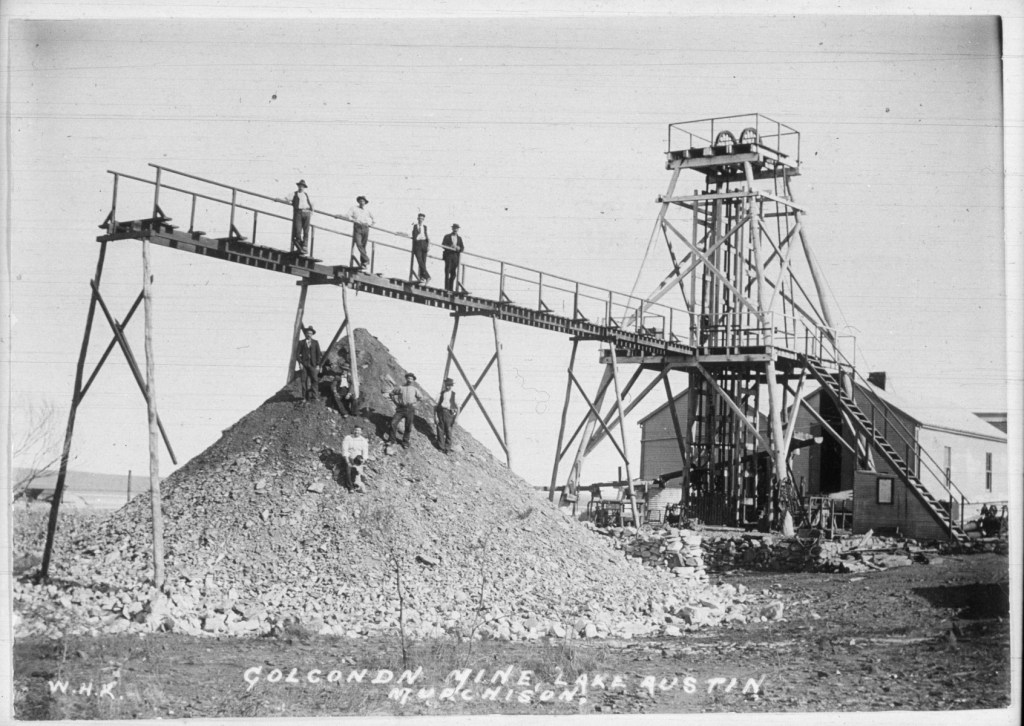
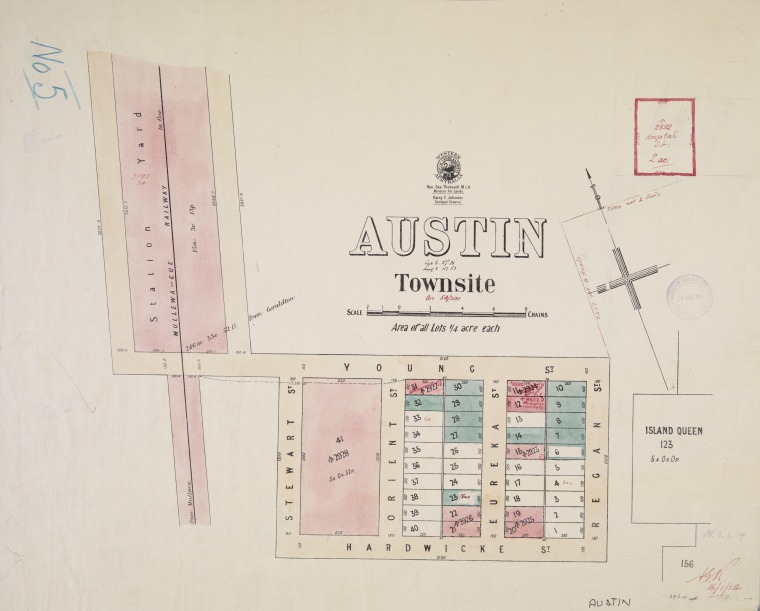
The town of Austin was officially gazetted in 1895. It was a period of rapid economic expansion. By October 1895, a ten-head stamp mill was operating at the Austin mine just outside the town, its heavy machinery crushing the quartz ore that Robert Austin had predicted would yield riches forty years earlier. Major operations like the Golconda and Island Eureka gold mines eventually produced 75% of the gold taken from the Island between 1897 and 1905.13
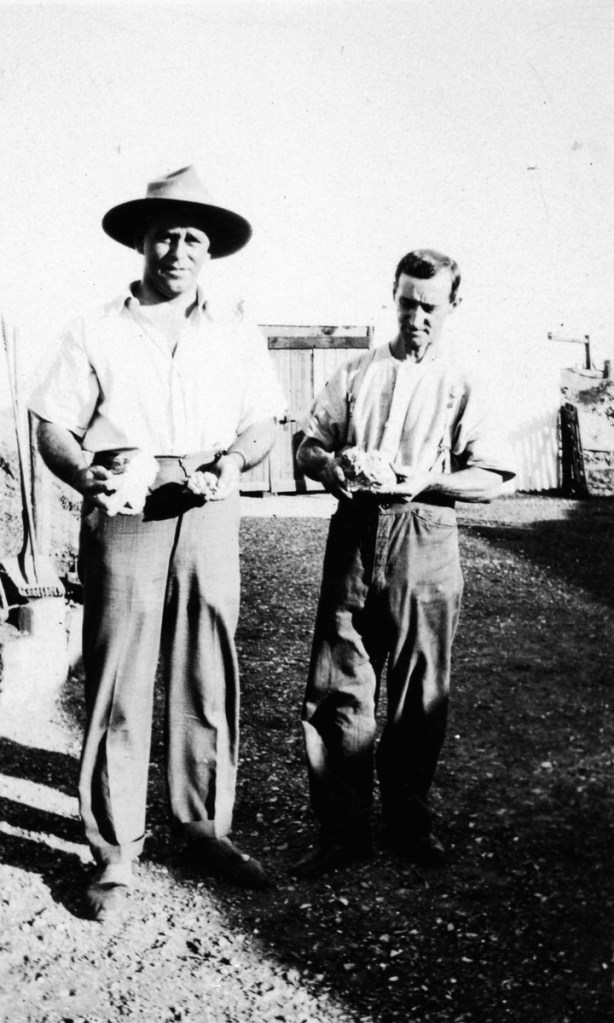
The Island Eureka Gold Mine, also known as Old Eureka Mine, supported three leases as early as 1895. From 1897 to 1905 the mine produced monthly crushings of 200-300 tonnes each. However, in 1905, following an unfavourable geology report, all employees were laid off and the plant and machinery was sold. Sometime later, the mine was acquired by Arthur C. Walker who was photographed showing off gold slugs from the Mine in 1932.14
A Resourceful Community
Life in Austin required a unique brand of architectural and social resourcefulness. Because timber was scarce and transport difficult, many miners turned to the most readily available material: loose ironstone. They constructed dry stone huts, many of which were built on higher elevations to catch the cooling breezes.16
These huts are now considered a rare jewel of Western Australian heritage. Unlike the temporary hessian or corrugated iron structures common on other goldfields, the Austin huts featured window and door openings, fireplaces, and even shelving built directly into the stone walls. The quality of the stonewalling suggests that many of these immigrant miners, likely from Europe, brought traditional masonry techniques with them to the outback. While none of the roofs remain today, the footings and tiled floors, constructed from flat pieces of local ironstone, serve as a testament to a community that planned to stay.
At its social peak, Austin was more than just a collection of miners’ huts. It was a town with two hotels, the Miners Arms Hotel and the Railway Hotel, the latter of which housed a general store. Postal directories from the late 1890s reveal a surprisingly diverse local economy, listing drapers, blacksmiths, butchers, bakers, carpenters, and even a “soft drink manufacturer”. In 1904, the local school was overseen by Margaret P. Clarkson, who served as the “Head Teacher on Supply”.17 18
Transport links also improved significantly. Initially, the only connection to the outside world was a bi-weekly coach from Yalgoo. However, the arrival of the railway in 1898 provided a massive boost to the town’s viability, connecting Austin to the larger centres of Mullewa and Cue. A substantial concrete platform was constructed, indicating that the Austin station was a sizeable and important stop on the line.
The Residents of Austin
For those interested in family history, the Lake Austin Island Cemetery, also known as “The Island of the Dead,” provides a poignant look at the individuals who called Austin home. The records of this small, isolated graveyard reveal the harsh realities of life on the Murchison.19 20
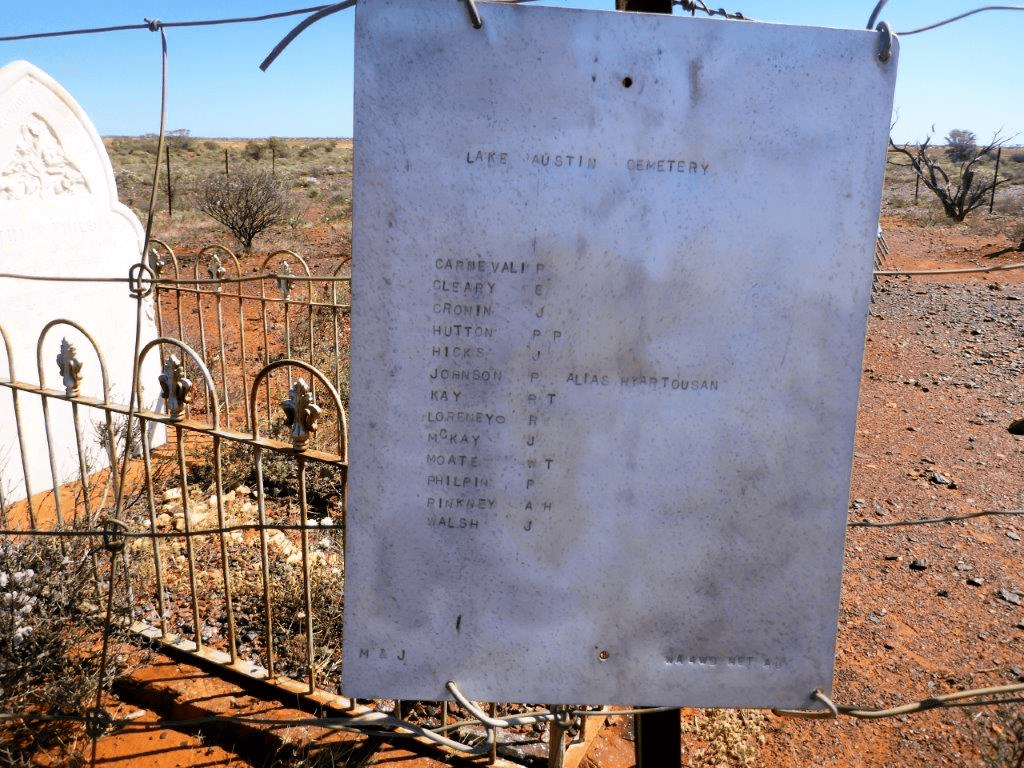
- Jeremiah ‘Jerry’ Cronin: Perhaps one of the town’s most eccentric figures, Jerry died in his tent in July 1895 at the age of 70. His camp was described as being of the “most miserable description,” and he was known to complain constantly of his poverty. However, after his death from dysentery and cardia syncope, police discovered 51 sovereigns hidden in his clothing and bank passbooks showing a credit of £250—a substantial fortune for the time. He had lived a life of extreme self-denial despite his wealth.
- Patrick Philbin: The licensee of the Miners Arms Hotel, Philbin was a prominent local figure who died of a cerebral haemorrhage in July 1895.
- Alfred Henry Pinkney: His story is a grim reminder of the environmental dangers of the region. In January 1894, Pinkney became lost in the bush during a period of intense heat. Driven to “temporary insanity” by thirst and heat, he committed suicide by cutting his throat near Webbs Patch. He left behind a wife and numerous children in both South Australia and Kalgoorlie.
- Pietro Carnevali: An Italian immigrant who represents the diverse workforce of the mines, Carnevali died in 1902 at the age of 28 from inhaling dynamite fumes at the Golconda Mine.
- William “Willie” Thomas Moate: A single man from Victoria, Willie was killed in November 1901 when a bench of ground collapsed while he was working an alluvial claim single-handedly. He was the sole support for his widowed mother and invalid brother.
- James McKay: An “old and respected identity” of the Island, McKay was found unconscious at the entrance of the Golconda Mine in 1896 and died from a ruptured blood vessel in the brain.
- Owen Roberts: A prospector from New South Wales who strangled himself with his own belt in December 1893 while intoxicated, found about 12 miles from Cue.
Even those who survived the mines faced the challenges of the outback. Michael William Duggan worked as the Austin Postmaster in 1898, earning an annual salary of £170 at the age of 21 after training as a telegraphist in Ballarat. The census records of the era show the town’s population peaked in 1905 at 191 people, but it began to dwindle almost immediately as the easy gold was exhausted.21
The 1930 Mystery
One of the most enduring and haunting mysteries of Austin concerns a discovery made long after the town’s heyday. On 26 November 1930, Hughie King, an employee of the Austin Downs Station, was hunting foxes southeast of the lake when he sought shade under a small gum tree. There, he found the skeletal remains of two men, partially covered by sand and grass.22
Constable William Fanning of the Cue Police led the investigation. Sifting through the sand, police found rusted hobnails from boots, a pipe, a magnifying glass, and a few coins, one dated 1877 and another 1890. Near the second skeleton lay another pipe and a Waterbury watch which had stopped at 4 o’clock. Incredibly, despite being buried for years, the watch gave a few ticks when wound.
The investigation eventually focused on Alfred Credgington and Ernest Bradbury, two prospectors who had borrowed three camels from the Public Works Department at Day Dawn in July 1909 and subsequently vanished. Although a camel returned to Sandstone years later, the men were never seen again. Police theorised the pair had died of dehydration, but the discovery was not without controversy. William Summers, a former manager of the firm that provisioned the men, insisted that Bradbury was a “first-class bushman” who would not have perished so easily in that locality, suggesting instead that they might have been murdered for their equipment. Due to the lack of conclusive evidence and the decayed state of the bones, the remains were eventually reburied under the very tree where they were found, and the case remains one of the outback’s great unsolved mysteries.
Environmental and Social Decline
The decline of Austin was as swift as its rise. The town’s economy was entirely dependent on gold, and once the seams were exhausted, there was little to sustain the population. Pastoralism, specifically sheep grazing at Austin Downs Station, continued in the surrounding area, but the township itself began to crumble.23
Socially, the town was impacted by the same economic pressures that saw even its namesake, Robert Austin, dismissed from his post in Queensland in 1893. Politically, the state’s focus shifted towards larger, more sustainable fields, and the small “Island” community was left behind. By the 1930s, the population had plummeted to roughly 20 people. A photo from 1950 shows only a small cluster of buildings remaining of the once-proud Railway Hotel. By the 1960s, even these were gone as the train service decreased. The railway line through Lake Austin officially closed in 1978.
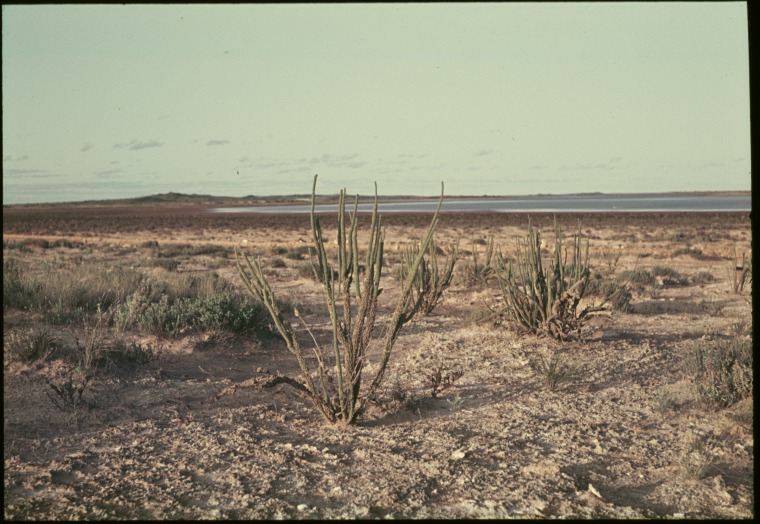
The environment of Lake Austin also played a role in its isolation. The high evaporation rate, nearly 15 times the annual rainfall, means the lake is most often a salt-encrusted basin devoid of vegetation, save for the hardy samphire plants (Tecticornia species) that fringe its saline shores. In modern times, the lake has been used for the discharge of hypersaline groundwater from nearby gold mines, and large deposits of gypsum sand are located on its edges.
Austin Today: A Silent Landmark
Today, Austin is a ghost town, though its presence remains tangible to those travelling along the Great Northern Highway, which still passes through the island. The 2016 census recorded a population of just 13 people for the broader locality, while the townsite itself remains abandoned. By 2021, the population was reported as “low population”.25 26
The Old Stone Huts are now protected by heritage listings, recognised as a rare and significant contribution to our understanding of life on the Murchison goldfields. They stand as “evidence of the resourcefulness of early prospectors,” simple and functional dwellings that have survived over 130 years of harsh outback weather.
For the visitor, Austin is a place of warning and wonder. The landscape is still littered with hundreds of old, deep, and often unmarked mine shafts, making exploration a dangerous endeavour. Yet, for those who tread carefully, the island offers a silent museum of human effort. From the rusted metal of the old railway corridor to the gyro-marks on the stone walls, Austin remains a powerful monument to the thousands of men and women who once sought to build a life on the edges of the Great Inland Marsh. It is a story of a town that was, for a brief and shining moment, the auriferous heart of the Murchison.
Timeline
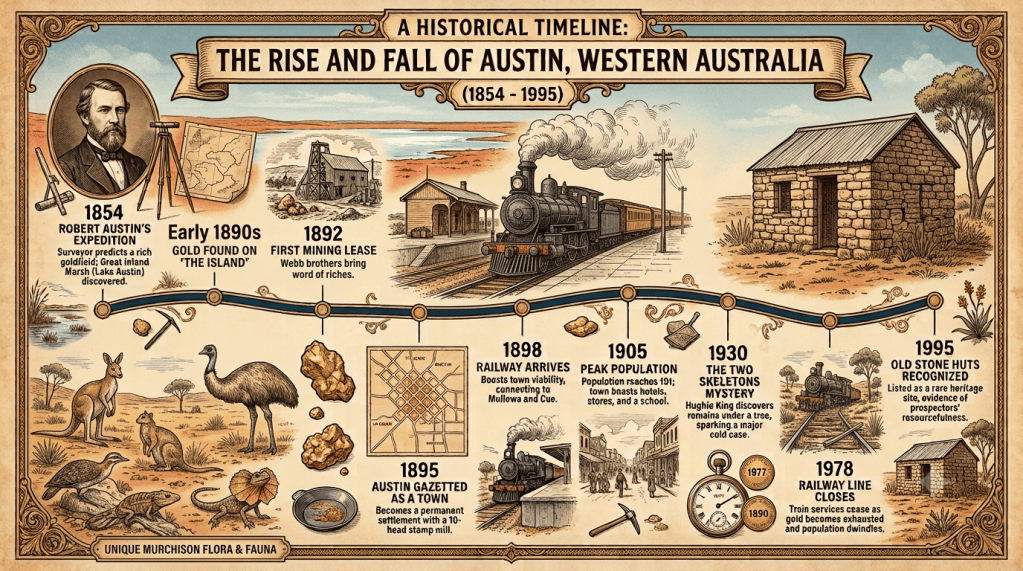
- 1854 (July): Robert Austin leads an expedition from Northam into the Murchison, discovers the “Great Inland Marsh” and correctly predicts a rich goldfield.
- 1890: Gold is discovered at Nannine, sparking the Murchison rush.
- 1891: Approximately 300 to 400 prospectors are active on the Murchison fields.
- 1892 (May): The Webb brothers arrive in Geraldton with a large quantity of Lake Austin gold.
- 1892 (June): The first mining lease (Ironclad) is granted on “The Island”.
- 1893 (Dec): Owen Roberts dies by suicide near the town.
- 1895: The townsite of Austin is officially gazetted.
- 1895 (July): Patrick Philbin, Miners Arms licensee, and Jeremiah Cronin die.
- 1898: The railway is extended to Austin, connecting it to Mullewa and Cue.
- 1901: William “Willie” Moate dies in a mining accident on the Island.
- 1905: Robert Austin dies in Thornborough, Queensland.
- 1905: Austin reaches its peak recorded population of 191 people.
- 1909 (July): Alfred Credgington and Ernest Bradbury disappear after leaving Day Dawn.
- 1930 (Nov): Hughie King discovers two skeletons under a tree, sparking a major cold case investigation.
- 1978: The railway line through Lake Austin officially closes.
- 1995: The “Old Stone Huts” are officially recorded as a heritage site.
Map
Sources
- State Library of Western Australia (n.d.) Austin. Retrieved 7 Aug 2026 from https://purl.slwa.wa.gov.au/slwa_b3089287_1 ↩︎
- MR. R. AUSTIN. (1905, March 3). The Week (Brisbane, Qld. : 1876 – 1934), p. 17. Retrieved August 8, 2026, from http://nla.gov.au/nla.news-article181810268 ↩︎
- Austin, Robert (1856). Report by Assist.-Surveyor ROBERT AUSTIN, of an Expedition to Explore the Interior of Western Australia. Published in The Journal of the Royal Geographical Society of London, 1856 Vol.26 pp.235-274. Published by Wiley on behalf of the Royal Geographical Society (with the Institute of British Geographers) and retrieved on 8 Aug 2026 from https://www.jstor.org/stable/1798360 ↩︎
- McLaren, Glen (2005). Robert Austin (1825-1905). Published in the Australian Dictionary of Biography, Supplement and retrieved 8 Aug 2026 from https://adb.anu.edu.au/biography/austin-robert-12777 ↩︎
- THE AURIFEROUS ZONE IN WESTERN AUSTRALIA. (1895, January 4). The Inquirer and Commercial News (Perth, WA : 1855 – 1901), p. 16. Retrieved August 8, 2026, from http://nla.gov.au/nla.news-article66263457 ↩︎
- Wikipedia (2019). Austin, Western Australia. Retrieved 8 Aug 2026 from https://en.wikipedia.org/wiki/Austin,_Western_Australia ↩︎
- Brendan’s Odyssey. The Stone Huts of Lake Austin. YouTube video retrieved 8 Aug 2026 from https://youtu.be/gobYQ2Mfcww?si=Bk0BUa7ivde-i26u ↩︎
- Jeaks, Jye (2 Apr 2024). Blufect Railway Photography Australia. Retrieved 8 Aug 2026 from https://www.facebook.com/share/p/18QkecB1W5/ ↩︎
- NEWS FROM NORTHAM. (1891, December 4). The Daily News (Perth, WA : 1882 – 1955), p. 3. Retrieved August 8, 2026, from http://nla.gov.au/nla.news-article77393255 ↩︎
- Wikipedia (2018). Lake Austin (Australia). Retrieved 8 Aug 2026 from https://en.wikipedia.org/wiki/Lake_Austin_(Australia) ↩︎
- Barratt, Jessica (2017). Death at Lake Austin. Published in The Dusty Box and retrieved 8 Aug 2026 from https://thedustybox.com/2017/08/03/death-at-lake-austin/ ↩︎
- State Library of Western Australia (1905). William Kretchmar collection of images of Western Australia. Retrieved 10 Aug 2026 from https://catalogue.slwa.wa.gov.au/record=b6625352~S2 ↩︎
- Kiddle (2025). Austin, Western Australia facts for kids. Retrieved 8 Aug 2026 from https://kids.kiddle.co/Austin,_Western_Australia ↩︎
- Hudson Institute of Mineralogy (n.d.) Island Eureka Gold Mine, The Island Goldfield (Austin), Cue Shire, Western Australia, Australia. Retrieved 11 Aug 2026 from https://www.mindat.org/loc-264917.html ↩︎
- State Library of Western Australia (1932). A.C. Walker’s Old Eureka Mine, Lake Austin, February 1932. Retrieved 11 Aug 2026 from https://catalogue.slwa.wa.gov.au/record=b2334874~S2 ↩︎
- Heritage Council of WA (2022). Old Stone Huts & associated mine shafts & workings. Retrieved 9 Aug 2026 from https://inherit.dplh.wa.gov.au/public/inventory/details/228bfbd2-ed14-481a-a35e-c966fb914235 ↩︎
- Sharp, Moya (n.d.) Hotels M – Z. Retrieved 8 Aug 2026 from https://www.outbackfamilyhistory.com.au/records/record.php?record_id=747 ↩︎
- Carnamah Historical Society (n.d.) WA State School Teachers 1900-1980. Retrieved 9 Aug 2026 from https://www.carnamah.com.au/teachers?keyword=lake+austin ↩︎
- Sharp, Moya (2025). The Island of the Dead: Uncovering Lake Austin’s Cemetery. Retrieved 9 Aug 2026 from https://www.outbackfamilyhistoryblog.com/the-island-of-the-dead-uncovering-lake-austins-cemetery/ ↩︎
- Outback Graves Markers (n.d.) Lake Austin – Island Cemetery. Retrieved 9 Aug 2026 from https://outbackgraves.org/burial-records/location/41 ↩︎
- Duggan, Michael (18 May 2025). Comment on a blog post by Moya Sharp on Outback Family History. Retrieved 11 Aug 2026 from https://www.outbackfamilyhistoryblog.com/the-island-of-the-dead-uncovering-lake-austins-cemetery/ ↩︎
- Barratt, Jessica (3 Aug 2017) The Dusty Box: Death at Lake Austin. Retrieved 11 Aug 2026 from https://thedustybox.com/2017/08/03/death-at-lake-austin/ ↩︎
- Kiddle (2025). Lake Austin (Australia) facts for kids. Retrieved 11 Aug 2026 from https://kids.kiddle.co/Lake_Austin_(Australia) ↩︎
- Beard, John Stanley (c1970). Photograph in the collection of State Library of Western Australia, published in Plant Life of Western Australia p.198 and retrieved on 8 Aug 2026 from https://purl.slwa.wa.gov.au/slwa_b4230275_1 ↩︎
- Australian Bureau of Statistics (2016) 2016 Census All persons QuickStats : Lake Austin. Retrieved 11 Aug 2026 from https://abs.gov.au/census/find-census-data/quickstats/2016/SSC50802 ↩︎
- ustralian Bureau of Statistics (2021) 2021 Census All persons QuickStats : Lake Austin. Retrieved 11 Aug 2026 from https://abs.gov.au/census/find-census-data/quickstats/2021/SAL50810 ↩︎
- What3Words.com (11 Aug 2026). Austin, Western Australia. Retrieved 11 Aug 2026 from https://what3words.com/carefully.paperweight.blanking ↩︎
Further Reading
- The Lake Austin Librarian – https://ghostswa.au/2024/08/26/austin-librarian/
Versions
| Date | Changes |
|---|---|
| 11 Aug 2026 | Version 0.1 – First draft |
| 6 Sep 2026 | Version 1.0 – First published |

