Christine Harris (2026)
Demographics
Region: Mid West
LGA: Perenjori
Industry: Primary Industry & CBH Receival Site
Other Names: Bundjil
Open Street Map: -29.652806611962728, 116.36394003729717
What3Words: https://what3words.com/steamboat.cashes.shark
Settled: 1913
Gazetted: 1914
Abstract
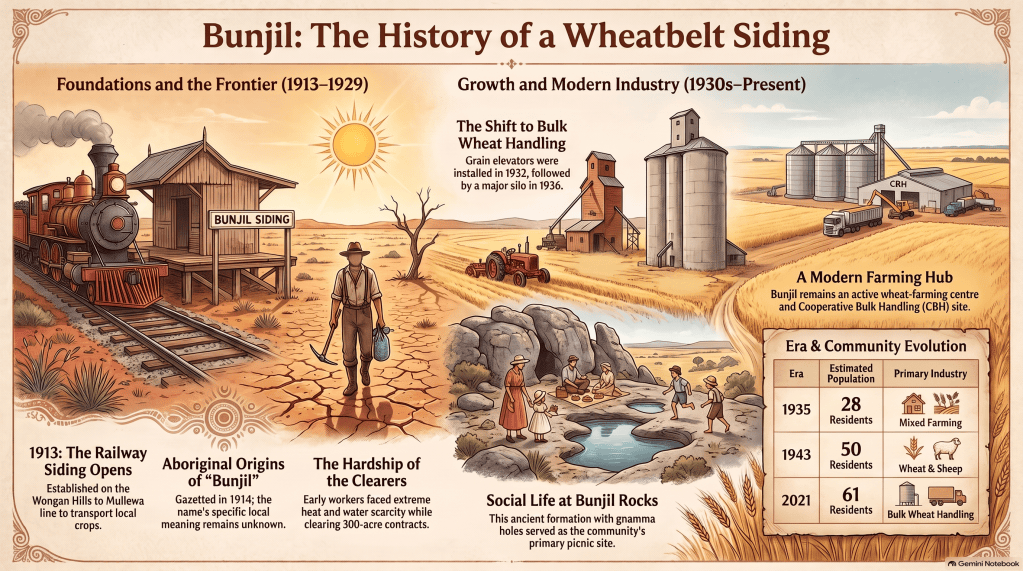
The townsite of Bunjil, located in Western Australia’s northern wheatbelt, was established in 1913 as a siding on the Wongan Hills to Mullewa railway line to open the dry interior for agricultural settlement. Officially gazetted in 1914, the siding was named Bunjil, suggesting Indigenous origins. Arduous land clearing in scorched, arid conditions defined the early years, as captured in the 1924 pioneer poem Bunjil: The Song of a Clearer.
Good rainfall starting in 1914 paved the way for interwar mixed farming prosperity. Wheat production surged, prompting local siding upgrades including engine powered mechanical grain elevators in 1932 and a massive 200,000-bushel bulk handling silo in 1936. Large properties like F.W.G. Liebe’s Waddi Farm drove this expansion, employing dozens of clearers to reclaim thousands of acres.
As economic foundations solidified, community life flourished, peaking at approximately fifty residents in the early 1940s. This period saw active participation in the Bunjil Progress Association, local tennis clubs, the Country Women’s Association, and family outings to the ancient granite Bunjil Rocks. Post-war years brought further technological shifts, notably modern log clearing methods with crawler tractors. Today, Bunjil remains a quiet agricultural centre with around sixty residents. Its rich history is officially preserved in the local heritage survey, which recognises Bunjil Rocks, Liebe’s Gates, and the historic Waddi machinery sheds.
History
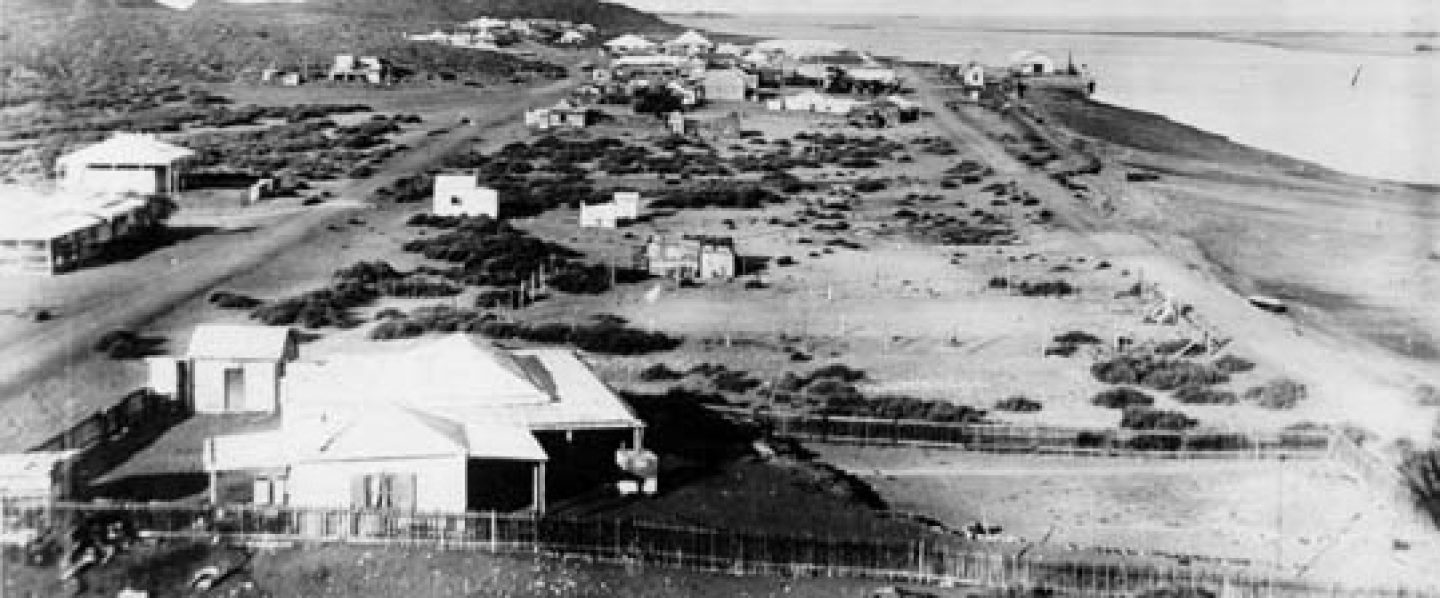
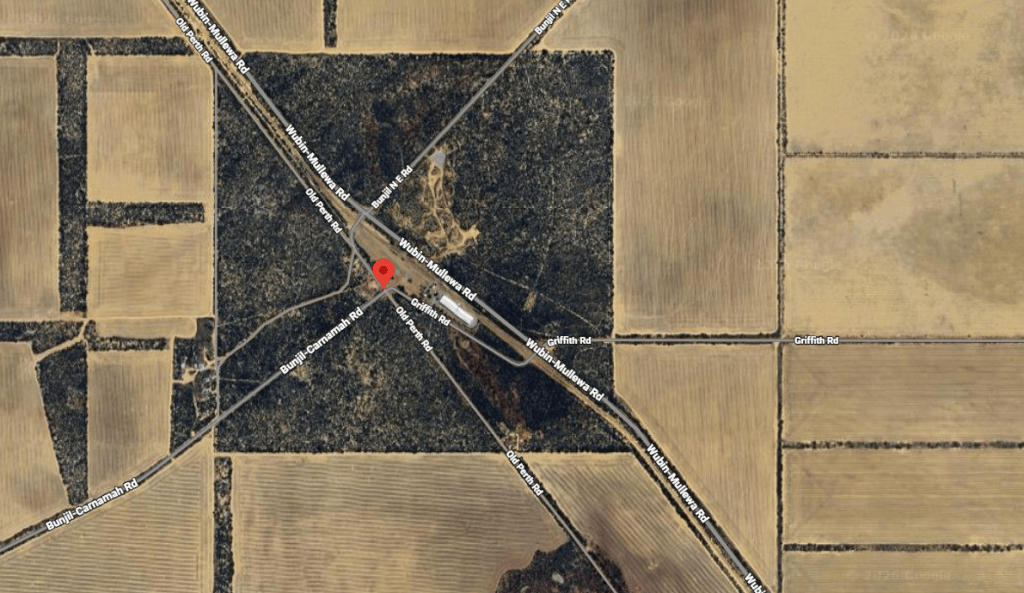
The townsite of Bunjil, nestled in the northern wheatbelt of Western Australia, represents a study of pioneering endurance and agricultural transformation. Located on the Mullewa-Wubin Road, approximately 326 kilometres north of Perth in the Mid West region, this small locality originated from a political decision to expand the state’s transport infrastructure. In the early years of the twentieth century, the Western Australian Government sought to open up the fertile but dry interior for agricultural settlement. This drive culminated in the construction of the Wongan Hills to Mullewa railway line, designed to enable the transport of newly cultivated crops and stock.2
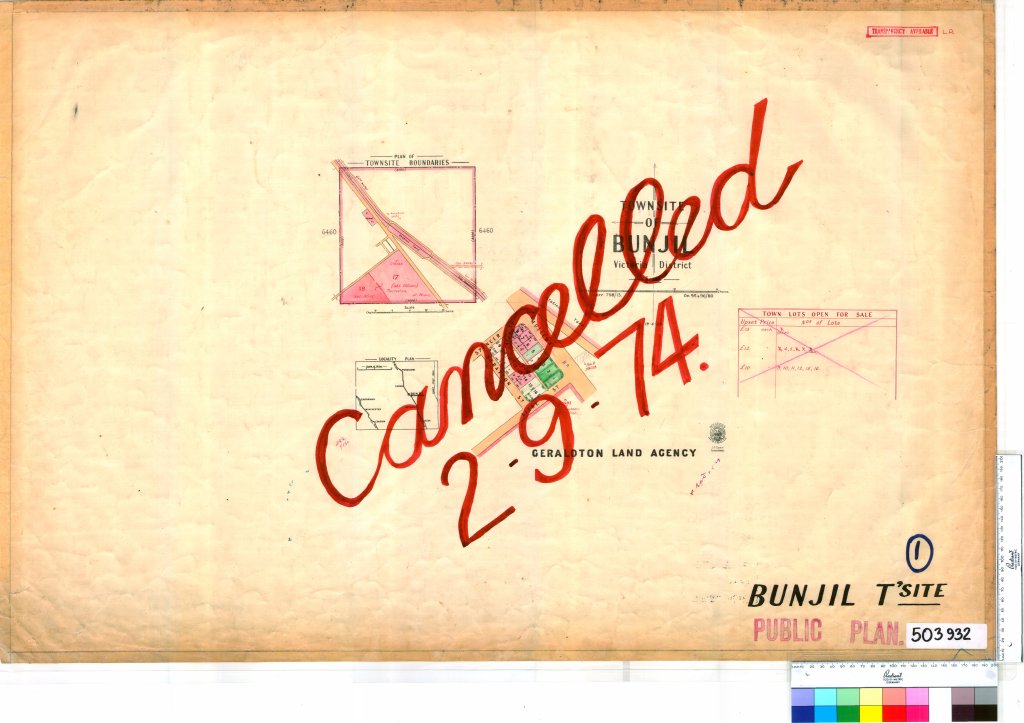
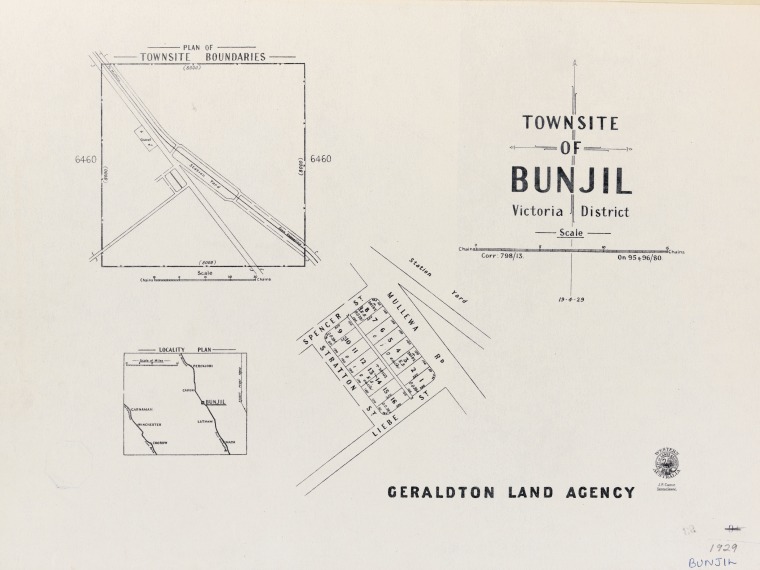
In 1913, as the railway line pushed northwards, Bunjil was established as a railway siding. The townsite itself was gazetted in 1914, to support settlers taking up land. Surveyor Smith, the acting District Surveyor, suggested the Aboriginal name “Bunjil”. While its local meaning remains unknown, historians note intriguing connections. Although geographically situated in Western Australia, the name Bunjil is highly prominent in the indigenous traditions of the Kulin people of Victoria, where Bunjil represents a significant ancestral eagle being. Regardless of its etymological origin, the name soon became synonymous with a lonely, hot and challenging outpost where early settlers built a community.
The Siding and Early Land Clearing
In its infancy, Bunjil was characterised by its isolation and the sheer scale of the environmental challenges faced by those clearing the dense native scrub. In 1924, Bunjil was described as a lonely little siding located about seventeen miles from Perenjori on the Government railway to Geraldton via Goomalling. The landscape was dominated by dense scrub, towering trees and an arid climate.3
A vivid window into this demanding early period survives in a poem published in the Western Mail on the sixteenth of October, 1924, titled “Bunjil: The Song of a Clearer,” penned by an early labourer using the initials S.O.J.L.. The poem describes the experiences of a small company of four clearers felling three hundred acres of tree-land in the blazing heat. Upon arrival, they erected a simple bush shed and stacked their bunk beds one above the other, two on each side, giving their dwelling the cramped appearance of a ship’s cabin. S.O.J.L. captured the harsh environmental realities of Bunjil, where water was scarce as gold and the sun scorched their necks and arms. Yet, despite the heat, these clearers maintained an optimistic outlook, felling the towering trees with determined vigor. After a hard day of physical toil, they would jokingly pretend they were sailors at sea as they retired to their double-decker bunks.
The full text of the poem is available on the Visit Perenjori website 5 but here is a short extract:
Away beyond the haunts of man,
Midst silence, deep and still
Midst lonely plain and forest land,
You’ll find dear old Bunjil,
Devoid of almost, any life.
With water scarce as gold,
It stands up there, like some lost sheep,
Stayed far beyond the fold.
This strenuous hand labour was the foundation upon which the district’s agricultural economy was built. The earliest genealogical records of Bunjil reflect these arduous pioneering years. Among the first permanent settlers were John Allen and Elizabeth Ann Allen. John Allen, who resided at Bunjil, died at sixty-three on 25 July, 1918, and was buried in the nearby Perenjori Cemetery. Elizabeth Ann Allen passed away on 25 October, 1922, and was laid to rest alongside him. Their early deaths highlight the physical toll that reclaiming the wheatbelt demanded from its first generation of farmers.6
Mixed Farming and Interwar Economic Prosperity
Despite the immense initial difficulties, Bunjil experienced a period of remarkable growth and prosperity during the late 1920s. This economic expansion was heavily supported by environmental factors, particularly consistently good rainfall seasons that began in 1914. Windmills soon dot the landscape, and settlers discovered that good water was almost always obtainable by sinking shallow bores.
Wheat production surged in Western Australia’s northern wheatbelt. During the 1929-30 harvesting season, an extraordinary total of 71,795 bags of wheat were moved through Bunjil siding, demonstrating the high productivity of local soils. A major driver of this agricultural boom was the development of Waddi Farm, owned by the prominent agriculturalist F.W.G. Liebe. In 1929, the crop at Waddi Farm reached a staggering 18,000 acres, with Liebe employing forty clearers at a time to prepare more land.
The rapid increase in wheat volume necessitated significant upgrades at Bunjil siding. In 1932, the Wheat Pool of Western Australia announced that Bunjil would install two mechanical grain elevators, each fitted with its own engine, to speed up grain loading. The expansion of bulk handling continued in 1936 when a massive bulk wheat silo was erected at the siding. This silo possessed a storage capacity of 200,000 bushels, solidifying Bunjil’s role as a vital cog in the state’s grain export network.
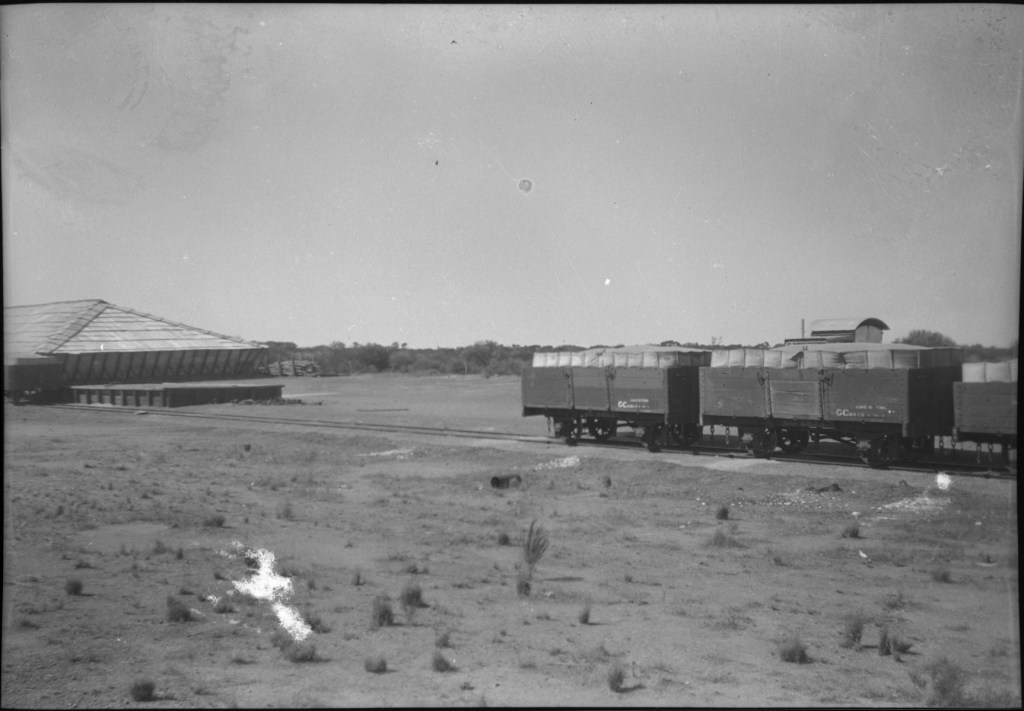
The prosperity of the interwar years also saw the introduction of motor vehicles, transforming the daily lives of local families. Early motor vehicle registration records show that several Bunjil residents adopted motor transport. Leo Colin Campbell Allan, a local farmer, registered a Chevrolet vehicle with the plate PM 1 during the 1922-23 period. J. P. Stratton registered a Fiat car (plate PM 13) in 1924-25, adding a Chevrolet Truck in 1927-28. F. F. A. Jaeschke registered a Ford Truck (plate PM 69) in 1927-28 to haul wool and wheat. Other pioneering families, such as the Dring brothers of Lindum Farm on the Bunjil-Carnamah Road, established properties that became landmarks.8 9
Community Life and Social Gatherings
As Bunjil’s economic foundations solidified, the local population grew, peaking at approximately fifty residents during the 1942-43 period. This active population fostered a vibrant community life, typified by local institutions and recreational facilities.
The Bunjil Progress Association was formed as the chief representative body to advocate for the community’s political, social and educational needs. Because Bunjil lacked its own school, the association agitated for a bus service to transport students to Caron or Latham. In 1938, they lobbied for the construction of a school within Bunjil itself, due to the distances involved.
Social connection and physical recreation were highly valued. In 1935, the Bunjil Tennis Club constructed a new tennis court to cater for an increase in membership, followed by a second court in the late 1930s. For women in the district, the establishment of the Caron-Bunjil branch of the Country Women’s Association (CWA) in 1938 provided an invaluable forum for mutual support, craftwork and community service. Social gatherings were accompanied by country hospitality. Hilda Eslick, who worked as a storekeeper in Bunjil, was fondly remembered for serving a tasty supper to those who attended Progress Association meetings.10
The natural environment played a central role in Bunjil’s social life. Bunjil Rocks, an ancient granite rock formation featuring several deep gnamma holes and natural water catchment areas southwest of the townsite, became a popular area for celebrations, family picnics and recreational activities. For instance, on a Sunday in September 1938, the Caron Parents and Citizens’ Association held its annual picnic at Bunjil Rocks, attracting families from across the district. Local newspaper reports from September 1938 provide a fascinating glimpse into Bunjil. It was reported that local resident F. F. A. Jaeschke suffered a painful accident when his stirrup leather snapped while mounting his horse, requiring surgical attention. James Harry Turner returned home to Bunjil after a brief visit to Perth.11 12
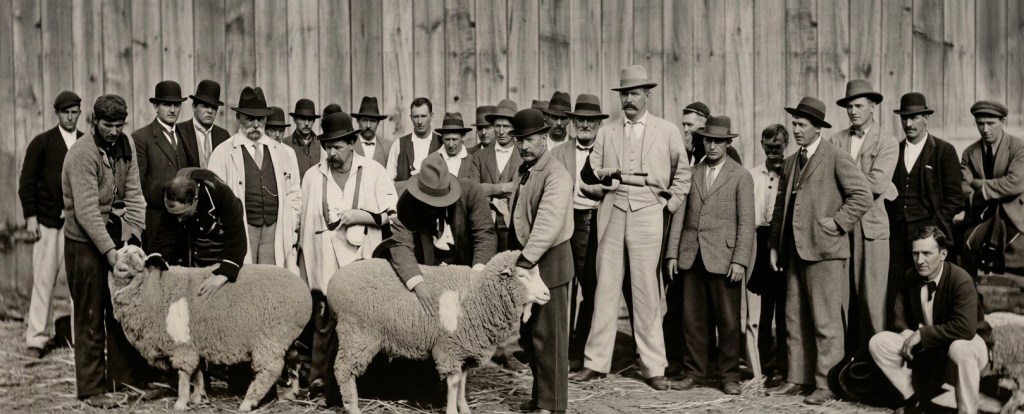
Community members also gathered for practical education. In August 1936, Mr Hugh McCallum, a sheep and wool inspector, delivered a practical demonstration on the handling of sheep at Arthur G. Spencer’s farm. Spencer had registered his Bunjil Farm brand, V7Q, in 1925. Local resident E. Byne arranged the successful demonstration, and the day concluded with refreshments served by Spencer and local ladies.13 14
The Post-War Era: Storekeeping, Scrub Clearing, and Change
The post-war era brought further social and technological shifts to Bunjil. In 1943, Arthur Frederick Cannon and his wife, Joan Margaret Cannon, took over the management of the Bunjil general store and post office. Joan Cannon’s oral history provides an invaluable record of her time running the store, capturing the characters and daily hardships of Bunjil life.
In 1945, Arthur Cannon applied to the licensing court for a Gallon Licence for the store. However, the application was unsuccessful. The police opposed the licence, arguing that the requirements of the district did not warrant it, especially given that the permanent population residing immediately at the siding had dwindled to just three people. The Cannons left the store in 1949 to take up farming northwest of Caron.
The post-war years also witnessed a massive wave of land clearing, driven by the availability of modern crawler tractors. In the 1950s, Bunjil became a focal point for demonstrating these new, highly efficient clearing methods. Local farmer Mr A. N. Davis demonstrated how traditional “scrub-bashing” practices could be modernized by attaching a heavy 35-foot log to two 55 horsepower crawler tractors. The two tractors would move abreast through the dense mallee timber about 40 feet apart, pulling trees out by their roots. Davis boasted that with just two tractors, he had cleared 1,100 acres of mallee country at Bunjil in only twelve days.
This aggressive clearing successfully expanded the wheat belt, but it also marked the end of the original pioneering era as the natural landscape was permanently transformed. The community’s social structures evolved; a Caron-Bunjil sub-branch of the Returned and Services League (RSL) was established in 1948.
Genealogical and cemetery records from the 1950s and 1960s also record the personal histories of Bunjil’s families. Infant burials at the Three Springs and Winchester cemeteries included baby Peter Joseph Winton, who died in January 1952; Dale Elizabeth Lakeman, who survived for only five hours in September 1956; the stillborn child of the Just family in March 1957; Tracey Ann Just, who passed away in August 1959; and Catherine Delane, who died twelve hours after birth in April 1961. The Delane family also suffered the loss of twenty-four-year-old Shirley Delane in November 1957. Older pioneers also passed away, including David Smith, who died in November 1939, and Leslie Abner Horbury, who passed away in November 1961.16
Bunjil Today: Preservation of Heritage
Today, Bunjil remains a quiet wheat farming centre of about sixty residents. At the 2016 census, Bunjil recorded sixty residents, with a median age of thirty-four years. By the 2021 census, the population was sixty-one people, with a median age of thirty-nine years.17 18
The townsite continues to serve as an active Cooperative Bulk Handling (CBH) grain receival site, maintaining its historic connection to the Western Australian agricultural export economy. Although passenger train services have long since ceased, the massive grain silos still stand as testament to the agricultural triumphs of the interwar years.19
The rich pioneering history of Bunjil has been officially recognised and preserved through the Shire of Perenjori’s Local Heritage Survey finalised in 2023. Several Bunjil sites have been classified as Category 2 heritage places of considerable significance. These include the Liebe Sheds Precinct on Tremlett and Lampard-Tremlett Roads, which consist of the historic timber and iron machinery sheds built by F.W.G. Liebe. Additionally, Liebe’s Gates are protected as a Category 2 heritage site. Bunjil Rocks itself is recognised under the State Heritage Office’s inHerit database (place number 14152) for its high social and recreational value, continuing to be cherished by both locals and visiting campers.20
Timeline
The following timeline outlines the major events in Bunjil’s history:
- 1913: Bunjil is established as a railway siding on the newly constructed Wongan Hills to Mullewa railway line to transport crops and stock.
- 1914: The Bunjil townsite is officially gazetted to support agricultural settlers.
- 1924: The poem “Bunjil: The Song of a Clearer” is published in the Western Mail, detailing early land clearing.
- 1929: F.W.G. Liebe’s Waddi Farm has 18,000 acres under crop, employing forty clearers to expand the land.
- 1930: Siding moves 71,795 bags of wheat during the harvest season.
- 1932: The Wheat Pool of Western Australia installs two engine powered grain elevators at the railway siding.
- 1933: Local clearing methods modernize, with farmers utilizing a heavy ball and chain to clear up to 100 acres per day.
- 1936: State sheep and wool inspector Hugh McCallum conducts a practical sheep handling demonstration at Arthur Spencer’s farm.
- 1936: A massive bulk wheat silo with a capacity of 200,000 bushels is erected.
- 1938: The Caron Parents and Citizens’ Association hosts its annual picnic at Bunjil Rocks.
- 1943: Arthur and Joan Cannon begin running the Bunjil general store and post office.
- 1945: Arthur Cannon’s formal application for a Gallon Licence at the Bunjil store is refused due to the small resident siding population.
- 1948: The Caron-Bunjil sub-branch of the Returned and Services League (RSL) is established.
- 1953: Mr A. N. Davis conducts a public clearing demonstration using crawler tractors and a 35-foot log.
- 1962: Post-war livestock brands are officially registered for major local properties, including Treverton and Springfield.
- 2021: The national census records sixty-one residents in the Bunjil district, with a stable median age of thirty-nine years.
- 2023: The Shire of Perenjori local heritage survey officially classifies Bunjil Rocks, the Liebe Sheds, and Liebe’s Gates as Category 2 heritage places.
Map
Sources
- State Records Office of WA (2015.) Townsite Plan. Retrieved 4 Sep 2026 from https://archive.sro.wa.gov.au/index.php/bunjil-sheet-1-tally-no-503932-0289 ↩︎
- Wikipedia (2022). Bunjil, Western Australia. Retrieved 5 Sep 2026 from https://en.wikipedia.org/wiki/Bunjil,_Western_Australia ↩︎
- BUNJIL. (1924, October 16). Western Mail (Perth, WA : 1885 – 1954), p. 44. Retrieved September 5, 2026, from http://nla.gov.au/nla.news-article37637605 ↩︎
- State Library of WA (n.d.) Townsite Plan. Retrieved 4 Sep 2026 from https://purl.slwa.wa.gov.au/download/slwa_b1867066_1 ↩︎
- Shire of Perenjori (n.d.) Bunjil. Retrieved 5 Sep 2026 from https://www.visitperenjori.com.au/bunjil.aspx ↩︎
- Carnamah Historical Society (n.d.) Register of Burials. Retrieved 5 Sep 2026 from https://www.carnamah.com.au/cemeteries?keyword=Bunjil ↩︎
- Hughes, David Francis (1949). Bunjil Siding. B&W photographic image in the David Hughes Collection of Photographs BA3123/1/98 in the State Library of Western Australia. Retrieved 4 Sep 2026 from http://purl.slwa.wa.gov.au/slwa_b6328014_2 ↩︎
- Carnamah Historical Society (n.d.) WA Motor Vehicle Registrations 1915-1928. Retrieved 5 Sep 2026 from https://www.carnamah.com.au/car-registrations?keyword=Bunjil ↩︎
- Carnamah Historical Society (n.d.) Biographical Dictionary of Coorow, Carnamah and Three Springs. Retrieved 5 Sep 2026 from https://www.carnamah.com.au/keyword-results?cx=014924852676970019018%3Aoquc8xeepwu&ie=UTF-8&q=bunjil&sa=Search&siteurl=www.carnamah.com.au%2Fbiographical-dictionary&ref=&ss=1119j290665j6 ↩︎
- Carnamah Historical Society (n.d.) Hilda ESLICK / BRETT / BYNE. Retrieved 5 Sep 2026 from https://www.carnamah.com.au/bio/hilda-eslick ↩︎
- Heritage Council of WA (1999) Bunjil Rocks. Retrieved 5 Sep 2026 from https://inherit.dplh.wa.gov.au/public/inventory/details/41c282ee-7264-457f-89dd-62f0467fd3fc ↩︎
- Bunjil. (1938, September 23). The Northern Producer and Morawa and District Advertiser (WA : 1930 – 1947), p. 1. Retrieved September 5, 2026, from http://nla.gov.au/nla.news-article257668117 ↩︎
- Carnamah Historical Society (n.d.) WA Livestock Brands 1912-1962. Retrieved 5 Sep 2026 from https://www.carnamah.com.au/livestock-brands?keyword=Bunjil ↩︎
- SHEEP DEMONSTRATION AT BUNJIL (1936, August 20). Dalgety’s Review (Perth, WA : 1926 – 1948), p. 1. Retrieved September 5, 2026, from http://nla.gov.au/nla.news-article265533735 ↩︎
- ibid ↩︎
- Carnamah : Register of Burials (as above) ↩︎
- Australian Bureau of Statistics (2016). Bunjil 2016 Census All persons Quick Stats. Retrieved 5 Sep 2026 from https://abs.gov.au/census/find-census-data/quickstats/2016/SSC50213 ↩︎
- Australian Bureau of Statistics (2021). Bunjil 2021 Census All persons Quick Stats. Retrieved 5 Sep 2026 from https://abs.gov.au/census/find-census-data/quickstats/2021/SAL50213 ↩︎
- Higham, Geoffrey (2015). Back along the line : An historical gazetteer of railway stations, sidings and related facilities along Western Australian railway lines. p.25. Retrieved 5 Sep 2026 from https://www.geoproject.com.au/News/Gaz_5_rail_ordered_08July2016.pdf ↩︎
- Gray, Laura (2023). Shire of Perenjori: Local Heritage Survey 2023. Retrieved 5 Sep 2026 from https://www.perenjori.wa.gov.au/documents/99/local-heritage-survey ↩︎
- Google (2026). Google map of the location of Bunjil townsite in Sep 2026. Retrieved 6 Sep 2026 from https://www.google.com/maps/place/29%C2%B039’10.1%22S+116%C2%B021’50.2%22E/@-29.6537759,116.3635567,3177m/data=!3m1!1e3!4m4!3m3!8m2!3d-29.6528066!4d116.36394?entry=ttu&g_ep=EgoyMDI2MDkwMi4wIKXMDSoASAFQAw%3D%3D ↩︎
Versions
| Date | Changes |
|---|---|
| 5 Sep 2026 | Version 0.1 – First draft |
| 6 Sep 2026 | Version 1.0 – First published |
| 6 Sep 2026 | Version 1.1 – Updated to include current map of Bunjil townsite |

