Christine Harris (2026)
Demographics
Region: Wheatbelt
LGA: Dumbleyung
Industry: Transportation
Other Names:Candlelight Railway Siding, Candlelight Soak, Tub Soak
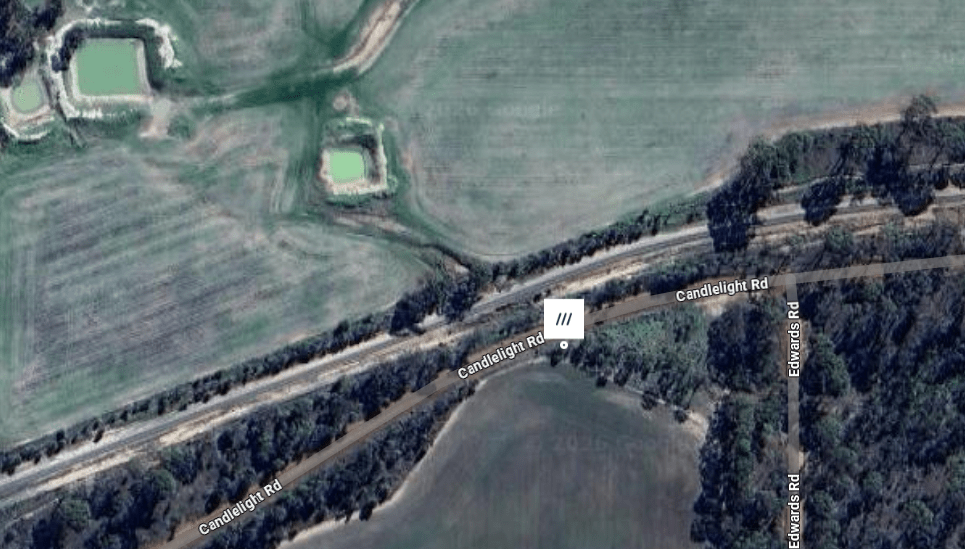
Open Street Map: -33.13410606978524, 117.98631353544334
What3Words: ///sample.raider.cradle
Settled: 1906
Gazetted: 1911
Abandoned: 1976
Abstract
The history of the Candlelight locality in the Shire of Dumbleyung provides a quintessential study of Western Australian agricultural development and the pivotal role of rail infrastructure. Initially defined by the Candlelight Soak, a critical water source for early pioneers, the area’s European history began in earnest when settlers like George Edwards selected land in 1906. The subsequent petitioning and establishment of the Candlelight Railway Siding on the Wagin to Newdegate line transformed the community from an isolated outpost into a productive economic node.
This article details the area’s growth, spurred by wheat and dairy production, and the sophisticated social fabric that emerged around the “Katoomba” homestead. However, the community’s trajectory was frequently altered by volatile environmental factors, including severe droughts in the 1940s and the catastrophic fire of 1954, which was sparked by the very railway that sustained the region. As road transport eclipsed rail in the mid-20th century, the siding’s economic importance waned, leading to its eventual decline as a functional transport hub. Today, Candlelight is preserved through heritage initiatives and nature-based tourism, illustrating a modern shift toward acknowledging historical legacies while adapting to new economic realities in the Wheatbelt.
History
The history of Candlelight, situated within the Shire of Dumbleyung in the Western Australian Wheatbelt, is a narrative of human perseverance against a beautiful but unforgiving landscape. Centred on the geographical coordinates of 33° 13′ 59″ S and 117° 58′ 59″ E, the area is characterised by a hot-summer Mediterranean climate that has dictated the economic and social rhythms of the community for over a century. From its early days as a precarious soak to its zenith as a bustling railway siding, the story of Candlelight reflects the broader political and economic shifts of regional Australia.1
Discovery and Early Settlement
Long before European expansion, the land was cared for by its Traditional Custodians, the Aboriginal and Torres Strait Islander people, whose connection to the region is formally acknowledged by the modern community. For early European pioneers, the area’s significance was primarily hydrological, centred on the Candlelight Soak (also known as a well or the “Tub Soak”).2 3 4
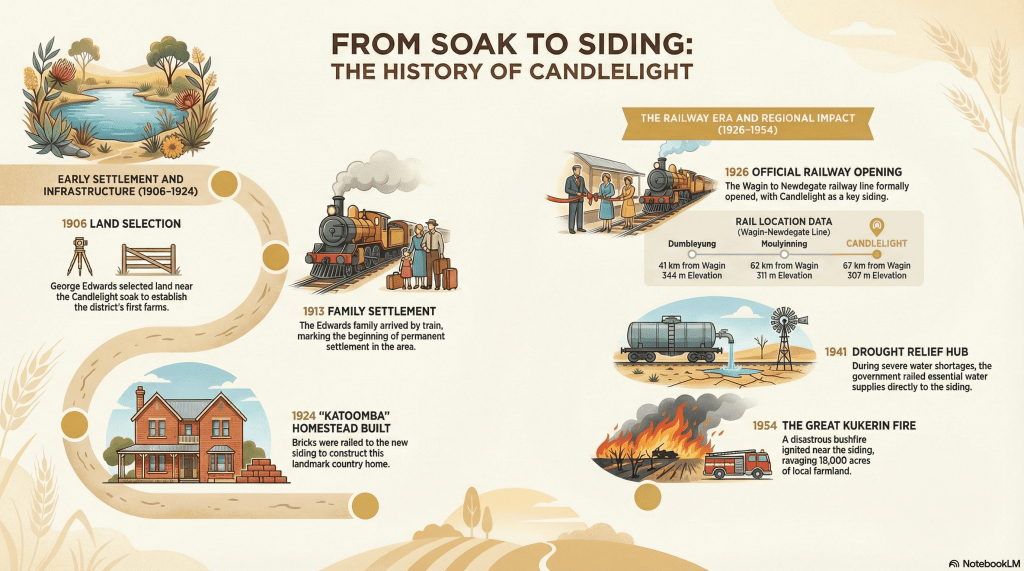
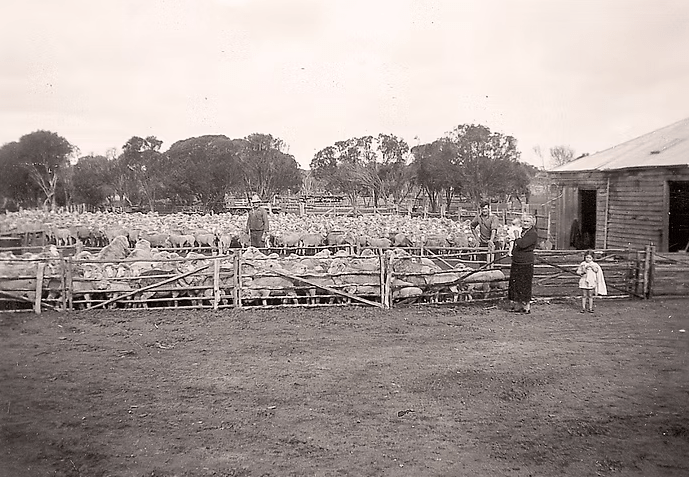
The agricultural “discovery” and settlement of the area were exemplified by the Edwards family. In 1906, George Edwards, who had moved to Western Australia from New South Wales in 1895, selected land near the Candlelight Soak. The initial growth was arduous; a team of Italians was employed to clear the virgin bush, and a modest timber and iron home was erected to house the family upon their arrival by train in 1913. This period marked the transition of Candlelight from a mere geographical marker to a permanent agricultural settlement.5
The Arrival of the Rail
The most significant political and economic driver for the community was the expansion of the Western Australian Government Railways. The Wagin-Dumbleyung Railway Act of 1905 authorised the first section of the line, which reached Dumbleyung in 1907. However, for settlers further east, the distance remained a major hurdle. In September 1913, a petition was presented to the Minister for Works by Sydney Stubbs, MLA, and E.B. Johnston, urging the creation of a siding and dam near the soak. Settlers argued that the lack of a siding forced them to undertake an “extra six miles of carting” during the critical wheat season.
The government eventually acceded, and the Candlelight Railway Siding was established on the Wagin to Newdegate line, situated 67 miles (approx. 108 km) from Wagin. The siding became the community’s economic heart. Bricks were railed from Perth to the siding in 1924 to build the grand “Katoomba” homestead, and the railway allowed for the export of butter and eggs to metropolitan stores. By the time the full line to Newdegate officially opened in February 1926, Candlelight was firmly integrated into the state’s grain and dairy networks.7 8 9
Social Life and Local Governance
The interwar years saw Candlelight flourish as a social hub. The Dumbleyung Road Board minutes from 1926 and 1927 reveal a community deeply involved in local governance, debating road surveys, water supply, and vermin control. Political life was local and practical; the Board managed everything from dingo bonuses (set at £3 per scalp in 1927) to the gravelling of the Wishbone-Dongolocking road.10 11
Socially, the community was tight-knit. Large families, such as the Edwards and the Clarks, formed the backbone of the district. Events like the Kukerin Show, established around 1922, showcased the area’s agricultural prowess. The soil, once doubted by critics in Perth, was proven productive through the lush gardens and orchards of the Katoomba homestead, which the local press noted could grow fruit and vegetables that “would thrive in these districts”.12 13
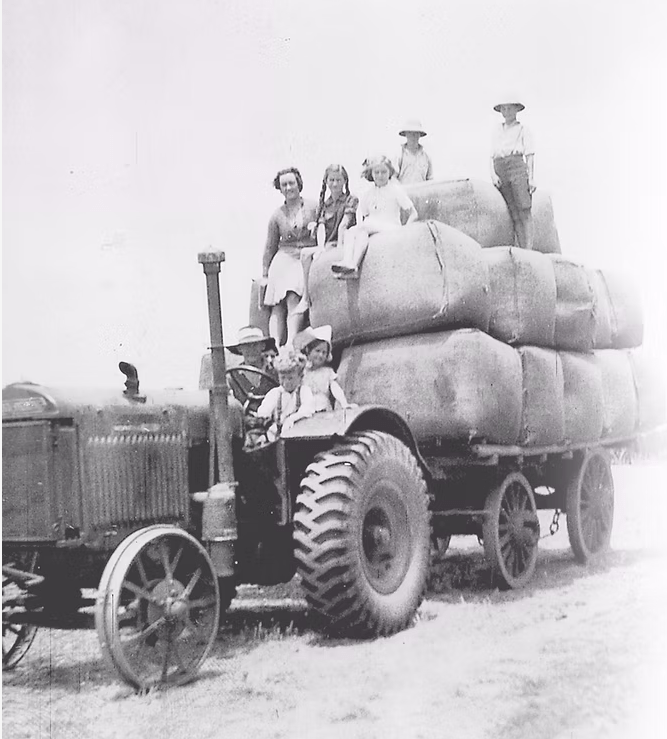
Harry Edwards (driving), Noel Edwards, Cath Bartlett
Teresa Edwards, Jean Bartlett, June Bar14tlett
George Bartlett, John Bartlett
Environmental Hardship: Drought and Fire
The community’s resilience was tested by environmental extremes. Between 1939 and 1941, a severe drought crippled local water supplies. Dams that had been regarded as secure failed, and the salinity of underground soaks increased, rendering them useless for livestock. In a vital display of political intervention, the Public Works Department began railing water to the Candlelight siding at a cost of 2/6 per 100 gallons to save the district’s sheep.15
However, the most traumatic event in the community’s history occurred on Sunday, 19 December 1954. A disastrous blaze, described as the worst in the history of the Kukerin district, was reportedly sparked by the engine of a goods train just east of the Candlelight Siding. Fanned by hot winds and temperatures exceeding 110 degrees Fahrenheit (43°C), the fire swept over 18,000 acres. The destruction was total for some; Max Bairstow was “completely burnt out,” losing everything but his house, while Eli Adams lost hundreds of sheep and miles of fencing. The fire highlighted the environmental risks inherent in a rail-dependent economy, where the very technology providing growth could also trigger catastrophe.16
Decline and Heritage Preservation
The decline of the Candlelight Siding as a functional transport node mirrored the broader trend of the mid-20th century, as road transport became more efficient and railway sections began showing significant financial losses. A 1954 report indicated that the Lake Grace to Newdegate line was suffering from expenditure nearly four times its earnings. While grain transport continued via contracts with groups like CBH, the passenger and small-freight era of the siding eventually ended.17
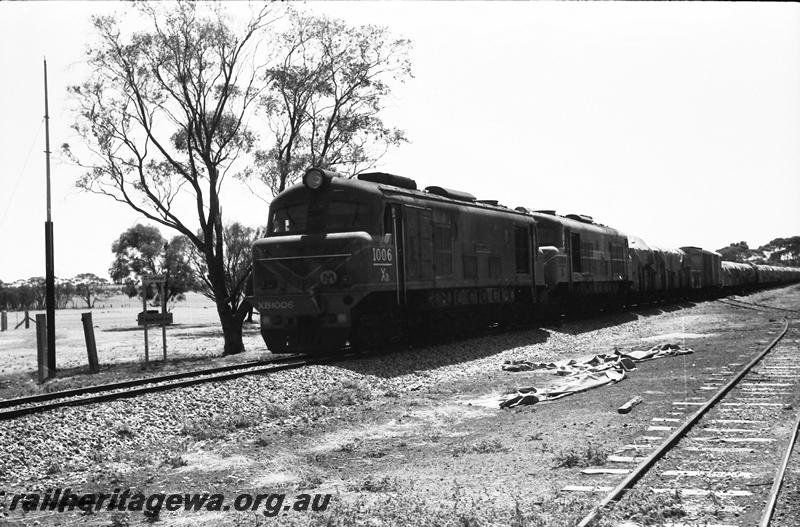
The withdrawal of the station master from Dumbleyung in 1984 signalled the end of an era for the local rail network. Today, the Candlelight Soak and Siding is recognised by the State Heritage Office as a Category E historic site, meaning it is a site “without built features” but one that warrants recognition for its historical significance.19
Modern Use and Recent History
In recent years, the Candlelight locality has found new life through nature-based tourism. The “Candlelight Country Experience” now offers camping and glamping, allowing visitors to connect with the landscape that once sustained the Edwards family. Additionally, the Shire of Dumbleyung has installed Historical Locality Signs to document the history of settling families and farm practices for tourists on drive trails.20 21
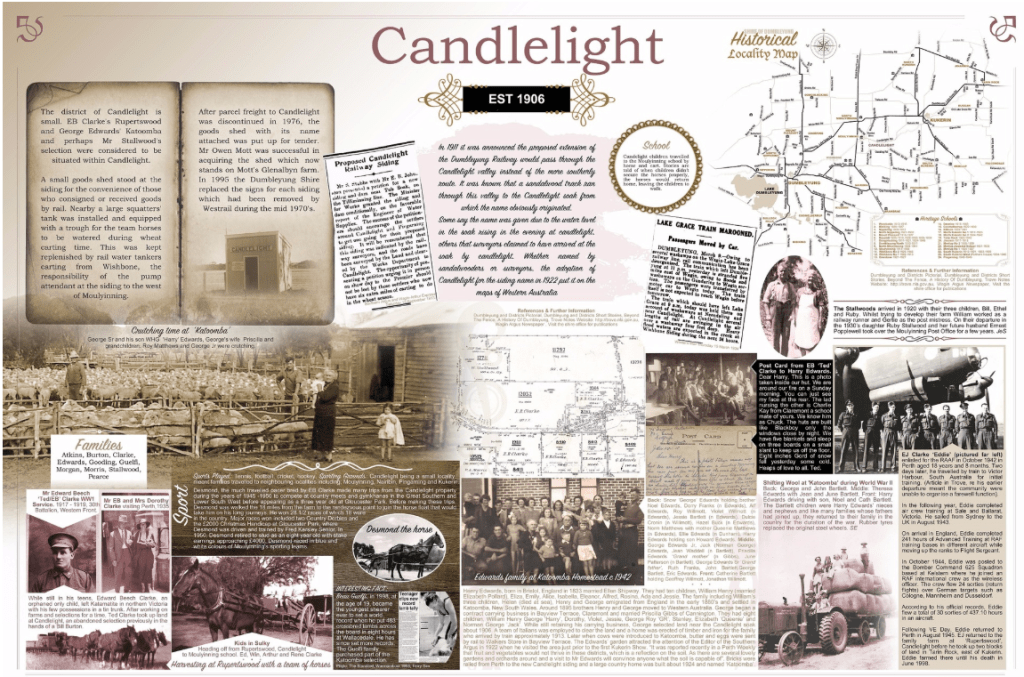
Though the steam trains no longer halt at the siding and the “Katoomba” homestead has aged into a legacy, the name Candlelight remains a symbol of the pioneer spirit of the Wheatbelt. It stands as a testament to a time when a simple water soak and a short track of parallel rail were enough to build a community.23
Timeline
- 2018: The Shire of Dumbleyung launches the Historical Locality Sign project to preserve Candlelight’s history for tourists.
- 1833: Birth of Henry Edwards in Bristol, England, whose descendants would settle the Candlelight area.
- 1895: Brothers Henry and George Edwards move from New South Wales to Western Australia.
- 1905: The Wagin-Dumbleyung Railway Act is passed, initiating the rail line that would eventually reach Candlelight.
- 1906: George Edwards Sr. selects land near the Candlelight Soak.
- 1907: The rail section from Wagin to Dumbleyung officially opens.
- 1912: The rail extension from Dumbleyung to Kukerin opens.
- 1913: The Edwards family arrives by train to settle on their cleared land.
- September 1913: Sydney Stubbs, MLA, presents a petition for a siding and dam at Candlelight.
- 1922: The first Kukerin Show is held; the local press praises the quality of the Edwards family’s garden at Candlelight.
- 1924: The “Katoomba” homestead is constructed using bricks railed to the new Candlelight siding.
- February 1926: The full Wagin to Newdegate railway line is officially opened.
- 1927: E.B. Clark and H. Edwards of Candlelight are among the first to register motor vehicles (Chevrolet and Rugby) with the Dumbleyung Road Board.
- 1939–1941: Severe drought impacts the region; water is railed to the Candlelight siding by the Public Works Department to support farmers.
- 1948: The horse “Desmond,” bred or owned in the district, wins a “hat trick” of races at Gloucester Park.
- January 1954: George “Pop” Edwards celebrates his 80th birthday at Candlelight with 51 direct descendants.
- December 1954: A catastrophic fire, allegedly sparked by a goods train engine near the siding, destroys 18,000 acres of stock and crops.
- 1984: The station master is withdrawn from Dumbleyung, marking the decline of the local rail infrastructure.
- 2002: The Candlelight Soak and Siding site is formally adopted into the Municipal Heritage Inventory.
Map
Sources
- mindat.org (n.d.) Candle Light Siding, Dumbleyung Shire, State of Western Australia, Australia. Retrieved 27 Feb 2026 from https://www.mindat.org/feature-2075041.html ↩︎
- Candlelight Country Experience (2026). Welcome to our Camp. Retrieved 27 Feb 2026 from https://www.candlelightcountryexperience.com/ ↩︎
- GeoNames (n.d.) Candle Light Soak. Retrieved 27 Feb 2026 from https://www.geonames.org/8837995/candle-light-soak.html ↩︎
- Proposed Candlelight Railway Siding (1913, September 13). The Southern Argus and Wagin-Arthur Express (Perth, WA : 1905 – 1924), p. 3. Retrieved February 27, 2026, from http://nla.gov.au/nla.news-article203570282 ↩︎
- Shire of Dumbleyung (2018). Edwards Family. Retrieved 27 Feb 2026 from https://www.dumbleyung.wa.gov.au/history/candlelight-locality/edwards-family ↩︎
- ibid: Photograph retrieved 28 Feb 2026 from https://www.dumbleyung.wa.gov.au/history/candlelight-locality/edwards-family ↩︎
- Proposed Candlelight Railway Siding (1913, September 13). The Southern Argus and Wagin-Arthur Express (Perth, WA : 1905 – 1924), p. 3. Retrieved February 27, 2026, from http://nla.gov.au/nla.news-article203570282 ↩︎
- Wikipedia (2025). Newdegate railway line. Retrieved 27 Feb 2026 from https://en.wikipedia.org/wiki/Newdegate_railway_line ↩︎
- branchline.uk (2025) Western Australia Railways Passenger Lines, Stations & Stops. Retrieved 27 Feb 2026 from https://www.branchline.uk/jfpdf/westernaustraliarlys.pdf ↩︎
- Dumbleyung Road Board (1926, September 13). Lake Grace Newdegate Cultivator and Dumbleyung and Kukerin Producer (WA : 1925 – 1930), p. 3. Retrieved February 27, 2026, from http://nla.gov.au/nla.news-article251797558 ↩︎
- DUMBLEYUNG ROAD BOARD (1927, April 14). The Wagin Argus and Arthur, Dumbleyung, Lake Grace Express (WA : 1924 – 1954), p. 5. Retrieved February 27, 2026, from http://nla.gov.au/nla.news-article257772653 ↩︎
- Family Notices (1954, December 9). The Wagin Argus and Arthur, Dumbleyung, Lake Grace Express (WA : 1924 – 1954), p. 2. Retrieved February 27, 2026, from http://nla.gov.au/nla.news-article257860043 ↩︎
- Shire of Dumbleyung: refers to community life ↩︎
- ibid: Photograph retrieved 28 Feb 2026 from https://www.dumbleyung.wa.gov.au/history/candlelight-locality/edwards-family ↩︎
- MOULYINNING NEWS (1941, February 27). The Wagin Argus and Arthur, Dumbleyung, Lake Grace Express (WA : 1924 – 1954), p. 3. Retrieved February 27, 2026, from http://nla.gov.au/nla.news-article257826486 ↩︎
- DISASTROUS KUKERIN BLAZE (1954, December 23). The Wagin Argus and Arthur, Dumbleyung, Lake Grace Express (WA : 1924 – 1954), p. 1. Retrieved February 27, 2026, from http://nla.gov.au/nla.news-article257860432 ↩︎
- Wikipedia, 2025: refers to closure of line ↩︎
- Rail Heritage WA (n.d.) XB class 1006 “NANGAMADA” double heading with XB class 1024 “KOGARA”, Candlelight, WLG line, wheat train. Retrieved 26 Feb 2026 from https://www.railheritagewa.org.au/archive_scans/displayimage.php?album=search&cat=0&pid=6926#top_display_media ↩︎
- Heritage Council of WA (2003). Candlelight Soak & Siding – Site. Retrieved 27 Feb 2026 from https://inherit.dplh.wa.gov.au/public/inventory/details/c139113d-b8bb-467b-a01c-b31a630b651f ↩︎
- Candlelight Country Experience: refers to modern tourist facilities ↩︎
- Shire of Dumbleyung (2018). Candlelight Locality Sign. Retrieved 26 Feb 2026 from https://www.dumbleyung.wa.gov.au/history/candlelight-locality/candlelight-locality-sign ↩︎
- ibid: image of brochure retrieved 28 Feb 2026 from https://www.dumbleyung.wa.gov.au/history/candlelight-locality/candlelight-locality-sign ↩︎
- OCTOGENARIAN (1954, February 11). The Wagin Argus and Arthur, Dumbleyung, Lake Grace Express (WA : 1924 – 1954), p. 5. Retrieved February 27, 2026, from http://nla.gov.au/nla.news-article257869919 ↩︎
- what3words.com (2026). Candlelight. Retrieved 27 Feb 2026 from https://what3words.com/sample.raider.cradle ↩︎
 People of Western Australia's Ghost Towns