Demographics
Region: Goldfields-Esperance
LGA: Dundas
Industry: Telecommunications and Port
Other Names: Eucla Telegraph Station, Eucla Jetty, Yinculyer, Eucla Roads
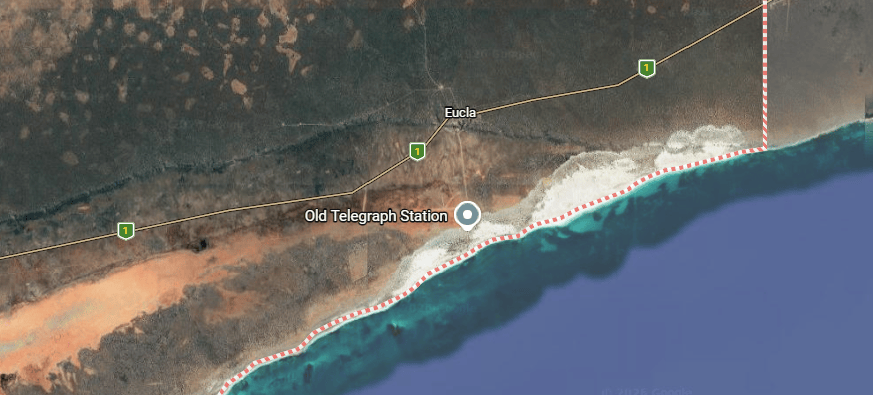
Open Street Map: -31.71325232794275, 128.8865266482857
What3Words: ///steep.minder.talented
Established: 1841
Gazetted: 1887
Relocated: 1890s
Closed: 1929
Abstract
Eucla, the eastern most settlement in Western Australia, occupies a unique historical niche where high Victorian technology once met extreme environmental isolation. This article explores the town’s development from its initial documentation by Edward John Eyre in 1841 to its modern status as a vital service stop on the Eyre Highway. A critical turning point occurred in 1867 with Lieutenant B. Douglas’s discovery of a viable port, an event that inadvertently sparked a heated political boundary dispute between South Australia and Western Australia. The subsequent construction of the East-West Telegraph Line in 1877 transformed Eucla into the busiest manual repeater station in the nation. It served as a technical “pigeon hole” where messages were converted between different Morse codes across a symbolic physical border wall within the station.
The narrative explores the lives of early pastoral families like the Muirs, McGills, and Kennedys, who braved isolation and tragedy to establish runs like Mundrabilla. Central to Eucla’s decline at its original site was an environmental catastrophe in the 1890s: a rabbit plague decimated dune vegetation, triggering massive sand drifts that slowly consumed the town. Following the relocation of the telegraph line in 1929, the community moved to the escarpment. Today, though its population has dwindled, Eucla remains a testament to pioneering resilience on the edge of the Nullarbor.
History
Christine Harris 2026
The Bright Star of the Nullarbor
Eucla is a place of geographical and historical extremes, situated on the precipice of the Great Australian Bight and the vast, arid expanse of the Nullarbor Plain. To the modern traveller, it is the largest and most essential settlement on the Nullarbor crossing, but to the historian and genealogist, it represents a remarkable chapter in the pioneering spirit of Western Australia. The name “Eucla” itself is a window into this past, believed to be an anglicised version of the Aboriginal word Yinculyer, which refers to the rising of the planet Venus, the “bright” morning star over the dunes. Another local Aboriginal name for the townsite area is Chinialla. For decades, this remote outpost was indeed a bright spot of human activity and high technology in a landscape that many early Europeans considered an impassable wasteland. 2 3 4
Early Explorations and the Harbour Controversy
The European history of the region began with extreme hardship. In 1841, the explorer Edward John Eyre and his companion John Baxter became the first Europeans to traverse this stretch of coast during their journey from Adelaide to Albany. Eyre’s accounts were notably bleak, focusing on the chronic lack of surface water, a reality underscored by the area’s modern average rainfall of only 254 to 321 mm per annum, and the “dreary” nature of the terrain, which discouraged immediate interest in the area. It would be another quarter-century before the potential of Eucla was truly recognised. 5 6
In 1867, Lieutenant B. Douglas, President of the Marine Board of South Australia, reported the discovery of a potential port at Eucla. This discovery was pivotal; it was the only viable harbour west of Fowler’s Bay, offering a natural breakwater formed by a line of sandbanks and a rocky shoal about 2.4 kilometres offshore. In a region where the Bunda Cliffs represent the longest stretch of uninterrupted cliff face in the world, Eucla offered the only place where boats could safely moor for hundreds of kilometres.7 8
However, this survey triggered a political and diplomatic “vexation” between the colonies of South Australia and Western Australia. Captain Douglas’s careful observations led him to conclude that the harbour sat approximately eight-tenths of a mile within Western Australian territory. This news was received with “great displeasure” and “grossly insulting” language in the South Australian Parliament, where members were loath to lose such a strategic asset to their western neighbour. Despite their protests and even the removal of Douglas’s survey marks, the 129th meridian remained the firm boundary, placing the future township under the jurisdiction of the government in Perth. 9
The Pastoralists
While the politicians argued, the pioneers were already moving into the marginal lands. The reports of South Australian surveyor E. A. Delisser in the 1860s had begun to dissipate the “bug-bear” that the country was a useless desert. Delisser found that while surface water was non-existent, the plains were covered in saltbush and grass that improved further inland. He even noted signs of improved country, such as shea-oaks, which suggested the presence of fresh water below the surface.10
The first to take up the challenge were the Muir brothers, who established Moopina Station in 1872. They were followed closely by the Kennedy brothers, Thomas and William, and William Stuart McGill. The Kennedy and McGill party undertook a harrowing 1,200-kilometre journey from Albany in 1872 with a team of bullocks, a wagon, and 1,500 merino sheep. Arriving at Eucla in August, they were forced to retreat to Mundrabilla, 100 kilometres to the west, due to a severe lack of water at the Eucla townsite.11
Life on these stations was a constant battle against isolation and the environment. Thomas Kennedy had previously lived in Victoria and New Zealand before seeking his fortune on the Nullarbor. Thomas died . Such anecdotes are common in the genealogical records of Eucla, illustrating the high price paid by those who “opened up” the arid country. Another pastoral tragedy was that of 21-year-old Annie McGill, the wife of William Stuart McGill, who died in childbirth in 1879. Thomas and Annie are buried on Mundrabilla Station alongside her stillborn daughter.12 13
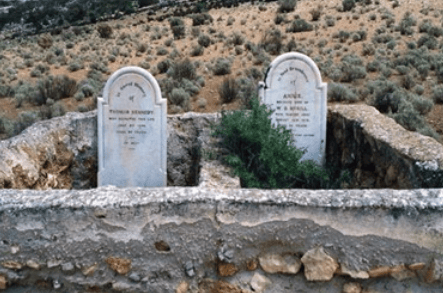
For his article “Murder and ‘The Execution of the Law’ on the Nullarbor” 15, Peter Gifford investigated reported crimes against the local Mirning people, including poisonings, mass shootings, and brutal beatings, during the late 19th century. The study focused primarily on allegations against the pastoralists William Stuart McGill and brothers Thomas and William Kennedy. None of the accused were prosecuted and McGill later became a Justice of the Peace.
The Telegraph Era: Eucla’s Golden Age
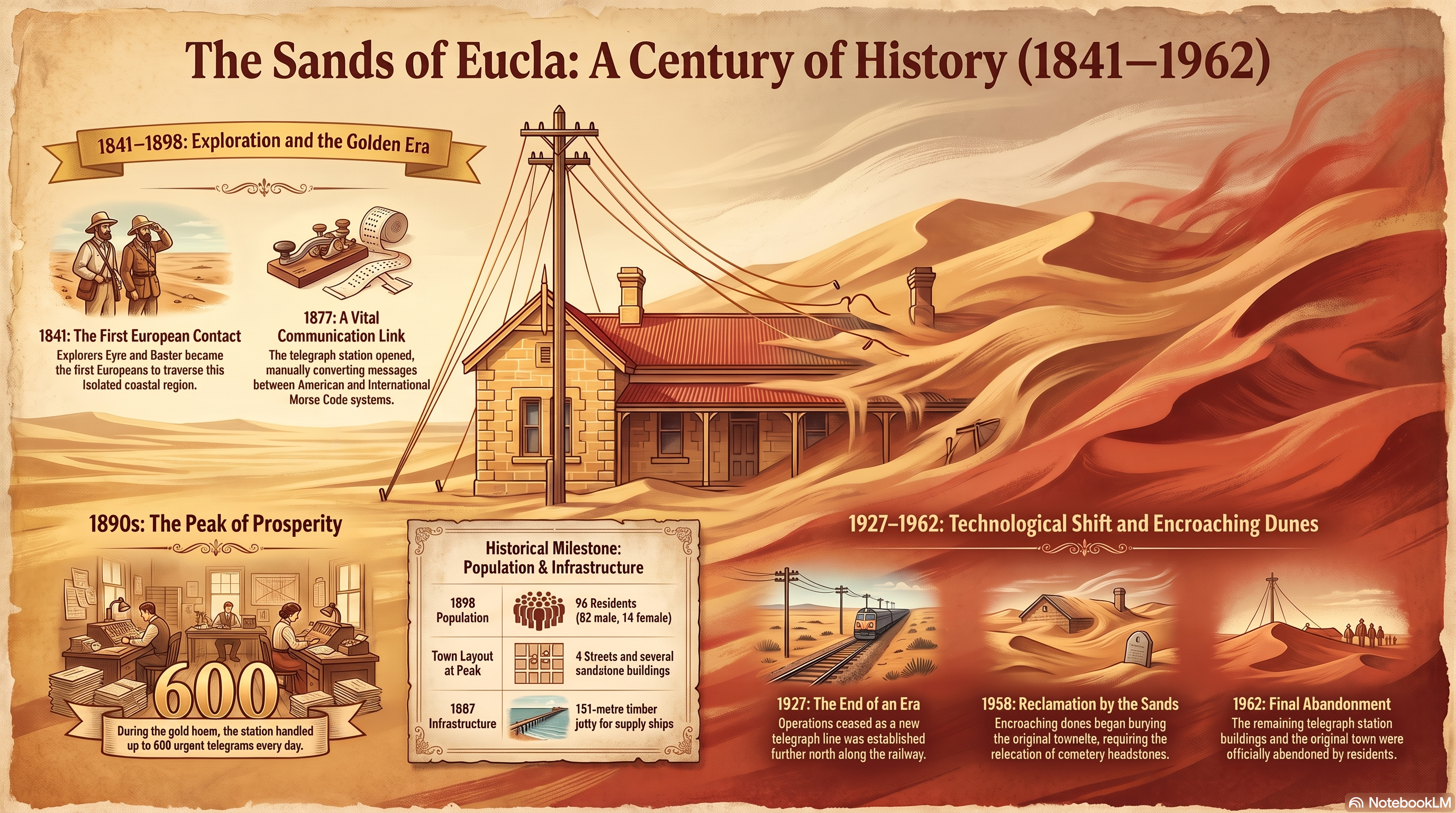
The true catalyst for Eucla’s growth was the “electric telegraph,” which reached the settlement in 1877. The East-West Telegraph Line was the final link in Australia’s national communication infrastructure, finally connecting Perth to Adelaide and the rest of the world. Construction was a logistical marvel; materials like jarrah poles from Western Australia and tubular metal poles from South Australia had to be landed from ships standing two miles offshore and rafted to the beach. Three supply ships – the Mary Ann, Twilight, and Catabunup – were wrecked during this arduous process.16
Eucla became the busiest manual repeater station on the line, acting as the critical conversion point between two different telegraphic systems. South Australia and Victoria used the American Morse code (known as the “Victorian alphabet”), while Western Australia utilised the International Morse code. This technical requirement necessitated a large, permanent staff. In its heyday, the station was manned by telegraphists from both colonies who worked on opposite sides of a wooden table. A wooden partition symbolically marked the border within the office, and messages were passed through physical “pigeon holes” or “boundary holes” to be re-transmitted. Interestingly, the operators even worked in different time zones; the Western Australians were an hour behind their South Australian counterparts until 1899.17
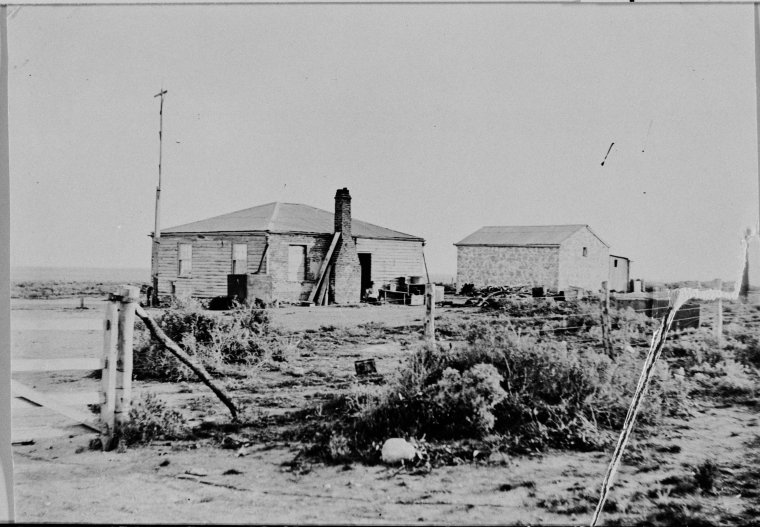
This influx of well-educated, skilled workers created a unique and sophisticated social environment. Eucla was a tight-knit community that valued intellectual pursuits and fellowship. Between 1898 and 1900, the staff produced The Eucla Recorder, a monthly newspaper that provides a vivid snapshot of town life. The paper reported on cricket matches, tennis tournaments, athletics, and billiards, and even included editorials on the Boer War, women’s enfranchisement, and Federation. Residents enjoyed a lending library and organised elaborate weekend picnics to distant beauty spots, with the entire population sometimes travelling by camel, bicycle, or horse-drawn cart.19 20
The People of Eucla
For those tracing their ancestry to the region, the records reveal a diverse population of officials, labourers, and colorful characters. One notable figure was William George Bailey, a telegraphist who arrived in 1876 but died of appendicitis just 18 days before the line officially opened in 1877. His grave was eventually threatened by the shifting sands, and his headstone was moved to the local museum for preservation.21
Eucla also attracted eccentric characters like Arthur Chichester Beadon, an English “remittance man”. Supported by regular payments from home to stay away from England, Beadon became a pioneer in his own right. He was reportedly the first white man to cross the Nullarbor Plain from south to north, accompanied by a group of Tigamba natives. He eventually settled in Eucla after a failed venture as a station owner west of Fowler’s Bay.22
The Beere family also left a significant mark on the community. Frederick William Beere served as a linesman, patrolling the desolate telegraph line for many years. He and his wife, Margaret Laura Wellstead, also ran a large general store in Lempriere Street during the 1890s. Their family story is one of typical frontier struggle; they had nine children, though at least one died as an infant and was buried on Eucla Town Lot 31.23 24 Other families, like the Clayers, also spent years at the station; Albert Clayer was a telegraphist there in the early 1900s, and his daughter Leila was reportedly the only white child in the town for a period.25
Environmental Factors and the Great Relocation
The demise of the original Eucla townsite was not caused by economic failure, but by an environmental catastrophe. In the 1890s, the region was hit by a massive rabbit plague. Millions of rabbits, which had spread from Victoria, descended on the Delisser Sandhills. They stripped the dunes of their scrub and vegetation, which had previously acted as a natural anchor for the sand. In a desperate and ill-fated attempt at biological control, some residents introduced cats to hunt the rabbits, resulting in a secondary plague of feral cats while the rabbits remained.
Without vegetation, the dunes became unstable. Under the influence of the Southern Ocean winds, massive drifts of sand began to move inland, relentlessly encroaching on the town. Buildings, including the original weatherboard telegraph station, were slowly buried. This environmental pressure, combined with the technological shift to a new telegraph line along the Trans-Australian Railway in 1929, sealed the fate of the old town.
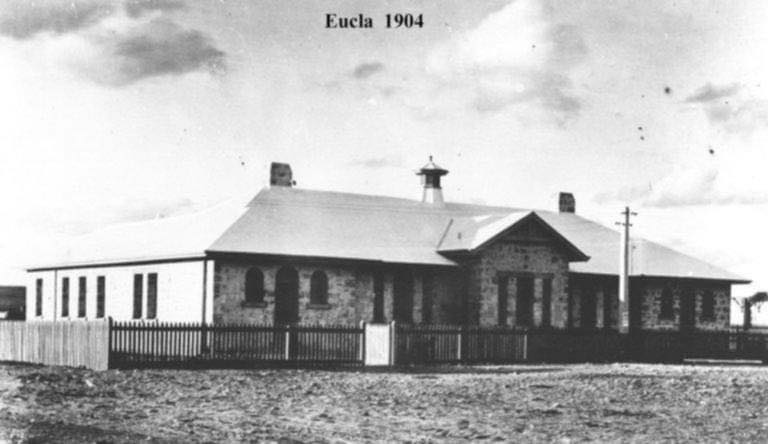
The community was forced to abandon the coastal site. A new township was established approximately four kilometres to the north, situated higher up on the escarpment where the limestone cliffs provided protection from the drifting sands. Today, the ruins of the 1898 stone telegraph station remain as a haunting “ghost town,” with its walls occasionally peeking through the white dunes as a reminder of the original settlement.
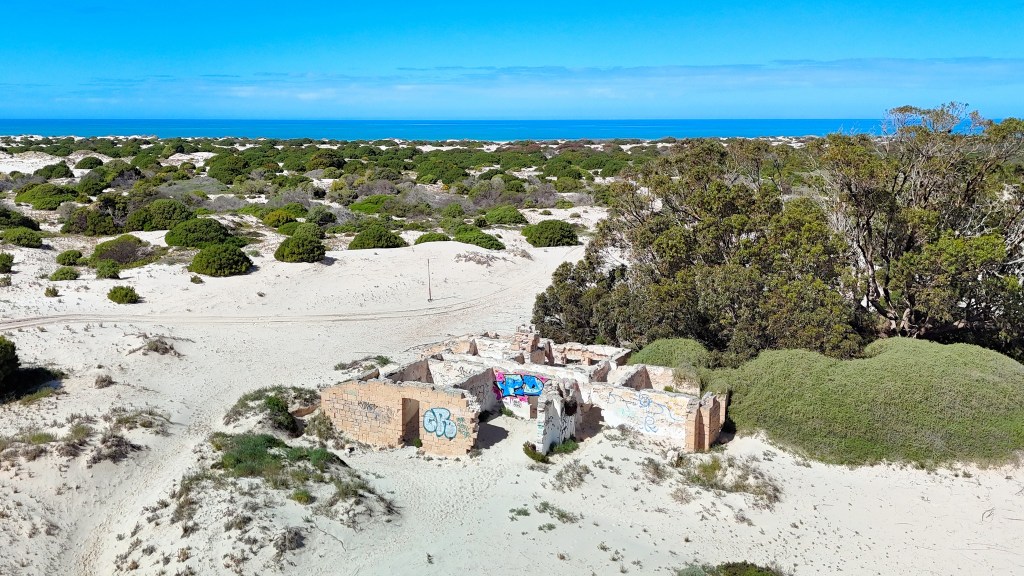
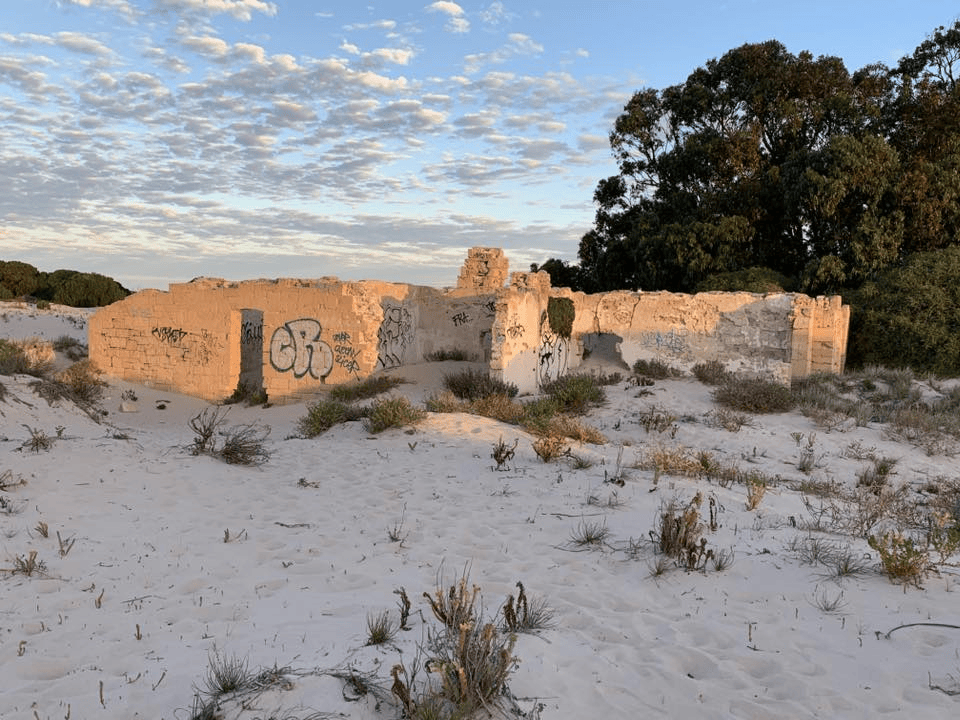
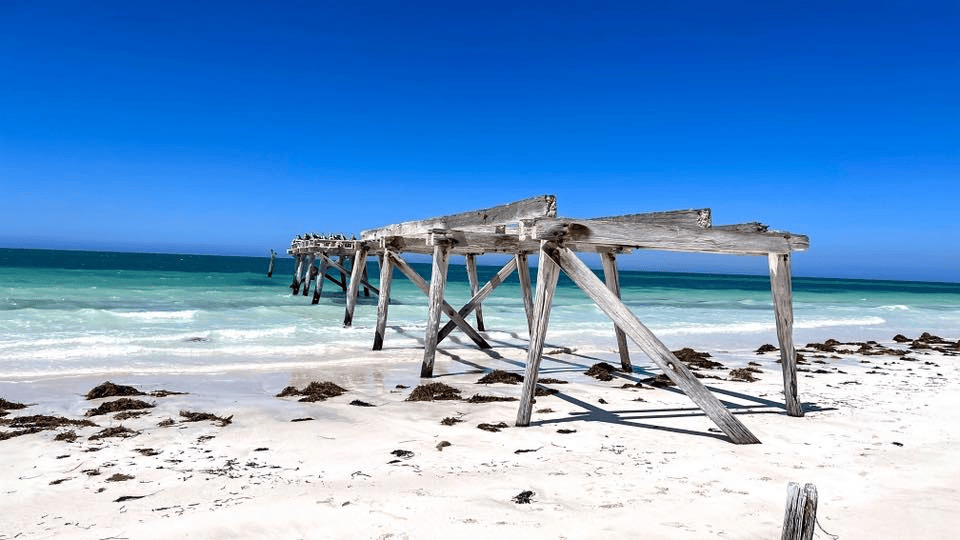
© D Hardman, Mar 2026
Economic and Social Evolution
The economy of early Eucla was built on the twin pillars of communications and wool. The jetty, constructed in 1887 and repaired in 1898, was the town’s lifeline. Supplies arrived quarterly via ships like the Grace Darling and the Flinders, while returning vessels carried out bales of wool from Mundrabilla and Moopina, as well as sandalwood collected along the coast.26 27
The 1890s gold boom in Kalgoorlie and Coolgardie brought a final surge of prosperity to Eucla. As the busiest manual repeater station, it handled urgent messages from sharebrokers and mining magnates, with daily traffic reaching up to 600 telegrams. However, this prosperity was transient. By 1918, reports indicated that the jetty was in a “dangerous condition,” with its piles eaten away by sea worms and blocked by sand. The Engineer for Harbours and Rivers recommended closure rather than repair, noting that it was often easier to simply dump cargo on the beach.28
The 20th century saw the rise of the Eyre Highway, which transformed Eucla into a service hub for road travellers. This modern era brought its own set of challenges; in October 2005, Greyhound Australia ceased its McCafferty’s bus route across the Nullarbor, which had provided the only public transport link for the town. This was a significant blow for roadhouse owners who relied on the service to transport staff and stranded travellers across the longest stretch of road in the world without services.29
Tall Tales and the Modern Community
Eucla has also maintained its place in the public imagination through clever pieces of fiction. In 1971, a story emerged of the “Nullarbor Nymph”—a half-naked blonde girl living wild among the kangaroos. This hoax, cooked up by local residents like kangaroo shooter Laurie Scott to generate publicity, was remarkably successful, drawing worldwide media attention and ensuring that the tiny settlement remained on the map.30

Today, Eucla remains the largest settlement on the Nullarbor Plain between Norseman and Penong. It hosts a Royal Flying Doctor Service base, a hospital, a police station, and essential services for those making the long trek across the state border. Census data from 2021 shows a small, permanent population of just 37 people, with a median age of 56, reflecting an ageing but dedicated community.32 33
Notable modern landmarks include the Travellers Cross, established around 1969 on the escarpment to commemorate locals and offer a symbolic protection for those crossing the highway.34 35 For the genealogist, Eucla is a site of ancestral struggle; for the traveller, it is a welcome respite; and for the historian, it is a testament to a time when a “bright” outpost on the edge of the world kept the heart of Australia connected through the clicks of a telegraph key.
Footnote
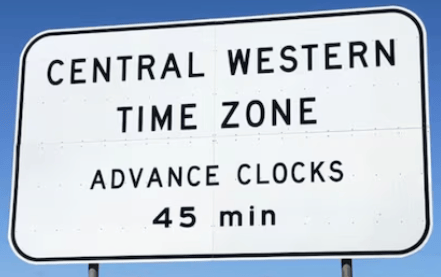
Eucla one of only six places to be included in the Central Western Standard Time. The others are Caiguna, Cocklebiddy, Madura and Mundrabilla in Western Australia and Border Village in South Australia. Officially designated UTC+08:45, CWST is affectionately known as Eucla Time. 36
Timeline
- 1841: Edward John Eyre and John Baxter become the first Europeans to traverse the Eucla coast during their trek from Adelaide to Albany.
- 1867: Captain B. Douglas discovers and surveys Eucla Harbour, declaring it a viable port.
- 1867–1868: A boundary dispute erupts as Douglas confirms the port is eight-tenths of a mile within Western Australian territory.
- 1870: John Forrest camps at Eucla for two weeks while awaiting a supply ship during his exploratory expedition.
- 1872: The Muir brothers establish Moopina Station, the first pastoral run in the area.
- 1872: Kennedy and McGill arrive with 1,500 sheep to establish Mundrabilla Station after failing to find enough water at Eucla.
- 1873: Land is officially set aside for the Eucla telegraph station.
- 1875: The governments of WA and SA agree to construct the East-West Telegraph Line.
- 1877: The telegraph line opens on December 8; Eucla begins operations as a manual repeater station.
- 1885: Eucla is officially proclaimed and gazetted as a township.
- 1887: Construction of the first Eucla Jetty is completed by Ballie, Davies, and Wishart.
- 1890s: A massive rabbit plague destroys coastal vegetation, followed by an unsuccessful attempt to control them with cats.
- 1896: A new telegraph line is built from Eucla to Norseman to serve the Eastern Goldfields.
- 1898: The telegraph station is rebuilt in stone to accommodate expanded staff and families.
- 1898–1900: The Eucla Recorder newspaper is published by the telegraph station staff.
- 1912: The Western Australian State Shipping Service is formed, providing regular calls to Eucla from Fremantle.
- 1927: The Eucla Telegraph Station ceases manual operations as technology advances.
- 1929: A new telegraph line is established further north along the Trans-Australian Railway, leading to Eucla’s decline.
- 1949: The Gurney family occupies the old telegraph station buildings as a wayside house.
- 1962: The original telegraph station buildings and old townsite are finally abandoned due to sand encroachment.
- 1969: The Travellers Cross is established on the escarpment.
- 1971: The “Nullarbor Nymph” hoax draws worldwide media attention to the tiny settlement.
- 1978: The Eucla Area, including ruins and dunes, is entered on the Register of the National Estate.
- 2005: Greyhound Australia cancels the last regular public bus service across the Nullarbor.
- 2021: The Australian Census records Eucla’s population at 37 persons.
Map
Sources
- Cowans, Gary (2017) Eucla 1904 Building. Published in East-West Gelegraph Line – Eucla and retrieved on 3 Aug 2026 from https://www.outbackfamilyhistoryblog.com/east-west-telegraph-line-eucla/ ↩︎
- Wikipedia (2025). Eucla, Western Australia. Retrieved 3 Aug 2026 from https://en.wikipedia.org/wiki/Eucla,_Western_Australia ↩︎
- Heritage Council of Western Australia (2004). Register of Heritage Places – Assessment Documentation : Eucla Jetty (Ruins), Abutment & Beach Landing (Remains). p.5. PDF document retrieved on 3 Aug 2026 from https://inherit.dplh.wa.gov.au/admin/api/file/59d7a35b-34fe-50c0-8375-79839cfe1a0e. ↩︎
- Landgate (2022). Town names. Retrieved from the Internet Archive on 3 Aug 2026 from https://web.archive.org/web/20220314101618/http://www0.landgate.wa.gov.au/maps-and-imagery/wa-geographic-names/name-history/historical-town-names ↩︎
- EUCLA HARBOUR, WESTERN AUSTRALIA. (5 Feb 1868). The Inquirer and Commercial News (Perth, WA : 1855 – 1901), p. 3. Retrieved 4 Aug 2026, from http://nla.gov.au/nla.news-article69386552 ↩︎
- Walkabout (2006). Eucla, WA. Retrieved from the Internet Archive on 3 Aug 2026 from https://web.archive.org/web/20060824104930/http://www.walkabout.com.au/locations/WAEucla.shtml ↩︎
- WA Now & Then (n.d.) Eucla. Retrieved 4 Aug 2026 from https://www.wanowandthen.com/eucla.html ↩︎
- Sharp, Moya (2017). East-West Telegraph Line – Eucla. Published in Outback Family History and retrieved on 3 Aug 2026 from https://www.outbackfamilyhistoryblog.com/east-west-telegraph-line-eucla/ ↩︎
- The Inquirer & Commercial News Published (20 Nov 1867, p. 2) Retrieved 4 Aug 2026, from http://nla.gov.au/nla.news-article69387145 ↩︎
- Heritage Council of WA (2022) Balladonia Station. Retrieved 4 Aug 2026 from https://inherit.dplh.wa.gov.au/Public/Inventory/Details/f483afa7-4b99-4fef-a0ef-705a4b9d11c2 ↩︎
- Outback Graves Markers (n.d.) Search results for Eucla. Retrieved 4 Aug 2026 from https://www.outbackgraves.org/burial-records/burial-search/?Name=&Keywords=Eucla&action_OGMSearch=Search ↩︎
- ibid : Annie Harkness (CRAWFORD) MCGILL. Retrieved 4 Aug 2026 from https://www.outbackgraves.org/burial-records/person/6370 ↩︎
- Mathis, Esme (24 Apr 2023). Now a ghost town, Eucla owes its hey day to the telegraph station. Published in Australian Geographic and retrieved 3 Aug 2026 from https://www.australiangeographic.com.au/history-culture/2023/04/now-a-ghost-town-eucla-owes-its-hey-day-to-the-telegraph-station/ ↩︎
- Eucla Motel (2026). Telegraph Station. Retrieved 4 Aug 2026 from https://www.euclastay.com.au/telegraph-station/ ↩︎
- State Library of WA (n.d.) ↩︎
- Cryle, D. (2019). The Eucla Recorder (1898 – 1900): community journalism on a remote telegraph station. Published in Journal of Telecommunications and the Digital Economy, 7(1), 83-93. https://doi.org/10.18080/jtde.v7n1.177 ↩︎
- Heritage Council of Western Australia (2004) : p.6 refers to staffing of the telegraph station ↩︎
- Outback Graves Markers (n.d.) William George Bailey. Retrieved 3 Aug 2026 from https://www.outbackgraves.org/burial-records/person/6363 ↩︎
- ibid : Arthur Chichester Beadon. Retrieved 3 Aug 2026 from https://www.outbackgraves.org/burial-records/person/6364 ↩︎
- ibid : Edward John Beere. Retrieved 3 Aug 2026 from https://www.outbackgraves.org/burial-records/person/6365 ↩︎
- ibid : Unnamed male child Beere. Retrieved 3 Aug 20206 https://www.outbackgraves.org/burial-records/person/6366 ↩︎
- Green, Keith (2 Jan 2018). Comment on article by Moya Sharp (2017) as above. ↩︎
- Heritage Council of Western Australia (2004) : p.5 refers to construction of the jetty ↩︎
- ibid : p.7 refers to shipping ↩︎
- Eucla Motel (2026). Eucla’s History. Retrieved 3 Aug 2026 from https://www.euclastay.com.au/euclas-history/ ↩︎
- ABC News (10 Oct 2005) Nullabor bus service proves too costly. Retrieved 4 Aug 2026 from https://www.abc.net.au/news/2005-10-10/nullarbor-bus-service-proves-too-costly/2121098 ↩︎
- Wikipedia (2022) Nullabor Nymph. Retrieved 4 Aug 2026 from https://en.wikipedia.org/wiki/Nullarbor_Nymph ↩︎
- ibid ↩︎
- Kiddle (2025). Eucla, Western Australia facts for kids. Retrieved 3 Aug 2026 from https://kids.kiddle.co/Eucla,_Western_Australia ↩︎
- Australian Bureau of Statistics (2021). 2021 Census All persons QuickStats: Eucla. Retrieved 4 Aug 2026 from https://www.abs.gov.au/census/find-census-data/quickstats/2021/SAL50494 ↩︎
- Raymond, Kerry and Horton, David (2007). Travellers Cross, Eucla WA. Retrieved 5 Aug 2026 from https://www.chapelhill.homeip.net/FamilyHistory/Photos/Eucla_Travellers_Cross-WA/ ↩︎
- Shire of Dundas (n.d.) Eucla Roadside Cross. Retrieved 5 Aug 2026 from https://visitdundas.com.au/things-to-do/attractions/eucla-roadside-cross.aspx ↩︎
- ABC News (30 Mar 2024). Central Western Time, affectionately known as ‘Eucla Time’ is WA’s lesser-known second time zone. Retrieved 5 Aug 2026 from https://www.abc.net.au/news/2024-03-30/central-western-time-eucla-time-second-time-zone-in-wa/103243096 ↩︎
Further Reading
- Moynihan, J. F. (1981) Some brief notes on owners and operators of early telegraph lines in Western Australia, 1869-1873.
- Stevens, G. P. (1933) The east-west telegraph 1875-7. Published in Early Days Vol.2, Pt.13, pp.16-35
- Stevens, G. P. (1936) Inauguration of the Electric Telegraph in Western Australia, 1869.
- Stirling, Edmund (1897). A brief history of the first establishment and development of the Electric Telegraph in Western Australia.
Versions
| Date | Changes |
|---|---|
| 5 Aug 2026 | Version 0.1 – First draft |
| 6 Sep 2026 | Version 1.0 – First Published |

