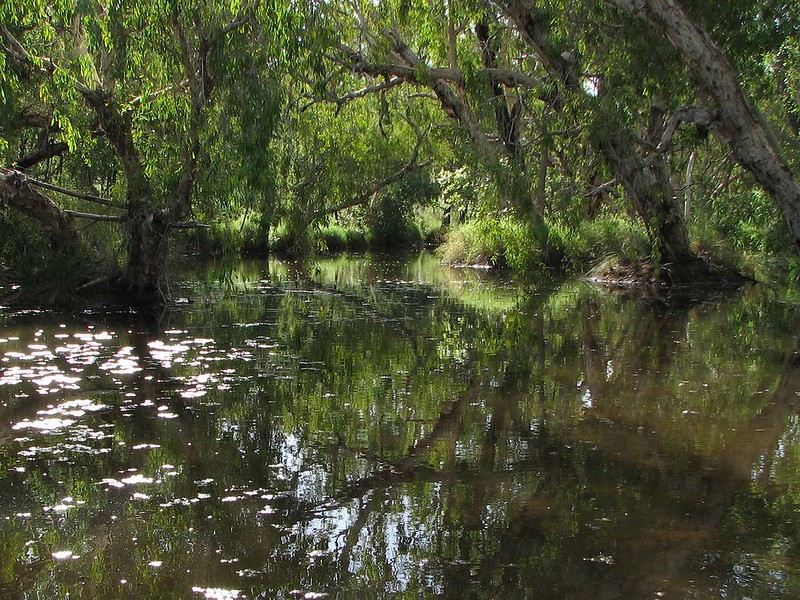
yaruman51
Demographics
Region: Kimberley
LGA: Halls Creek
Industry: Gold mining
Other Names: Fletcher Creek
Open Street Map: -16.640542567729064, 128.26974651195474
What3Words: ///judo.occurs.renew
Settled: 1890
Gazetted: N/A
Closed: 1895
Abstract
Fletcher’s Creek, located on a branch of the Bow River in Western Australia’s rugged East Kimberley district, owes its name to the gold rush era of the mid-1880s, when travellers christened the main tributary of the Ord River after the New South Wales Minister for Mines. Its subsequent importance centered on its strategic location along the telegraph line connecting Wyndham and Halls Creek. A police camp was established there around 1890, primarily tasked with protecting the fragile colonial infrastructure and enforcing law and order in the increasingly contested pastoral region. The history of the Fletcher Creek Police Station, built by police in late 1893/early 1894, is intrinsically linked to the violent frontier conflict, notably suffering an attack and burning by local Aboriginal groups in June 1893. Following intense pacification campaigns in the mid-1890s, the station was withdrawn in December 1895. Today, the site is recognized as a stream location and a modern rest area.
History
The Genesis of a Frontier Outpost
The establishment of the Fletcher’s Creek community, located on a branch of the Bow River and a main tributary of the Ord River in the East Kimberley region2 3, was a direct consequence of the late 19th-century gold rush in Western Australia.
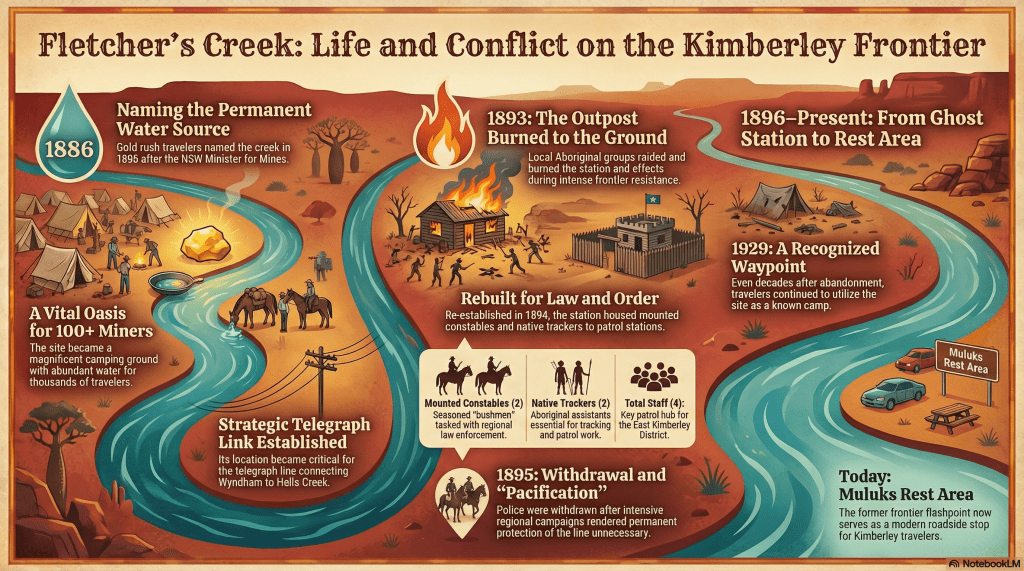
In July 1886, during the rush to the Kimberley diggings, a special correspondent recorded reaching the creek, situated approximately 180 miles from Cambridge Gulf (Wyndham). Finding it a magnificent camping ground with abundant water and splendid grass, and noting nearly 100 men camped there that night, the party christened the watercourse “Fletcher’s Creek” in honor of the Hon. James Fletcher, who was the Minister for Mines in New South Wales at the time. At that time, men returning from the diggings reported that gold accounts had been greatly exaggerated and that obtaining provisions was nearly impossible, illustrating the harsh economic realities of the area. In the early years, the area was also a passage point for those traveling to the Richenda diggings.4 5
The Establishment and Purpose of the Police Station
The ongoing tension between incoming settlers and local Aboriginal groups, combined with the vulnerability of essential infrastructure, quickly led to the formal establishment of a colonial presence. The East Kimberley district was heavily promoted for pastoral expansion in the 1880s.6
A police camp or midway outstation was first positioned at Fletcher’s Creek in 1890. Its primary function, alongside that of the Denham River camp, was to protect the telegraph line running from Wyndham to Halls Creek. This infrastructure was under constant threat, as Aboriginal people reportedly interfered with the line, using the porcelain insulators as material for spearheads.
The police establishment at Fletcher Creek quickly became crucial to colonial administration and control in the remote district. Records show the existence of Occurrence Books for the station spanning from November 1890 to December 1895. Although operating as a police camp earlier, the actual Fletcher Creek Police Station was built by police forces, under the direction of Sub Inspector Drewry, with construction occurring between December 1893 and January 1894. For the 1895-1896 period, the station was staffed by two mounted constables and two native trackers, totaling four personnel, underscoring its role as a key patrol hub in the East Kimberley District. These police were known as “bush police” or “bushmen,” seasoned individuals necessary for law enforcement in the isolated and often violent district.7 8
Frontier Conflict and External Impacts
The presence of the police station underscores the violent resistance that accompanied the expansion of the pastoral industry (cattle stations like Argyle and Lissadell) into Aboriginal lands. The Aboriginal response to the encroaching settlers and their stock was militant, with reports of Europeans being speared and killed.9
The most significant event in the station’s operational arc occurred in June 1893, when natives made a raid upon the Fletcher Police Station, burning the entire station and all the effects belonging to the police stationed there, and spearing the police horses. One individual, “Wingbing,” was charged with this offense. In the aftermath, the question was raised in the Legislative Assembly whether the Government intended to refund the constables for their loss sustained due to the outrage.10
The police stationed at Fletcher’s Creek were heavily involved in bush patrols, seeking to arrest offenders (who were then chained and marched to Wyndham or Halls Creek gaol) and undertake “dispersals”—repressive acts involving killings sanctioned by the Commissioner of Police in Perth. Law enforcement archives document arrests and convictions originating from Fletcher Creek during this period, including records of conviction for individuals like Murdigan in August 1892.11 12
Beyond the social conflict, environmental factors influenced the outpost. Flooding, characteristic of the region, was a persistent issue; in March 1895, a report indicated that three telegraph poles were washed down and carried away by a flood at Fletcher Creek, disrupting the vital line connecting Wyndham.13
The economic driver for the region shifted from the gold rush to the booming pastoral industry, especially after 1893 when the Kalgoorlie goldfields created a massive market for beef. This amplified the conflict, leading to reports in 1900 of blacks killing cattle on Fletcher Creek and neighboring Turkey Creek. Patrols, often involving native assistants and the transport of Aboriginal prisoners on the chain to Wyndham Gaol, continued to utilize Fletcher Creek as a waypoint.14 15
Withdrawal of Police Presence
The period of intense police activity culminated in the formal withdrawal of constables from the Fletcher Creek camp in December 1895.16 This decision was predicated on the view that the telegraph line no longer required permanent protection due to the effectiveness of the extensive pacification efforts – referred to euphemistically in records as “extensive killing and imprisonment” of local Aboriginal people. John Inglis, who served at the station, was the Officer in Charge for the last two months before the station’s closure in 1896. Trackers who served at Fletcher Creek, such as Jacky, Pluto, and Tommy, were transferred to the newly established Argyle camp, which consolidated policing efforts in the region.17
Although officially withdrawn, the location continued to be recognized. In 1929, travelers noted camping at the unoccupied Fletcher Creek police station.
Fletcher’s Creek today
Today, Fletcher Creek is geographically identified as a stream in Western Australia, located in the Ord River region. The history of the site has evolved significantly, and it is now officially recognized as the location of the Muluks Rest Area (Fletchers Creek) in Ord River, WA 6770. Thus, the location, born from the gold rush, served as a flashpoint for frontier law and conflict for a decade before being repurposed, finally becoming a contemporary roadside rest stop in the vast Australian landscape.18
Timeline
- July 1886: Fletcher’s Creek is christened by gold rush travelers, named after Hon. James Fletcher, Minister for Mines in NSW, during the rush to the Kimberley diggings.
- 1888: Report notes two lost men, Michael Anderson and Conrad Hobin, entering a camp on the Fletcher in an emaciated state while traveling to the Richenda diggings.
- Circa 1890: A police camp/midway outstation is established at Fletcher Creek to protect the telegraph line from Wyndham to Halls Creek and police the East Kimberley pastoral district.
- 1890–1895: Fletcher Creek Police Station maintains Occurrence Books, detailing reported events and police movements.
- June 1893: The Fletcher Police Station is raided and burned by natives; the station, its contents, and police horses are destroyed.
- December 1893 – January 1894: The Police Station at Fletcher Creek is rebuilt by police forces under Sub Inspector Drewry.
- March 1895: Three telegraph poles at Fletcher Creek are washed down and carried away due to floods, interrupting communication.
- 1895–1896: The Police Force proposed distribution lists the Fletcher Creek Police Station with 2 mounted constables and 2 native trackers. John Inglis serves as Officer in Charge for the last two months of operation.
- December 1895: Constables are withdrawn and the camp is closed/discontinued, following intensive “dispersal” and imprisonment efforts in the region.
- 1896: Native Trackers Jacky, Pluto, and Tommy are transferred from the former Fletcher Creek Police Station to the new Argyle camp.
- October 1900: Constable Wilson’s patrol journal reports on natives killing cattle in the Fletcher Creek area.
- 1929: The location is still recognized as the Fletcher Creek police station camp by travelers.
- Present Day: Fletcher Creek is recognized as a stream in Western Australia and is the site of the Muluks Rest Area.
Map
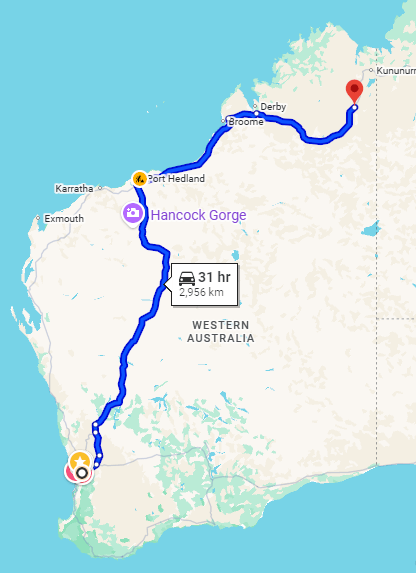
Fletcher’s Creek is a tributary of the Ord River.
The Ord River near Kununurra is one of Western Australia’s most significant waterways. It’s not surprising that the Aboriginal meaning for the word Kununurra is “big waters” or the “meeting of the waters”.
Created by the Ord River dam, the massive Lake Argyle is the biggest man made lake in Australia and passes through Carlton Gorge with its magnificent cliffs and rock overhangs.

Sources
- yaruman5, 2007. Fletcher’s Creek. Colour photograph dated 4 Feb 2007. Retrieved 2 Dec 2025 from https://www.flickr.com/photos/barkochre/392654441/in/photostream/ ↩︎
- Morawa District Historical Society, n.d. Ghost Towns and Wayside Inns of Western Australia. Retrieved 2 Dec 2025 from https://morawamuseum.org.au/ghosttowns/F.pdf ↩︎
- EN ROUTE TO THE KIMBERLEY DIGGINGS. (1886, September 7). The West Australian (Perth, WA : 1879 – 1954), p. 3. Retrieved December 2, 2025, from http://nla.gov.au/nla.news-article3760057 ↩︎
- ibid. ↩︎
- State Records Office of WA, n.d. Police Occurrence Books: Fletcher’s Creek. Retrieved 2 Dec 2025 from https://archive.sro.wa.gov.au/index.php/occurrence-books-fletcher-creek-police-station-s4835 ↩︎
- Owen, Chris, 2003. The police appear to be a useless lot up there’: law and order in the East Kimberley 1884-1905.Published in Aboriginal History 2003 Vol 27 p.106. Retrieved 2 Dec 2025 from https://press-files.anu.edu.au/downloads/press/p73641/pdf/ch0649.pdf ↩︎
- ibid, p114. ↩︎
- THE ESTIMATES. (1895, August 16). The West Australian (Perth, WA : 1879 – 1954), p. 6. Retrieved December 2, 2025, from http://nla.gov.au/nla.news-article4544539 ↩︎
- Owen, p.110. ↩︎
- PARLIAMENT. (1895, July 2). The West Australian (Perth, WA : 1879 – 1954), p. 6. Retrieved December 2, 2025, from http://nla.gov.au/nla.news-article4538672 ↩︎
- PARLIAMENT. (1895, July 3). The West Australian (Perth, WA : 1879 – 1954), p. 6. Retrieved December 2, 2025, from http://nla.gov.au/nla.news-article4538473 ↩︎
- Owen, p.109-110 ↩︎
- NEWS AND NOTES. (1895, March 4). The West Australian (Perth, WA : 1879 – 1954), p. 4. Retrieved December 2, 2025, from http://nla.gov.au/nla.news-article4547611 ↩︎
- CATTLE KILLING BY NATIVES. (1900, December 11). The West Australian (Perth, WA : 1879 – 1954), p. 6. Retrieved December 2, 2025, from http://nla.gov.au/nla.news-article23849596 ↩︎
- State Records Office, Police Occurrence Books. Retrieved 2 Dec 2025 from https://www.google.com/url?sa=E&q=https%3A%2F%2Farchive.sro.wa.gov.au%2Findex.php%2Fgeneral-files-2-s76 ↩︎
- Owen, p.121 ↩︎
- Owen, p.121 & 126 ↩︎
- WhereIS, n.d. Muluks Rest Area. Retrieved 2 Dec 2025 from https://www.whereis.com/wa/ord-river-6770/yellowId-LN297242 ↩︎
 People of Western Australia's Ghost Towns