Christine Harris (2026)
Demographics
Region: Mid West
LGA: Meekatharra
Industry: Mining
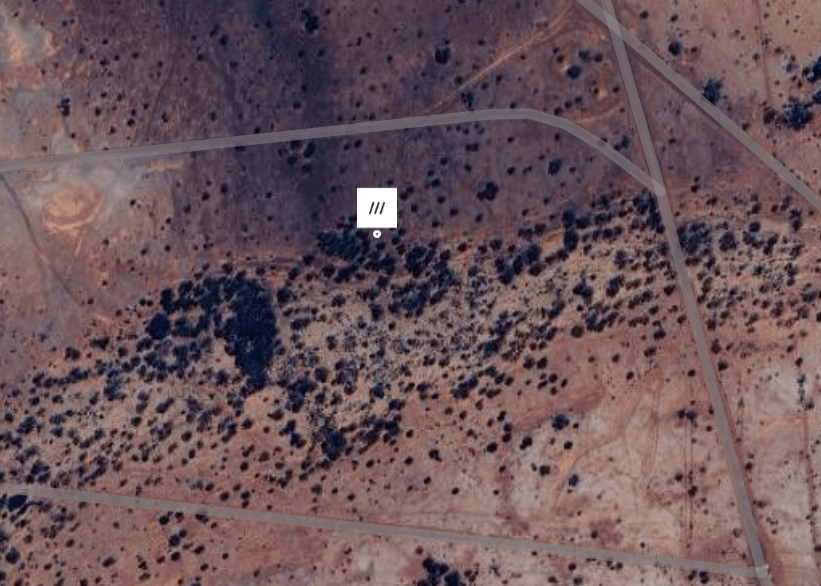
Open Street Map: -26.426274679981354, 118.46355243624188
What3Words: ///silliness.unclog.lavender
Settled: 1894
Gazetted: N/A
Abandoned: About 1945
Abstract
Located approximately 20 kilometres north-west of Meekatharra, Garden Gully represents a vital chapter in the history of the Western Australian goldfields. Initially pegged in May 1894, the field became a focal point of the early Murchison rush, hosting a 10-head battery that serviced both local mines and the nascent operations at Meekatharra. Despite its name, which reflects the natural beauty of its river gums and flowering shrubs rather than man-made cultivation, the community was defined by the harsh realities of desert mining, with a shanty town of tin and hessian housing its early prospectors.
The area’s economic trajectory was marked by two distinct peaks: the first centred on the Crown gold mine in the late 1890s, and a second, richer period following the Kyarra discovery in 1909. Beyond its mineral wealth, Garden Gully was environmentally crucial as Meekatharra’s first water source, though its highly mineralised wells eventually limited its use to industrial purposes. Socially, the site evolved from a rugged mining camp into a beloved recreational hub for the district, hosting annual picnics and school sports days well into the 20th century. Today, while only foundations and relics remain, Garden Gully is seeing a political and economic resurgence through multi-million dollar strategic investments in modern gold exploration.
History
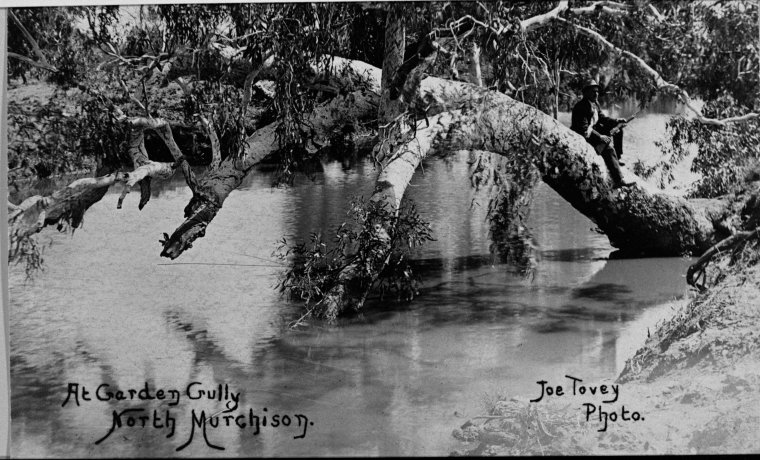
Nestled borders the east bank of a creek 20 kilometres north-west of Meekatharra, the site known as Garden Gully stands as a testament to the boom-and-bust cycle that defined the Murchison goldfields. Unlike many of its counterparts in the arid Western Australian interior, the area was not named for human industry but for its natural environment—a verdant creek shaded by river gums and filled with a profusion of flowering shrubs. Yet, beneath this tranquil exterior lay the economic promise of gold, a discovery that would transform the gully from a natural landmark into a bustling, if ephemeral, community.2 3 4
Discovery and the First Wave (1894–1901)
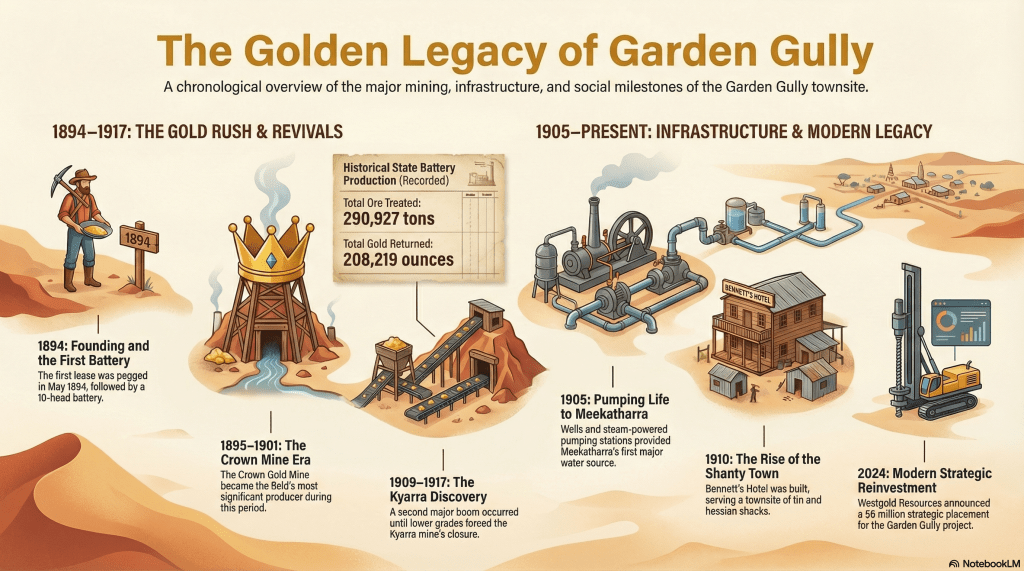
The history of Garden Gully as a colonial community began in May 1894, when the first lease, known as the Old Battery Group, was pegged. This discovery occurred during a period of feverish exploration across the state, as prospectors moved afield from earlier finds in Coolgardie and Kalgoorlie. The economic potential of the field was immediately apparent. Shortly after the first leases were secured, a 10-head battery was erected by the Garden Gully G.M. Co. to crush ore for local prospectors.5 6 7 8
During these early years, Garden Gully served a political and industrial purpose that extended beyond its own borders. Until 1901, its battery provided essential crushing services for the fledgling mines at Meekatharra, which lacked their own facilities. The most significant operation of this era was the Crown gold mine, which produced consistent, albeit small, yields from January 1895 until the turn of the century.9 10
Socially, the community of this first phase was a rugged “shanty town” composed of tin and hessian shacks. Life was defined by the environmental extremes of the Hot Desert Climate (BWh), where mean maximum temperatures in January reached a blistering 38.3°C. Despite these hardships, the population grew, driven by the hope of striking it rich in a landscape where gold was frequently associated with native elements, quartz, and pyrite.11 12 13
The Kyarra Boom and Social Growth (1909–1917)
Interest in the field waned after 1901 when Meekatharra established its own State Battery, but a second, more prosperous era was heralded by the discovery of the Kyarra mine in 1909. This period saw Garden Gully reach its zenith as a residential and social centre. In 1914, P. J. O’Brien and his party unearthed what was described by the Meekatharra Miner as a “veritable jeweller’s shop” at the Lydia mine, south-west of the Kyarra. This find, which produced 15 ounces of gold from a mere 60 pounds of stone, ignited a new wave of prospector activity.14
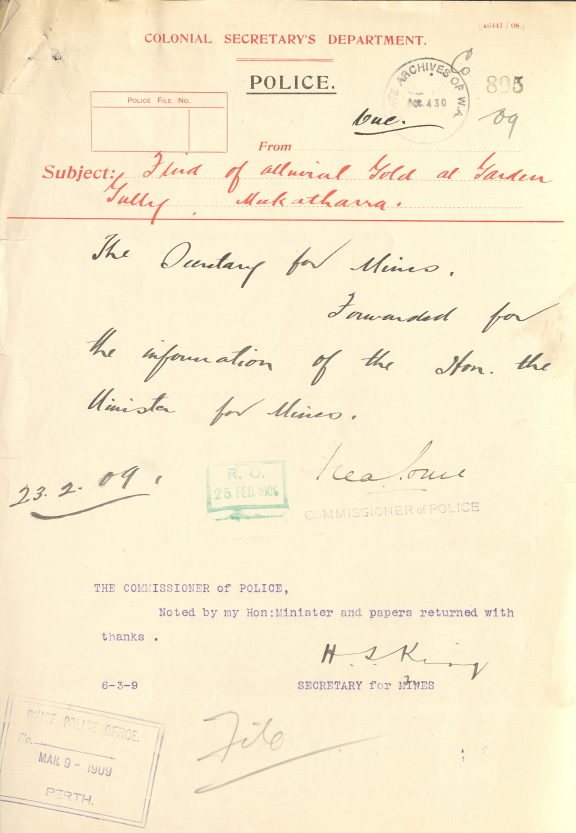
Cover page of report filed with the Colonial Secretary’s Department for the attention of the Minister for Mines. The original report reads:
POLICE DEPARTMENT. 895
Murchison District, Meekatharra Station.
Feb 16th, 1909
REPORT of A. Sampson Const. Reg. No. 607 relative to New alluvial Gold find
I respectfully report that a new alluvial patch has been found at Garden Gully by a prospector named Alfred Barker, & situate on a lease that is held by Thos. Middleton Willson & others. So far three claims have been pegged, but there have been a large number of prospectors getting ready to visit the find & some already left this afternoon for the scene of operations. It is not known for sure the permanency of the patch or the extent of it but Mr. Barker reported to the Deputy Mining Registrar the finding of the patch & of obtaining payable alluvial gold.
A. Sampson, Const 607
Sub Insp. Mitchell, Cue.15
Economic prosperity allowed for the development of more permanent community infrastructure. Around 1910, Arch Bennett and his wife established Bennett’s Hotel on the main track connecting Meekatharra to Peak Hill. The hotel became a social anchor, providing mass for the Roman Catholic community and serving as a focal point for travellers. The area also supported a market garden operated by the Wilton Brothers, who famously potted a rabbit that had been “worrying” their rock melons in 1910—a small but telling example of the environmental interactions between the settlers and the local fauna.16 17 18
Political and social life in Garden Gully was inextricably linked to Meekatharra. The community was significant enough to host Mass and Sunday services, and it became the preferred site for the district’s recreation. The annual Catholic Picnic, established in 1943, and numerous school sports days in the 1930s utilised the shaded creek beds, making Garden Gully a place of cultural significance for generations of Murchison residents.19 20 21
Environmental Challenges and the Water Works
One of Garden Gully’s most critical contributions to the region was not gold, but water. In 1905, the environmental necessity of sustaining the growing town of Meekatharra led to the sinking of wells along the Garden Gully creek. Pumping stations were established, with the No. 1 station housing a massive steam engine that powered the entire system.22
However, the environment presented a significant hurdle: the water from Garden Gully was highly mineralised. Political and health officials eventually deemed it unsuitable for domestic use, forcing Meekatharra to look elsewhere for “sweet water”. Nevertheless, the Garden Gully water remained an economic asset for the mining industry, supplying the Fenian mine at Paddy’s Flat until the pumping stations finally ceased operation around the Second World War.23
Decline and Dormancy
The decline of Garden Gully was precipitated by both economic and global factors. The Kyarra mine, the field’s mainstay, began to encounter lower-grade ore and various operational issues, leading to its closure in 1917. This mirrored a broader trend across Western Australia, where gold production fell to a third of its peak by 1920 due to a lack of overseas investment and the enlistment of miners during the First World War.24 25 26
Throughout the mid-20th century, the community largely dispersed. By 1950, many of the surrounding settlements, like the Twelve-Mile, had disappeared. While Garden Gully remained a popular spot for picnics and parties, its status as a permanent residential community faded. All that remained of its former grandeur were the foundations of buildings, equipment relics, and the cellar of Bennett’s Hotel.27
Modern Exploration and Heritage
In recent decades, Garden Gully has experienced a political and economic revival. The area was explored by Dourado Resources in 2012, and as of 2024, the Garden Gully Gold Project has seen renewed life through a $6 million strategic placement by Westgold Resources into Ora Gold. This modern interest is driven by new technologies that allow mines to operate profitably on grades as low as 1 gram per tonne—a far cry from the high-grade “jeweller’s shops” sought by 19th-century prospectors.28 29
Recognising its historical value, the Shire of Meekatharra has listed Garden Gully as a protected heritage site (Site 20). It is significant not only for its mineral output but for the cultural events held there over the years.30 31
Conclusion
Garden Gully’s history is a microcosm of the West Australian goldfields experience. It was shaped by the harsh desert environment, driven by the economic promise of the Kyarra and Crown mines, and sustained by a resilient social fabric that found beauty in a creek-side “garden”. While the shanty towns and steam pumps of the past have vanished, the area remains a landmark of the Murchison, bridging the gap between the adventurous prospectors of 1894 and the strategic mining enterprises of the 21st century.
Timeline
- May 1894: The first gold mining lease, the Old Battery Group, is pegged at Garden Gully.
- January 1895: The Crown Gold Mine begins production, becoming the most significant mine of the first era.
- 1894–1901: A 10-head battery operates at Garden Gully, crushing ore for both local and Meekatharra mines.
- 1905: Wells are sunk along the creek to provide Meekatharra’s first major water source.
- 1909: Discovery of the Kyarra mine sparks a major second period of activity and growth.
- 1910: Arch Bennett builds Bennett’s Hotel to serve the growing population and travellers.
- March 1910: Wilton Brothers report potting a rabbit in their Garden Gully market garden.
- May 1913: The community is large enough to warrant scheduled Roman Catholic services by Father Flanagan.
- November 1914: O’Brien and party discover “The Lydia,” revealing exceptionally rich “jeweller’s shop” ore.
- 1917: The Kyarra mine closes due to lower grades, beginning the area’s long decline.
- 1924–1925: Motor vehicle registrations show resident families (Ashton, Holtzman, Jefferson, Percy) still active in the community.
- 1930s: Garden Gully is a popular venue for district school sports days.
- Circa 1940: Water pumping stations cease operations around the time of the Second World War.
- 1943: The annual Catholic Picnic is established at the Garden Gully creek.
- 2012: Dourado Resources conducts modern exploration of the northern workings.
- September 2013: The Garden Gully site is formally adopted into the Shire of Meekatharra’s Municipal Inventory of Heritage Places.
- 2024: Westgold Resources makes a $6 million strategic placement into Ora Gold’s Garden Gully project.
Map
Sources
- State Library of Western Australia (n.d.) Collection of photographs from the Royal Western Australian Historical Society; BA1886/727. Retrieved 26 Feb 2026 from https://encore.slwa.wa.gov.au/iii/encore/record/C__Rb3016906 ↩︎
- Heritage Council of Western Australia (2017). Garden Gully. Retrieved 26 Feb 2026 from https://inherit.dplh.wa.gov.au/public/inventory/printsinglerecord/cf04b490-271d-47f6-9a13-34f238eeb164 ↩︎
- mindat.org (n.d.) Garden Gully Goldfield, Meekatharra Shire, Western Australia, Australia. Retrieved 26 Feb 2026 from https://www.mindat.org/loc-265601.html ↩︎
- Gray, Laura (2012). Shire of Meekatharra: Heritage Inventory Review 2012. p.92. Retrieved 26 Feb 2026 from https://www.meekashire.wa.gov.au/documents/465/municipal-heritage-list ↩︎
- mindat: refers to periods of activity ↩︎
- ExplorOz (2026). Garden Gully Townsite – WA. Retrieved 26 Feb 2026 from https://www.exploroz.com/places/314569/wa+garden-gully-townsite ↩︎
- Wikipedia (2024). Gold mining in Western Australia. Retrieved 26 Feb 2026 from https://en.wikipedia.org/wiki/Gold_mining_in_Western_Australia ↩︎
- Heritage Council of WA: refers to constructon of battery ↩︎
- mindat: refers to battery ↩︎
- ExplorOz: refers to Crown gold mine ↩︎
- Heritage Council of WA: refers to “shanty town” ↩︎
- Gray: p.92 ↩︎
- mindat: refers to environment ↩︎
- “A JEWELLER’S SHOP.” (1914, November 21). Meekatharra Miner (WA : 1909 – 1918), p. 2. Retrieved February 26, 2026, from http://nla.gov.au/nla.news-article203557644 ↩︎
- State Records Office of WA. Colonial Secretary’s Papers. Retrieved 25 Feb 2026 from https://archive.sro.wa.gov.au/index.php/cue-find-of-alluvial-gold-at-garden-gully-report-dated-16-2-1909-1909-0895 ↩︎
- Shire of Meekatharra (2013). Minutes of Council Meeting held at the Council Chambers, Meekatharra on Saturday 21 September 2013 commenced at 9.40am. p.165. Retrieved 26 Feb 2026 from https://www.meekashire.wa.gov.au/council-meetings/ordinary-council-meetings/ordinary-council-meeting/187/documents/21092013-minutes.pdf ↩︎
- Advertising (1913, May 24). Meekatharra Miner (WA : 1909 – 1918), p. 2. Retrieved February 26, 2026, from http://nla.gov.au/nla.news-article200939105 ↩︎
- General News. (1910, March 12). Meekatharra Miner (WA : 1909 – 1918), p. 2. Retrieved February 26, 2026, from http://nla.gov.au/nla.news-article202941409 ↩︎
- Advertising (1913, May 24). Meekatharra Miner (WA : 1909 – 1918), p. 2. Retrieved February 26, 2026, from http://nla.gov.au/nla.news-article200939105 ↩︎
- Heritage Council of WA: refers to picnics and sporting events ↩︎
- Gray: refers to church and school activities ↩︎
- Heritage Council of WA: refers to wells ↩︎
- Gray: refers to use of Garden Gully water for mining ↩︎
- mindat: refers to closure of Kyarra mine ↩︎
- ExplorOz: refers to closure of Kyarra mine ↩︎
- Wikipedia, 2024: refers to the impact of WWI ↩︎
- Heritage Council of WA: refers to the remains of the townsite ↩︎
- mindat: refers to the use of new technology ↩︎
- Wikipedia, 2024: refers to post WWII technological change ↩︎
- Heritage Council of WA: recognition of the significance of the town ↩︎
- Gray: refers to the significance of Garden Gully ↩︎
- what3words.com (2026). Garden Gully. Retrieved 26 Feb 2026 from https://what3words.com/silliness.unclog.lavender ↩︎
 People of Western Australia's Ghost Towns