Christine Harris (2026)
Demographics
Region: Mid West
LGA: Cue
Industry: Market Gardens
Other Names: Gardners Well
Open Street Map: -27.421208,117.824936
What3Words: ///reforming.refrained.interception
Settled: 1894
Gazetted: N/A
Abandoned:
TO DATE, WE HAVE NO PHOTOGRAPHS OF
GARDEN WELL.
CAN YOU HELP US?
CONTACT US
IF YOU HAVE ANY INFORMATION
Abstract
Garden Well, located between the abandoned goldfields towns of Day Dawn and Cuddingwarra, represents a microcosm of the rise and fall of the Murchison frontier. Initially established in 1894 to provide essential fresh produce to Cue’s surging gold rush population, the site evolved through diverse economic phases: from a teamster’s rest stop and a licensed wayside inn to a critical junction for the Murchison Firewood Company’s tramway. This article examines the community’s development through the lens of social, environmental, and political factors. Socially, Garden Well served as a venue for both refined wedding breakfasts and volatile industrial action, most notably during the 1908 Nallan Wood Strike, which highlighted ethnic tensions between British and Italian workers. Environmentally, the community battled an arid “hot desert” climate and periodic plagues. Economically, its fortunes were tied to the Great Fingall Mine’s hunger for fuel and the subsequent transition to pastoralism under the Beghetti family. Today, Garden Well exists only as stone ruins on Austin Downs Station, serving as a silent witness to the transient nature of the Australian goldfields.
History
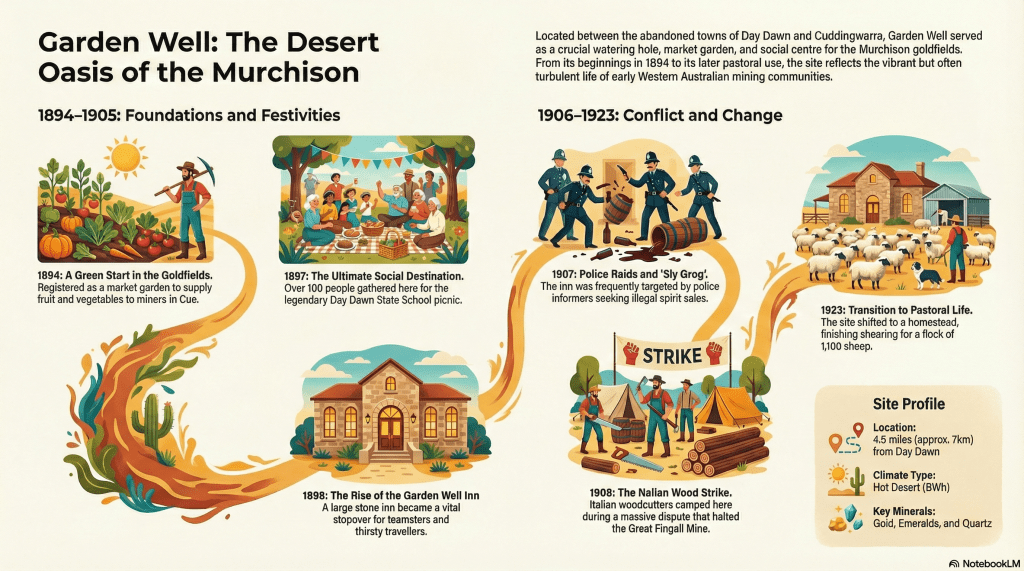
In the harsh, arid landscape of Western Australia’s Murchison district, where the “hot desert” climate often dictated the limits of human endurance, the community of Garden Well emerged as a vital, if transient, sanctuary. Located roughly four and a half miles from the bustling gold mining centre of Day Dawn, Garden Well served as a critical support system for the surrounding goldfields. Its history is a complex tapestry of industrial necessity, social conviviality, and the inevitable decline that follows the exhaustion of mineral wealth.1 2 3
Discovery and Early Growth
The origin of Garden Well was rooted not in the search for gold, but in the basic human need for sustenance. In 1894, as the gold rush brought thousands of prospectors to the Cue district, James Truss and James Hunter registered “Garden, The Granites” as the nineteenth market garden in the area. The fertile ground near the granite outcrops, combined with the sinking of a substantial well in 1896, allowed for the cultivation of fruit and vegetables that were essential for a population prone to the rigours of life in the mulga.4 5
By 1896, the location had become more than just a farm; it was a strategic teamster’s stopover on the busy road between the emerging towns of Day Dawn and Cuddingwarra. Recognizing the economic potential of this traffic, Charles Long erected a large stone building and secured a wine and beer licence. This establishment, eventually known as the Garden Well Inn or Hotel, would become the social heart of the small community for the next two decades.6 7
Social Hub and Community Life
At its peak, Garden Well was the “resort of Sunday excursionists, picnic parties and moonlight meanderers”. The landscape, which could transform from a parched red plain to a carpet of “millions of large wild flowers” after heavy rains, made it an ideal location for recreation. The Day Dawn State School held significant picnics there, where children competed in skipping contests and races for prizes such as “squeaking dolls” and “donkeys,” while adults participated in their own races and games.8 9 10
Social events often brought the disparate elements of the Murchison together. In 1906, the wedding of Thomas Eli Lambert and Kate Livingstone showcased the community’s capacity for elegance amidst the dust. The wedding breakfast, prepared by Mrs J. Rechner, was followed by a dance attended by a large number of visitors from Cue and Day Dawn. The community was also known for its charity, notably contributing more to the Cue and Day Dawn Hospital box in 1921 than any other establishment in the district, including the local hotels and the law courts.11 12
Industrial Importance and the Wood Line
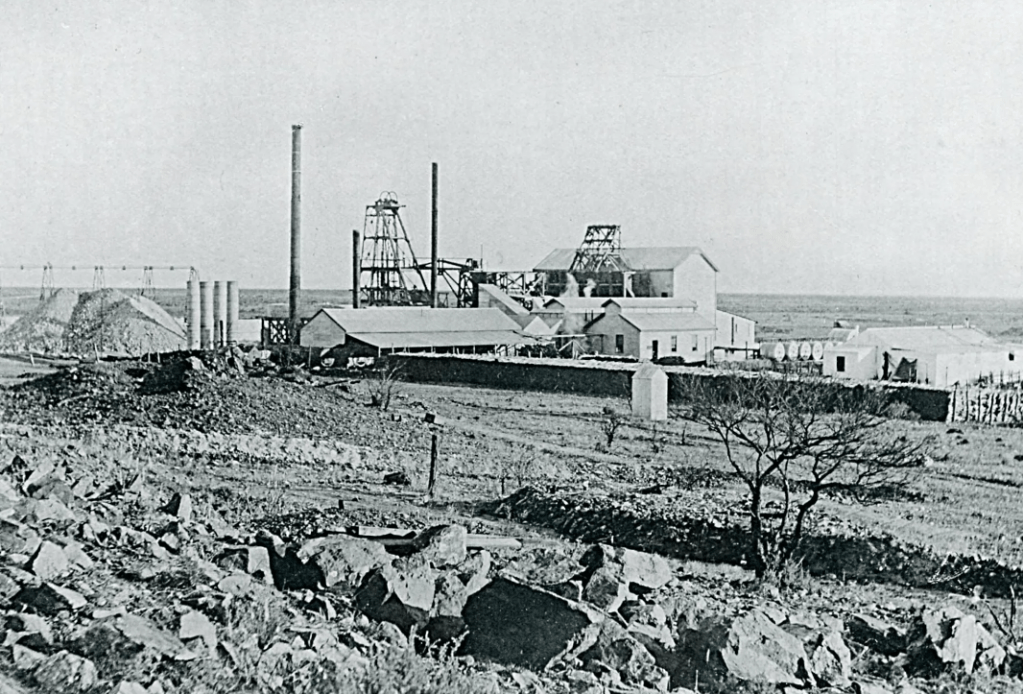
The economic survival of the Murchison mines depended heavily on timber for fuel, leading to the development of the Nallan wood line by the Murchison Firewood Company. Garden Well became a major depot on this tramway, which stretched nearly 40 miles into the mulga country. The company used the site not only for stacking thousands of tons of firewood but also as a base for its workforce and a venue for corporate hospitality, such as the 1913 annual picnic for 100 residents.13 14
However, the wood line also brought political and industrial unrest. The workforce was predominantly of Italian and South European descent, often facing “cleaning out” policies that forced them to clear entire areas for minimal pay. This culminated in the 1908 Nallan Wood Strike, a significant industrial dispute that brought the Great Fingall mine to a standstill. During this conflict, Garden Well was a flashpoint for tension; six Italians were arrested for “unlawful assemblage” after allegedly rushing trucks to prevent British loaders from working. The strike highlighted the fragile balance between the mining giants and the culturally diverse labour force that powered them.15
Social Friction and Legal Turmoil
Life at Garden Well was not without its darker side. The isolation of the inn made it a frequent target for police scrutiny regarding the illegal sale of spirits. Abel Seth Hemmingson, the long-term licensee, was prosecuted in 1903 in a case involving police informers and “sly grog”. Later, in 1907, a controversial case involving a “putrid police pimp” named John Carroll led to a heavy fine for the Bardi family, who were then managing the inn. The reporting of these events in the local press revealed deep-seated distrust of the “informer” system and the heavy-handedness of local law enforcement.17 18
The community also witnessed personal and tribal tragedies. In 1898, the suicide of a barmaid named Nellie Connelly in Perth was linked back to a theft charge she had faced at Garden Well. In 1901, Robert French, a relative of the licensee, was found hanging from a mulga tree near the well, his death attributed to financial anxieties. Furthermore, the local police records mention the death of an Aboriginal man, Vunakarra, at Garden Well in 1905, the result of injuries sustained in a tribal fight months earlier.19 20 21
Environmental and Pastoral Factors
The environment was a constant challenge. While the well provided water, the community was at the mercy of the elements. In May 1900, a devastating plague of black caterpillars swept through the area, destroying the entire night’s worth of vegetables at the garden. Conversely, heavy thunderstorms, like those in 1923 which dropped 150 points of rain nearby, could briefly turn the parched country into a lush landscape, though they also made the primitive roads impassable.22 23
As the gold mines began to decline, the economic focus shifted toward pastoralism. The commonage land surrounding Garden Well became the subject of heated political debate in 1919 when F. Beghetti applied to fence in large portions for private use. Despite petitions from ratepayers who argued the land should be retained for teamsters and stockmen, the Beghetti family established a successful homestead. By 1923, the Garden Well homestead was a functioning sheep station, producing 23 bales of wool from a flock of 1,100 sheep.24 25
Decline and Legacy
The eventual decline of the Great Fingall Mine and the transition of the district into larger pastoral holdings led to the gradual abandonment of the Garden Well community. The social hub of the inn and the industrial bustle of the wood line faded as the population drifted away.
Today, Garden Well is a quiet heritage site on the Austin Downs Station. All that remains are the stone ruins of the wayside inn, a stone-walled yard, and a solitary date palm. The well itself, the community’s namesake and original reason for existence, remains in use, providing water to a landscape that has reclaimed its silence. Though the community has vanished, its ruins stand as a significant reminder of the resilience and complexity of those who sought to build a life in the heart of the Murchison.26
Timeline
- 1894: Registration of “Garden, The Granites” as a market garden by James Truss and James Hunter.
- 1896: A deep well is sunk to support the gardens; Charles Long is granted a wine and beer licence for a stone premise.
- 1897: Carl Hemmingson takes over the inn’s licence; Day Dawn State School holds its second annual picnic at the site.
- 1898: Nellie Connelly is charged with the theft of £11 from a teamster at the saloon; a high-stakes pigeon shooting match is held.
- 1900: A plague of black caterpillars destroys all vegetables at the garden in a single night.
- 1901: Robert French, brother-in-law to the licensee, commits suicide near the well due to financial troubles.
- 1903: Licensee Abel Hemmingson is fined £20 for “sly grog selling” (retailing spirits without a licence).
- 1905: The death of an Aboriginal man named Vunakarra is reported following a tribal fight.
- 1906: Thomas Lambert and Kate Livingstone hold their wedding breakfast and dance at the Garden Well Hotel.
- 1907: A police raid led by an informer results in a heavy fine for the Bardi family for illegal spirit sales.
- 1908: Six Italian woodcutters are arrested at Garden Well during the Nallan Wood Strike.
- 1911: Prospectors Whitley and Dyer strike a rich gold reef at the Bob Bell mine near the Garden Well road.
- 1913: The Murchison Firewood Company hosts an annual picnic for 100 people at Garden Well.
- 1919: A heated public dispute occurs regarding the granting of commonage land to F. Beghetti.
- 1921: The Garden Well community collects the highest donation in the district for the Cue and Day Dawn Hospital box.
- 1923: Shearing is completed at the Beghetti homestead, yielding 23 bales of wool.
- 1996: The site is officially adopted into the Municipal Inventory as a heritage place.
Maps
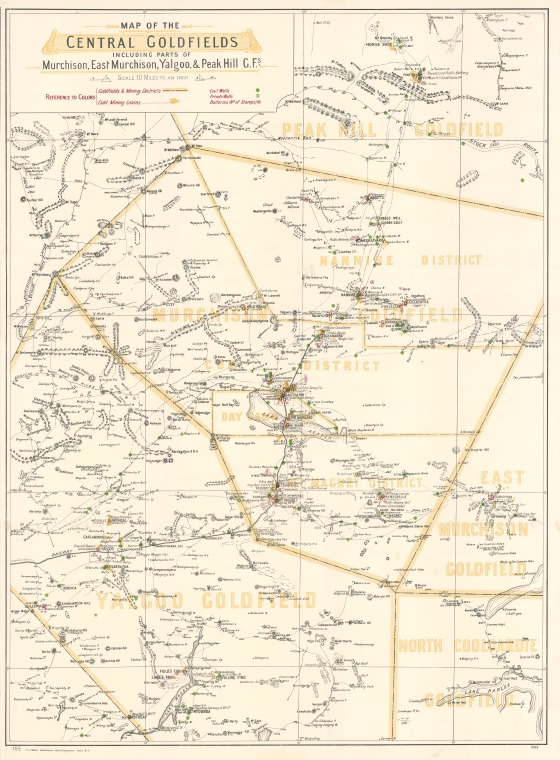
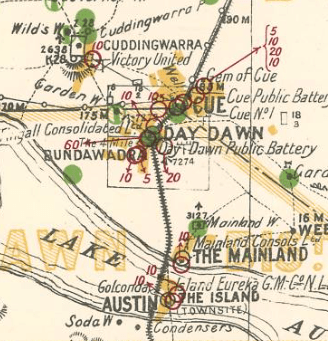
Garden Well is identified as Garden W
(NW of Day Dawn & SSE of Cuddinwarra)27
Sources
- mindat.org (n.d.) Garden Well, Cue, State of Western Australia, Australia. Retrieved 27 Feb 2026 from https://www.mindat.org/feature-8845139.html ↩︎
- DAY DAWN SCHOOL CHILDREN’S PICNIC. (1897, July 31). The Murchison Times and Day Dawn Gazette (Cue, WA : 1894 – 1925), p. 2. Retrieved February 27, 2026, from http://nla.gov.au/nla.news-article233235748 ↩︎
- Morawa District Historical Society (n.d.) Ghost Towns & Wayside Inns of Western Australia. Retrieved 27 Feb 2026 from https://morawamuseum.org.au/ghosttowns/G.pdf ↩︎
- Murchison GeoRegion (2024). Site Map and Murchison GeoRegion site info. Retrieved 27 Feb 2026 from https://murchisongeoregion.com/map/ ↩︎
- A Day in the Mulga. (1913, August 16). The Murchison Times and Day Dawn Gazette (Cue, WA : 1894 – 1925), p. 3. Retrieved February 27, 2026, from http://nla.gov.au/nla.news-article233249323 ↩︎
- Morawa HS: refers to hotel licensee ↩︎
- PUTRESCENT POLICE PIMP. (1907, March 3). Truth (Perth, WA : 1903 – 1931), p. 8 (SUNDAY EDITION). Retrieved February 27, 2026, from http://nla.gov.au/nla.news-article206694704 ↩︎
- A Day in the Mulga. (1913, August 16). The Murchison Times and Day Dawn Gazette (Cue, WA : 1894 – 1925), p. 3. Retrieved February 27, 2026, from http://nla.gov.au/nla.news-article233249323 ↩︎
- DAY DAWN SCHOOL CHILDREN’S PICNIC. (1897, July 31). The Murchison Times and Day Dawn Gazette (Cue, WA : 1894 – 1925), p. 2. Retrieved February 27, 2026, from http://nla.gov.au/nla.news-article233235748 ↩︎
- PUTRESCENT POLICE PIMP. (1907, March 3). Truth (Perth, WA : 1903 – 1931), p. 8 (SUNDAY EDITION). Retrieved February 27, 2026, from http://nla.gov.au/nla.news-article206694704 ↩︎
- Cupid’s Chains. (1906, October 27). Day Dawn Chronicle (WA : 1902 – 1909), p. 2. Retrieved February 27, 2026, from http://nla.gov.au/nla.news-article250963383 ↩︎
- HOSPITAL BOXES. (1921, October 14). The Murchison Times and Day Dawn Gazette (Cue, WA : 1894 – 1925), p. 3. Retrieved February 27, 2026, from http://nla.gov.au/nla.news-article233500720 ↩︎
- Harris, Christine (2026) The Nallan Wood Strike of 1908. Blog post retrieved on 27 Feb 2026 from https://ghostswa.au/2026/01/25/nallan-strike/ ↩︎
- A Day in the Mulga. (1913, August 16). The Murchison Times and Day Dawn Gazette (Cue, WA : 1894 – 1925), p. 3. Retrieved February 27, 2026, from http://nla.gov.au/nla.news-article233249323 ↩︎
- THE NALLAN WOOD STRIKE. (1908, October 24). Western Mail (Perth, WA : 1885 – 1954), p. 40. Retrieved February 27, 2026, from http://nla.gov.au/nla.news-article37817951 ↩︎
- mindat.org (n.d.) Great Fingall. Retrieved 27 Feb 2026 from https://www.mindat.org/photo-1466569.html ↩︎
- SLY GROG SELLING. (1903, August 8). The Murchison Times and Day Dawn Gazette (Cue, WA : 1894 – 1925), p. 2. Retrieved February 27, 2026, from http://nla.gov.au/nla.news-article233374457 ↩︎
- PUTRESCENT POLICE PIMP. (1907, March 3). Truth (Perth, WA : 1903 – 1931), p. 8 (SUNDAY EDITION). Retrieved February 27, 2026, from http://nla.gov.au/nla.news-article206694704 ↩︎
- NELLIE CONNELLY. (1898, October 20). The Murchison Times and Day Dawn Gazette (Cue, WA : 1894 – 1925), p. 3. Retrieved February 27, 2026, from http://nla.gov.au/nla.news-article233216307 ↩︎
- The Suicide Case at Cue. (1901, May 16). The Murchison Times and Day Dawn Gazette (Cue, WA : 1894 – 1925), p. 3. Retrieved February 27, 2026, from http://nla.gov.au/nla.news-article233338879 ↩︎
- GENERAL NEWS. (1905, November 23). The Murchison Times and Day Dawn Gazette (Cue, WA : 1894 – 1925), p. 2. Retrieved February 27, 2026, from http://nla.gov.au/nla.news-article233405438 ↩︎
- NUGGETS. (1900, May 3). The Murchison Times and Day Dawn Gazette (Cue, WA : 1894 – 1925), p. 2. Retrieved February 27, 2026, from http://nla.gov.au/nla.news-article233349617 ↩︎
- Pastoral Notes. (1923, March 9). The Murchison Times and Day Dawn Gazette (Cue, WA : 1894 – 1925), p. 3. Retrieved February 27, 2026, from http://nla.gov.au/nla.news-article233504832 ↩︎
- Cue-Day Dawn Common. (1919, May 9). The Murchison Times and Day Dawn Gazette (Cue, WA : 1894 – 1925), p. 3. Retrieved February 27, 2026, from http://nla.gov.au/nla.news-article233280977 ↩︎
- Pastoral Notes. (1923, August 31). The Murchison Times and Day Dawn Gazette (Cue, WA : 1894 – 1925), p. 3. Retrieved February 27, 2026, from http://nla.gov.au/nla.news-article233506302 ↩︎
- Heritage Council of Western Australia (1997). Garden Well, Date Palm and Inn Ruins. Retrieved 27 Feb 2026 from https://inherit.dplh.wa.gov.au/public/inventory/details/45cf27ea-ca60-436f-8198-8ba134197493 ↩︎
- State Library of Western Australia (n.d.) Parliamentary Paper; 1904, no.17. Retrieved 27 Feb 2026 from https://encore.slwa.wa.gov.au/iii/encore/record/C__Rb2247326 ↩︎
Further Reading
- King, Jo Jackson : “The Station at Austin Downs”
- The Nallan Wood Strike of 1908 : https://ghostswa.au/2026/01/25/nallan-strike/
 People of Western Australia's Ghost Towns