Christine Harris (2026)
Demographics
Region: Wheatbelt
LGA: Yilgarn
Industry: Water Supply Infrastructure
Other Names: No. 7 Pumping Station
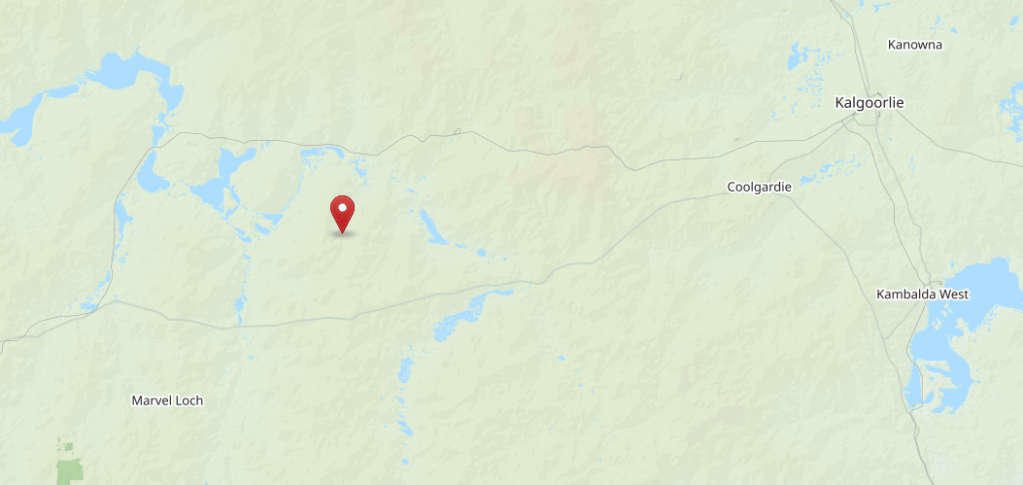
Open Street Map: -31.066533772019366, 119.98226122358338
What3Words: ///slips.monologues.straw
Settled: 1902
Closed: 1969 (demolished 1979)
Abstract
This article explores the historical trajectory of Gilgai, a remote locality in Western Australia defined by its role as the site of the No. 7 Pumping Station on the Goldfields Water Supply Scheme. Conceived by Engineer-in-Chief C. Y. O’Connor and supported by Premier Sir John Forrest, the station was essential in propelling fresh water from Mundaring Weir across the arid interior to the Eastern Goldfields. The narrative traces the community’s origins from the native meaning of its name, a water hole surrounded by grass, through its establishment at the dawn of the 20th century.
The early history is highlighted by the challenges of extreme isolation, earning the settlement the nickname Siberia. Despite these hardships, a vibrant community developed, centered around the steam-powered pumping station and the Eastern Goldfields Railway. The article details the lives of the pump people, engineers, firemen, and their families, documenting births, marriages, and personal anecdotes like the 1901 soldier riot and the 1912 barracks fire. Social factors, such as the intermittent operation of the local school and the unique architectural blueprint of worker housing, are examined alongside technical specifications of the Worthington-Simpson pumps. Finally, the article discusses the factors leading to Gilgai’s decline, including the shift toward electric pumping and the relocation of the railway, concluding with its modern significance as a ghost town site on the Golden Pipeline Heritage Trail.
History
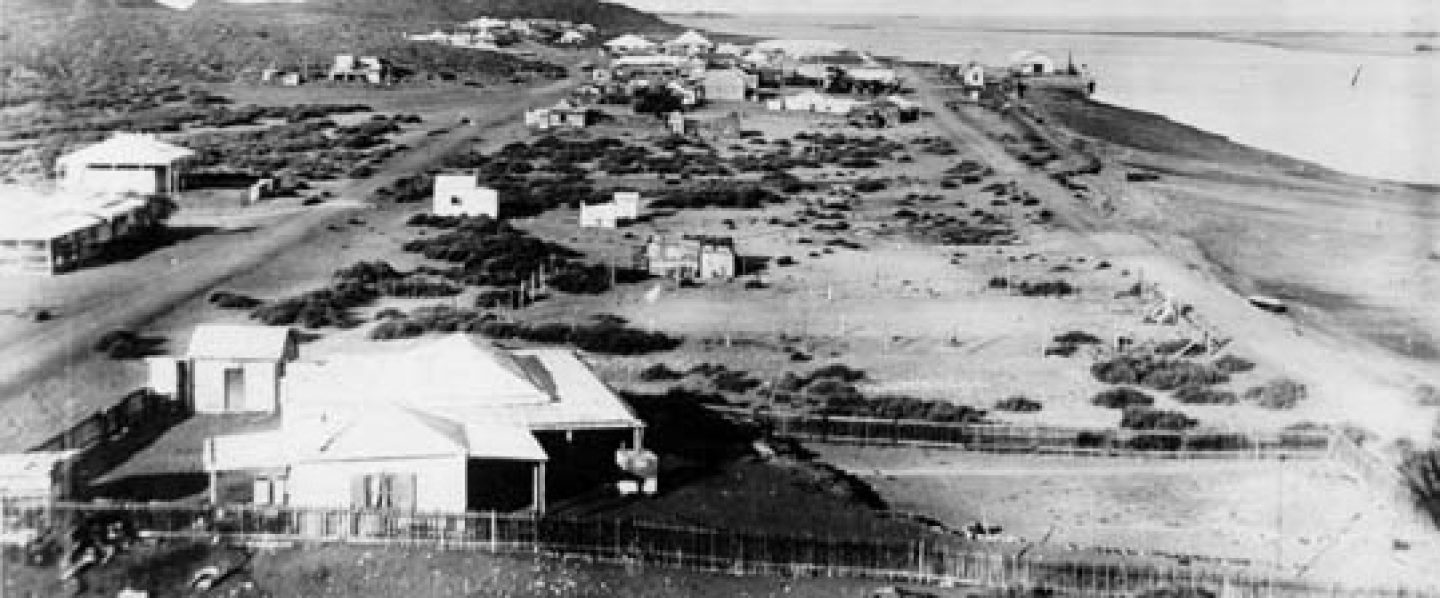
The story of Gilgai is one of technical audacity and human resilience in one of the most inhospitable environments in Western Australia. Located approximately 410 kilometres east of Perth and sitting 458 metres above sea level, Gilgai was never a large town in the traditional sense; rather, it was a specialized community purpose-built to serve the No. 7 Pumping Station of the Goldfields Water Supply Scheme. The name itself is rooted in the landscape’s indigenous heritage, derived from an Aboriginal word meaning a water hole with grass around it. For the workers and families who settled there at the turn of the 20th century, this definition would take on a literal and figurative significance as they maintained the artificial river that sustained the desert.1 2
The Origins of the Golden Pipeline
The establishment of Gilgai was dictated by the desperate need for water on the burgeoning Eastern Goldfields. In the late 1890s, the population of Kalgoorlie and Coolgardie had exploded, yet the region remained virtually waterless except for hidden sand soaks and rock holes. The state government had spent significant sums on salt water distillation and boring, but these measures were insufficient for the needs of the mines and the thousands of people living there.3
C. Y. O’Connor, the Irish born engineer who had already successfully constructed the Fremantle Harbour, announced a plan that the world viewed with skepticism; he proposed to pump five million gallons of fresh water daily from the Helena River to the goldfields, a distance of nearly 560 kilometres. This massive undertaking required eight pumping stations to lift the water a total of 1,200 feet over the Darling Ranges and across the inland plains. Gilgai was selected as the site for No. 7, positioned as a critical booster between station No. 6 at Ghooli and No. 8 at Dedari.4 5
Construction and Early Milestones
Work on the pipeline was well underway by the start of the new century. In December 1900, the warden’s court in Southern Cross began granting business areas near the proposed pumping stations. Thomas Egan was one of the earliest to see opportunity at Gilgai, applying for a provisional license for an establishment there, which was granted subject to the passing of the buildings he intended to erect.6 7
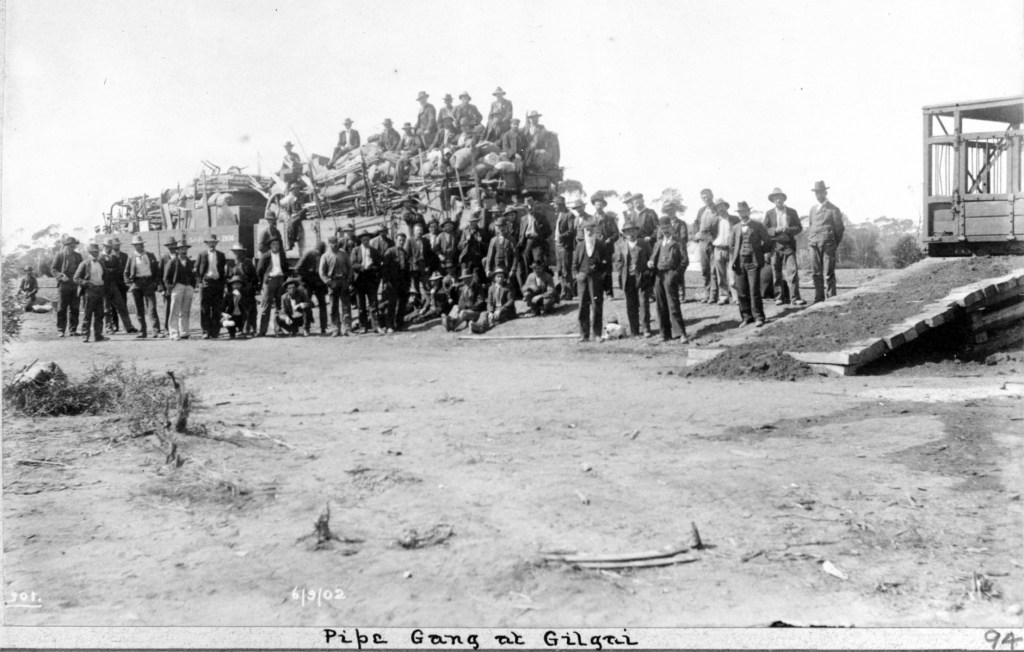
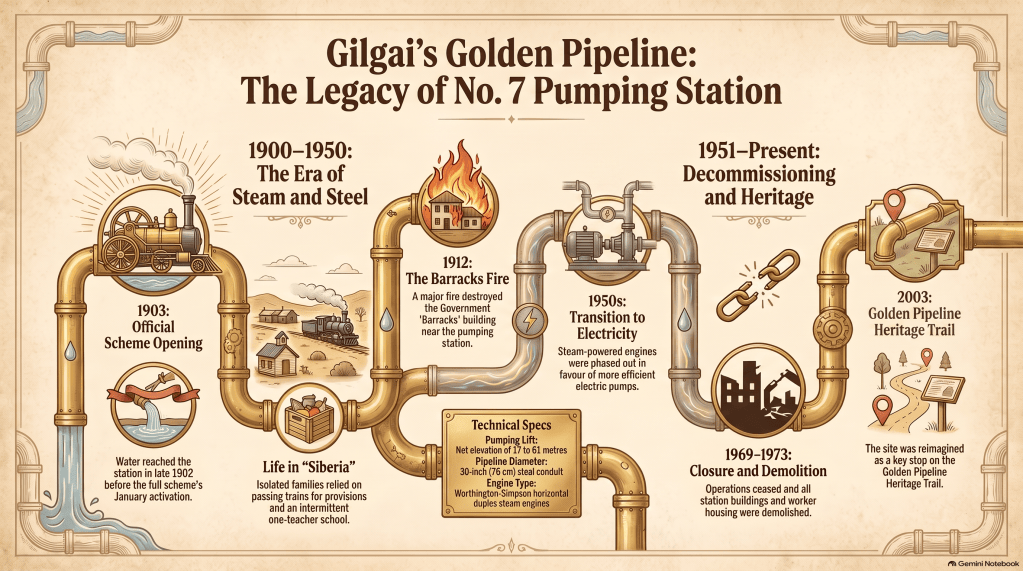
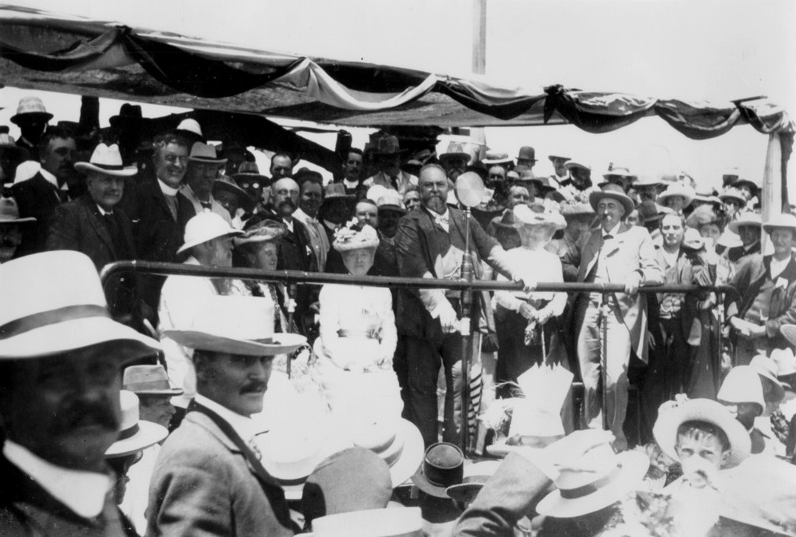
Construction crews arrived in force between 1901 and 1902. The technical specifications at Gilgai were formidable. The station was equipped with two Worthington-Simpson horizontal duplex triple expansion steam pumping engines, which were powered by wood-fired boilers. These engines were responsible for lifting the water 179 feet into a concrete receiving tank at Koorarawalyee, located about one and a half miles further along the line. By late 1902, the water had reached the station, and on 24 January 1903, Sir John Forrest officially turned on the tap in Kalgoorlie, marking the successful completion of the scheme.9
Life in Siberia: The Social Fabric of Gilgai
The isolation of No. 7 Pumping Station was so profound that residents frequently referred to the locality as Siberia. The community was composed mainly of the pumping station staff, their families, and railway fettlers who maintained the Eastern Goldfields Railway line. A typical shift team consisted of eleven staff members, including engineers, firemen, and greasers, who worked in three eight-hour cycles to keep the steam pumps operational day and night.11
Housing at Gilgai followed a strict government blueprint; four-room structures made of tin, weatherboard, and asbestos. Visitors were rare enough that there was no established road past the front doors, only a dusty bike track. Conversely, a well-worn track at the rear of the houses led to the row of outhouses, or dunnies, which were positioned precisely thirty paces from the back doors.
The psychological impact of this isolation was heavy. Rose Birss, who lived at Gilgai from 1930 to 1936, recalled that when her father finally received a transfer, her mother sat down and wept with relief. For twenty-five years, she had fought the adversities of life in the bush, and the prospect of being closer to doctors and shops was overwhelming. Yet, despite the hardships, many former residents remembered their time at the pumps as the best years of their lives, characterized by a close-knit community that played tennis and celebrated milestones together.12
The Role of Education
Education in such a remote area was a constant struggle. A one-teacher school opened at Gilgai in 1919 but was forced to close intermittently as pupil numbers fluctuated. The school served as a community hub, often timings its lessons to the passing of trains. Genealogy enthusiasts will find interest in the long list of dedicated teachers who served at the No. 7 Pumping Station School. Annie Frost was a head teacher on probation in 1921, followed by Ada V. Porter in 1924 and Walter Kingston from 1926 to 1928. In the late 1920s, Ronald Brown took over the role, and decades later, teachers like Alfred Stewart (1952-1954) and Richard Pugh (1965-1966) continued the tradition of providing education to the isolated children of the pump workers and railway gangs.13
Chronicles of the People
The local newspapers of the era provide a window into the daily lives and notable events of Gilgai’s residents. In September 1901, Mr. Mooney, the night officer at Katanning, was promoted to officer-in-charge at Gilgai and was presented with a purse of sovereigns by the community before his departure. The early years were not without drama; in March 1901, a group of goldfields men departing for the 6th contingent to South Africa caused a riot at Boorabbin and subsequently delayed the express at Gilgai by refusing to entrain.14 15
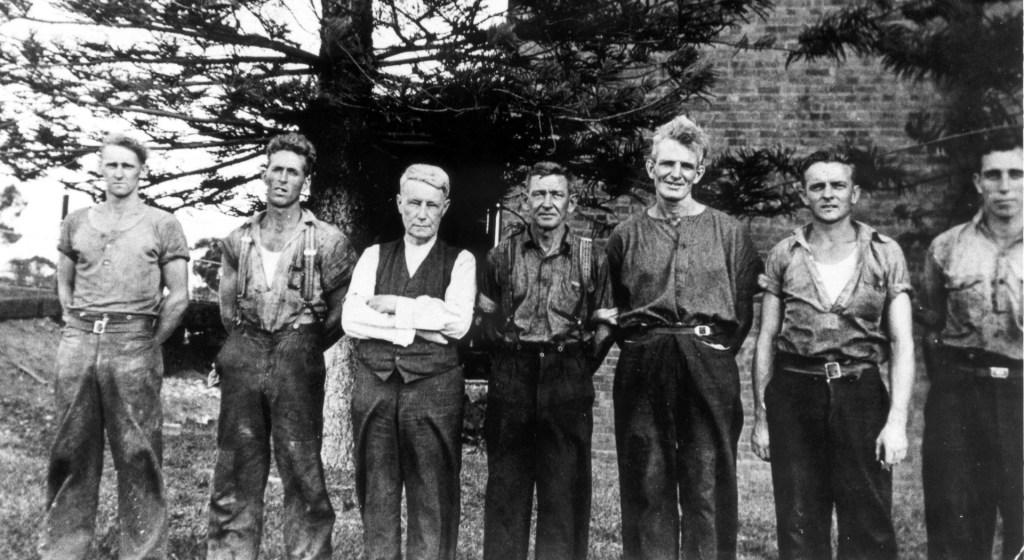
Family life was marked by both joy and tragedy. In March 1906, the wife of Walter Newell of Gilgai gave birth to twin sons at Boulder City. In December 1914, H. W. Jordan and his wife welcomed a son, while the Byrne family would welcomed a son, Phillip James, in October 1931.17 18
Accidents and legal disputes also occasionally disrupted the quiet routine. In June 1912, a fire broke out near midnight in the Government Barracks at the station. The building, which was divided into tenements, was occupied by a fireman named Charles Nordstorn and his wife, as well as several bachelors. The building was completely destroyed, and Mrs. Nordstorn, described as a cripple, had to be rescued from the flames with great difficulty.19 In 1919, a returned soldier named William Sydney McCreed was charged in the Kalgoorlie Police Court for being in unlawful possession of a tin dish valued at four shillings and sixpence. The dish had been left at a camp in Gilgai by a railway employee, but the magistrate ultimately dismissed the case, noting there was no dishonest intention.20
Economic and Environmental Factors
The economy of Gilgai was inextricably linked to the pumping station and the railway. Woodcutting was a major auxiliary industry, as the boilers required a constant supply of fuel. In 1924, Leslie Baumgarten, based at the station, registered a livestock brand, BX7, suggesting that some small-scale animal husbandry occurred alongside industrial activities. The environment, however, remained a persistent adversary. Low rainfall, high evaporation, and the constant threat of dust made life difficult.21
Political shifts also affected the town. In 1948, federal electoral boundaries were redrawn, placing Gilgai in the Moore division, which extended from just north of Perth to the goldfields. Postal vote officers were regularly appointed from the station staff, including G. V. Potter and B. Laughton in 1933, and Joseph William K. Potter in 1934.22 23 24
Decline and Decommissioning
The mid-20th century brought technological changes that would eventually render the original steam-powered stations obsolete. The transition to diesel and electric pumps began in the 1950s, with electricity reaching Gilgai by 1953. As the original steam infrastructure aged, it became increasingly dangerous. In 1967, an economiser explosion in the boiler house claimed the life of fireman Louis Odgers, an event that led to immediate safety modifications on all remaining steam units across the scheme.
The final blow to Gilgai’s viability was the construction of the standard gauge railway in the 1960s, which was laid 20 kilometres to the north of the original line. Without the railway siding to provide supplies and the decline of the gold mining industry reducing water demand, the station was decommissioned in 1969. By the early 1970s, the community had completely vanished. All principal structures, including the main station, the houses, and the school, were demolished.25
Legacy and Heritage
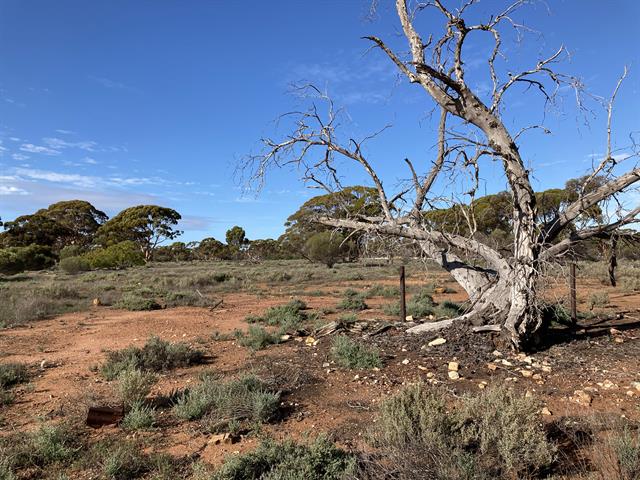
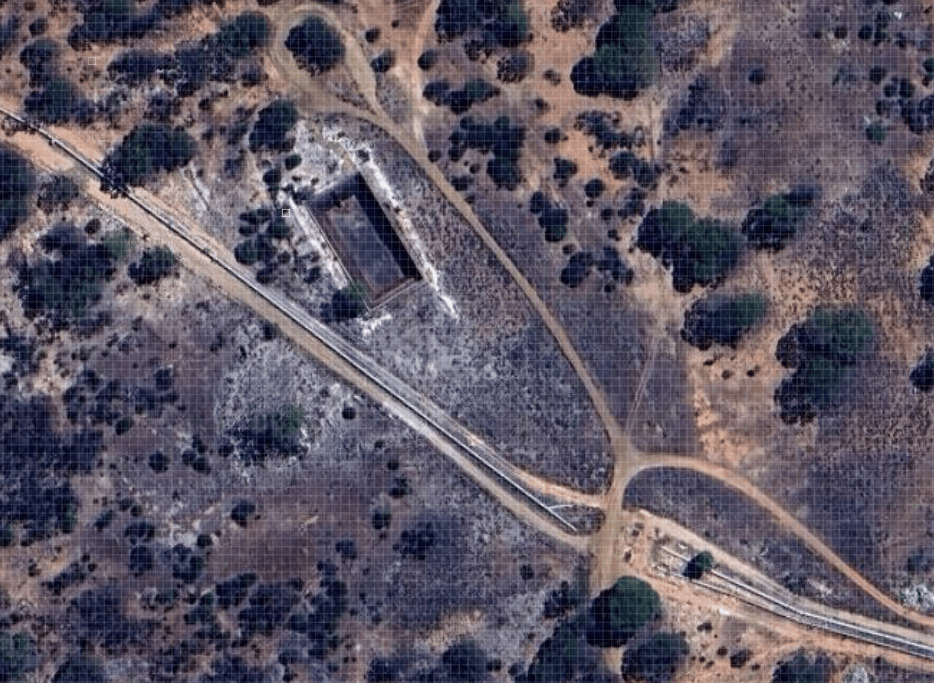
Today, Gilgai is a ghost town site, its silence a stark contrast to the rhythmic thumping of the Worthington-Simpson engines that once echoed through the bush. The only significant structural remnant is the massive concrete receiving tank. The locality is now a featured stop on the 560 kilometre Golden Pipeline Heritage Trail, managed by the National Trust of Australia (Western Australia). Interpretive signage and visitor infrastructure, completed in 2002, allow modern travelers to walk through the footprints of the former houses and imagine the lives of the people who once called this isolated outpost home. Gilgai stands as a testament to the era when Western Australia built a river in the desert to secure its future.27
Timeline
- 1896 The Eastern Goldfields Railway reaches Kalgoorlie, passing through the future site of Gilgai.
- 1900 The Warden’s Court grants Thomas Egan a business area at Gilgai.
- 1901 Mr. Mooney is appointed as the first officer-in-charge at Gilgai railway station.
- 1901 Riotous soldiers for the 6th South African contingent cause a disturbance at the station.
- 1902 Construction of the No. 7 Pumping Station is completed, and bricks are dispatched from Coolgardie for finishing work.
- 1903 Official opening of the Goldfields Water Supply Scheme.
- 1906 Birth of twin sons to the Newell family of Gilgai.
- 1907 Major alterations to mail closing times for the Gilgai district are announced.
- 1909 The young daughter of the Byrne family is tragically lost in the bush near the station.
- 1910 Mr. Phelps, a member of the station staff, takes a well-publicized holiday.
- 1912 A severe fire destroys the Government Barracks and the possessions of fireman Charles Nordstorn.
- 1914 Birth of a son to the Jordan family at Gilgai.
- 1919 The Gilgai school opens for the first time.
- 1920 Birth of a son to the J. L. Wall family of No. 7 Pumping Station.
- 1921 Chief Engineer John Drysdale marries Annie McDougall.
- 1921 Tenders are called for a new steel or brick chimney at the station.
- 1924 Leslie Baumgarten registers the BX7 livestock brand at Gilgai.
- 1925 Tenders are awarded to Duncan and Ganderton for the construction of new school teacher’s quarters.
- 1931 Phillip James Byrne is born to the Byrne family at No. 7 pump.
- 1937 Leo Hunter is transferred from Cunderdin to the No. 7 station staff.
- 1948 Federal electoral boundaries are shifted, moving Gilgai into the Moore division.
- 1953 Electricity is installed at the station to facilitate technical upgrades.
- 1967 A fatal economiser explosion occurs, resulting in the death of fireman Louis Odgers.
- 1969 The No. 7 Pumping Station is officially decommissioned.
- 1973 Final closure of the station site and demolition of the remaining buildings.
- 2003 Launch of the Golden Pipeline Heritage Trail, including Gilgai as a historical interpretive site.
Map
Sources
- NATIVE NAMES. (1926, November 20). The West Australian (Perth, WA : 1879 – 1954), p. 13. Retrieved August 19, 2026, from http://nla.gov.au/nla.news-article31997021 ↩︎
- Grokipedia (2025). Gilgai, Western Australia. Retrieved 19 Aug 2026 from https://grokipedia.com/page/gilgai_western_australia ↩︎
- THE HILLS FOR HEALTH AND HAPPINESS. (1933, September 7). Western Mail (Perth, WA : 1885 – 1954), p. 9 (Edition 2). Retrieved August 19, 2026, from http://nla.gov.au/nla.news-article37840869 ↩︎
- GREAT SOUTHERN WATER SUPPLY. (1936, June 6). The Great Southern Herald (Katanning, WA : 1901 – 1966), p. 2. Retrieved August 19, 2026, from http://nla.gov.au/nla.news-article147426756 ↩︎
- BIRDS EYE VIEW OF THE PIPE LINE FROM THE MUNDARING RESERVOIR TO KALGOORLIE. (1903, January 31). Western Mail (Perth, WA : 1885 – 1954), p. 11. Retrieved August 19, 2026, from http://nla.gov.au/nla.news-article37538598 ↩︎
- Warden’s Court (1900, December 8). The Southern Cross Miner (WA : 1899 – 1902), p. 3. Retrieved August 19, 2026, from http://nla.gov.au/nla.news-article255692795 ↩︎
- TUESDAY, DECEMBER 4. (1900, December 5). The Southern Cross Times (WA : 1900 – 1920), p. 2. Retrieved August 19, 2026, from http://nla.gov.au/nla.news-article206585079 ↩︎
- State Library of Western Australia (n.d.) 011078D: Pipe gang at Gilgai. Black and white photograph taken 6 Mar 1902 and retrieved 19 Aug 2026 from https://purl.slwa.wa.gov.au/slwa_b2125973_1 ↩︎
- HILL RESORTS NEAR PERTH. (1931, October 8). Western Mail (Perth, WA : 1885 – 1954), p. 45 (Edition 2). Retrieved August 19, 2026, from http://nla.gov.au/nla.news-article44784641 ↩︎
- State Library of Western Australia (n.d.) Sir John Forrest opens Goldfields Water Supply Scheme, Coolgardie, 1903. Retrieved 19 Aug 2026 from https://encore.slwa.wa.gov.au/iii/encore/record/C__Rb1913661 ↩︎
- National Trust of WA, (n.d.) The Golden Pipeline: No 7 Pump Station. Retrieved 19 Aug 2026 from https://www.goldenpipeline.com.au/place/no-7-pump-station/ ↩︎
- ibid : The Golden Pipeline: Pump People. Retrieved 19 Aug 2026 from https://www.goldenpipeline.com.au/the-people/pump-people/ ↩︎
- Carnamah Historical Society (n.d.) WA State School Teachers 1900-1980. Retrieved 19 Aug 2026 from https://www.carnamah.com.au/teachers?keyword=No+7+Pumping+Station ↩︎
- THE GREAT SOUTHERN DISTRICT. (1901, September 24). The Albany Advertiser (WA : 1897 – 1965), p. 4. Retrieved August 19, 2026, from http://nla.gov.au/nla.news-article69920846 ↩︎
- THE BOLD SOLDIER BOY! (1901, March 11). The Kalgoorlie Miner (WA : 1895 – 1954), p. 4. Retrieved August 19, 2026, from http://nla.gov.au/nla.news-article88714574 ↩︎
- State Library of Western Australia (n.d.) 009172D: No.7 Pumping Station Staff 1936. Black and white photograph taken 1936 and retrieved 19 Aug 2026 from https://purl.slwa.wa.gov.au/slwa_b2114441_1 ↩︎
- Family Notices (1914, December 27). Sunday Times (Perth, WA : 1902 – 1955), p. 2. Retrieved August 19, 2026, from http://nla.gov.au/nla.news-article57807979 ↩︎
- PERSONAL AND SOCIAL (1931, October 24). The Southern Cross Times (WA : 1923 – 1940), p. 6. Retrieved August 19, 2026, from http://nla.gov.au/nla.news-article206605464 ↩︎
- FIRE AT GILGAI. (1912, June 12). The Southern Cross Times (WA : 1900 – 1920), p. 2. Retrieved August 19, 2026, from http://nla.gov.au/nla.news-article206572462 ↩︎
- ALLEGES UNLAWFUL POSSESSION (1919, July 12). The Kalgoorlie Miner (WA : 1895 – 1954), p. 3. Retrieved August 19, 2026, from http://nla.gov.au/nla.news-article92896569 ↩︎
- Carnamah Historical Society (n.d.) WA Livestock Brands 1912-1962. Retrieved 19 Aug 2026 from https://www.carnamah.com.au/livestock-brands?keyword=Gilgai ↩︎
- FEDERAL ELECTORAL BOUNDARIES (1948, August 20). The Great Southern Herald (Katanning, WA : 1901 – 1966), p. 2. Retrieved August 19, 2026, from http://nla.gov.au/nla.news-article147592174 ↩︎
- ITEMS OF NEWS (1933, March 14). Western Argus (Kalgoorlie, WA : 1916 – 1938), p. 18. Retrieved August 19, 2026, from http://nla.gov.au/nla.news-article34613635 ↩︎
- PERSONAL ITEMS (1934, April 24). The Kalgoorlie Miner (WA : 1895 – 1954), p. 4. Retrieved August 19, 2026, from http://nla.gov.au/nla.news-article95038221 ↩︎
- Grokipedia : refers to safety issues, decommmissioning and demolition ↩︎
- Williams, Karina (2021, 10 Jun). Photograpic series for Heritage Council of Western Australia. Published on the Inherit website and retrieved on 19 Aug 2026 from https://inherit.dplh.wa.gov.au/Public/inventory/Image/ece61e6e-8248-462a-b07d-a4e18dd0df0f ↩︎
- Dept Planning, Lands and Heritage (2023, 17 Apr). News story: Recent Additions to the State Register of Heritage Places. Retrieved 19 Aug 2023 from https://www.wa.gov.au/government/announcements/goldfields-water-supply-scheme ↩︎
- What3Words (2026). Gilgai. Retrieved 19 Aug 2026 from https://what3words.com/slips.monologues.straw ↩︎
- Open Street Map (2026). Gilgai. Retrieved 19 Aug 2026 from https://www.openstreetmap.org/search?query=-31.066533772019366%2C+119.98226122358338&zoom=10&minlon=114.796142578125&minlat=-29.331903797454444&maxlon=116.95220947265626&maxlat=-28.301962451766745#map=9/-31.020/120.429&layers=C ↩︎
Versions
| Date | Changes |
|---|---|
| 19 Aug 2026 | Version 0.1 – First Draft |
| 6 Sep 2026 | Version 1.0 – First Published |

