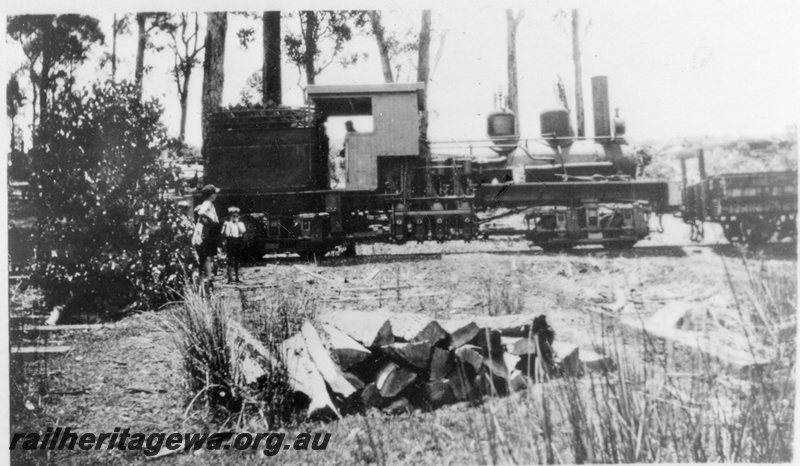
Rail Heritage WA1
Demographics
Region: South West
LGA: Donnybrook Ballingup
Industry: Forestry
Other Names: East Kirupp, East Kirup, East Kirup Timber Mill
Open Street Map: -33.615744485062656, 116.05593115304757
What3Words: ///traders.translates.hooch
Settled: ~1910
Gazetted: N/A
Abandoned: ~1945 (milling operations recommenced in 1950)
History
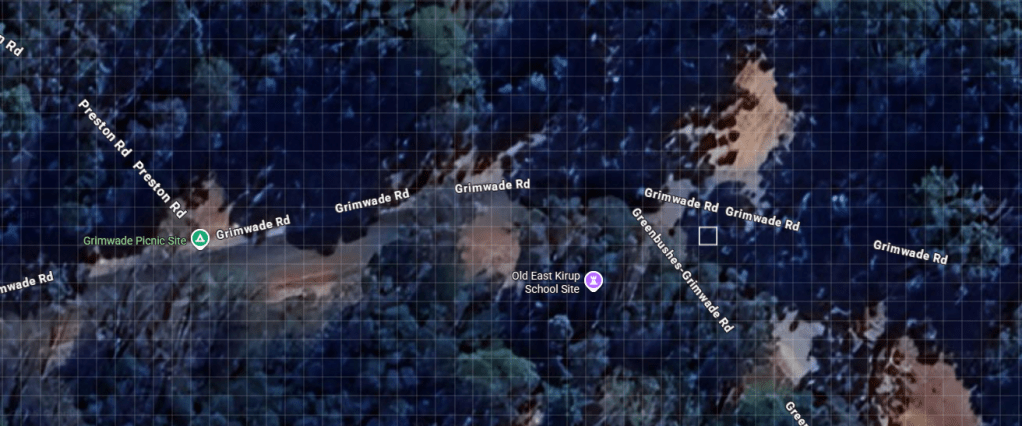
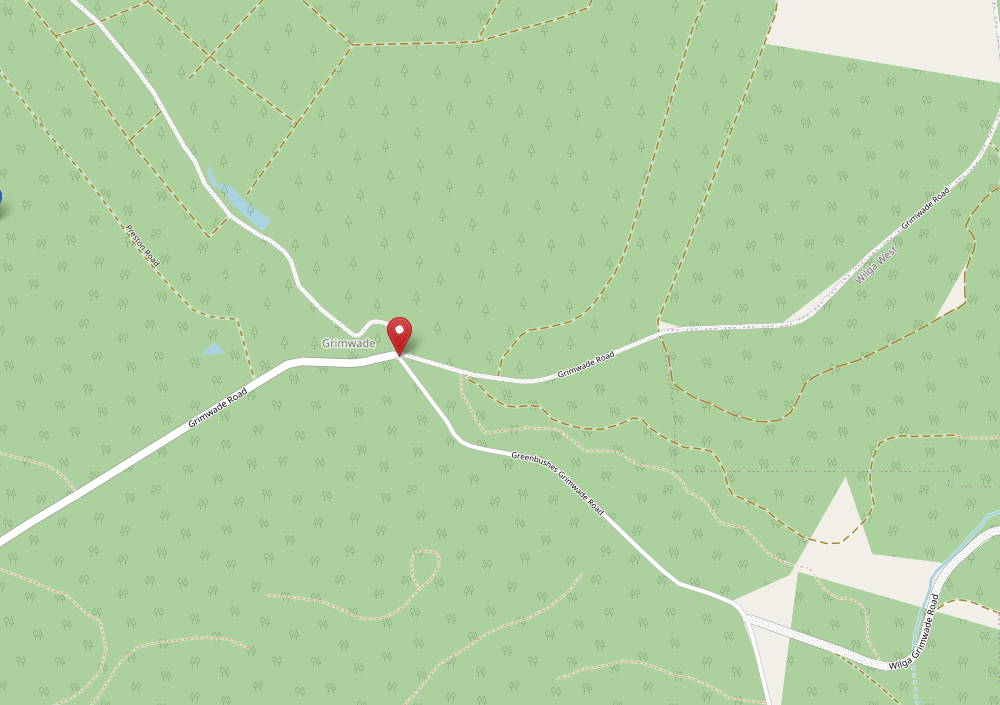
Grimwade, a heavily forested locality in Western Australia’s Shire of Donnybrook–Balingup, offers a quiet retreat for visitors today. Its tranquil bush landscape belies a rich industrial past, tracing its origins back to the early 20th century as the bustling timber settlement of East Kirup. The locality is situated on the traditional land of the Wardandi people of the Noongar nation and is midway between Balingup and Noggerup; the road is sealed on the Balingup side, but is good gravel to Noggerup, through picturesque bush of the Preston National Park. Originally a mill settlement, only the streets and some foundation remnants remain. It is about 14kms NE of the town of Kirup.2, 3, 4
Origins and Development: East Kirup (1910–1929)
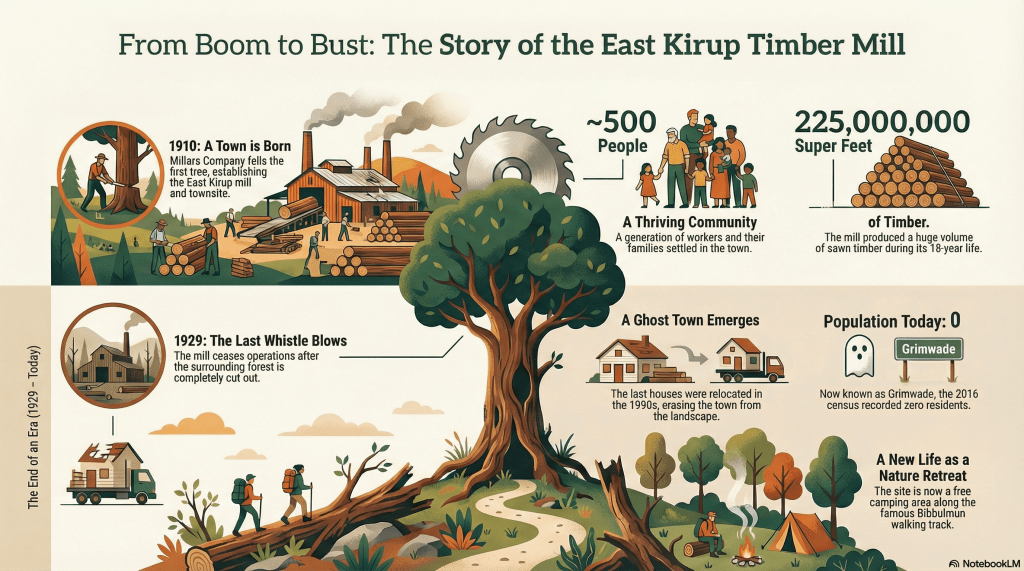
The settlement’s history began in the autumn of 1910 when Millars’ Company felled the first tree to create the large clearing necessary for the mill and townsite. Located thirteen miles east of the Kirup railway station, the area was initially spelled East Kirupp, later becoming East Kirup. The timber mill was built in 1910 by Millars using material from the Waterous Timber Mill. The rail line to the mill followed the old rail formations of the W.A. Jarrah Saw Mills. The mill came into production in September 1910. It was closed from 1915 to 1919, then stayed in production until 1938. The rails to East Kirup were removed in about 1945. 5
The community formed around the very large hardwood sawmill owned by Millars Karri and Jarrah Company Ltd. This area was surrounded by splendid forest, calculated to accommodate the mill with train loads of magnificent logs for many years.6
A Thriving Mill Town
Profiting by prior experience, the designers built a mill that left little room for criticism. It was constructed to produce about 42,000 super feet of timber per day. In its early days, when large, easily accessible trees were abundant, the mill often achieved this limit.
Over its eighteen years of operation (starting around 1911), the mill produced a stupendous total of 225,000,000 super feet of sawn products, including sleepers, waggon and building scantlings, flooring boards, and joinery dimensions. The industry also provided remunerative work for big gangs of sleeper-cutters, making that neighborhood one of the state’s main centers for sleeper production.
During its operational peak, East Kirup supported a community of four or five hundred residents. The total wages paid to the workers during the life of the mill amounted to over £900,000. The settlement enjoyed a pleasant location among great forested hills and a climate considered splendid and bracing.7
The Closure of the Mill
The end of the large-scale timber operations came due to resource depletion. The bush around East Kirup had been “cut out” of sufficient timber to keep a major mill operational.
The long-expected order to cease operations was issued, and the mill’s whistle blew “for the last time” on a Saturday in October 1929. Although the main activities were at an end, a big stack of timber remained, and some employees were kept working for a period. The closure meant East Kirup was added to the “long list of bush mills that have ceased to operate”. The closure caused regret, as a generation of children “born and bred” in the healthy, cooler districts of the south-west were subsequently scattered.8
Following the major closure, hopes were expressed for a revival of the timber trade, though the local newspaper noted that in the “age of steel and concrete,” a significant revival seemed unlikely.
The Grimwade Era
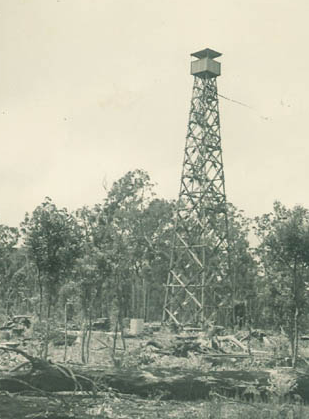
The East Kirup fire lookout tower 9 was in use from 1935 until 1980. It was described in a 1935 newspaper article as the “Novel Tower at Kirup”.10 In 1980, the tower was demolished using explosives and only the original concrete supporting blocks were still visible in 2019.
The Forests Department eventually took over the East Kirup Mill and the area was officially
The locality that was originally known as East Kirupp, then East Kirup was finally,renamed Grimwade around 1949. The renaming was done to recognize the services to forestry provided by Sir Russell Grimwade.
The site was adapted, with the Grimwade Mill being taken over for pine timber production. In 1950, small-scale milling operations recommenced at East Kirup, involving six employees, who were described by the local newspaper as “New Australians” settling into new houses constructed at the mill. However, the Forestry Department’s expanded pine planting programs later faced criticism from some who blamed them for the decline of agriculture and the associated decline of activity in the nearby township of Balingup.
Present day Grimwade
The physical evidence of the historical settlement eventually vanished. The last houses from the Grimwade locality were relocated to Kirup around 1990. In 2024 on a visit to Bridgetown, the author drove along Grimwade Road to try to locate the site. These photos are all that came of the visit:
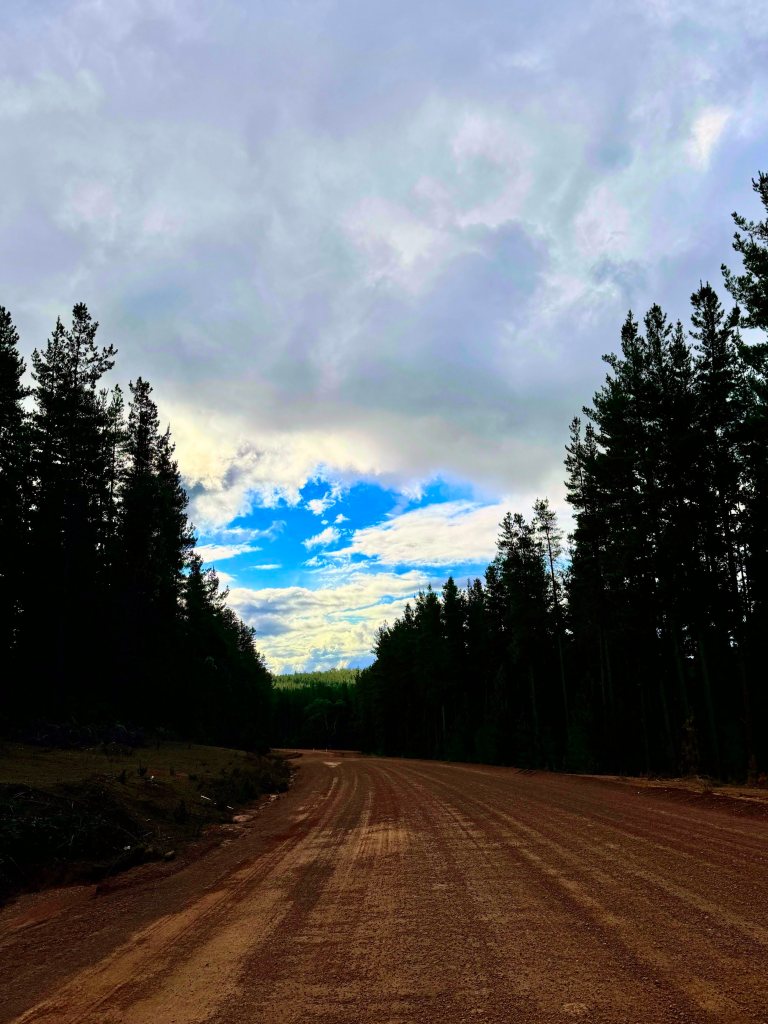
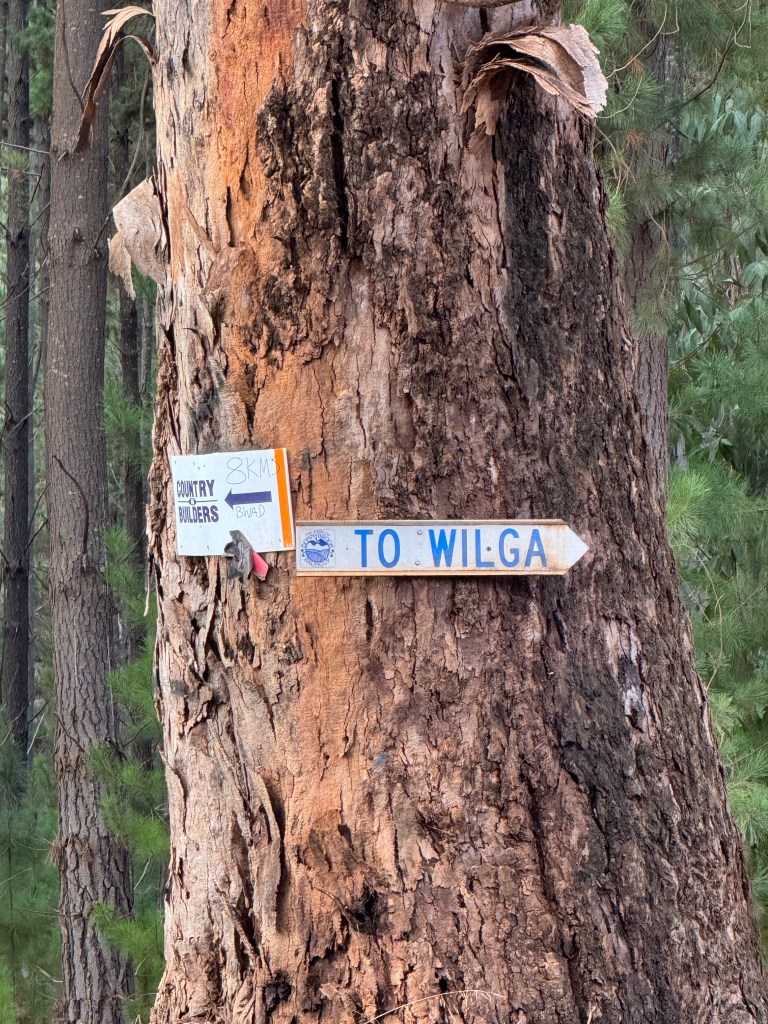
No evidence of the former mill or the dwellings the mill workers lived in now exists, with the last houses having been relocated to Kirup in the 1990s. During the operational period of the mill, East Kirup had a population of almost 500 people.
Today, there is little physical evidence that the timber mill or the dwellings ever existed. The remaining relics include open spaces where buildings once stood, some bitumised roads, concrete foundations, and paths. Grimwade is now a rural locality in the Shire of Donnybrook–Balingup. It functions as a popular free bush camping area, lacking facilities, where visitors can find only a few fruit trees that blossom in spring and two dams remaining of the former town.11
The location also provides access to the renowned Bibbulmun Track.
Timeline
- Autumn 1910: Millars’ Company felled the first tree to clear the site for the mill and townsite, 13 miles east of Kirup railway station.
- 1910: East Kirup (initially East Kirupp) large hardwood sawmill established by Millars Karri and Jarrah Company Ltd. The mill was calculated to produce 42,000 super feet of timber daily.
- During WW1: The mill operation experienced a period of inactivity.
- October 1929: The major mill ceased operations permanently, having cut out the necessary timber supply. During its lifespan, the mill produced 225,000,000 super feet of sawn timber.
- 1935: A novel fire tower was constructed at East Kirup.
- 1946: Maureen McCune, the only girl “towerman” employed by the Forests Department in Western Australia, worked as the fire watcher at the East Kirup tower.
- Around 1949: The Forests Department took control, and the area was renamed Grimwade to recognize Sir Russell Grimwade’s services to forestry.12
- 1950: Small-scale milling operations recommenced, with new houses built and six employees settling, described as “New Australians”.
- Around 1990: Records indicate the final houses from the settlement were relocated to Kirup.
- Present Day: Grimwade exists as a heavily forested locality, used primarily for camping, with few relics remaining aside from some concrete foundations, old roads, and two dams
Stories
- The Picturesque Manager
For many years, East Kirup mill was managed by James Kelly, who was described as one of the most picturesque men ever involved with sawmilling in the West. He was sometimes nicknamed “The Mug,” but this moniker was ill-fitting, as he was a very wide-awake man with an incisive tongue, possessing strong powers of organization and management. His big figure and “rousing, cheery voice” were well known to travelers on the route between Perth and Kirup for many years. He had a characteristic “way wid ‘im” rooted in his race, and the author suggests one can never think of Kirup without thinking of James Kelly. - Sawmilling Waste
Despite the massive output of timber, the sawmilling process generated enormous, unavoidable waste. The percentage of merchantable timber recovered from the log often amounted to less than half, and frequently little better than one-third. Although no sawmiller—having paid the faller and incurred high hauling costs—would send a usable stick of slab to waste, the leftover material fed a constant stream of rejections to the fireheap, which was dramatically described as a “moloch of a sawmill”. - The Girl Towerman
In 1946, a young woman named Maureen McCune gained distinction as the only girl “towerman” employed by the Forests Department in Western Australia, fulfilling the crucial role of fire watcher at the East Kirup tower.13
Map
Sources
- Rail Heritage WA, n.d. Rail Heritage WA Archive Photo Gallery. Black and white photograph retrieved 23 Nov 2025 from https://www.railheritagewa.org.au/archive_scans/displayimage.php?album=88&pid=16655#top_display_media ↩︎
- Wikipedia, 2025. Grimwade, Western Australia. Retrieved 26 Nov 2025 from https://en.wikipedia.org/wiki/Grimwade,_Western_Australia ↩︎
- Wiki Australia, n.d. Guide to Grimwade. Retrieved 26 Nov 2025 from https://wikiaustralia.com/destination/grimwade/ ↩︎
- WA Now and Then, n.d. Grimwade. Retrieved 26 Nov 2025 from https://www.wanowandthen.com/Grimwade.html ↩︎
- Morawa District Historical Society, n.d. Ghost Towns of Western Australia. Retrieved on 23 Nov 2025 from https://morawamuseum.org.au/ghosttowns/E.pdf ↩︎
- THE END OF THE MILL. (1929, November 23). The West Australian (Perth, WA : 1879 – 1954), p. 5. Retrieved 26 Nov 2025, from http://nla.gov.au/nla.news-article32332383 ↩︎
- THE END OF THE MILL, 1929. (Refers to productivity and outputs from the mill.) ↩︎
- EAST KIRUP MILL (1929, October 4). The Blackwood Times (Greenbushes, WA : 1905 – 1955), p. 1. Retrieved November 26, 2025, from http://nla.gov.au/nla.news-article266743341 ↩︎
- Fire Lookouts Down Under, n.d. East Kirup. Retrieved on 23 Nov 2025 from https://www.firelookoutsdownunder.com/Western%20Australia/eastkirup.html ↩︎
- TIMBER CONSTRUCTION (1935, November 26). The West Australian (Perth, WA : 1879 – 1954), p. 8. Retrieved November 23, 2025, from http://nla.gov.au/nla.news-article32978374 ↩︎
- Better Pets and Gardens, n.d. Grimwade, Balingup. Retrieved 26 Nov 2025 from https://www.betterpetsandgardens.com.au/grimwade-balingup/ ↩︎
- Wikipedia, 2025. Russell Grimwade. Retrieved 26 Nov 2025 from https://en.wikipedia.org/wiki/Russell_Grimwade ↩︎
- WA Now and Then, Grimwade. (Refers to Maureen McCune) ↩︎
 People of Western Australia's Ghost Towns