
Attribution
Demographics
Region: Goldfields-Esperance
LGA: Kalgoorlie Boulder
Industry: Gold mining
Other Names: White Feather, Cement Workings
Coordinates: -30.60667,121.60329
What3Words: ///relit.flops.albino
Settled: 1893
Gazetted: 1895
Abandoned: 1953
Abstract
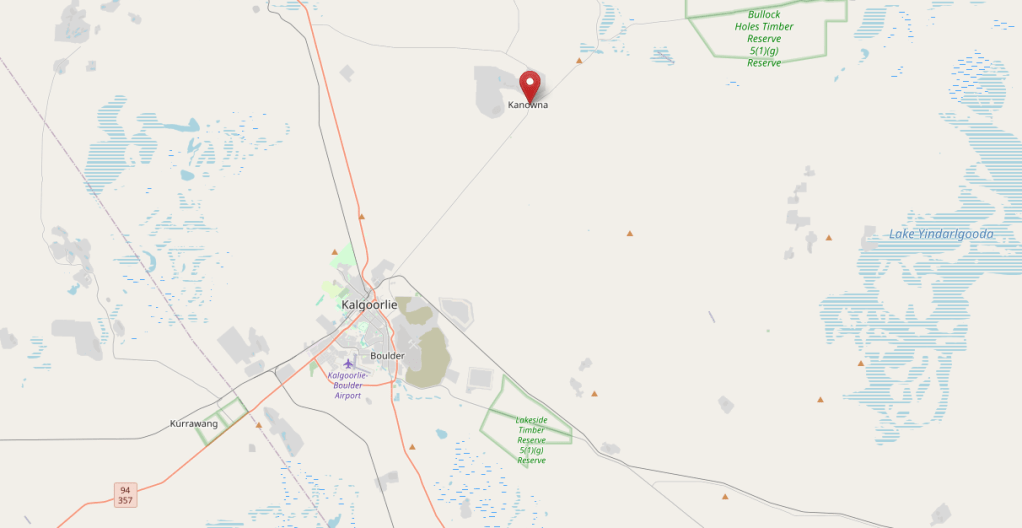
Located 20 kilometers northeast of Kalgoorlie, Kanowna stands today as one of Western Australia’s most poignant ghost towns. This profile explores the town’s trajectory from Jerry McAuliffe’s initial 1893 gold discovery to its rapid expansion into a regional hub boasting sixteen hotels and two breweries by 1900. The narrative examines how economic reliance on “deep lead” gold deposits and environmental challenges like water scarcity dictated the town’s development. Key social milestones, including the infamous “Sacred Nugget” hoax of 1898 and the town’s legendary footballing prowess, provide a window into the feverish atmosphere of the era. Finally, the profile analyzes the social and economic factors—namely the depletion of surface gold and the impact of the Great Depression—that led to the town’s abandonment by 1953 and its eventual physical dismantling, followed by a modern industrial rebirth via the Kanowna Belle mine.
History
In the arid scrubland 20 kilometers northeast of Kalgoorlie lies a landscape of red dust and silence that once roared with the machinery of progress and the voices of thousands. This is Kanowna, a town whose history serves as a definitive case study of the “boom and bust” cycles that defined the Western Australian goldfields. Today, it is promoted as a ghost town, though visitors often find only a railway platform, two cemeteries, and the weathered signs of a vanished civilization. Yet, at its zenith, Kanowna was a bustling municipality that challenged the prominence of its neighbors, driven by an almost pathological “gold fever” that saw its inhabitants quite literally digging up the dead in search of fortune.1 2
Discovery and the “White Feather”
The story of Kanowna began in 1893, shortly after the foundational finds in Coolgardie and Kalgoorlie. The area was initially known by the evocative name “White Feather”. Local lore suggests this name originated from a dispute between prospectors; when one party retreated from a contested claim, the victors supposedly left a white feather to mock their “cowardice”. Another theory suggests the name “Kanowna” is a corruption of an Aboriginal term meaning “place of no sheep,” a nod to the unforgiving, rocky terrain that characterized the region.3
The true catalyst for the town’s birth was Jerry McAuliffe, who unearthed a significant gold nugget in late 1893. This discovery triggered a rush of miners who had been prospecting nearby at Mt. Youle and Coolgardie. The townsite was officially gazetted in 1894, and by 1897, the population had reached 2,500. This was merely the beginning of a meteoric ascent.4

An old prospector dollying (crushing) his gold bearing ore beside his iron and brushwood dwelling, afew miles from Kanowna. Although he is more than 80 years of age the old man lives alone, his nearest neighbour about six miles away. Once or twice a week he cycles to Kanowna for stores.5
A Gilded Metropolis: Growth and Social Vibrance
Between 1897 and 1899, Kanowna’s population exploded from 2,500 to over 12,500 people. By 1900, the town had become a sophisticated urban center with sixteen hotels, two breweries, a hospital, a post office, and a dedicated railway terminus connecting it to Kalgoorlie.6
The social fabric of Kanowna was tightly knit and fiercely competitive. The town was famous as the home of the champion football team of the goldfields. Tom Doyle, the mayor of Kanowna, was so determined to maintain this prestige that he personally funded the recruitment of twenty of the best players from Victoria and South Australia—including stars like Teddy Rowell of Collingwood—to bolster the local side. On Saturday nights, the town was so crowded that “it was difficult to find standing room” at the railway station as people traveled between Kanowna, Boulder, and Kalgoorlie for entertainment.7
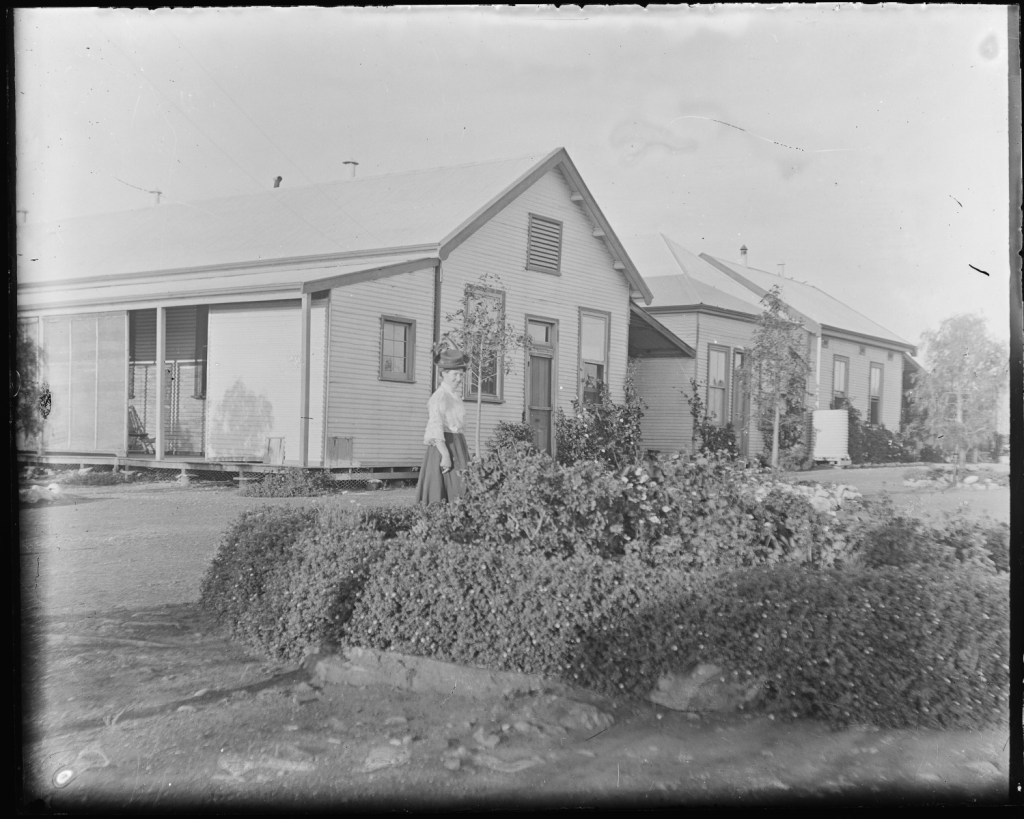
SLWA8
The Economic Engine
Kanowna’s economic prosperity was rooted in its unique geology. While many fields relied on surface alluvial gold or vertical quartz reefs, Kanowna was famous for its “deep leads”. These were gold-bearing gravels found in ancient, buried riverbeds (palaeochannels) up to 30 meters underground. These leads, such as the North Lead and the Fitzroy Lead, were often cemented by kaolin and silica, requiring more intensive mining efforts than simple dry-blowing.
The yield was staggering. Between 1893 and 1907, the Kanowna field produced approximately 152,000 ounces of gold. Half of this wealth came from quartz veins adjacent to the town, while the other half was extracted from the deep shoots to the north and west. This wealth sustained an economy that supported newsagencies, bakeries, and even specialized schools.9 10
Environmental Desperation
Life in Kanowna was a constant battle against the environment. Water was the most precious commodity; early prospectors like Paddy Hannan and Dan Shea recalled that “the water difficulty” was only solved by heavy, welcome rains in 1893 that filled local claypans and lakes.11
By 1900, however, the hunger for gold began to override social and environmental boundaries. In a famous incident that highlighted the intensity of “gold fever,” a gravedigger struck gold while preparing a plot in the local cemetery. This discovery led to the issuance of “cemetery leases,” where most of the cemetery’s occupants had to be exhumed and moved to make way for gold-seekers. Today, the “lonely grove” of the remaining graves stands as a testament to this era of desperation.12
The Great Hoax
Perhaps the most colorful chapter in Kanowna’s history is the “Sacred Nugget” mystery of 1898. In July of that year, a rumor circulated that a massive, sickle-shaped nugget valued at £6,500 had been found. A young priest, Father Long, claimed to have seen the gold and was eventually pressured by a crowd of 7,000 miners to reveal its location from the balcony of Donnellan’s Hotel. If you want to know the full story of the Sacred Nugget, read our blog post – The Sacred Nugget.13 14

SLWA15
Decline and Abandonment
The decline of Kanowna was as steady as its rise had been swift. By 1914, the “easily won” surface gold and the richest parts of the deep leads were exhausted. As mining became less profitable, the population began to drift toward the more sustainable “Golden Mile” in Kalgoorlie. Economic hardship during the Great Depression dealt a final blow, leading to the closure of the railway station.16
Mining ceased almost entirely by 1946. The last hotel, kept by Dan Adamson, closed its doors in 1952, and the town was officially abandoned by 1953. In 1959, the remaining structures—mostly corrugated tin and hessian—were dismantled for materials, leaving only the concrete foundations and the railway platform.17
Kanowna Today
While the original townsite remains a ghost town, Kanowna’s economic story did not end in 1959. In the late 1970s, rising gold prices and advanced geological surveying led to the discovery of a massive gold deposit that had remained hidden because its veins did not reach the surface. This led to the opening of the Kanowna Belle mine in 1986. By 2002, this modern operation employed over 300 people, proving that while the town of Kanowna had died, the “golden country” Jerry McAuliffe first identified still held secrets beneath its sands.18
Timeline
- 1893: Jerry McAuliffe discovers a gold nugget; the area is initially named “White Feather”.
- 1894: The townsite of Kanowna is officially gazetted.
- 1897: The population reaches 2,500; the mining boom accelerates.
- 1898 (July-August): The “Sacred Nugget” hoax; Father Long addresses a crowd of 7,000 from a hotel balcony, sparking a fruitless rush.
- 1899: Kanowna reaches its peak population of over 12,500 people.
- 1900: Gold is struck in the town cemetery, leading to “cemetery leases” and the relocation of graves.
- 1893–1907: The field produces its most significant historical output of 152,000 oz of gold.
- 1914: Exhaustion of easily accessible surface gold leads to a rapid population decline.
- 1930s: The railway station and terminus are closed during the Great Depression.
- 1946: Small-scale mining and lone prospecting officially cease.
- 1952: The last hotel in the town closes its doors.
- 1953: The town is officially considered abandoned.
- 1959: Remaining town buildings are dismantled.
- 1986: Mining recommences with the opening of the Kanowna Belle mine following new geological discoveries.
Map
Sources
- mindat.org, n.d. Kanowna Goldfield, Kalgoorlie-Boulder Shire, Western Australia, Australia. Retrieved 2 Jan 2026 from https://www.mindat.org/loc-12564.html ↩︎
- Wikipedia, 2022. Kanowna, Western Australia. Retrieved 2 Jan 2026 from https://en.wikipedia.org/wiki/Kanowna,_Western_Australia ↩︎
- Past glory of Kanowna (1951, February 1). Western Mail (Perth, WA : 1885 – 1954), p. 15. Retrieved January 2, 2026, from http://nla.gov.au/nla.news-article39110396 ↩︎
- Hannan and Shea tell of their great discovery. KALGOORLIE FIELD (1950, September 14). Western Mail (Perth, WA : 1885 – 1954), p. 26 (COUNTRYMAN’S MAGAZINE). Retrieved January 2, 2026, from http://nla.gov.au/nla.news-article39104953 ↩︎
- Prospector Sits to Dolly His Gold (1951, December 13). Western Mail (Perth, WA : 1885 – 1954), p. 16 (WESTERN MAIL ANNUAL). Retrieved January 2, 2026, from http://nla.gov.au/nla.news-article52182578 ↩︎
- Western Mail, 1951: refers to White Feather and the early development ↩︎
- Those were the days When We Were Minors (1950, September 14). Western Mail (Perth, WA : 1885 – 1954), p. 30 (COUNTRYMAN’S MAGAZINE). Retrieved January 2, 2026, from http://nla.gov.au/nla.news-article39104968 ↩︎
- State Library of Western Australia, n.d. Kanowna and Kalgoorlie Hospitals: John Joseph Holland collection of photographs. Retrieved 2 Jan 2026 from https://encore.slwa.wa.gov.au/iii/encore/record/C__Rb2558168 ↩︎
- Western Mail, 1950: refers to economic growth of the town ↩︎
- mindat.org: refers to mining at Kanowna ↩︎
- Western Mail, 1950: refers to water shortages ↩︎
- A BUSH TIGER (1951, January 4). Western Mail (Perth, WA : 1885 – 1954), p. 15. Retrieved January 2, 2026, from http://nla.gov.au/nla.news-article39109565 ↩︎
- Some facts about HISTORIC NUGGETS (1950, September 14). Western Mail (Perth, WA : 1885 – 1954), p. 36 (COUNTRYMAN’S MAGAZINE). Retrieved January 2, 2026, from http://nla.gov.au/nla.news-article39104972 ↩︎
- OUR STRANGE PAST (1953, November 19). Western Mail (Perth, WA : 1885 – 1954), p. 10. Retrieved January 2, 2026, from http://nla.gov.au/nla.news-article39358444 ↩︎
- State Library of Western Australia, n.d. Sacred Nugget Fraud Photographs. Retrieved 2 Jan 2026 from https://encore.slwa.wa.gov.au/iii/encore/record/C__Rb2240584 ↩︎
- mindat.org: refers to exhausted gold ↩︎
- Wikipedia, 2022: refers to closure of railway, impact of the Great Depression ↩︎
- ibid: refers to the Kanowna Belle mine ↩︎
 People of Western Australia's Ghost Towns