Christine Harris (2026)
Demographics
Region: Goldfields-Esperance
LGA: Leonora
Industry: Mining
Other Names: Kathleen Valley
Open Street Map: -27.272057640942453, 120.57863013094939
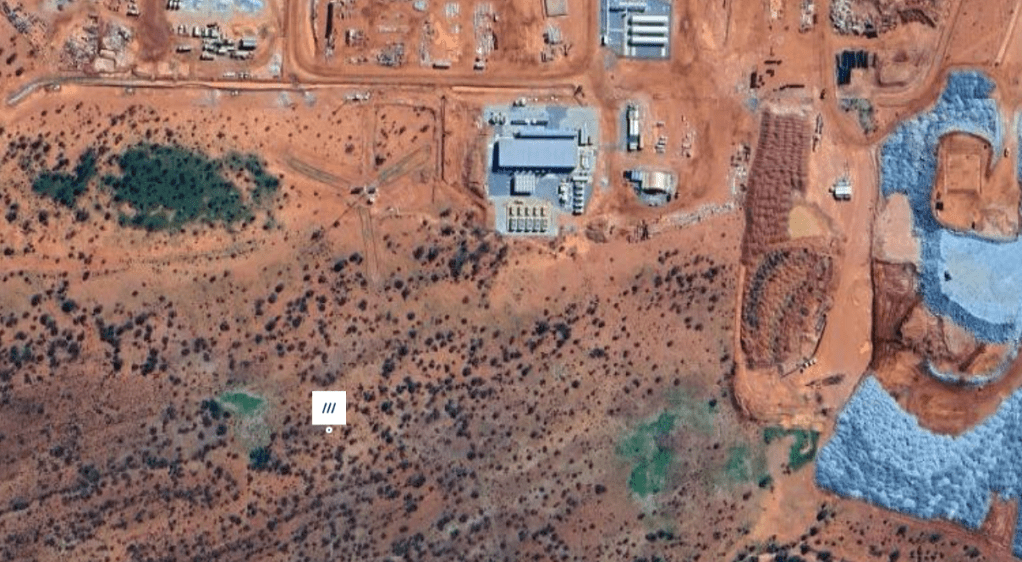
What3Words: ///kilts.heats.tanking
Settled: 1897
Gazetted: 1900
Abandoned:
Abstract
Kathleen Valley, situated in the North-eastern Goldfields of Western Australia, serves as a significant example of the state’s volatile resource-driven history. Discovered during the gold rushes of the late 19th century, the town supported a vibrant community of miners and pastoralists before declining into a ghost town due to economic and environmental pressures. The 21st-century global transition to clean energy has catalysed a dramatic political and economic shift for the region. The discovery of globally significant lithium deposits led to the establishment of Australia’s first major underground lithium mine by Liontown Resources.
A defining feature of this modern era is the prioritisation of social and cultural factors over traditional mining methods. Following the national impact of the Juukan Gorge disaster, the Kathleen Valley lithium project underwent a rigorous redesign process. In consultation with the Tjiwarl Traditional Owners, the mine transitioned to predominantly underground operations to protect the sacred Jones Creek (Ngurluwuriwuri). This modern chapter is further distinguished by a landmark Native Title Agreement and the integration of high-tech renewable energy, ensuring that the legacy of Kathleen Valley evolves from manual gold extraction to sophisticated, heritage-conscious mineral production.
History
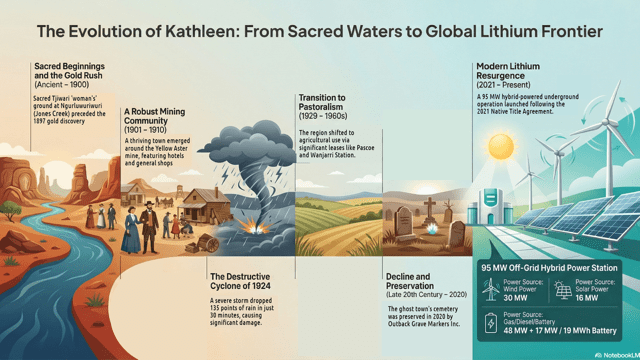
Kathleen Valley is a region defined by its Archaean geology and a narrative of extreme economic cycles. Located approximately 60 kilometres north of Leinster, it has transitioned from a feverish gold camp to an abandoned townsite, and finally to a site of global strategic importance in the green energy sector.1 2 3
Discovery and the Turn of the Century (1897–1910)
Gold was first unearthed in the area in 1897. Locals initially dubbed the camp “Kathleen Valley” because the original gold finds were situated within a physical valley. The name was a tribute to Kathleen Colreavy, the wife of Leo Colreavy, a well-known Yilgarn pioneer. When the townsite was officially gazetted in 1900, the Department of Lands and Surveys dropped the “Valley” suffix, though the full name remained common in the district.4 5
At its zenith, the community was a robust frontier outpost. By 1901, the town supported a general shop and a butcher, and by 1902, two hotels served as the social heart of the population. One prominent resident was Edward Coffey, who operated a hotel on Powell Street from 1902 until 1906. Social life was typical of the Goldfields, defined by a sense of community rivalry and spirit. In May 1903, a high-stakes football match between teams from Kathleen Valley and nearby Mt Sir Samuel drew a significant crowd to watch Kathleen win by a narrow margin of two points.6 7 8
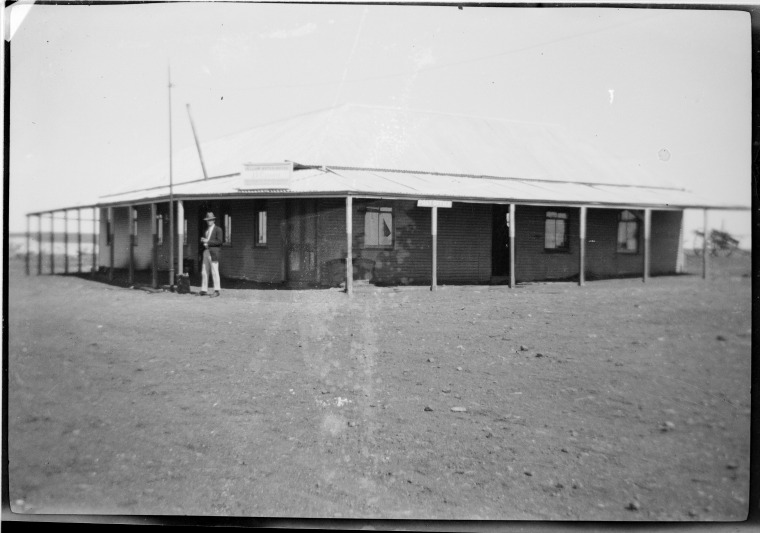
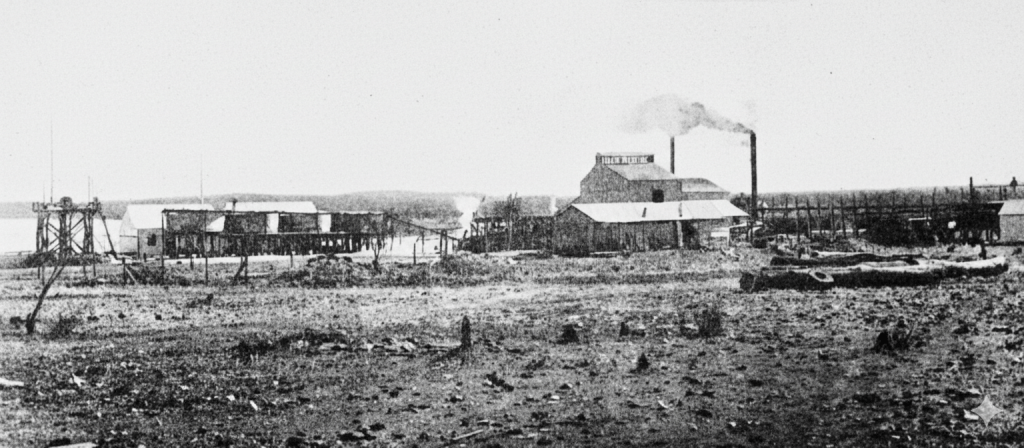
The economic foundation of the town was the Yellow Aster mine, which was considered one of the richest finds in the fields during its early development. Mining statistics from May 1904 confirm that Kathleen Valley was a steady contributor to the East Murchison Goldfield’s output. However, life was fraught with environmental and physical danger. The Kathleen Valley Cemetery contains the remains of pioneers like Philip Curran, killed by a fall of stone in 1903, and John Leech, who succumbed to enteric fever in 1905.10 11 12
Decline and the Pastoral Era (1910–1950)
As gold yields diminished, the community faced mounting economic and environmental challenges. By the 1920s, the focus shifted toward pastoralism. J.J. Currie, the owner of the Yellow Aster mine, controlled a vast belt of leasehold country that he transitioned from cattle grazing to sheep farming. Copper also provided a brief secondary industry; the Kathleen Valley Copper Company was formed in 1909 to work four leases in the district.14 15
The remote desert climate tested the resilience of the few remaining residents. In February 1924, a severe cyclone struck the valley, dropping 34 millimetres of rain in just thirty minutes and causing widespread damage. By 1946, the district was described as “quiet,” with prospectors hampered by the fact that the old State mill at Mt Sir Samuel was beyond reconditioning. Consequently, the town gradually met the criteria for a “ghost town”—a site no longer inhabited where businesses had long ceased to operate. For several decades, the area’s history was preserved only through pastoral brands like Pascoe and Wanjarri Station.16 17 18 19 20 21
Modern Resurgence: Lithium and the Protection of Heritage
The 21st-century demand for battery minerals has transformed Kathleen Valley into a strategic asset for Western Australia. Liontown Resources’ Kathleen Valley Lithium Operation is a globally significant project with a resource estimate of 150 million tonnes. However, the political and social climate of modern mining has fundamentally changed since the era of Edward Coffey.22 23
In a move that set a new benchmark for the industry, the project was specifically redesigned to protect Aboriginal cultural heritage. The original mine design featured a massive open pit that would have required the diversion of Jones Creek, known as Ngurluwuriwuri to the Tjiwarl Traditional Owners. Tjiwarl owner June Tullock noted that the creek is regarded as “woman’s ground” and was the birthplace of her father. To avoid a “cultural heritage disaster,” the mine plan was significantly altered to become a predominantly underground operation.24
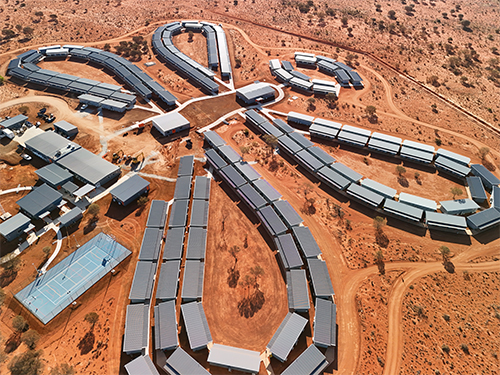
This redesign was formalised through a Native Title Agreement signed in 2021. While some Traditional Owners expressed sadness over any disturbance to the land, many welcomed the agreement as a framework for ongoing dialogue and economic opportunity. The move underground also offered operational advantages, including minimal waste removal and reduced contamination of the ore.26 27
Environmental Innovation and Future Outlook
The modern community at Kathleen Valley is defined by high-tech sustainability. The operation is supported by a 95 MW off-grid hybrid power station that incorporates 30 MW of wind power, 16 MW of solar power, and a massive battery system to reduce reliance on gas and diesel.28
Today, the project attracts skilled workers back to the red earth where pioneers once sought their fortunes. The AU$1.0 billion underground mining contract at Kathleen Valley is a major employer and a key contributor to the State’s economy, representing a full circle in the area’s history—from the manual extraction of gold to the high-tech, heritage-conscious production of minerals essential for the global transition to clean energy.29
Timeline
- • 1892: Explorer Lawrence Wells names the nearby Mount Sir Samuel.
- • 1897: Gold is discovered in a valley; locals begin using the name “Kathleen Valley”.
- • 1900: The townsite is officially gazetted as “Kathleen”.
- • 1901: A shop and butcher open to serve the burgeoning mining camp.
- • 1902: The town supports two hotels, including one run by publican Edward Coffey.
- • 1903: Kathleen Valley wins a high-profile football match against Mt Sir Samuel.
- • 1903–1905: Multiple deaths recorded at the Yellow Aster and Nil Desperandum mines due to accidents and fever.
- • 1909: The Kathleen Valley Copper Company N.L. is formed.
- • 1924: A severe cyclone causes flash flooding and significant damage.
- • 1929: J.J. Currie prepares the local leasehold country for sheep grazing.
- • 1946: Reports indicate the district is quiet as milling infrastructure fails.
- • 1962: Wanjarri Station recorded as a pastoral property in the valley.
- • 2020: Outback Grave Markers Inc placed plaques to preserve pioneer history at the local cemetery.
- • 2021: A landmark Native Title Agreement is signed between Liontown Resources and the Tjiwarl Traditional Owners.
- • 2023: Byrnecut commences the AU$1.0 billion underground mining contract.
- • 2024: Open pit mining begins as a precursor to underground production.
- • 2025: Official opening of the Kathleen Valley lithium project as Australia’s first major underground lithium mine.
Map
Sources
- Wikipedia (2025). Kathleen, Western Australia. Retrieved 25 Feb 2026 from https://en.wikipedia.org/wiki/Kathleen,_Western_Australia ↩︎
- Sharp, Moya (2024). Kathleen Valley – ghost town. Retrieved 25 Feb 2026 from https://en.wikipedia.org/wiki/Kathleen,_Western_Australia ↩︎
- Liontown (2026). Kathleen Valley. Retrieved 25 Feb 2026 from https://www.liontown.com/project/kathleen-valley/ ↩︎
- Sharp, Moya (n.d.) Kathleen Valley Western Australia. Retrieved 25 Feb 2026 from https://www.outbackfamilyhistory.com.au/records/record.php?record_id=1025 ↩︎
- Wikipedia: refers to naming of the town ↩︎
- ibid: refers to early business in the town ↩︎
- Carnamah Historical Society & Museum (n.d.) Biographical Dictionary of Coorow, Carnamah and Three Springs : “Mick” Clifford Felix COFFEY. Retrieved 25 Feb 2026 from https://www.carnamah.com.au/bio/clifford-felix-coffey ↩︎
- COUNTRY FOOTBALL. (1903, May 29). The Kalgoorlie Miner (WA : 1895 – 1954), p. 8. Retrieved February 25, 2026, from http://nla.gov.au/nla.news-article89036574 ↩︎
- State Library of Western Australia (n.d.) James McKern collection of photographs; BA1678/26. Retrieved 25 Feb 2026 from https://encore.slwa.wa.gov.au/iii/encore/record/C__Rb3787002 ↩︎
- Harper, Peter (2002). Rolled Out the Barrels. Retrieved 25 Feb 2026 from https://hibeach.net/kathleenv.html ↩︎
- Mines Dept. (1904) Western Australian Goldfields – Mining Statistics. Published in a Supplement to the Government Gazette of Friday, 22 July 1904) and retrieved 25 Feb 2026 from https://www.legislation.wa.gov.au/legislation/prod/gazettestore.nsf/FileURL/gg1904_042d.pdf/$FILE/Gg1904_042d.pdf?OpenElement ↩︎
- Sharp, Moya (n.d.) Kathleen Valley Cemetery – Reserve 10290. Retrieved 25 Feb 2026 from https://www.outbackfamilyhistory.com.au/records/record.php?record_id=1026 ↩︎
- No Title (1903, July 7). Kalgoorlie Western Argus (WA : 1896 – 1916), p. 20. Retrieved February 25, 2026, from http://nla.gov.au/nla.news-article32675141 ↩︎
- Harper: refers to deminished gold returns ↩︎
- FORTY YEARS AGO (1949, December 21). The Kalgoorlie Miner (WA : 1895 – 1954), p. 4. Retrieved February 25, 2026, from http://nla.gov.au/nla.news-article95651991 ↩︎
- mindat.org (n.d.) Kathleen Valley Lithium Project, Yakabindie Station, Leonora Shire, Western Australia. Retrieved 25 Feb 2026 from https://www.mindat.org/loc-249018.html ↩︎
- ibid: Kathleen Valley, Leonora, State of Western Australia, Australia. Retrieved 25 Feb 2026 from https://www.mindat.org/feature-2068643.html ↩︎
- ITEMS OF NEWS (1924, February 12). The Kalgoorlie Miner (WA : 1895 – 1954), p. 4. Retrieved February 25, 2026, from http://nla.gov.au/nla.news-article93745142 ↩︎
- Kathleen Valley District Quiet (1946, November 28). The Kalgoorlie Miner (WA : 1895 – 1954), p. 1. Retrieved February 25, 2026, from http://nla.gov.au/nla.news-article95552123 ↩︎
- Morawa District Historical Society (n.d.) The Ghost Towns and Wayside Inns of Western Australia. Retrieved 25 Feb 2026 from https://morawamuseum.org.au/ghosttowns-intro.html ↩︎
- Sharp, 2024: refers to Kathleen Valley as a Ghost Town ↩︎
- Michael, David (2025). Cook Government welcomes launch of landmark WA lithium project. Retrieved 25 Feb 2026 from https://www.wa.gov.au/government/media-statements/Cook%20Labor%20Government/Cook-Government-welcomes-launch-of-landmark-WA-lithium-project-20250710 ↩︎
- Goodwin, Sarah and Jaffair, Madina (2021). Goldfields lithium project shifted around cultural heritage sites but not all traditional owners happy. Retrieved 25 Feb 2026 from https://www.abc.net.au/news/2021-11-19/liontown-tjiwarl-mining-deal-with-traditional-owners/100635122 ↩︎
- ibid ↩︎
- Liontown (2023). Increasing Tjiwarl participation in our procurement value chain. Retrieved 25 Feb 2026 from https://www.liontown.com/latest-news/increasing-tjiwarl-participation-in-our-procurement-value-chain/ ↩︎
- Goodwin & Jaffair: refers to Native Title agreement ↩︎
- ibid: refers to move to underground mining ↩︎
- Wikipedia, 2025: refers to hybrid power ↩︎
- Byrnecut (n.d.) Kathleen Valley, Australia, WA. Retrieved 25 Feb 2026 from https://www.byrnecut.com/projects/oceania/australia/kathleen-valley/ ↩︎
- what3words.com (2026) Kathleen Valley. Retrieved 25 Feb 2026 from https://what3words.com/kilts.heats.tanking ↩︎
 People of Western Australia's Ghost Towns