Demographics
Region: Goldfields-Esperance
LGA: Kalgoorlie-Boulder
Industry: Gold Mining
Other Names: Mulgabbie, Maori Gold Mine
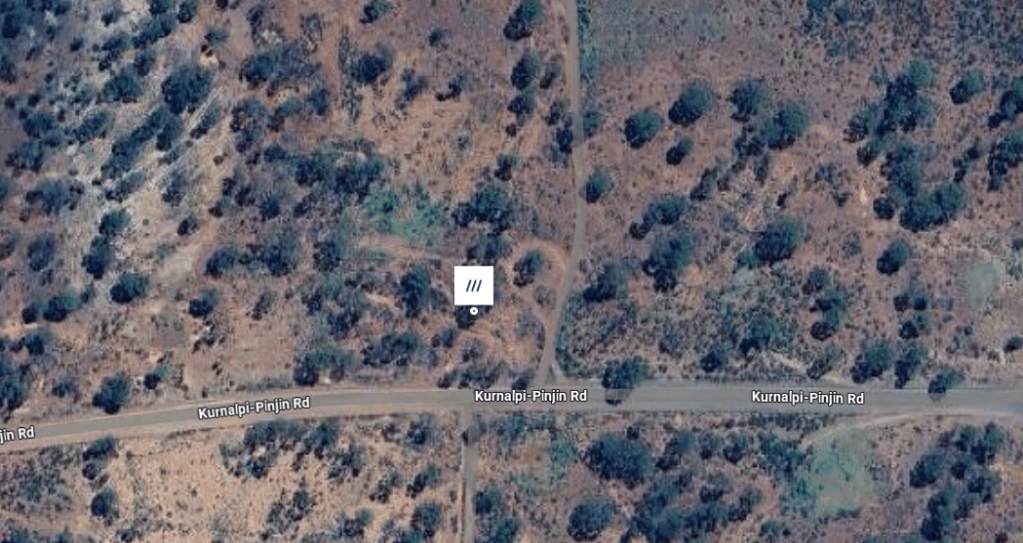
Lat/Long: -30.16178429923292, 122.29969330212198
What3Words: ///commissioner.hobbling.adders
Settled: 1894
Gazetted: 1895
Abandoned: 1910
Abstract
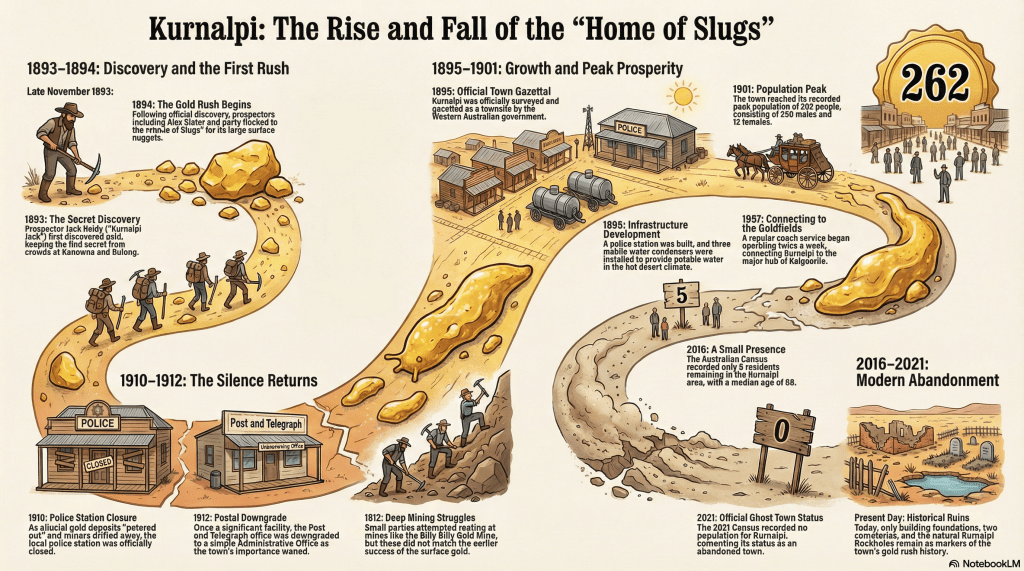
Kurnalpi, once famously known as the “home of slugs,” was a significant gold-mining town in Western Australia’s Eastern Goldfields. Discovered in late 1893 by the solitary prospector Jack Reidy, the area sparked an immediate rush due to its incredibly rich surface alluvial gold. At its peak in the late 1890s, the town supported a population of hundreds, complete with hotels, a police station, and essential water condensers. However, the community faced severe environmental challenges, primarily a desperate lack of potable water, which necessitated the use of expensive mobile condensers. As the easily accessible alluvial gold was exhausted and reef mining proved unremunerative due to high costs and lack of crushing facilities, the population dwindled rapidly. Today, Kurnalpi is an abandoned ghost town, serving as a silent monument to the resilience and ambition of the early gold-seekers.
History
Kurnalpi was like a flash flood in a dry creek bed: it arrived with sudden, overwhelming force, filling the landscape with life and activity, only to vanish just as quickly when the initial source—the surface gold—ran dry, leaving the terrain forever marked by its passage but once again silent.
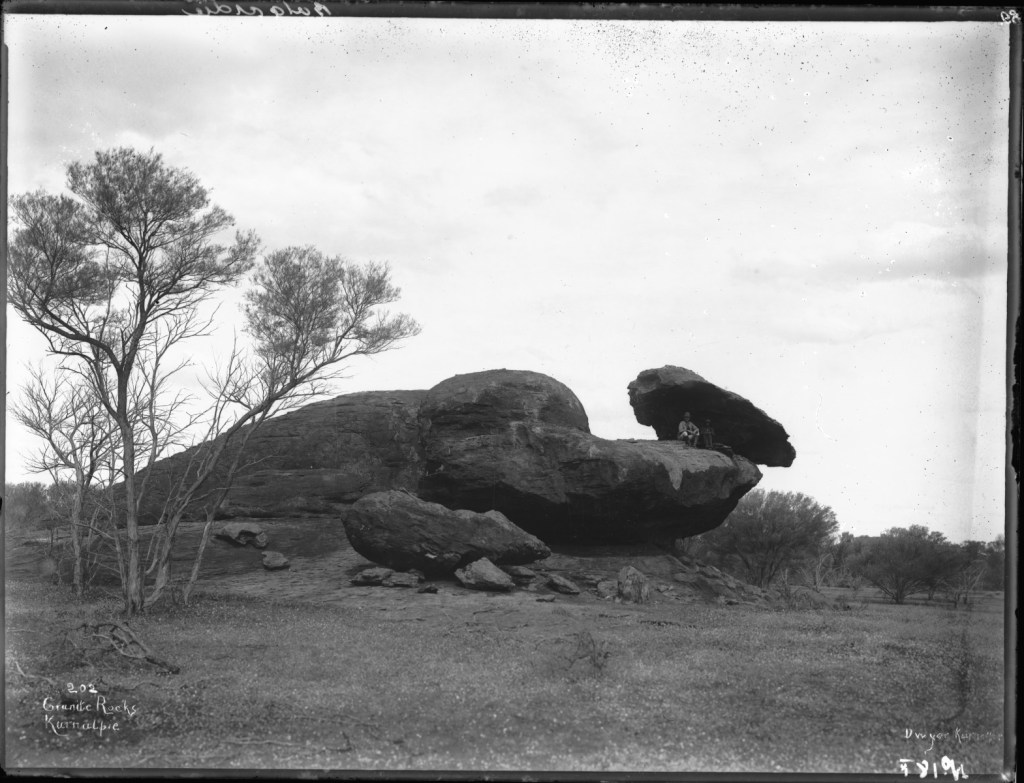
The story of Kurnalpi is one of the most evocative chapters in the history of the Western Australian gold rushes. Situated approximately 80 kilometers northeast of Kalgoorlie and 671 kilometers from Perth, this remote locality was once a bustling center of hope and fortune. Known to early prospectors as the “home of slugs,” Kurnalpi was celebrated not for its deep quartz reefs, but for the enormous, slug-shaped gold nuggets that lay scattered across its red-earth flats.1 2 3
SLWA4
Discovery and the Birth of a Legend
The town’s origins are tied to the legend of “Kurnalpi Jack” – a prospector named Jack Reidy. In late 1893, Reidy was prospecting alone, accompanied only by a faithful native friend. Near the head of Lake Lapage, Reidy “specked” (found on the surface) significant quantities of gold. The discovery might have remained a secret for much longer had it not been for a dispute; after Reidy thrashed his companion in a fit of temper, the native fled to a nearby pool where he encountered Mr. Anderson, the manager of the Hampton Plains Estate.5 6
Tempted by food and a drink from Anderson’s flask, the native revealed that Reidy was finding gold “all the same” as a small frying pan. This revelation sparked the Kurnalpi Rush. By December 1893, news reached the burgeoning camp at Coolgardie. Men of all descriptions – “horsemen” who could afford teams and “footmen” who “padded the hoof” carrying their gear – began a desperate race across the parched landscape. 7 8
Among the first to capitalize was Jack Ryan and his mate Jimmy Lydon, who followed tracks to a burnt patch of ground later known as Social Flat. In that single location, they specked nearly 300 ounces of gold. Reidy himself reportedly obtained 1,300 ounces of rough gold with the aid of his native friends before the mass of diggers arrived. 9
Establishment and Community Development
The town of Kurnalpi was surveyed in 1894 and gazetted in 1895. The name was derived from the Kurnalpi Rockholes, a natural feature that had long served as a vital water source for the local Aboriginal people (Maduwongga territory) and later for the prospectors.10 11
As the population grew, reaching an official peak of 262 by 1901, a small but functional township emerged. The Cable, Lardner, and Jones store provided essential hardware and supplies, while two hotels offered respite from the harsh desert conditions. A police station was established in 1896 to maintain order, and the arrival of a telegraph line in the same year connected the remote outpost to the wider world.
Life in Kurnalpi was defined by the economic dominance of alluvial gold. Unlike other fields where mining required deep shafts and heavy machinery, Kurnalpi was a “specker’s” paradise. Miners engaged in “lousing”—raking the surface with fingers or sticks—to uncover gold slugs hidden just beneath the soil. Major alluvial workings included Social Flat, Six Mile, and the area near the local cemetery.
Environmental and Social Challenges
The greatest threat to Kurnalpi’s survival was water. The region was intensely dry, and surface deposits were quickly exhausted. To sustain the community, several mobile water condensers were brought to the town between 1896 and 1898. These machines processed salty water from nearby lakes to create potable water, an expensive but necessary lifeline.
Socially, the town was a rugged environment dominated by men; of the 262 residents in 1901, 250 were male. However, families like the Cables and Lardners established roots, their stories of pioneering spirit becoming hallmarks of the district’s heritage. The town even experienced unusual natural phenomena, such as a rare snowfall in October 1900, a stark contrast to the usual blistering heat.
The Shift to Reef Mining
As the surface gold began to “peter out” around 1900, the community attempted to transition to reef mining. Geologically, the area was complex. Below the soil lay a tough layer of “cement” or hardpan that made locating lodes difficult. Billy Billy Hill, a prominent landmark formed by a quartz porphyry dyke, became a focus for deeper mining.
The Maori Reef and the Billy Billy lease showed promise, with some stone yielding 1 to 2 ounces per ton. However, these reefs often “cut out” at shallow depths or were too thin to remain profitable. The lack of local crushing facilities was a significant economic barrier; by 1899, the only local battery – a small “five-head affair” at the Success mine – had fallen silent. Without cheap milling and a reliable water supply for deep sinking, even promising properties like the Scottish Lass were forced to close.
Decline and the Ghost Town Era
The decline of Kurnalpi was as swift as its rise. By 1899, a correspondent noted that the district had little to recommend it to the public, as the alluvial gold had been exhausted. People began drifting away to more prosperous finds. The police station closed its doors in 1910, and postal services were drastically reduced in 1912.
By the early 20th century, the once-bustling streets were returning to the scrub. While the 1912 report by geologist J.T. Jutson spoke of “rich contact finds” and potential lode formations, he admitted that prospecting at Kurnalpi was largely “blind stabbing” due to the thick covering of laterite and cement.
Throughout the latter half of the 20th century, modern exploration companies like Amax and Carrick Gold revisited the area, using bulldozers to scrape the surface where pioneers once used their hands. These modern efforts focused on base metals like nickel rather than the elusive gold slugs of old.
Legacy
Today, Kurnalpi is a true ghost town. The 2016 census recorded just five residents, and by 2021, the population had dropped to zero. All that remains are weathered ruins, old cemetery headstones, and the expansive red earth that once hid a fortune. Visitors today find only silence and the “rugged natural beauty” of the outback.
Kurnalpi remains a symbol of the precarious nature of the goldfields. It was a town built on a finite treasure, thriving only as long as the earth gave up its “slugs.” When the gold vanished, so did the people, leaving behind a landscape of “diggings, piles of dirt, and the old cemetery” to tell the story of the thousands who once called it home.
Timeline
Pre-1893: Aboriginal knowledge of gold in the area; surveyor Charlie Crossland informed of gold at “Kurnalpi”.
Late November 1893: Jack Reidy (Kurnalpi Jack) discovers gold at Kurnalpi while prospecting with a native companion.
December 1893: News of the find reaches Coolgardie; the rush begins as horsemen and “footmen” head east.
1894: Townsite surveyed; the Post Office is established in December.
1895: Kurnalpi is officially gazetted as a townsite.
1896: Police station is built; the post office is upgraded to a Post and Telegraph Office.
1897: Regular coach service to Kalgoorlie begins twice weekly.
1896–1898: Six mobile water condensers are established to address the critical water shortage.
1899: Mining begins to decline; only 30 residents remain as alluvial gold is exhausted.
October 1900: A rare weather event occurs with snow falling at the goldfield.
1901: The peak recorded population reachs 262 people.
1910: The Kurnalpi police station is officially closed.
1912: J.T. Jutson conducts a detailed geological survey of the field; postal services are downgraded to an Administrative Office.
1970s: Resurgence of interest as exploration companies (Amax, Esso) conduct surveys.
2016: Australian Census records a population of only five people.
2021: Kurnalpi is effectively abandoned, with a population recorded as zero or extremely low.
Map
Sources
- Wikipedia, 2011. Kurnalpi, Western Australia. Retrieved 3 May 2024 from https://en.wikipedia.org/wiki/Kurnalpi,_Western_Australia ↩︎
- Wiki Australia, n.d. Guide to Kurnalpi: Western Australia. Retrieved 7 Dec 2025 from https://wikiaustralia.com/destination/kurnalpi/ ↩︎
- mindat.org, n.d. Kurnalpi Goldfield, Kalgoorlie-Boulder Shire, Western Australia, Australia. Retrieved 7 Dec 2025 from https://www.mindat.org/loc-146979.html ↩︎
- State Library of Western Australia, n.d. J. J. Dwyer collection ; 5816B/293: Kurnalpi Rocks ca.1910. Black and white photograph in the John Joseph Dwyer collection retrieved on 27 Dec 2025 from https://encore.slwa.wa.gov.au/iii/encore/record/C__Rb2561447 ↩︎
- Moya Sharp, 2022. Kurnalpi Jack – on his lonesome. Retrieved 7 Dec 2025 from https://www.outbackfamilyhistoryblog.com/kurnalpi-jack-on-his-lonesome/ ↩︎
- KURNALPI JACK. (1904, June 12). The Sun (Kalgoorlie, WA : 1898 – 1929), p. 10. Retrieved December 27, 2025, from http://nla.gov.au/nla.news-article211599208 ↩︎
- ibid ↩︎
- Eastern Goldfields Historical Society, 2020. Glimpses of the Past: The Legend of Convicts Gold – Kurnalpi Part 1. Retrieved 3 May 2024 from https://www.facebook.com/share/p/1823mim1qb/ ↩︎
- Sharp, 2022: refers to Social Flat, Jack Ryan and Jimmy Lyndon ↩︎
- Wikipedia: refes to gazettal ↩︎
- Moya Sharp, n.d. Kurnalpi Western Australia AKA ‘Billy Billy’. Retrieved 27 Dec 2025 from https://www.outbackfamilyhistory.com.au/records/record.php?record_id=225 ↩︎
- what3words.com (2026). Kurnalpi. Retrieved 28 Feb 2026 from https://what3words.com/commissioner.hobbling.adders ↩︎
 People of Western Australia's Ghost Towns