Christine Harris (2026)
Demographics
Region: Goldfields-Esperance
LGA: Leonora
Industry: Mining
Other Names: Diorite King, Currajong
Open Street Map: -28.711, 121.102
What3Words: ///feuds.seethed.handsets
Settled: 1897
Gazetted: 1899
Abandoned: 1918
Abstract
This article provides a comprehensive history of the abandoned town of Kurrajong, Western Australia, once famously known as Diorite King. Emerging from the gold fever of the mid-1890s, the settlement was defined by its eponymous mine and the rugged diorite hills that both yielded incredible wealth and presented a “pitiless” environment for pioneers. The narrative traces the town’s evolution from a collection of prospector camps to a formally surveyed townsite on the flats, necessitated by the uneven, stony terrain of the goldfields which proved unsuitable for residential building.
Central to the town’s social and economic identity was John Joseph “JJ” Williams, a former Mayor of Broken Hill whose “wiles” in managing the Diorite King mine and the Kurrajong Hotel became local legend. The article examines the economic impact of high-grade ore discoveries, such as the phenomenally rich Little Wonder mine, and the subsequent consolidation of mining leases that eventually led to the town’s decline.
Genealogical records and historical anecdotes highlight a community marked by extreme hardship and tragedy, from the murder of Martin Cody to the accidental death of John Leyland. Environmental factors, particularly the lack of permanent water and the brutal summer heat, played a decisive role in the settlement’s transience. By 1918, the closure of the Kurrajong Hotel signalled the end of the town’s living history, leaving behind only scattered shafts and remnant sands for modern heritage explorers on the Agnew Loop.
History
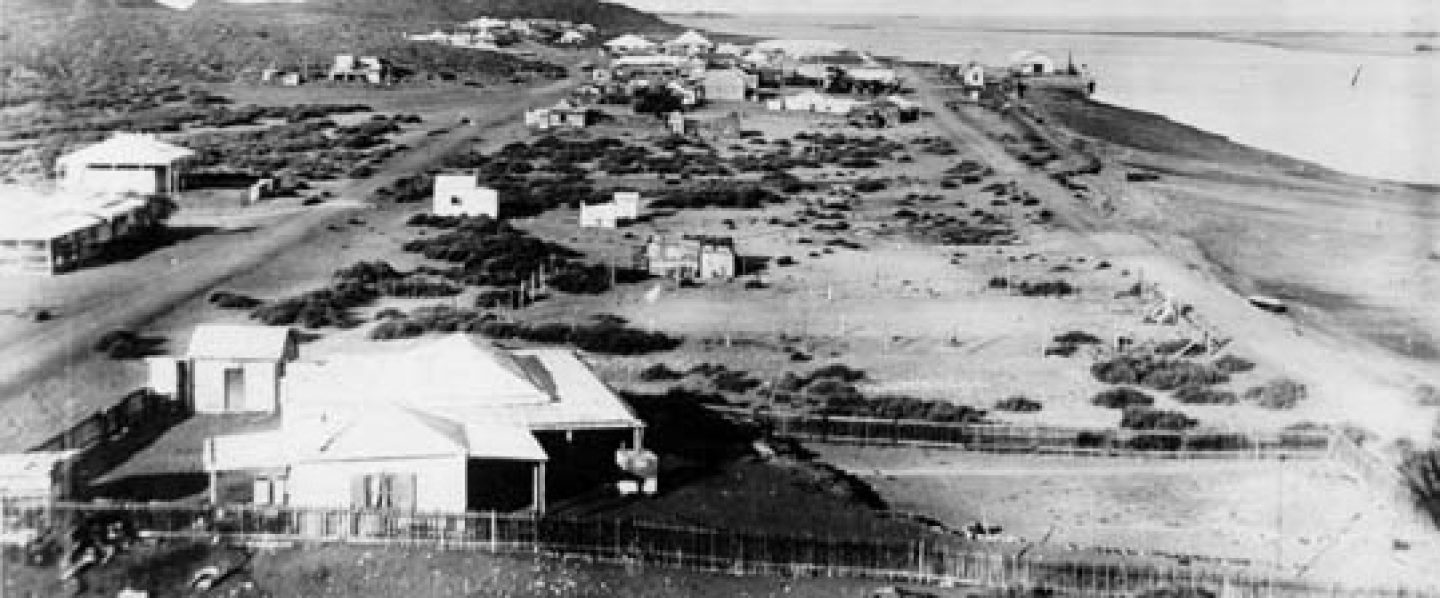
Deep in the North Eastern Goldfields of Western Australia, along the red sands of the Old Agnew Road, lies the silent site of Kurrajong. To the modern traveller, it is a ghost town of overgrown sands and scattered mine shafts, but to the pioneers of the 1890s, it was known by a more prestigious title: Diorite King. Its history is a quintessential Australian saga of incredible wealth discovered in a land that was “hot, harsh and horribly unforgiving.”1 2 3
Gold and the Birth of a Townsite
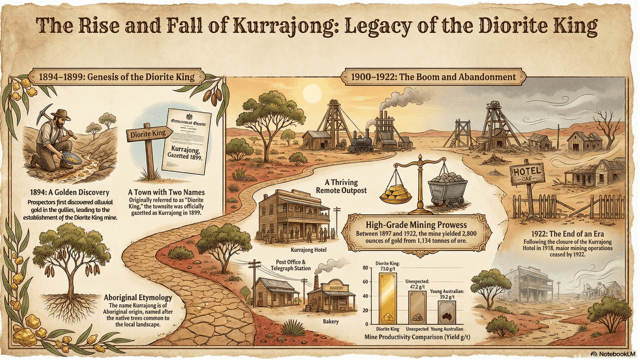
The story began in 1894 and 1895 when gold was discovered in the diorite hills north-west of Leonora. Early prospectors like Booden, who had travelled across from the Murchison, found alluvial gold in the gullies near what became the Little Wonder mine. He was followed by others such as Bill Cutmore, Edward “Doodah” Sullivan, and John “Jack” Doyle.4 5
Sullivan is often credited as the first to find gold near Leonora itself, but the Diorite King area remained the early focal point of the district. Doyle’s discovery of the Little Wonder mine was particularly sensational. For the amount of ore raised, it was reportedly the richest show in the State, with the party recovering £45,000 worth of gold.6
In these early days, before a local battery was erected in 1898, the logistics of mining were staggering. Doyle and his party were forced to cut a track as “straight as the crow flies” all the way to Southern Cross, the nearest treatment facility at the time, transporting their rich stone by pack-horse. This track remains visible on mining maps of the district today as a testament to their dogged perseverance.7
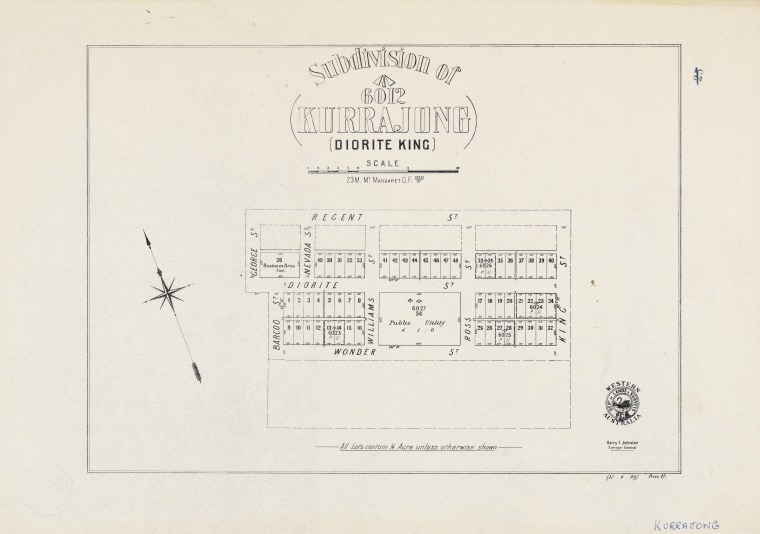
By 1897, the population had grown sufficiently to require a formal town. However, the immediate vicinity of the mines was too stony and uneven for housing. Consequently, Surveyor H.S. King chose a site on the nearby flats, approximately three kilometres to the south. The town was officially gazetted on 16 June 1899 and named Kurrajong, after the Aboriginal word for a species of tree common to the area.8 9
JJ Williams and the “Wiles” of Kurrajong
The most dominant figure in the town’s history was undoubtedly John Joseph Williams, known universally as “JJ.” A former blacksmith and the first Mayor of Broken Hill, Williams brought a wealth of civic and mining experience to the field. He arrived in the mid-1890s to manage the Diorite King mine for a London syndicate and was highly respected for pioneering the district.11
However, Williams was also a shrewd businessman whose tactics became part of local folklore as “Williams’s Wiles.” Although the mine workings were nearly a mile from the Kurrajong Hotel, which he part-owned, Williams strategically placed the mine’s office right next to the pub. This ensured that every miner was obliged to walk to the hotel to receive their pay cheques, which were quite predictably often cashed directly over the bar.12
Despite such tactics, he was a pillar of the community. He served as chairman of the Progress Committee, which planned for town sanitation, a public hall, and improved roads. He was also a prominent member of the Australian Natives’ Association (ANA) and the Masonic Lodge, and he frequently presided over local cricket and jockey club events. A banquet was held in his honour in September 1897 to celebrate his role in bringing the Diorite King mines to a paying stage, attended by miners who appreciated the “good fellowship” he fostered.13 14
A Harsh and Unforgiving Environment
Life in Kurrajong was a constant struggle against the elements. By August 1897, the town had a telegraph station, a bakery, and an iron post office, but most residents lived in spartan conditions. While the mine office and hotel were brick, the majority of the population resided in hessian shanties and tents.
The environment was “pitiless,” and the historical record is punctuated by tragedies that illustrate the dangers of outback life. The story of Billy Johnson in 1894 is a grim example. He set off for a water condenser only four miles away, but became “bushed” in the dark. Johnson, a strong man, covered nearly 40 miles in a desperate circle before dying of thirst; his grave is now marked only by a pile of stones near Pigeon Rocks.15
Fresh water at the find was described as “valuable,” and those without resources were cautioned against attempting the journey through the country from Menzies. The extreme heat and the presence of diseases like typhoid, which claimed field telegraphist George Grundy, were constant threats.16
People of Kurrajong
For those with an interest in genealogy, Kurrajong’s history is rich with the records of large, resilient families who faced the goldfields’ rigours. The Morris family played a significant role in the prospecting history of the region. George Morris, who tragically took his own life at the King of the Hills mine in 1906, was the sixth of thirteen children born to James Morris and Bridget Mary Dooly. His parents had married in Brooklyn, New York, before arriving in Victoria and eventually following the gold to Western Australia. George’s suicide was attributed to “melancholy” following the death of his brother and inseparable companion, Isaac “Barlow” Morris, who had been killed in a dray accident two years earlier.17
The Cogley family also experienced profound loss. Thomas William Cogley, the eldest of nine children, was a teamster who committed suicide at the Diorite King mine during a fit of “temporary insanity” brought on by heavy drinking. He was buried in the Leonora Cemetery in 1902.18
Even the very young were not spared. The Diorite King Cemetery holds the remains of four-month-old Eva Discombe Davis, who died in May 1898 from “exhaustion and excessive diarrhoea.” These records provide a poignant human dimension to the town’s history, revealing the high personal costs of the gold rush era.19
Economic and Political Factors
Economically, Kurrajong was a “shooting-star settlement.” The initial boom was driven by exceptionally high-grade ore; the Diorite King mine alone produced stone yielding 73 grams of gold per tonne. This wealth attracted significant international interest, including London-based syndicates like the Vice Regent Gold Mine. The Vice Regent raised £54,000 in capital through exaggerated claims of gold “showing everywhere,” when in reality the workings were merely an open pit three feet deep. The venture collapsed, and the investors lost everything.21
Politically, the town’s formal existence was shaped by the government’s efforts to regulate the goldfields. The 1899 gazettal provided a sense of permanence, and the establishment of local institutions aimed to improve the spartan sanitation of the camps. However, the consolidation of many small leases into larger holdings by companies like East Murchison United (EMU) around 1900 began to change the economic landscape, moving the region away from the era of the individual prospector toward industrialised mining.22 23
Conflict and Crime
The rough-and-tumble nature of the field occasionally boiled over into violence. In April 1898, John Leyland, one of the co-founders of the Little Wonder mine, was killed while assisting a constable in tracking Aborigines who had been spearing horses near Lawlers. He was hit over the head with a waddy and died shortly after at the Malcolm Hospital.24
Social life at the Kurrajong Hotel also had its dark side. In 1902, Martin Cody was murdered following a drunken argument at the hotel. The dispute concerned “wind-sails” that had been erected over a mine shaft for ventilation. Cody was hit over the head with a stick by Michael Griffin and died that evening.25
Transport and the Decline of the Town
Transport was the lifeblood of Kurrajong. Cobb & Co began a coach service to Coolgardie in 1898, which was a vital link to the wider world. By 1903, a new service linked the town to Leonora. However, the very transport improvements that aided the town’s growth also contributed to its obsolescence.26
When the railway reached Leonora in June 1902, the regional economic focus shifted heavily toward that larger centre. Tragically, Kurrajong’s most prominent advocate, JJ Williams, died in Leonora that same month, just as the first train arrived. He passed away from heart failure at his Central Hotel at the age of 46. Without his leadership and with the dwindling of the highest-grade ore, Kurrajong began to fade.27
The closure of the Kurrajong Hotel in 1918 marked the effective end of the town as a living community. While some mining continued at the Diorite King mine until 1922, the social fabric of the settlement had unravelled.
Kurrajong Today
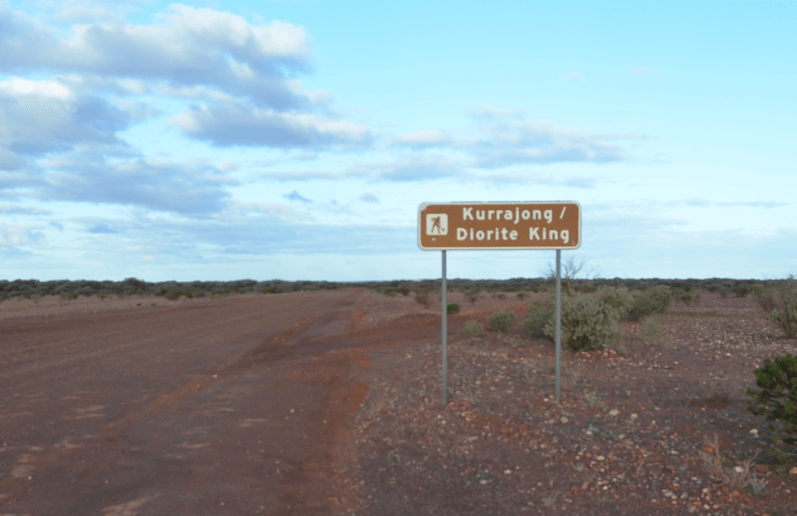
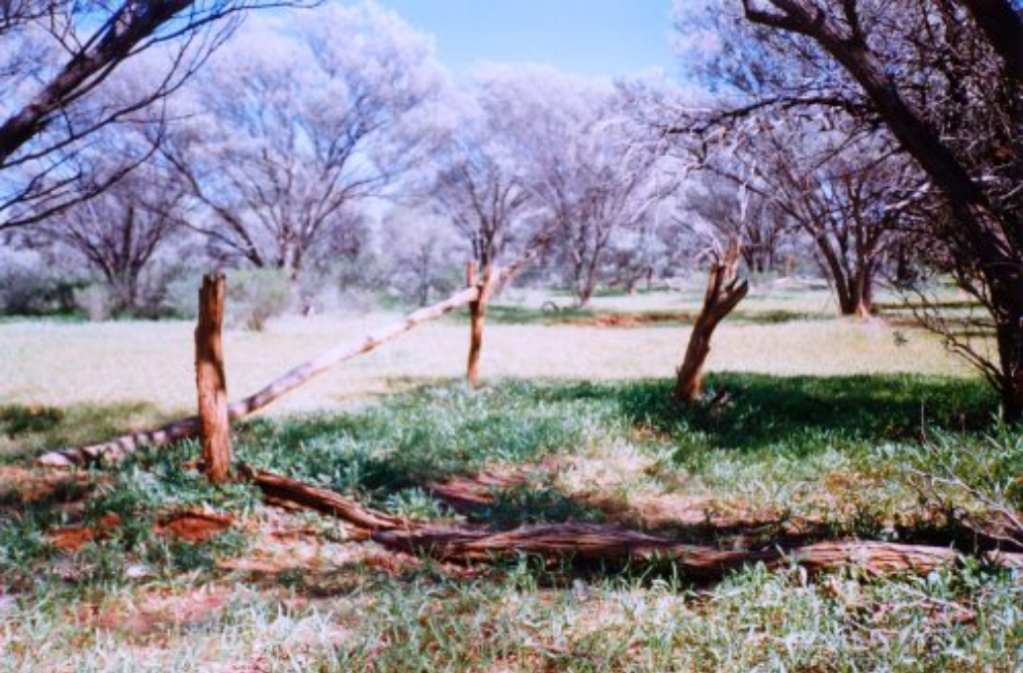
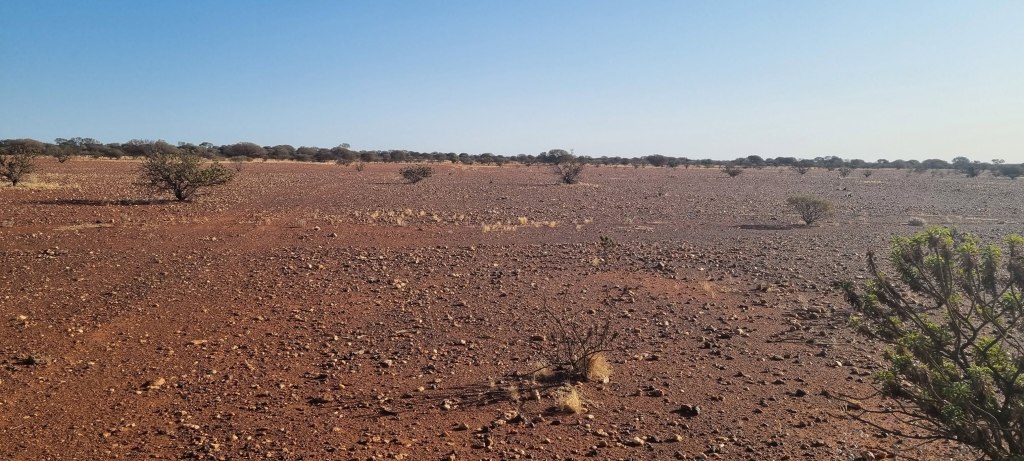
Today, Kurrajong is a site of memory on the Agnew Loop heritage trail. Visitors can still see the remnants of the battery and overgrown sands south of the Sturt Meadows Station turn-off. The area remains a place of caution, as old mine workings are unmarked and unstable. It stands as a silent monument to the “Diorite Men”, men like JJ Williams, Jack Doyle, and the many families who sought their fortunes in the unforgiving red earth of the Eastern Goldfields.
This photo of the site of Kurrajong was taken in 2020 by Mike Davies of the Western Australian History group.29
Timeline
- 1894: Gold is first discovered in the Diorite King area by prospectors including Cutmore, Sullivan, and Doyle.
- 1895: JJ Williams arrives to manage the Diorite King mine for a London syndicate; Booden finds rich alluvial gold in local gullies.
- 1897: Surveyor H.S. King marks out town lots on the flats; the telegraph is established and the Kurrajong Hotel is built.
- April 1898: Pioneer John Leyland is killed while tracking Aborigines near Lawlers.
- May 1898: Death of infant Eva Discombe Davis, highlighting the harsh life for families.
- 1898: Cobb & Co begins a coach service to Coolgardie; the first hotel licence is issued.
- 16 June 1899: The townsite of Kurrajong is officially gazetted.
- 1900: Consolidation of small mining leases into larger company holdings begins.
- June 1902: Death of JJ Williams in Leonora; the railway reaches Leonora, shifting economic focus away from Kurrajong.
- 1902: The murder of Martin Cody following a dispute at the Kurrajong Hotel.
- 1903: A new Cobb & Co coach service opens between Kurrajong and Leonora.
- 1918: The Kurrajong Hotel closes, marking the effective end of the town as a social centre.
- 1922: Gold mining operations at the original Diorite King mine officially cease.
Map
Sources
- Wikipedia (2011). Kurrajong, Western Australia. Retrieved 6 Apr 2026 from https://en.wikipedia.org/wiki/Kurrajong,_Western_Australia ↩︎
- Hudson Institute of Mineralogy (2025). Diorite King Gold Mine, Leonora, Leonora Shire, Western Australia, Australia. Retrieved 6 Apr 2026 from https://www.mindat.org/loc-268355.html ↩︎
- Shire of Leonora (2026). The Agnew Loop. Retrieved 5 Apr 2026 from https://www.leonora.wa.gov.au/mapping/trails/agnew-loop-trail ↩︎
- ibid ↩︎
- ibid: History. Retrieved 5 Apr 2026 from https://www.leonora.wa.gov.au/visitors/about-leonora/history.aspx ↩︎
- Outback Graves Markers (n.d.) John DOYLE. Retrieved 6 Apr 2026 from https://outbackgraves.org/burial-records/person/2322 ↩︎
- ibid ↩︎
- Landgate (2022). Historical Town Names: Kurrajong. Retrieved 6 Apr 2026 from https://web.archive.org/web/20220314101618/http://www0.landgate.wa.gov.au/maps-and-imagery/wa-geographic-names/name-history/historical-town-names#K ↩︎
- Wikipedia: refers to gazetting ↩︎
- State Library of Western Australia (n.d.) Townsite maps, Western Australia. Cadastral map showing landuse, dated 27/8/98. Retrieved 4 April 2026 from https://encore.slwa.wa.gov.au/iii/encore/record/C__Rb1928962 ↩︎
- Phillips, Peter (2025). John Joseph Williams. Retrieved 6 Apr 2026 from https://www.williams.ptwo.id.au/p1066.htm ↩︎
- A DIORITE MAN (1907, July 7). Sunday Times (Perth, WA : 1902 – 1955), p. 8. Retrieved April 6, 2026, from http://nla.gov.au/nla.news-article57230082 ↩︎
- DIORITE KING. (1897, August 23). The Goldfields Morning Chronicle (Coolgardie, WA : 1896 – 1898), p. 4. Retrieved April 6, 2026, from http://nla.gov.au/nla.news-article232982072 ↩︎
- DIORITE KING. (1897, September 21). The Goldfields Morning Chronicle (Coolgardie, WA : 1896 – 1898), p. 3. Retrieved April 6, 2026, from http://nla.gov.au/nla.news-article232984309 ↩︎
- Outback Graves Markers (n.d.) Billy JOHNSON. Retrieved 4 Apr 2026 from https://outbackgraves.org/burial-records/person/6587 ↩︎
- ibid: George GRUNDY. Retrieved 6 Apr 2026 from https://outbackgraves.org/burial-records/person/950 ↩︎
- ibid: George MORRIS. Retrieved 5 Apr 2026 from https://outbackgraves.org/burial-records/person/6223 ↩︎
- ibid: Thomas William COGLEY. Retrieved 5 Apr 2026 from https://outbackgraves.org/burial-records/person/6218 ↩︎
- Sharp, Moya (n.d.) Diorite King Cemetery – Western Australia. Retrieved 6 Apr 2026 from https://www.outbackfamilyhistory.com.au/records/record.php?record_id=145&town=Diorite%20King/Kurrajong ↩︎
- Coate, Kevin and Yvonne (1996). Kurrajong (Diorite King) Cemetery. Retrieved 6 Apr 2026 from https://lonelygraveswa.wags.org.au/index.php/lost-souls/m-to-r/q-s-1-3 ↩︎
- Hudson Institute of Mineralogy (2025). Diorite King Gold Mine, Leonora, Leonora Shire, Western Australia, Australia. Retrieved 6 Apr 2026 from https://www.mindat.org/loc-268355.html ↩︎
- Wikipedia (2011): refers to early development ↩︎
- Shire of Leonora (2026). The Agnew Loop. Retrieved 5 Apr 2026 from https://www.leonora.wa.gov.au/mapping/trails/agnew-loop-trail ↩︎
- Outback Graves Markers (n.d.) John LEYLAND. Retrieved 6 Apr 2026 from https://outbackgraves.org/burial-records/person/389 ↩︎
- ibid: Martin CODY. Retrieved 6 Apr 2026 from https://outbackgraves.org/burial-records/person/385 ↩︎
- Wikipedia (2011): refers to transportation ↩︎
- Shire of Leonora (2025). History. Retrieved 5 Apr 2026 from https://www.leonora.wa.gov.au/visitors/about-leonora/history.aspx ↩︎
- Hudson Institute of Mineralogy (2025). Diorite King Gold Mine, Leonora, Leonora Shire, Western Australia, Australia. Retrieved 6 Apr 2026 from https://www.mindat.org/loc-268355.html ↩︎
- Western Australian History Facebook Group. Retrieved 11 Jun 2026 from https://www.facebook.com/groups/699892317195967/?__cft__[0]=AZbJ8ZYSXa5vugI8B0EuTdetxh2NR1p73FJJx4aTqVEpo3CLdQ43GnlxdjCQjGD7DDnUmh7vrT1h7TZVKh8M8yYQq_nG_Lg2HVP0PkkmsjPsZ-zZwQ6gtB0rsQvwLO2MpbYIbaOJKpeUsPR0c2HPX25F6vEbN7icE09Nw_TNErdH2A&__tn__=-UC%2CP-R ↩︎
- Mapcarta (n.d.) Kurrajong Bore. Retrieved 4 Apr 2026 from https://mapcarta.com/30025724 ↩︎

