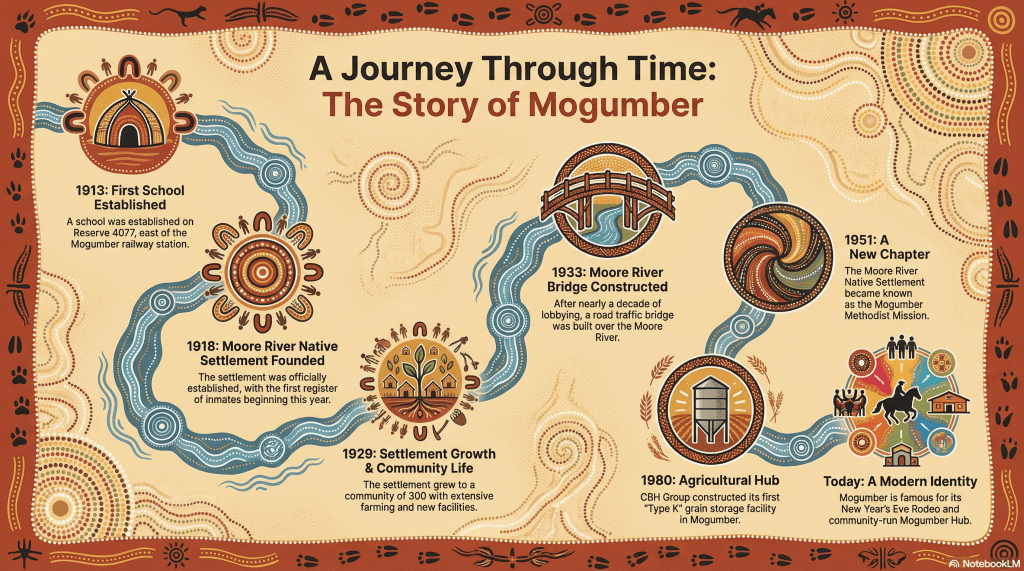
Demographics
Region: Wheatbelt
LGA: Victoria Plains
Industry: Farming
Other Names: Moore River Native Settlement, Mogumber Native Settlement, Mogumber Mission
Open Street Map: -31.038495916722187, 116.04595342518581
What3Words: ///linguist.incubation.miserably
Settled: 1892
Gazetted: N/A
Abandoned: ~1980s
Abstract
Mogumber, Western Australia, holds a complex history defined by its function as the site of the Moore River Native Settlement (later Mogumber Methodist Mission). By 1929, the settlement housed 300 people on an 11,000-acre reserve, pursuing self-supporting policies through agricultural development, clearing 450 acres and managing a sewing factory producing garments for indigenous populations statewide. The area was an important transport hub near the Mogumber railway station, frequently central to lobbying efforts for vital infrastructure, such as the Moore River bridge, connecting northern districts to Perth. Today, Mogumber is a small locality (population 58 in 2021), characterized by its modern community events, like the annual rodeo, and preservation of historical sites, including the State Registered Mogumber Cemetery.
History
Location
The locality known today as Mogumber, situated in the Shire of Victoria Plains in Western Australia, holds a complex and layered history, marked by its function as a rural hub, a key nexus for regional infrastructure, and, most significantly, the site of the controversial Moore River Native Settlement. Known variously throughout its existence as the Moore River Native Settlement, the Mogumber Native Settlement, and later the Mogumber Methodist Mission, the area’s history is inextricably tied to its social, economic, and environmental context within the broader Midlands district.1 2 3 4
Mogumber is geographically defined by the convergence of the Moore River East and the Moore River, providing a significant source of water for the area. The location, with an average rainfall of 20 inches, benefited from the Moore River running through the reserve in a series of large pools, creating an estimated eight miles of water that served as excellent drinking water, pumped and reticulated throughout the compound by an oil engine to large concrete-stand tanks.5
In the early 20th century, Mogumber was an established point on the Midland line, serving surrounding districts. In 1925, an individual named John Hudson Davies, a former regimental bandmaster, was recorded as having conducted the refreshment room at Mogumber before moving on to the Dongarra Hotel. The community was politically active; by 1924, a “Mogumber branch” was listed among the local government bodies belonging to the Central Midland Railway League, advocating for the purchase of the Midland Railway Company’s line and lands. The area was often associated with nearby Moora, being only eight miles from the Mogumber railway station.6 7
A primary economic and social factor impacting Mogumber’s development was road infrastructure. For residents traveling between Moora, the northern districts, and Perth, the lack of a suitable crossing over the Moore River at Mogumber was a major inconvenience. In 1925, the bridge over the Moore River at Mogumber was a local concern debated during political meetings, though noted as not being a Federal matter. Road Board officials and local progress associations campaigned for the bridge, arguing that in winter, the river was impassable, and construction would shorten the return journey from Perth to Geraldton by over 200 miles, saving both distance and petrol. The construction of a road traffic bridge over the Moore River at Mogumber, achieved through the efforts of M.L.A. P. D. Ferguson, eventually helped serve the people of these parts. The strategic significance of Mogumber was highlighted in 1927 when the route Muchea, Gingin, Mogumber, Moora was considered as a potential path for a Federal arterial road—the “Perth to Mt. Magnet and Nor-West” route.8 9 10 11 12 13
The Moore River Native Settlement
The Moore River Native Settlement was a central institution in the area, situated near the Mogumber railway station. By the mid-to-late 1920s, sources highlight a period of intensive development and activity, particularly after Superintendent A. J. Neal took charge (approximately 18 months prior to January 1929). Neal, described as an experienced farmer whose “one interest in life” was making the settlement a success, brought a focus on developing the settlement towards a self-supporting policy. 14
By 1929, the settlement housed 300 people. Administrative efforts centered on providing social welfare and instilling discipline, aiming for the “complete restoration of the natives to civil life” and demonstrating that their welfare was the authorities’ chief object. The residents were reported as a “happy, care-free community” who were “at liberty and unburdened with responsibility”. Health statistics from 1927 indicated improvements, noting 11 births, seven marriages, and six deaths, mostly attributed to senile decay.15
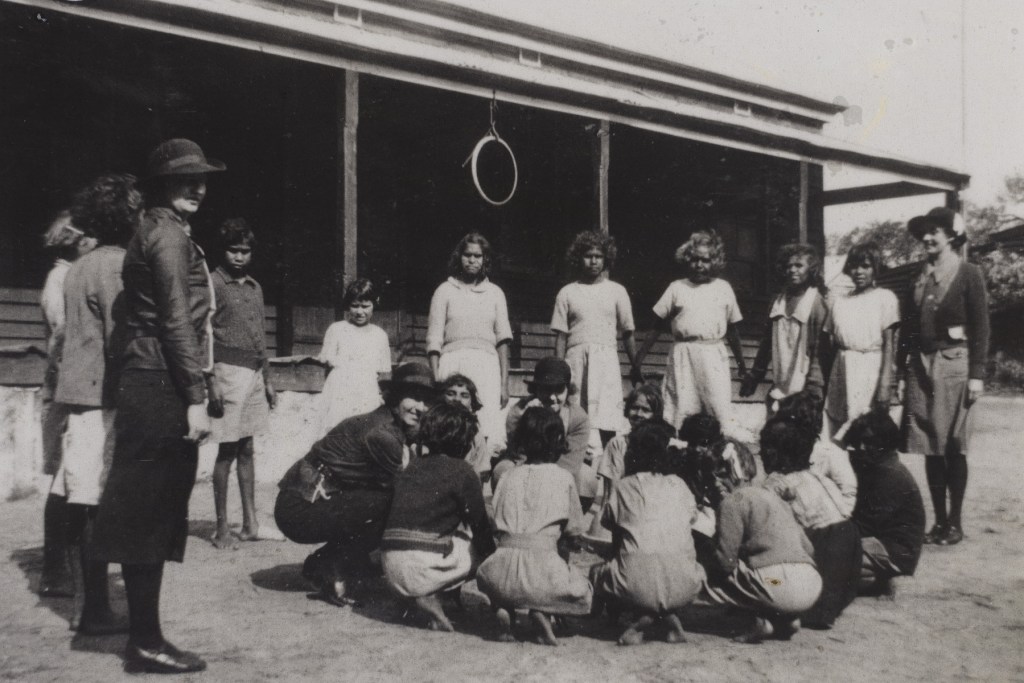
State Library of Western Australia 16
The staff included not only the Superintendent (Mr A. J. Neal) and Matron (Mrs Neal) but also a surgical nurse, compound nurse, maternity nurse, school teacher, sewing mistress, and assistant. The staff managed daily life, providing medical care and educational services. The sewing mistress, Miss Cross, oversaw native girls operating a dozen sewing machines in a clothing factory that produced 3440 garments from 25,000 yards of cloth annually for indigent natives across the State, simultaneously training the girls to be efficient domestics.17 18
The standard of living and facilities included residents being “very comfortably housed” in residences and spacious dormitories. Other infrastructure included a large dining hall, a general office, store, surgery, and bakehouse. A large stone tank with a capacity of 15,000 gallons was constructed to supplement the water supply. Notably, a large hospital building was contemplated, intended to include two 10-bed wards and a large maternity ward, which was planned to be constructed entirely from local white pipe clay, with timber cut and prepared by the natives themselves.19
Leisure and social activities were promoted, including annual Christmas Tree functions attended by visitors and government ministers, where presents were distributed. Entertainment plans included providing picture shows monthly and basket ball for the older girls. Furthermore, the native inmates were observed participating in contemporary dances like the waltz, foxtrot, and jazz, exhibiting “perfect unison with the music”.20
Economic and Environmental Factors
The settlement spanned a reserve area of 11,000 acres. Under Neal’s management, significant agricultural progress was made toward self-sufficiency. In 18 months leading up to January 1929, 400 acres had been cleared, contributing to the total of 450 acres cleared. Land clearing involved removing stumps and roots, with the timber being cut up for firewood. By June 1928, the intention was to acquire 3000 acres of good arable land nearby for cereal cultivation. Future cultivation plans aimed to use some 4000 acres for barley and rye, along with extensive planting of lupins, which experiments proved thrived there.
Livestock farming was a key goal, aiming for a “good sheep run” for breeding and fattening, with the surplus possibly being sent to the Midland market, generating income through wool growing. The dairy herd consisted of 22 cows. Farm haulage was managed by seven mules, ten horses, and a caterpillar tractor.
The local environment provided building materials; pipe clay, described as equal to cement, was used for structures like garages, the clothing store, and the proposed hospital. Experiments were also underway to use red and yellow ochre, found on the property, to tint the pipe clay for paint. Conservation efforts included planting over 1000 commercial pine trees in one year, with plans for 500 more annually.
The work conducted by the natives was critical to development. They constructed a nine-mile surveyed road to Mogumber for £40. They also contributed significantly to their own sustenance: while 26,689 lbs of mutton were consumed in one 12-month period, the meat bill was materially reduced because the natives hunted and procured 9,662 lbs of kangaroo.21 22
The decline of the community
While the initial sources detail the vigorous development and apparent prosperity of the Moore River Native Settlement in the late 1920s, subsequent records indicate a change in administration and eventual shift in focus. By the 1950s, the facility was operating as the Mogumber Methodist Mission (also referred to as the Moore River Native Settlement/Mogumber Methodist Mission interchangeably in some records). The Mission continued to serve as a destination for Aboriginal people requiring movement or care, such as the transport of an elderly male native from Tenindewa to the Mogumber Mission in 1953. 23This phase of operation involved various government-negotiated operations related to sanitation, water supply, and subsidies, suggesting a continued institutional function. During this period the Mission also operated agricultural training schemes and farm schools.24
In terms of economic decline, the area, like many rural communities, saw changes in agricultural operations and transport requirements. The CBH Group constructed a Type K grain storage bin at Mogumber in 1980; however, by 2020, this facility was no longer in use.25
Present Day
Modern Mogumber today exists as an unofficial settlement and locality within the Shire of Victoria Plains. The 2021 Census reveals a small population of just 58 people, with a median age of 55, reflecting a small, aging rural community. Economically, the few households report a median weekly income of $1,531 and high motor vehicle ownership (3.9 vehicles per dwelling), typical of remote areas.26
Socially and culturally, Mogumber preserves its heritage while adapting to modern tourist and local needs. Numerous historical structures are listed as heritage places, including the Mogumber Hotel (now Mogumber Tavern/Hub), the Mogumber bridges, the old Post Office & Store (The Old Stone House), and the Mogumber Cemetery, which is a State Registered Place.[citation required] The community now focuses on its identity as a local hub, hosting events such as the Gilmac Mogumber New Years Eve Rodeo, which draws over 3000 visitors annually, representing the district’s largest single-day tourist event.27 The historic, licensed Mogumber Hub (formerly the Mogumber Hotel/Tavern) is operated by the Mogumber Outback Club Inc, a local not-for-profit community group, serving as a modern center for food, beverage, and community gathering. Camping is also available at the Mogumber Oval & Reserve.
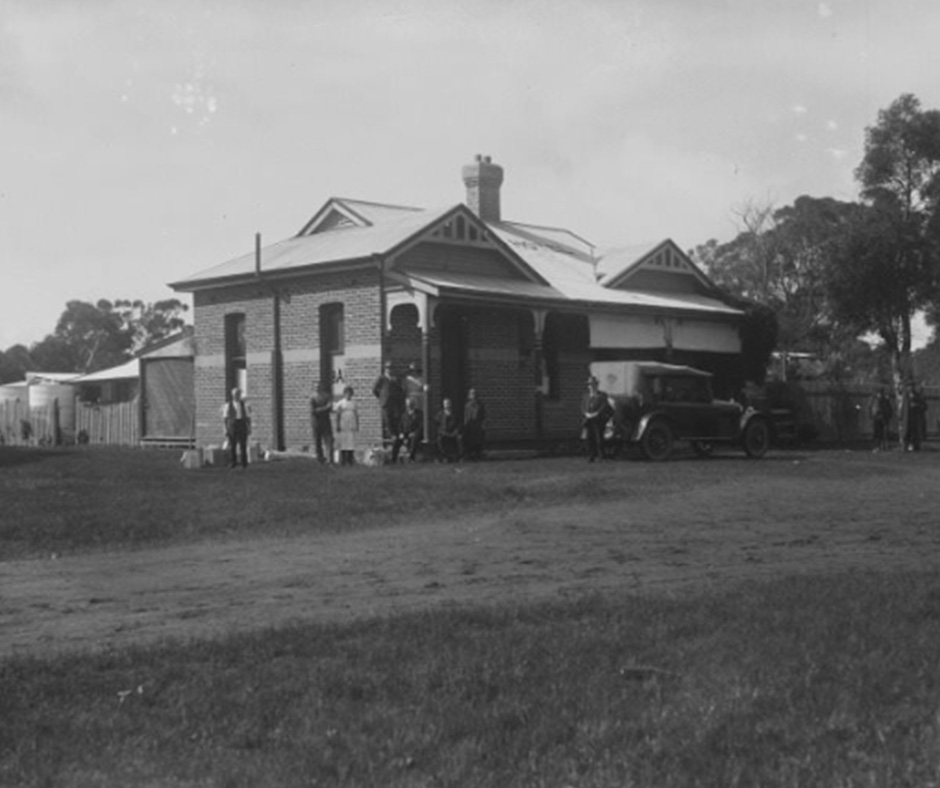
SLWA28
The history of Mogumber thus traces a path from a developing agricultural region and essential Aboriginal settlement institution in the 1920s to a mission post in the mid-century, culminating in a small, yet historically and culturally significant, modern locality.
Timeline
- 1899: Appointment of a master for a school at Mogumber noted.
- 1907: Early buildings and works at Mogumber noted in government records.
- 1909: Moora was constituted as a parish, geographically embracing districts between Watheroo and Mogumber.
- 1913: School attendance records begin for the Mogumber area.
- 1916: Native Settlement Reserve on the Moore River first noted in records.
- 1918–1920: Sheep farming and buildings at the Moore River Native Settlement noted in state archives
- 1921–1924: Moore River Native Settlement inmate registers are recorded.
- 1924 (August): A Mogumber branch was active in the Central Midland Railway League, supporting a deputation regarding the purchase of the Midland Railway Company’s line.
- 1924 (October): The Moora Road Board advocated for the Government to construct a bridge over the Moore River at Mogumber to create a more direct route between Moora and the city.
- 1925 (February): John Hudson Davies, who had previously managed the refreshment room at Mogumber, died.
- 1925 (May): A Mogumber school closed due to insufficient attendance.
- 1925 (May): Federal representative Mr. A. E. Green declared the proposed Moore River bridge at Mogumber was not a matter of Federal concern.
- 1926 (July): The Minister for Works sanctioned the construction of a bridge over the Moore River at Mogumber, noting it would shorten the return journey from Perth to Geraldton by 200 miles.
- 1926 (November): The Chairman of the Main Roads Board, Mr. Tindale, agreed that a bridge was urgently needed at Mogumber and confirmed it would be built on the western side of the railway line.
- ~Mid-1927: Mr. A. J. Neal assumed the role of Superintendent of the Moore River Native Settlement, initiating efforts toward a self-supporting policy.
- 1927 (Late): Health statistics for the Moore River Settlement recorded 11 births, 7 marriages, and 6 deaths (mostly from senile decay), indicating improved general health.
- 1927 (November): The proposed Route No. 2 for the Federal arterial road (Perth to Mt. Magnet) included Muchea, Gingin, Mogumber, and Moora.
- 1928 (June): The Native Settlement recorded having an area of 11,600 acres. A nine-mile surveyed road to Mogumber was completed entirely by native labor at a cost of £40.
- 1929 (January): The Moore River Native Settlement housed 300 people. The settlement had cleared 450 acres, 400 acres of which were cleared in the previous 18 months under Neal’s supervision.
- 1929 (January): The settlement’s clothing factory produced 3,440 garments annually utilizing 25,000 yards of cloth.
- 1929 (January): During the annual Christmas Tree function at the Settlement, the Minister announced plans to hold picture shows monthly and provide basketball for older girls.
- 1930 (April): The Mogumber Progress Association met to organize a petition to accelerate the construction of the Mogumber Bridge.
- 1933 (March): The road traffic bridge over the Moore River at Mogumber was constructed, credited largely to the efforts of M.L.A. P. D. Ferguson.
- 1947: Files related to the Moore River Native Settlement Water supply refer to the institution as the Mogumber Methodist Mission.
- 1951 (Start): Files related to the Mogumber Native Mission Administration begin.
- 1951–1970: Government files detail requisitions, subsidy payments, and administration for the Mogumber Methodist Mission.
- 1953 (January): An elderly male native was transported from Tenindewa to the Mogumber Mission by ambulance, highlighting its ongoing function as an Aboriginal welfare institution.
- 1964–1968: Building Schedules for the Mogumber Mission were documented.
- 1970–1974: Records noted an Agricultural Training Scheme operating at the Mogumber Mission.
- 1980: The CBH Group constructed a Type K grain storage bin at Mogumber.
- 2020 (circa): The CBH grain storage bin was no longer in use.
- 2021: The Mogumber locality had a total population of 58 people.
- Current Day: Mogumber, an unofficial settlement, is home to the historic licensed Mogumber Hub (formerly the Mogumber Hotel/Tavern), operated by a local not-for-profit community group.
- Current Day: Mogumber hosts the Gilmac Mogumber New Years Eve Rodeo, which is described as the district’s largest single day tourist event.
- Current Day: Several historic structures are heritage-listed, including the Mogumber Cemetery, which is listed as a State Registered Place.
Stories
- Hazel’s Story – an excerpt of an interview with the late Hazel Anderson RIP in 1990/91 for the book “A Sort of Place Like Home” by Susan Maushart. It is accompanied by largely unseen photographs taken at Moore River in the 1960s and 70s. Aboriginal and Torres Strait Islander viewers are advised that this post may contain images of deceased persons.
Map

Sources
- Wikipedia, 2023. Mogumber, Western Australia. Retrieved 14 Dec 2025 from https://en.wikipedia.org/wiki/Mogumber,_Western_Australia ↩︎
- Native Settlement. (1929, January 4). North-Eastern Courier (Perth, WA : 1923 – 1955), p. 2. Retrieved December 14, 2025, from http://nla.gov.au/nla.news-article257529501 ↩︎
- NOTES. (1925, July 3). North-Eastern Courier (Perth, WA : 1923 – 1955), p. 3. Retrieved December 14, 2025, from http://nla.gov.au/nla.news-article257521367 ↩︎
- State Records Office of WA, 2025. Search results for Mogumber Native Settlement. Retrieved 14 Dec 2025 from https://archive.sro.wa.gov.au/index.php/informationobject/browse?topLod=0&query=Mogumber+Native+Settlement ↩︎
- ENTERPRISE AND PROGRESS (1929, January 4). North-Eastern Courier (Perth, WA : 1923 – 1955), p. 2. Retrieved December 14, 2025, from http://nla.gov.au/nla.news-article257529499 ↩︎
- PROLIFIC WESTRALIA. (1925, February 20). North-Eastern Courier (Perth, WA : 1923 – 1955), p. 3. Retrieved December 14, 2025, from http://nla.gov.au/nla.news-article257363961 ↩︎
- MIDLAND DISTRICT RAILWAY LEAGUE. (1924, August 22). North-Eastern Courier (Perth, WA : 1923 – 1955), p. 3. Retrieved December 14, 2025, from http://nla.gov.au/nla.news-article257362992 ↩︎
- Road Board Conference (1924, October 24). North-Eastern Courier (Perth, WA : 1923 – 1955), p. 3. Retrieved December 14, 2025, from http://nla.gov.au/nla.news-article257363339 ↩︎
- OUR FEDERAL REPRESENTATIVE (1925, May 8). North-Eastern Courier (Perth, WA : 1923 – 1955), p. 3. Retrieved December 14, 2025, from http://nla.gov.au/nla.news-article257364423 ↩︎
- MOGUMBER BRIDGE (1926, November 26). North-Eastern Courier (Perth, WA : 1923 – 1955), p. 3. Retrieved December 14, 2025, from http://nla.gov.au/nla.news-article257528305 ↩︎
- THE WATHEROO-CARNAMAH ROAD. (1926, July 16). North-Eastern Courier (Perth, WA : 1923 – 1955), p. 3. Retrieved December 14, 2025, from http://nla.gov.au/nla.news-article257526363 ↩︎
- Attending to his Job (1933, March 10). North-Eastern Courier (Perth, WA : 1923 – 1955), p. 6. Retrieved December 14, 2025, from http://nla.gov.au/nla.news-article257393128 ↩︎
- PHILADELPHIAN PUBLICITY (1927, November 18). North-Eastern Courier (Perth, WA : 1923 – 1955), p. 2. Retrieved December 14, 2025, from http://nla.gov.au/nla.news-article257524693 ↩︎
- North Eastern Courier, 8 Jun 1928: refers to establishment and development of Moore River Native Settlement ↩︎
- North Eastern courier, 4 Jan 1919: refers to establishment and development of Moore River Native Settlement ↩︎
- State Library of Western Australia, 2025. Brownies, Moore River Native Settlement, Western Australia, Approximately 1939. A seriest of 3 photos in black and white. Retrieved 23 Nov 2025 from https://purl.slwa.wa.gov.au/slwa_b7457868 ↩︎
- North Eastern Courier, 4 Jan 1929: refers to improved health ↩︎
- North Eastern Courier, 8 Jun 1928: refers to staffing at the settlement ↩︎
- North Eastern Courier, 4 Jan 1929: refers to new hospital ↩︎
- Moore River Native Settlement (1930, January 11). North-Eastern Courier (Perth, WA : 1923 – 1955), p. 2. Retrieved December 14, 2025, from http://nla.gov.au/nla.news-article257366156 ↩︎
- North Eastern Courier, 4 Jan 1929: refers to productivity ↩︎
- North Eastern Courier, 8 Jun 1928: refers to refers to productivity ↩︎
- Tenindewa To Mocumber (1953, January 22). North-Eastern Courier (Perth, WA : 1923 – 1955), p. 2. Retrieved December 14, 2025, from http://nla.gov.au/nla.news-article257576048 ↩︎
- State Records Office, n.d. Mogumber Methodist Training Centre. Retrieved 14 Dec 2025 from https://archive.sro.wa.gov.au/index.php/mogumber-methodist-training-centre-1952-0154 ↩︎
- Wikipedia: refers to the construction and subsequent disuse of the CBH facility ↩︎
- Australian Bureau of Statistics, 2021. 2021 Census All persons QuickStats. Retrieved 14 Dec 2025 from https://www.abs.gov.au/census/find-census-data/quickstats/2021/SAL50974 ↩︎
- Shire of Victoria Plains, 2025. Things to Do: Mogumber. Retrieved 14 Dec 2025 from https://www.victoriaplains.wa.gov.au/play/things-to-do.aspx ↩︎
- State Library of Western Australia, n.d. Glass negative collection acquired by Dr James Sykes Battye ; 8956B/605. Retrieved 23 Nov from https://encore.slwa.wa.gov.au/iii/encore/record/C__Rb4566901 ↩︎
Further Reading
- State Records Office of Western Australia – Mogumber
- State Records Office of Western Australia – Moore River Native Settlement
- Mogumber Outback Club Inc.
- Mogumber – Photographs of Western Australia
| Originally published | 7 Dec 2025 |
| Updated | 14 Dec 2025 |
 People of Western Australia's Ghost Towns