Demographics
Region: Goldfields-Esperance
LGA: Menzies
Industry: Gold mining
Other Names: Menzie’s Find, North Niagara
Open Street Map: -29.373361, 121.439813
What3Words: ///grossing.labels.motorcar
Settled: 1895
Gazetted: 1896
Abandoned: 1909
Abstract
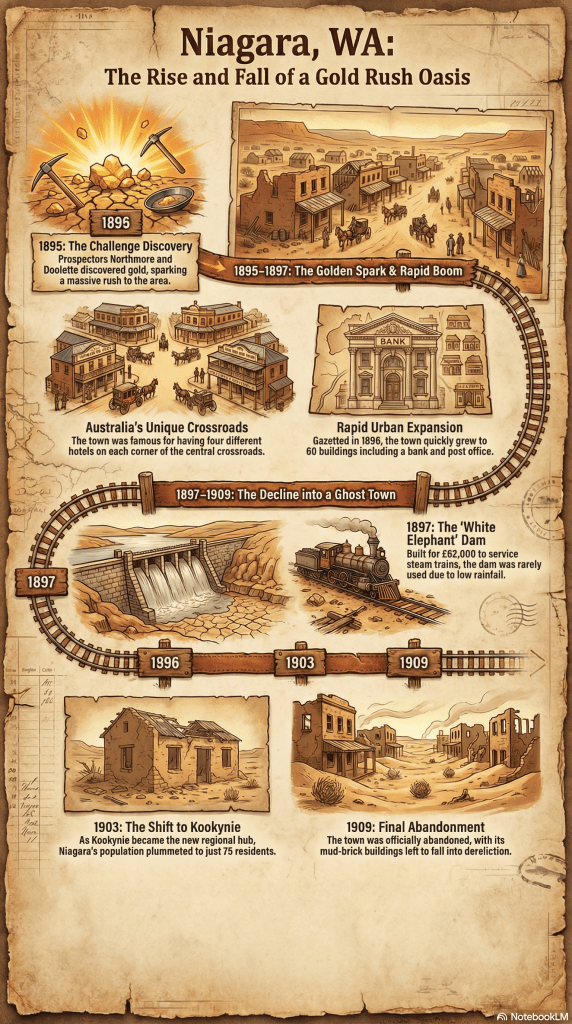
Niagara, situated in the Goldfields-Esperance region of Western Australia, serves as a quintessential example of the rapid boom-and-bust cycle of gold rush settlements. Gold was first discovered in early 1895 by prospectors including Charles Northmore, Dorrie Doolette, and J. Timms, leading to the establishment of the “Challenge” mine. The town grew with remarkable speed, being gazetted in late 1896, and soon featured infrastructure that was advanced for its remote location, including a telegraph line, a bank, and four hotels famously positioned on each corner of a central crossroads.
However, a combination of environmental and economic factors stifled Niagara’s long-term viability. The construction of the Niagara Dam between 1897 and 1898 was intended to supply water for steam locomotives but became a costly “white elephant” due to low rainfall and the discovery of better underground water at nearby Kookynie. By 1903, the population had dwindled to just 75 residents as the community shifted toward the burgeoning centre of Kookynie. By 1909, the township was officially abandoned, leaving only mud-brick ruins and the dam as testaments to its brief period of prosperity.
History
The history of Niagara began in the scorching summer of January 1895, when Charles Northmore and J. Timms commenced prospecting in the “Waterfall” area. On 4 February 1895, they discovered the Port Pirie mine, situated approximately three kilometres north of the ledge that would give the town its name. However, the harsh reality of the goldfields struck early; J. Timms died of typhoid just ten days later, on 14 February. Rival accounts of the discovery exist, with some claiming John Alway was first to peg a claim on 22 January 1895. Despite the confusion, it was the claim made by Dorrie Doolette and Charley Northmore in February 1895 that founded the “Challenge” mine, the true economic heart of the future township.1 2 3 4 5
The discovery triggered an immediate rush of “giants” who padded hot-foot from Siberia, the 90-Mile, and Menzies based on nothing but the report of gold. The financial impact was staggering for the era; the Challenge Gold Estates Proprietary was eventually floated in London with £225,000 of capital. The original prospectors received £180,000 of this, effectively making them instant millionaires by modern standards.6
Establishment and Naming
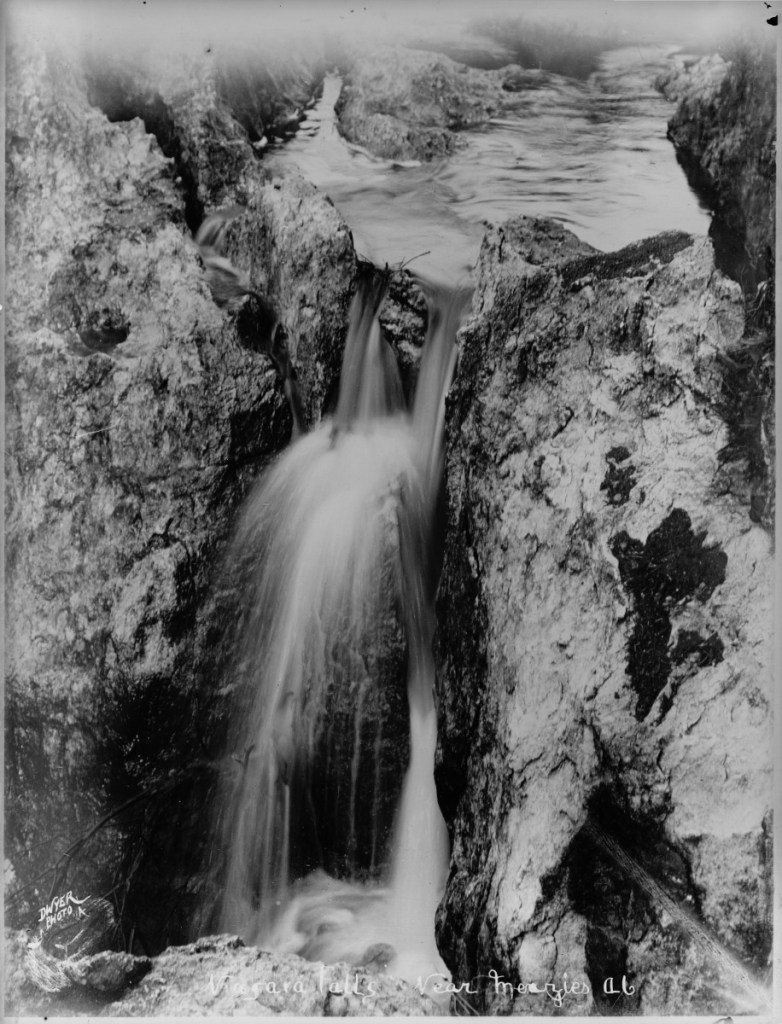
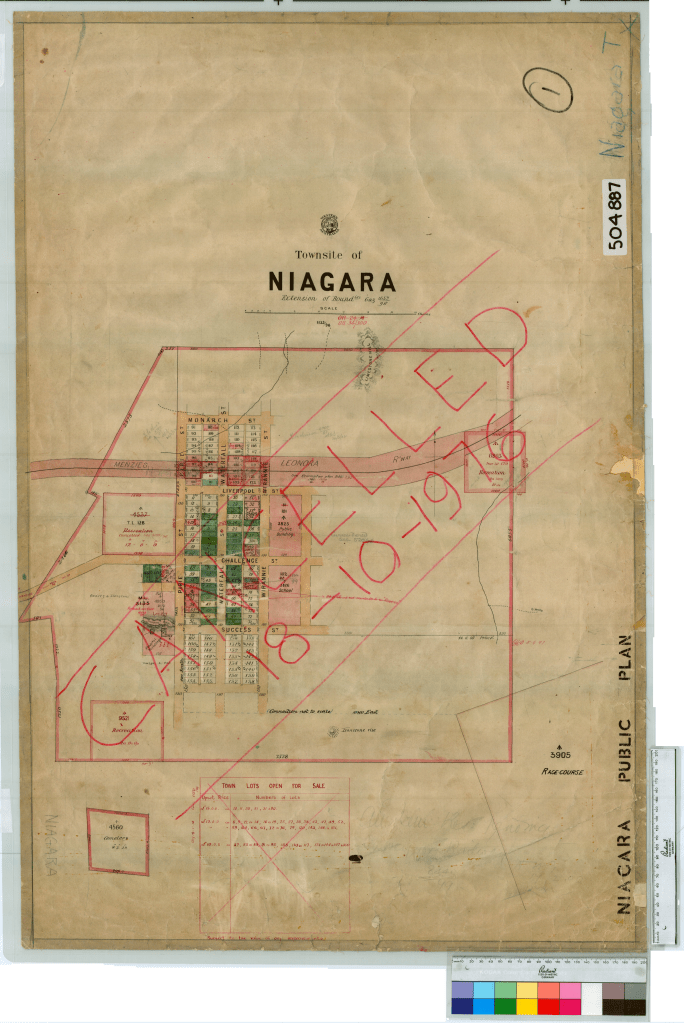
The town’s name was born of frontier irony. It was named after “Niagara Falls,” which was actually a modest three-metre ledge crossing the Niagara Creek. One of the early prospectors bestowed the name most likely in jest, as the small waterfall only ran occasionally during heavy rains. Following the rapid population influx, the Niagara Progress Committee requested a townsite declaration in early 1896. The Land Department officially gazetted the town in November 1896. While seven streets were planned, the town’s modest footprint meant only Challenge and Waterfall streets were ever fully developed.8 9 10
Social Fabric and Political “Bush Justice”
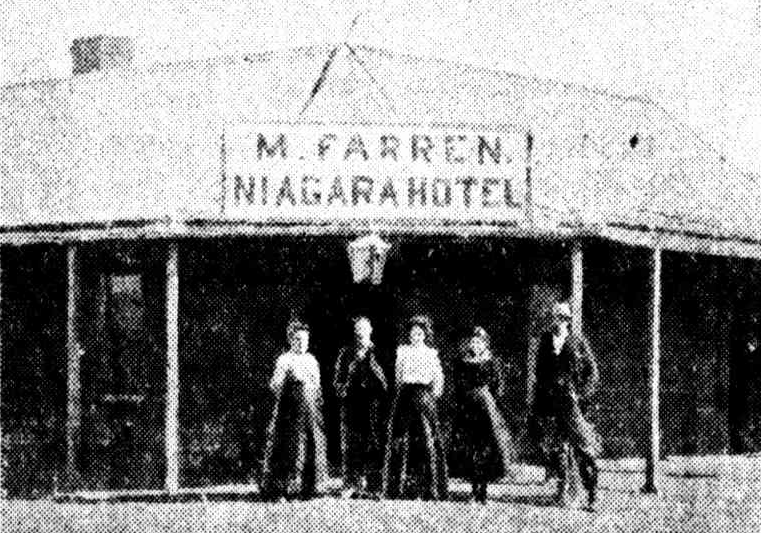
Niagara developed a unique social identity, defined by its central crossroads. The town was unique in Australia for having four hotels—one on each corner—facing each other in the centre of the township. The first was the mud-brick Niagara Hotel, built in 1897 by Tom Farren. These hotels became the focal point of community life; miners and prospectors would gather at the crossroads on pay nights to discuss their problems or participate in two-up schools, which frequently ended in brawls. Fred Wilkinson, licensee of the Great Western Hotel, often acted as a referee to ensure “fair play”.12 13 14
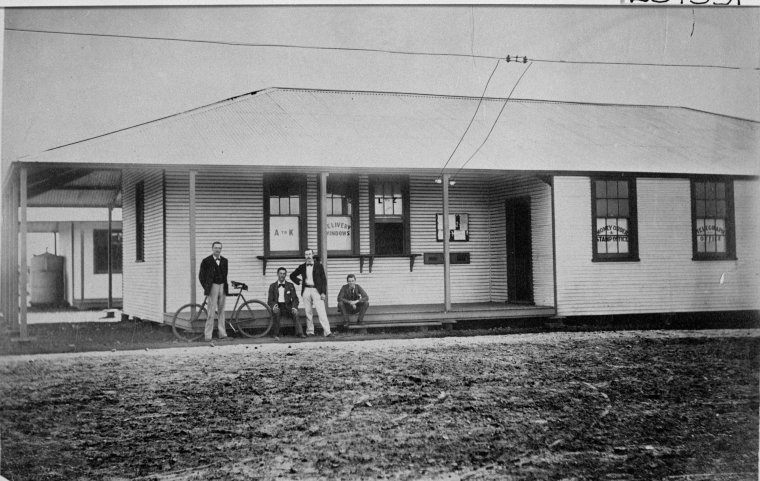
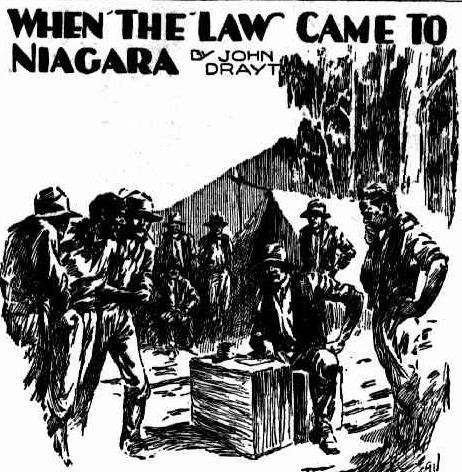
Before formal law was firmly established, Niagara was the site of a famous episode of “bush justice”. Following the death of a vagrant believed to be the heir to an English baronetcy, the town decided to set up its own legal system to avoid future “mistakes”. A local shopkeeper, Charley Jones, was mock-commissioned as a Justice of the Peace. He swore in a constable and presided over several “frame-up” trials, including an insanity case where the prisoner escaped and purloined all the hop beer. The game reached its peak when Jones sat as Coroner for a “murder trial” regarding a tribal riot 20 miles away, offering a £200 government reward for a body he had never seen. This drew the attention of real authorities in Perth, who dispatched a genuine J.P. to investigate, only to report that the locals were merely “having a game” with an idiot.17 18
Environmental and Economic Factors
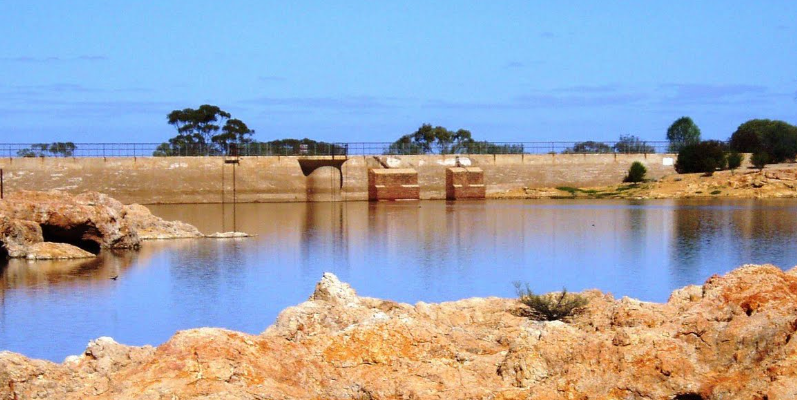
The environment was Niagara’s greatest adversary. Water was perpetually scarce, with the nearest supply initially 40 miles away at Menzies, transported via pack camel. To solve this, the Railways Department invested heavily in the Niagara Dam between 1897 and 1898. Constructed by Coolgardie-based contractors, the concrete wall cost £62,000—well over the tendered price of £42,000—due to miscalculations regarding the depth of the bedrock. Camel trains were used to transport vast quantities of powdered cement over 220 kilometres from Coolgardie.20 21
However, the dam became a notorious “white elephant”. By the time it was finished, it had collected almost no water due to a lack of rain. More importantly, a plentiful supply of good underground water was discovered at nearby Kookynie, rendering the expensive dam redundant for the locomotives it was meant to serve. Economically, the town was also supported by the Niagara State Battery and various mines like the Orion, Emperor, Mikado, and Sapphire.22 23 24
Infrastructure and Health
Despite its short life, Niagara boasted significant infrastructure. A brick and iron hospital with two wards was built by July 1896, though it struggled to remain open after the local doctor departed in 1898. A government school opened in 1900 in the Mechanics Institute, and by 1906, older school buildings from Batavia were shifted to the site to accommodate students. The cemetery, which remains today, recorded 86 graves, illustrating the perils of the era. Mortality was high among the young; children under five years old made up a significant portion of the burials, with causes of death ranging from dysentery and diarrhoea to “dentition exhaustion”. For adults, typhoid was a major killer, claiming nine lives, while mining accidents took seven.26 27
Downturn and Abandonment
The decline of Niagara was as swift as its rise. By 1900, Kookynie had begun to replace Niagara as the regional administrative and economic hub. The police station and court house were removed and re-erected in Kookynie by 1901. By 1903, the population of Niagara had plummeted to a mere 75 residents. By 1905, many of the mud-brick buildings that had once formed a flourishing town were derelict, and the town was officially abandoned by 1909.28 29
The final signs of life flickered out in 1913. The Niagara Hotel closed its doors that year, selling off its entire contents, including a billiard table and a piano. The State Battery conducted its last run in 1913, processing 809 tons of ore for 830 ounces of gold. The school held its last classes in August 1912. By the time Clara Paton reflected on the town in 1952, all that remained were mud-brick fragments and a single pepper tree. Today, the site serves as a quiet camping area, with the unused dam providing a stark memorial to the town’s brief, ambitious existence.30
Timeline
- January 1895: Initial gold discovery by Charles Northmore, J. Timms, and John Alway.
- February 1895: Discovery of the “Challenge” mine by Northmore and Dorrie Doolette.
- February 1896: Niagara Progress Committee requests the declaration of a townsite.
- July 1896: A brick and iron hospital is constructed.
- 6 August 1896: The Kalgoorlie-Niagara telegraph line is completed.
- November 1896: The Niagara townsite is officially gazetted.
- 1897: The mud-brick Niagara Hotel is built at the central crossroads.
- 1897–1898: Construction of the Niagara Dam by the Railways Department.
- May 1900: The hospital is closed.
- 1900: A government school opens in the Mechanics Institute.
- August 1901: The police station is closed and removed to Kookynie.
- 1903: The population declines to 75 people as Kookynie becomes the district centre.
- 1909: The town is officially abandoned.
- 1913: The Niagara Hotel and the State Battery cease operations.
Map
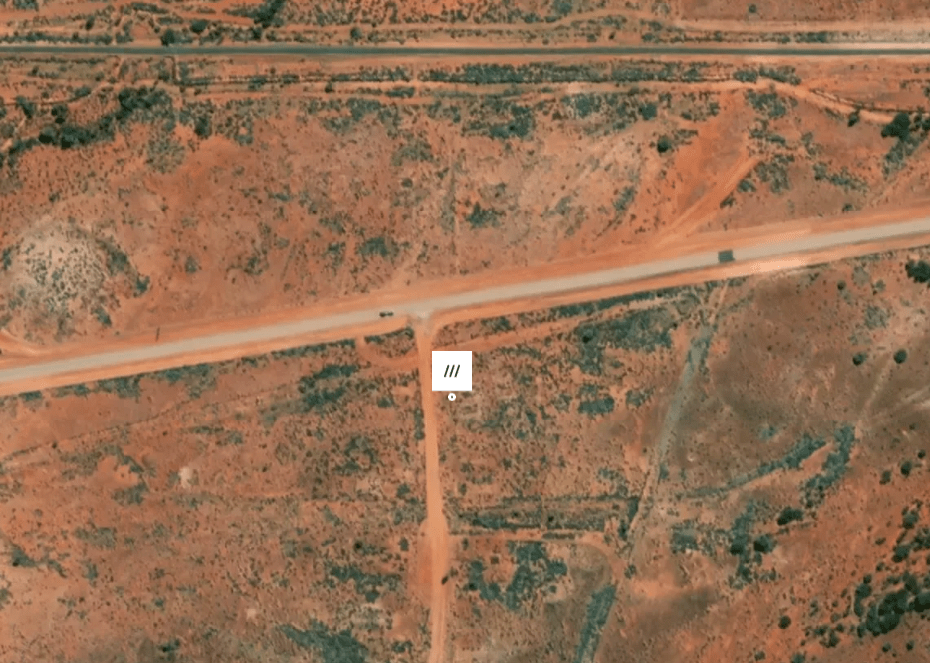
Note: location is just south of Kookynie Road
Sources
- Wikipedia, 2016. Niagara, Western Australia. Retrieved 14 Feb 2026 from https://en.wikipedia.org/wiki/Niagara,_Western_Australia ↩︎
- Lake Darlot Rush. (1895, May 7). Coolgardie Miner (WA : 1894 – 1911), p. 3. Retrieved February 14, 2026, from http://nla.gov.au/nla.news-article216659406 ↩︎
- THE NIAGARA. (1895, June 3). Coolgardie Miner (WA : 1894 – 1911), p. 3. Retrieved February 14, 2026, from http://nla.gov.au/nla.news-article216660175 ↩︎
- NEWS FROM NIAGARA. (1895, July 12). Coolgardie Miner (WA : 1894 – 1911), p. 3. Retrieved February 14, 2026, from http://nla.gov.au/nla.news-article216661162 ↩︎
- Outback Graves Markers, 2026. Niagara. Retrieved 14 Feb 2026 from https://outbackgraves.org/burial-records/location/61 ↩︎
- Sharp, Moya (2024). Outback Family History: When the Law Came to Niagara. Retrieved 13 Feb 2026 from https://www.outbackfamilyhistoryblog.com/when-the-law-came-to-niagara-3/ ↩︎
- State Library of Western Australia, n.d. Illustrations Ltd collection; 8292B/B/120. Retrieved 15 Feb 2026 from https://encore.slwa.wa.gov.au/iii/encore/record/C__Rb2570344 ↩︎
- Landgate, 2022. Town Names. Retrieved 14 Feb 2026 from https://web.archive.org/web/20220314101618/http://www0.landgate.wa.gov.au/maps-and-imagery/wa-geographic-names/name-history/historical-town-names#N ↩︎
- Sharp, Moya, n.d. Outback Family History: Niagara, Western Australia. Retrieved 14 Feb 2026 from https://outbackfamilyhistory.com.au/records/record.php?record_id=472 ↩︎
- mindat.org, n.d. Niagara, Kookynie Goldfield, Menzies Shire, Western Australia, Australia. Retrieved 14 Feb 2026 from https://www.mindat.org/loc-269354.html ↩︎
- State Records Office of WA, n.d. Niagara Sheet 1 [Tally No. 504887]. Retrieved 14 Feb 2026 from https://archive.sro.wa.gov.au/index.php/niagara-sheet-1-tally-no-504887-1278 ↩︎
- Roberts, Mick (2019). Time Gents: Niagara Hotel, Niagara WA. Retrieved 15 Feb 2026 from https://timegents.com/2019/01/20/niagara-hotel-niagara-wa/ ↩︎
- Outback Graves Markers: refers to the four Niagara Hotels ↩︎
- Wikipedia: refers to the four Niagara Hotels ↩︎
- WESTRALIANA (1952, October 30). Western Mail (Perth, WA : 1885 – 1954), p. 29. Retrieved February 15, 2026, from http://nla.gov.au/nla.news-article39354391 ↩︎
- State Library of Western Australia, n.d. Collection of photographs from the Royal Western Australian Historical Society; BA1886/755. Retrieved 15 Feb 2026 from https://encore.slwa.wa.gov.au/iii/encore/record/C__Rb3017073 ↩︎
- Sharp, 2024: refers to examples of bush justice ↩︎
- WHEN THE LAW CAME TO NIAGARA (1927, November 26). Smith’s Weekly (Sydney, NSW : 1919 – 1950), p. 4. Retrieved February 15, 2026, from http://nla.gov.au/nla.news-article234448751 ↩︎
- ibid: hand drawn illustration ↩︎
- ibid: refers to scarcity of water ↩︎
- Shire of Menzies (2026). Niagara Dam. Retrieved 15 Feb 2026 from https://www.menzies.wa.gov.au/niagara-dam.aspx ↩︎
- ibid ↩︎
- Outback Graves Markers: refers to Niagara Dam and other mines in the area ↩︎
- Wikipedia: refers to other mines in the area ↩︎
- Paine, Mel and Paine, Ted (2011). 8th August 2011 – Niagara Dam – Menzies District. Retrieved 15 Feb 2026 from https://nannapopwa.blogspot.com/2011/08/8th-august-2011-niagara-dam-menzies.html ↩︎
- Wikipedia: refers to infrastructure in the town ↩︎
- Outback Graves Markers: refers to health and education infrastructure, the cemetery and the mortality statistics ↩︎
- Roberts: refers to abandonment ↩︎
- Wikipedia: refers to closure of the town ↩︎
- Roberts: refers to the closure of the Niagara Hotel ↩︎
- what3words, 2026. Niagara. Retrieved 14 Feb 2026 from https://what3words.com/grossing.labels.motorcar ↩︎
 People of Western Australia's Ghost Towns