Christine Harris (2026)
Demographics
Region: Pilbara
LGA: Ashburton
Industry:Port
Other Names: Onslow (pre 1926)
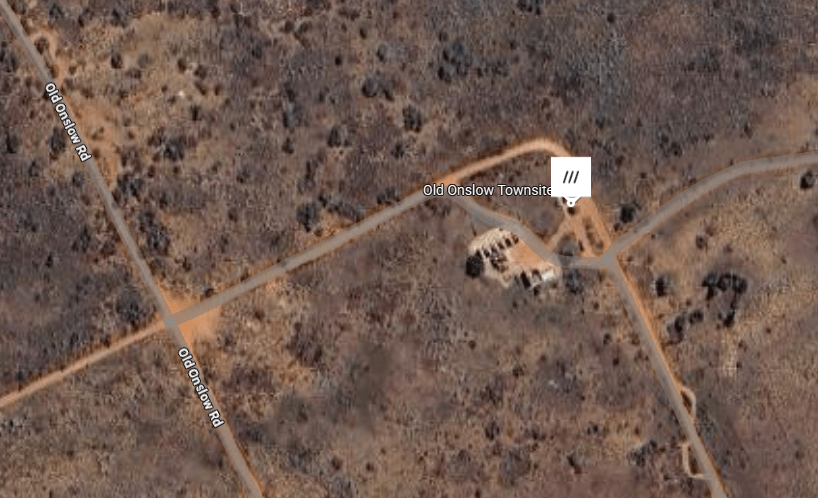
Open Street Map: -21.7119991, 114.9479677
What3Words: ///dull.indignant.purifying
Settled: 1885
Gazetted: 1885
Abandoned: 1925
Abstract
This article explores the historical trajectory of Onslow, Western Australia, from its gazettal in 1885 to its eventual relocation in 1925. Founded at the mouth of the Ashburton River, the town served as a critical maritime gateway for the Pilbara’s burgeoning pastoral industry, specifically the export of wool from stations such as Minderoo and Peedamulla. The narrative examines the economic drivers of the era, including the sheep and pearling trades, and the significant role of Indigenous labour.
A central theme is the town’s persistent struggle against environmental factors. Repeated cyclone damage and the chronic silting of the Ashburton River mouth rendered port operations increasingly untenable. This culminated in the 1923 decision to move the town to the deeper waters of Beadon Point. The logistical feat of this relocation, involving the transport of entire buildings by camel train, marks a unique chapter in Australian frontier history. Finally, the article discusses the post-relocation era, where the original townsite transitioned into a heritage site. Today, the ruins of Old Onslow provide a scientific and cultural record of early colonial life, standing in stark contrast to the modern resource-driven economy of the current Onslow township.
History
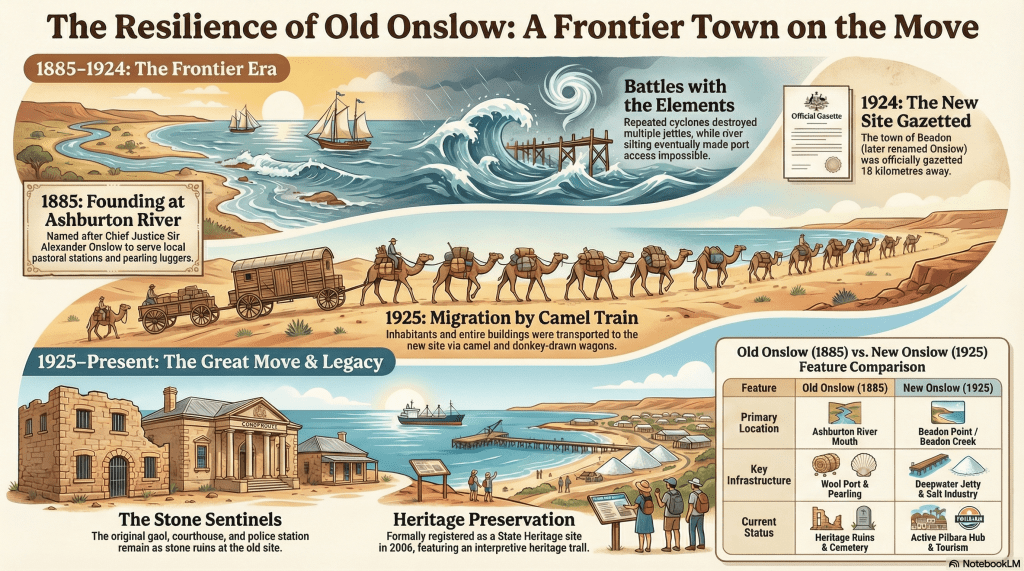
The history of Onslow is a saga of endurance, economic ambition, and a relentless struggle against the unforgiving elements of the Western Australian coast. Originally established at the mouth of the Ashburton River, the town was the lifeblood of the region’s pastoral and pearling industries for four decades before environmental pressures forced a remarkable relocation to Beadon Point in 1925. Today, the ruins of “Old Onslow” stand as a ghostly monument to the pioneers who attempted to tame one of the most cyclone-prone regions in Australia.
Discovery and Gazettal: A Port for the Ashburton
The inception of Onslow was driven by the rapid expansion of the pastoral industry in the Pilbara during the late 19th century. Explorers and early settlers identified the mouth of the Ashburton River as a strategic location for a port to export wool from the sprawling sheep stations emerging along the river’s banks. Before the town’s establishment, the locality was entirely uninhabited by Europeans, though pastoralists like E.T. Hooley had been carting wool through the area as early as the 1860s.1 23 4
On 26 October 1885, the townsite was officially gazetted and named after Sir Alexander Campbell Onslow, the then Chief Justice of Western Australia. The fledgling settlement quickly became a thriving hub. By 1886, it boasted a public house, a general store, and post and telegraph offices. Its primary function was to serve as a supply town and export point for the surrounding stations, such as Minderoo (established in 1882), Peedamulla, and Globe Hill.5 6
Growth and Economic Prosperity
The late 19th century was a period of significant economic growth for Onslow. The pastoral industry dominated the landscape, with sheep farming being the primary pursuit. Major holdings like Forrest, Burt & Co. (Minderoo) and McRae & Harper occupied hundreds of thousands of acres, shoring tens of thousands of sheep annually and producing high-valued wool for the Perth and international markets. This industry relied heavily on the labour of Native Australians, who worked as shepherds, shearers, and team drivers.7
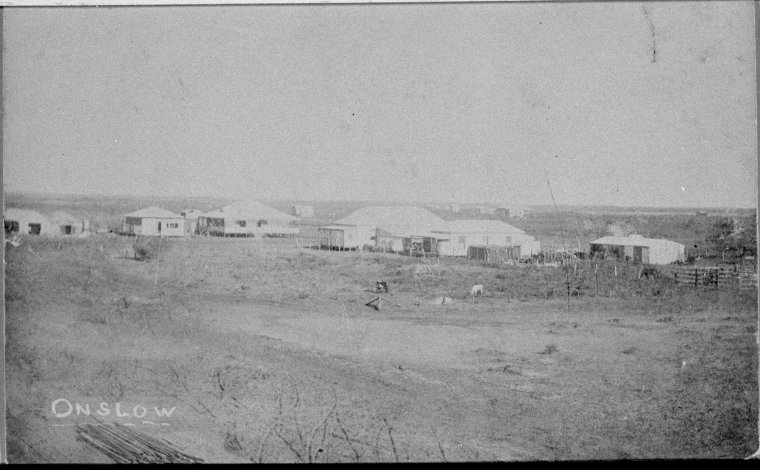
Beyond wool, Onslow’s economy was bolstered by the discovery of pearls in the nearby Exmouth Gulf. The town became the home port for a fleet of pearling luggers, adding a maritime dimension to the social and economic fabric of the community. These luggers remained a common sight in local waters until the outbreak of World War II. The influx of wealth from both land and sea supported a growing population, necessitating the construction of more substantial stone buildings, including a police station, a courthouse, and a hospital.9 10 11 12
Environmental Adversity and the Sinking Town
Despite its economic success, Old Onslow was plagued by its geography. Located a few miles inland from the ocean and adjacent to the river mouth, the town was “hanging grimly on to earth by its fingernails,” constantly battling the “cock-eyed bobs” (cyclones) and dust storms that define the region. The town’s houses were often wired down to prevent them from being swept away by the wind.13 14
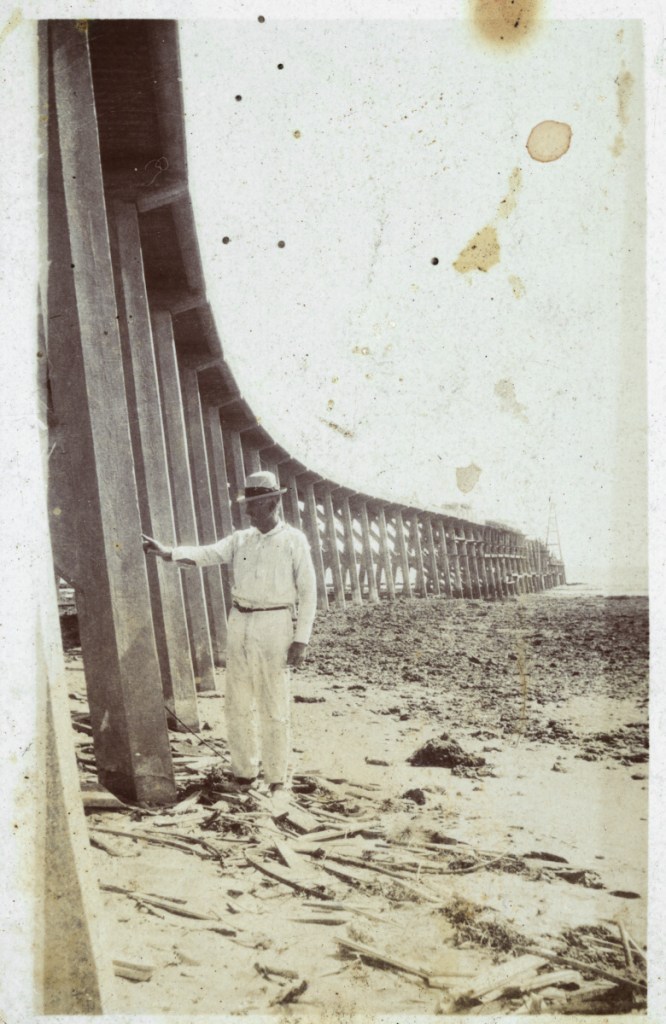
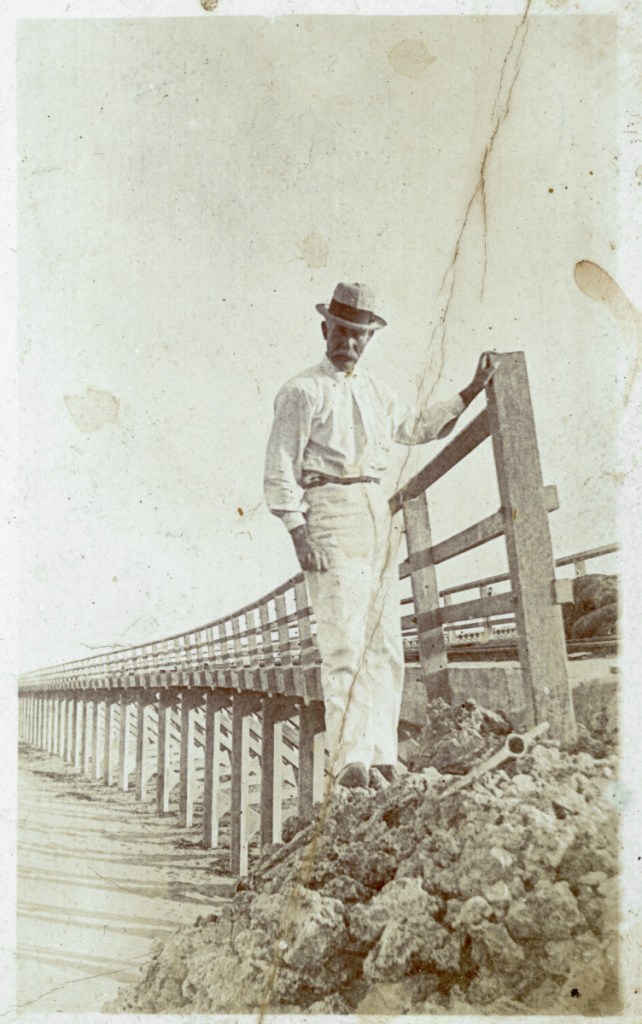
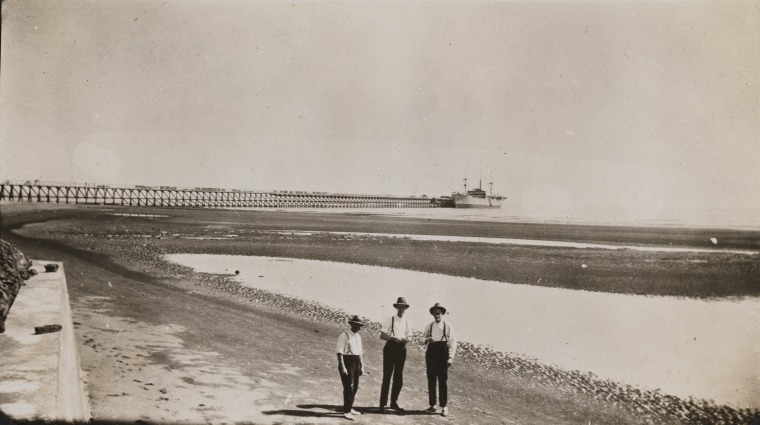
The most significant challenge, however, was the port itself. During the wet season, the Ashburton River would swell with such force that safe mooring was impossible, and the surrounding claypans frequently flooded, isolating the town. To address this, three separate jetties were constructed over the years. The first was destroyed by a massive cyclone in 1897. Subsequent jetties faced a different foe: silting. By 1924, heavy silting at the river mouth rendered the original jetty impractical for large coastal steamers, which were forced to anchor miles offshore while cargo and passengers were ferried to land via luggers and horse-drawn trams.15 16
The Transition to Beadon Point
By 1923, the logistical difficulties and repeated cyclone damage led to a momentous political and economic decision: the entire town would be relocated 18 kilometres up the coast to Beadon Point, where deeper water allowed for a more reliable jetty. This new site offered a significant “economic advantage,” even as some locals lamented the “idiocy” of the confusing nomenclature during the transition period.18 19 20
The relocation process in 1925 was a feat of frontier engineering and persistence. Most of the town’s timber and iron buildings were dismantled and transported to the new site via camel and donkey-drawn wagons. Residents were given blocks at the new townsite corresponding to their holdings in the old town. On 10 January 1924, the new town was gazetted as “Beadon,” though it was shortly thereafter renamed Onslow, leading to a period where the original site was referred to as “Old Onslow” or “Onslow South”. By mid-1925, the new reinforced concrete jetty at Beadon Point was officially opened at a cost of approximately £120,000.21 22 23
Decline and the Legacy of the Site
With the completion of the move, the original townsite was “absolutely abandoned”. Some buildings, like the Mechanics’ Institute Hall, were left to “rack and ruin” for a time before eventually being moved or repurposed. The stone structures that could not be easily moved, the gaol, police quarters, courthouse, and hospital, were left to the elements, slowly becoming the iconic ruins seen today.25 26 27
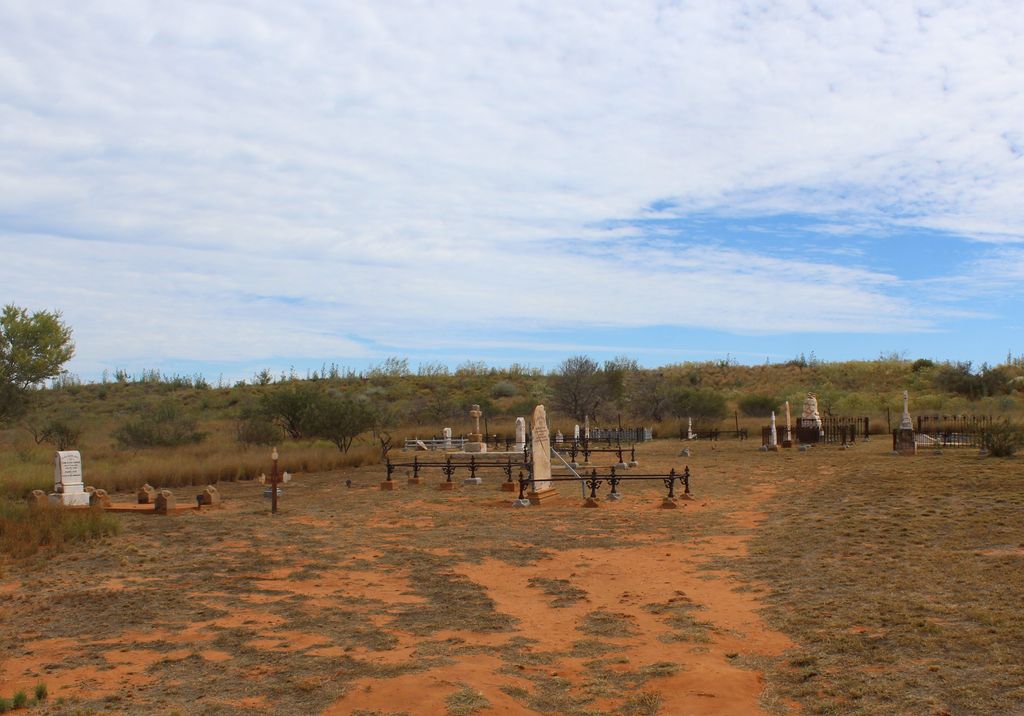
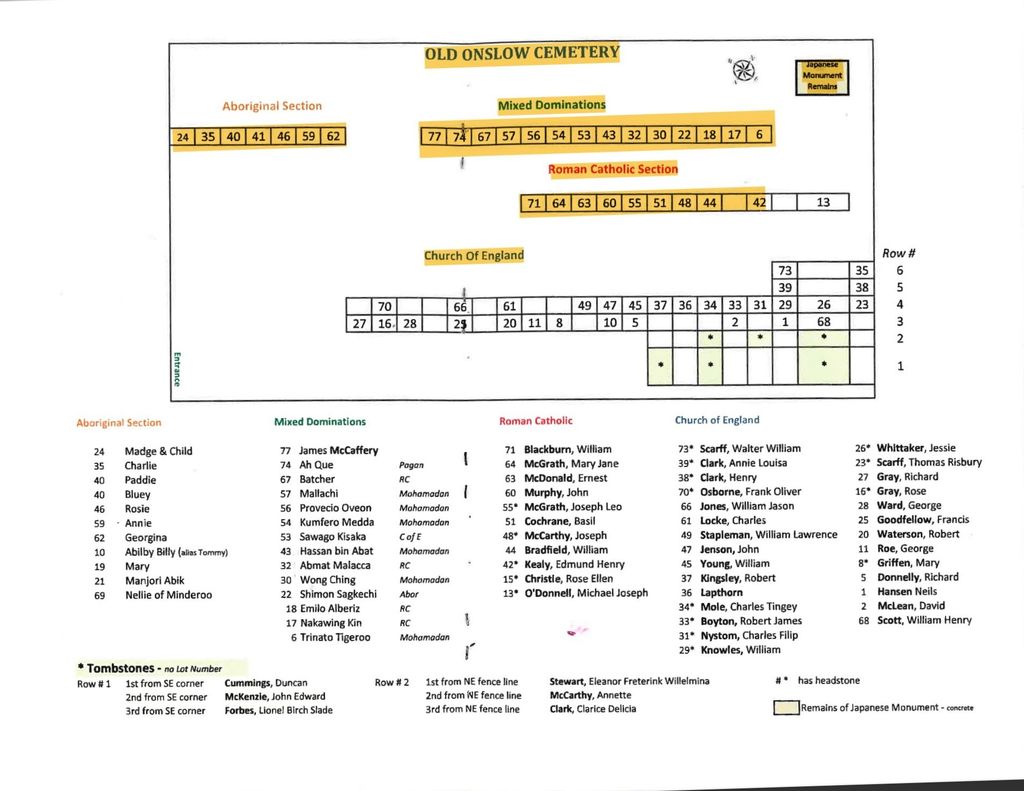
In the decades following the relocation, the site of Old Onslow transitioned from a living community to a heritage landmark. The Old Onslow Cemetery remained a poignant reminder of the early settlers, with graves of pioneers like Robert Waterson, Joseph McCarthy and the Clark family remaining remarkably intact despite the harsh environment.28 29
Heritage and Tourism
In the modern era, Old Onslow has found a new purpose as a site for scientific, cultural, and heritage tourism. Now under the care of the Shire of Ashburton and curated by the Onslow Visitor Centre, the site features restored ruins and interpretive signage that offer a window into the lives of the early pioneers. Visitors can undertake self-guided walks along the heritage trail, exploring the stone remains of the gaol and police station.31

The site is described as having a “ghostly quality” at sunset, leaving visitors with a sense of wonder and a connection to the spirit of the original settlement. While the economic heart of the region has moved to the resource-rich “New Onslow”, Old Onslow remains a vital cultural touchstone, representing the resilient foundation upon which the modern Pilbara was built.
Timeline
- 1882: Minderoo Station established by David Forrest.
- 1885: Onslow townsite gazetted on 26 October at the Ashburton River mouth.
- 1886: The town is a “thriving little settlement” with a hotel, store, and telegraph office.
- 1890: Majority of land along the Ashburton River claimed by pastoral stations.
- 1897: A major cyclone destroys the town’s first jetty.
- 1899: The shipwreck near Point Coates occurs, resulting in the loss of one life.
- 1916: Neil Clark forms the “Wright & Clark” partnership in the original townsite.
- 1923: Official decision is made to relocate the town due to jetty silting and cyclone damage.
- 10 January 1924: The town of Beadon is gazetted at Beadon Point.
- 1925: The physical relocation of buildings and inhabitants occurs via camel and donkey train.
- 10 June 1925: The new Beadon Jetty is officially opened.
- 1926: The new townsite is renamed from Beadon to Onslow.
- 1940s: Pearling luggers are commandeered or destroyed during World War II.
- 2006: The Old Onslow Townsite is added to the State Register of Heritage Places.
Map
Sources
- THE ASHBURTON (1886, May 22). Western Mail (Perth, WA : 1885 – 1954), p. 11. Retrieved February 26, 2026, from http://nla.gov.au/nla.news-article32697208 ↩︎
- Shire of Ashburton (2026) Visit Ashburton: Old Onslow Historic Townsite – Western Australia. Retrieved 26 Feb 2026 from https://www.visitashburton.au/reef/old-onslow ↩︎
- Destination Pilbara (n.d.) Old Onslow. Retrieved 27 Feb 2026 from https://destinationpilbara.com.au/features/attractions/old-onslow ↩︎
- Australia’s North West (n.d.) Old Onslow and Onslow Heritage Trail. Retrieved 27 Feb 2026 from https://www.australiasnorthwest.com/explore/pilbara/onslow/old-onslow-and-onslow-heritage-trail/ ↩︎
- Destination WA (2018). Destination WA – Old Onslow Town. Video retrieved 26 Feb 2026 from https://youtu.be/UkDqD5BQA3g?si=jbg9eqy96G10h2B0 ↩︎
- THE NORTH-WEST. (1925, October 17). The West Australian (Perth, WA : 1879 – 1954), p. 11. Retrieved February 26, 2026, from http://nla.gov.au/nla.news-article31886506 ↩︎
- Western Mail, 1886: refers to pastoral industies ↩︎
- State Library of Western Australia (n.d.) People and places in Western Australia; BA1760/26. Retrieved 27 Feb 2026 from https://encore.slwa.wa.gov.au/iii/encore/record/C__Rb2861630 ↩︎
- Australia’s North West: refers to the growth of the port of Onslow ↩︎
- Shire of Ashburton: refers to early Onslow ↩︎
- Tourism WA (n.d.) Old Onslow Historic Townsite. Retrieved 27 Feb 2026 from https://www.westernaustralia.com/en/attraction/old-onslow-historic-townsite/56b2670e2cbcbe7073ae0e57 ↩︎
- A TOWN TRANSFERRED. (1934, March 31). The West Australian (Perth, WA : 1879 – 1954), p. 13. Retrieved February 26, 2026, from http://nla.gov.au/nla.news-article33011791 ↩︎
- Onslow News. (1926, February 12). Northern Times (Carnarvon, WA : 1905 – 1952), p. 2. Retrieved February 26, 2026, from http://nla.gov.au/nla.news-article74973762 ↩︎
- Onslow, Amethystine And Atomic (1952, May 3). The West Australian (Perth, WA : 1879 – 1954), p. 18. Retrieved February 26, 2026, from http://nla.gov.au/nla.news-article49029655 ↩︎
- ibid ↩︎
- Australia’s North West: refers to extreme weather ↩︎
- State Library of Western Australia (n.d.) Private collection: Photographs of Onslow Jetty ca 1920. Retrieved 27 Feb 2026 from https://encore.slwa.wa.gov.au/iii/encore/record/C__Rb2383294 ↩︎
- Shire of Ashburton: refers to relocation ↩︎
- NTC Contracting (2026). Timeline. Retrieved 27 Feb 2026 from https://www.ntc.net.au/timeline/ ↩︎
- Onslow News. (1925, September 11). Northern Times (Carnarvon, WA : 1905 – 1952), p. 6. Retrieved February 26, 2026, from http://nla.gov.au/nla.news-article74972027 ↩︎
- Shire of Ashburton: refers to establishment of Beadon ↩︎
- A TOWN TRANSFERRED. (1934, March 31). The West Australian (Perth, WA : 1879 – 1954), p. 13. Retrieved February 26, 2026, from http://nla.gov.au/nla.news-article33011791 ↩︎
- BEADON JETTY DESTROYED (1934, March 31). The Kalgoorlie Miner (WA : 1895 – 1954), p. 4. Retrieved February 26, 2026, from http://nla.gov.au/nla.news-article95038117 ↩︎
- State Library of Western Australia (n.d.) Alan Sloan collection of photographs of the North West and Darwin; BA1410/2/84, 157. Retrieved 27 Feb 2026 from https://encore.slwa.wa.gov.au/iii/encore/record/C__Rb4726109 ↩︎
- A TOWN TRANSFERRED. (1934, March 31). The West Australian (Perth, WA : 1879 – 1954), p. 13. Retrieved February 26, 2026, from http://nla.gov.au/nla.news-article33011791 ↩︎
- Onslow News. (1926, February 12). Northern Times (Carnarvon, WA : 1905 – 1952), p. 2. Retrieved February 26, 2026, from http://nla.gov.au/nla.news-article74973762 ↩︎
- Tourism WA: refers to visible ruins ↩︎
- Outback Graves Markers (2026). Old Onslow Cemetery. Retrieved 27 Feb 2026 from https://outbackgraves.org/burial-records/location/787 ↩︎
- Jones, Veronica (2015). Australian Cemeteries: Old Onslow Cemetery. Retrieved 27 Feb 2026 from https://australiancemeteries.com.au/wa/ashburton/old_onslow_data2.htm ↩︎
- Find a Grave (2014). Old Onslow Cemetery. Contributors Jenny Downing (2021) and Heidi Oliver (2025). Retreived 26 Feb 2026 from https://www.findagrave.com/cemetery/2533617/old-onslow-cemetery ↩︎
- Destination WA (2018). Destination WA – Old Onslow Town. Video retrieved 26 Feb 2026 from https://youtu.be/UkDqD5BQA3g?si=jbg9eqy96G10h2B0 ↩︎
- Destinaton Pilbara (n.d.) Historic Old Onslow. Retrieved 27 Feb 2026 from https://destinationpilbara.com.au/features/attractions/old-onslow#lg=1&slide=0 ↩︎
- what3words.com (2026). Old Onslow Townsite. Retrieved 27 Feb 2026 from https://what3words.com/dull.indignant.purifying ↩︎
 People of Western Australia's Ghost Towns