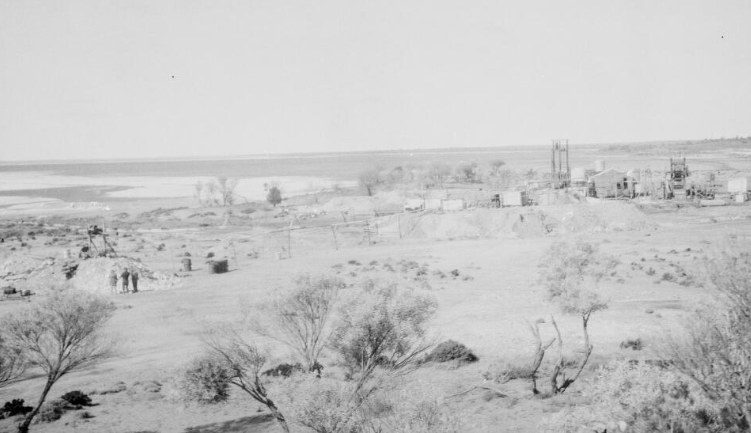
Trove1
Demographics
Region: Goldfields-Esperance
LGA: Menzies
Industry: Gold Mining
Other Names: Pingin, Pin-Gin
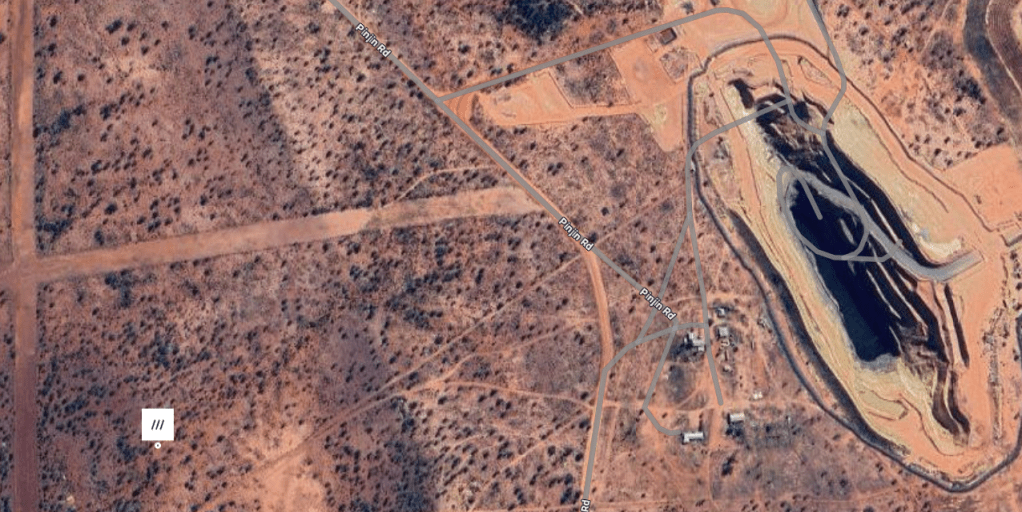
Open Street Map: -29.727657741982995, 122.74474858542384
What3Words: ///smidge.plump.ending
Discovery of Gold: 1897
Gazetted: N/A
Abandoned: 1918
Introduction
The remote Western Australian goldfield of Pingin / Pinjin is defined by a brief, intense gold rush. Following an initial gold find in 1897, prospectors returned in 1904, leading to the erection of a state battery in 1905. The community peaked around 1906, supporting about 50 male residents by 1910, despite operational struggles like a £716 battery deficit. Mining collapsed quickly; the main mine closed in 1915, and the last person left the town in 1918.
History
The history of the remote Western Australian goldfield community known interchangeably as Pingin or Pinjin is a classic tale of the boom and bust cycle that defined the Eastern Goldfields, characterized by periods of intense optimism, struggle against remoteness, and a swift return to the quiet life of pastoralism. Pinjin, the preferred spelling in the WA Post Office Directories, is today recognized primarily as a pastoral station and a ghost town, its name derived from a nearby waterhole of indigenous origin, the original meaning of which has since been lost.
The Gold Rush (1897–1906)
Pinjin is situated in a rugged, isolated region, approximately 166 kilometres north-east of Kalgoorlie via Kurnalpi, or about 220 kilometres south-east of Menzies via Kookynie. Gold was initially discovered here in 1897, but the field was quickly abandoned due to its extreme remoteness and a critical lack of water infrastructure.2
The promise of the region, however, lured prospectors back, marking the true establishment phase of the community. In 1904, prospectors returned to the Pinjin Goldfield, injecting new life into the region. Development accelerated quickly, bolstered by the construction of crucial government infrastructure: a state battery was erected in 1905. This period saw significant mining activity, with operations such as the Anglo-Saxon Mine running a main shaft, photographs of which were published in September 1905. Other notable operations included the Pinjin King Mine and the Shamrock Mine, suggesting a nascent, energetic community centered entirely on mineral wealth.3 4
The small town that grew around the goldfield reached its peak population in 1906. By 1910, the WA Post Office Directory recorded 50 residents, notably showing no women among the listed population, indicating a typical, rugged frontier community dominated by male laborers, miners, and storekeepers. The amenities that sustained this male population included a pub and a shop, missing only a church to complete the standard requirements for a town.5
Commercial Development
Despite the rich mineral potential, the life of the Pinjin community during its peak was fraught with operational challenges, particularly relating to the publicly funded infrastructure meant to support the miners.
A detailed account from J. H. Young, published in The West Australian in November 19076, articulated the frustrations facing the district, countering the perception that the local prospectors were not adequately supporting the battery. Young revealed that the Pinjin public battery had incurred a significant deficit of £716 for the year ending June 30. He fiercely defended the district by pointing out several severe deficiencies attributed to the Mines Department:
- The battery was a 5-head plant, which required the same staffing needed to run a 10-head plant that could crush twice the volume.
- The plant, when installed, was neither up-to-date nor first-class. Numerous costly alterations had to be undertaken over time, including dismantling a useless tailings wheel to erect a new one, enlarging the inadequate bin, and building up the ramp. Further construction included office and living rooms for the manager, and two condensers built at different times.
- Young pointed out that the Mines Department used a “marvellous” system of bookkeeping that charged these capital improvement costs to the battery’s working expenses (“treatment”) instead of the “plant” account.
- To exacerbate the operational chaos, the pumps were a “disgrace,” frequently causing hours of delay.
Young insisted that the delay in crushing stone was attributable primarily to the Department’s red tape and faulty machinery, not the prospectors, and boldly asserted that the district “is proving and will prove itself not only promising, but one of the best paying outside the Golden Mile”.
Decline and Pastoral Transition (1915–1935)
The boom phase proved unsustainable. Following the difficulties reported in 1907, the decline was rapid. The substantial Anglo-Saxon mine ceased operations in 1915. By 1918, the goldfield town had virtually disappeared, with the last person leaving, and the public battery and most mines having long been closed.7
As the mining industry collapsed, the area transitioned back to its established use as a pastoral region. The Pinjin Pastoral Station became the central institution. The station was originally established by Watt Newland, a figure from a prominent South Australian pastoral family, who was able to purchase Pinjin and establish the neighboring Edjudina Station through wealth derived from his gold mines at Yarri and Edjudina. Watt Newland was also known for his support of indigenous causes and was married to an aboriginal woman named Windtharra, also known as Larrikin Kitty. The nearby Edjudina School, serving the wider location, was established in 1908 but closed in 1923, reflecting the general population decrease in the area.8
The pastoral industry endured through the decline of mining. In April 1925, Pin-Gin Station was reported as sold by Messrs. Talbot and Newland to Mr. Percy Kerr at a highly satisfactory price. The isolation of the station meant logistics remained difficult well into the 1930s. An article from October 1933 noted the intense labor involved in “Bringing the clip to the rail head 150 miles from Pinjin Station taking 10 days”. By 1935, Mr R Acton Adams was recorded as the owner of Pinjin Station (100 miles northeast of Kalgoorlie), with Mr Taylor acting as manager. The focus on water conservation was evident, with documented efforts including the ploughing and scooping of a new dam on Pinjin Station.9
Even life on the station carried tragedy, as seen in the death of Sydney Groves, a 40-year-old miner and prospector, who died at Pinjin Station in September 1929. He died by suicide via gunshot outside the men’s quarters. A constable reported that Groves had been in indifferent health for several days and committed the act while “temporarily insane,” leading the Coroner to deem an inquest unnecessary.10
Pinjin Today
Today, Pinjin remains largely a remote locality. The old Pinjin homestead was eventually moved to its present site in the mid-1960s. The Pinjin Pastoral Station is currently run by Tisala Pty Ltd, an indigenous organization.
Despite the historical decline of the gold rush town, the goldfield maintains modern mineral interest. Recent exploration activities (May 2024) by Kalgoorlie Gold Mining (KalGold) have resulted in reports of thick, near-to-surface gold hits at the Pinjin project.11 The company is exploring the area as a potential extension of a larger gold system nearby, where 62,000 ounces have been pulled from open pit operations. However, the sources note that future large-scale mining is currently unlikely due to the presence of the homestead. The region may see increased activity soon due to a planned access road for the Tropicana Gold Mine development further to the north-east.12
The history of Pinjin stands as a powerful reminder of the ephemeral nature of gold rush towns, quickly rising to a 50-person settlement based around mining, struggling with inadequate infrastructure, suffering tragedy, and then fading rapidly, only to be sustained by the enduring pastoral industry and, recently, renewed interest in its deep mineral wealth.
Timeline
- 1897: Gold was first found at the Pinjin Goldfield, but the location was quickly abandoned due to remoteness and lack of water.
- 1904: Prospectors returned to the area.
- 1905: A state battery was erected in Pinjin. The Main Shaft of the Anglo Saxon Mine and the Pinjin King Show were noted.
- 1906: The small town of Pinjin reached its peak. Pingin School was established and closed in the same year.
- 1907 (March 10): Christina Isabel O’Brien, an infant aged 10 weeks, died at the Champion Gold Mine in Pinjin.
- 1907 (November 9): A letter was published detailing the severe operational issues and mismanagement of the Pingin Public Battery, noting a deficit of £716 for the year ending June 30.
- 1908: Edjudina School established on Kurnalpi-Pinjing Road.
- 1909 (June 16): Otto James Bowman, an infant aged 10 1/2 months, died in Pinjin.
- 1910: The WA Post Office Directory recorded 50 residents in Pinjin, notably listing no women.
- 1913 (January 14): Miner Denis Donovan died instantly from a broken neck after a rope snapped while he was being lowered 70 feet into the Unification Gold Mine shaft.
- 1915: The Anglo-Saxon Mine, the most substantial mine on the field, ceased operating.
- 1918: The community went into steep decline; the last person left the town, and the battery and most mines had long closed.
- 1923: Edjudina School closed.
- 1925 (April 26): Pin-Gin Station was sold on behalf of Messrs. Talbot and Newland to Mr. Percy Kerr.
- 1929 (September 24): Sydney Groves, a miner and prospector, died by suicide via gunshot outside the men’s quarters at Pinjin Station.
- 1933 (October 16): An operation involving bringing the sheep clip 150 miles from Pinjin Station to the rail head took 10 days.
- 1934 (approx.): Photographs documented workings near the Pinjin Pastoral Station.
- Mid-1960s: The old Pinjin homestead was relocated to its present site.
- Present Day (Pastoral): Pinjin Pastoral Station is run by Tisala Pty Ltd, an indigenous organization. Future large-scale mining is currently deemed unlikely due to the presence of the homestead.
- Recent (May 2024): Kalgoorlie Gold Mining reported finding thick, shallow gold hits at its Pinjin project.
What’s in a name?
For more than two years, the Ghosts project team have been researching the town of Pingin. Or should that be Pinjin?
Based on the sources we have found so far, it is not possible to give a single date when “Pinjin” became “Pingin,” or vice versa, because both names were used interchangeably and concurrently during the community’s entire history.13 14
However, the sources so suggest some interesting usage patterns:
- Co-existence and Origin: The location is known interchangeably as Pinjin or Pingin. The spelling Pinjin is noted as the preferred spelling in the WA Post Office Directories. The name itself is derived from a nearby waterhole of indigenous origin.15
- Early Usage: Both Pingin and Pinjin appear in early newspaper reports and photo captions relating to the gold boom:
- Photos published in September 1905 referred to the “Main Shaft of the Anglo Saxon Mine Pingin” and “On the Road to Pingin”.16 17
- A letter published in November 1907 discussing issues with the public battery uses the heading “PINGIN PUBLIC BATTERY” and the dateline “Pingin, November 1”.18
- The community ran a school named Pingin School, which was established and closed in 1906.19
- Official and Later Usage: The spelling Pinjin appears consistently in official listings and references to the pastoral station that succeeded the town:
- The WA Post Office Directory for 1910 lists the town as Pinjin.
- An infant death record from 1909 lists the place of death as Pinjin.
- The death of a miner in 1913 occurred at the Unification Gold Mine, Pinjin.
- In April 1925, the pastoral property was referred to with the hyphenated spelling “Pin-Gin”.20
- A news article in 1929 refers to a suicide at Pingin in 1929 and a burial at Pinjin Reserve21
- References to the succeeding pastoral operation in 1933 and 1935 use the spelling Pinjin Station.
Ultimately, the sources conclude that both spellings were utilized at various times, rather than one replacing the other in a definitive manner. Because of the consistent use of Pinjin in official listings, this project will be using Pinjin.
Stories of Life and Loss in Pinjin
Stories of the lives of the community, primarily drawn from cemetery inscriptions and newspaper reports, paint a poignant picture of life’s precariousness in the isolated goldfield.
Mining, the core economic driver, carried immense risk. In an incident reported in January 1913, the community suffered the tragic death of 52-year-old miner Denis Donovan at the Unification Gold Mine. While removing ladders at the bottom of a 70-foot shaft, the rope being used by two men, Frank Jarvis and Donald McIntosh, snapped after Donovan had only been lowered a few feet. Donovan fell 70 feet, sustaining a broken neck, which was presumed to be instantly fatal.
For families arriving in the remote area, infancy was also perilous. The records detail the short lives of two children buried in the Pinjin Reserve Cemetery:
- Christina Isabel O’Brien, born in Pinjin in 1906, died on March 10, 1907, aged just 10 weeks, at the Champion Gold Mine.
- Otto James Bowman, born in Boulder in July 1908, died in Pinjin on June 16, 1909, aged 10 and a half months. Records indicate that of the four children born to his parents, only one survived childhood.
Map
Sources
- Terry, Michael. (). Gold mine at Pinjin Pastoral Station, Pinjin, Western Australia, approximately 1934, 2 Retrieved December 1, 2025, from http://nla.gov.au/nla.obj-191239054 ↩︎
- Mindat, n.d. Pinjin Goldfield, Menzies Shire, Western Australia, Australia. Retrieved 1 Dec 2025 from https://www.mindat.org/loc-269650.html ↩︎
- ibid. ↩︎
- Sharp, Moya, n.d. Outback Family History: Pinjin Pics. Retrieved 1 Dec 2025 from https://www.outbackfamilyhistory.com.au/records/record.php?record_id=997&town=Pingin ↩︎
- Mindat, Pinjin: Refers to the amenities in the town ↩︎
- PINGIN PUBLIC BATTERY. (1907, November 9). The West Australian (Perth, WA : 1879 – 1954), p. 6. Retrieved December 1, 2025, from http://nla.gov.au/nla.news-article28831223 ↩︎
- Mindat, Pinjin: Refers to the decline of the town ↩︎
- Geopeoject Solutions Pty Ltd, 2018. WA Schools Gazetteer. Retrieved 1 Dec 2025 from http://www.geoproject.com.au/News/Schools_gaz_5_excl_preschools_10Dec2018.pdf ↩︎
- THE PINGIN MINES. (1905, September 9). Western Mail (Perth, WA : 1885 – 1954), p. 25. Retrieved December 1, 2025, from http://nla.gov.au/nla.news-article33518040 ↩︎
- Outback Graves Markers, n.d. Sydney GROVES. Retrieved 1 Dec 2025 from https://outbackgraves.org/burial-records/person/1878 ↩︎
- Duffy, Andrew, 2024. Pinjin delivers thick shallow gold hits for KalGold. Retrieved 1 Dec 2025 from https://thewest.com.au/business/bulls-n-bears/pinjin-delivers-thick-shallow-gold-hits-for-kalgold-c-14768194 ↩︎
- Mindat, Pinjin: Refers to current mining in the area ↩︎
- Sharp, Moya, 2023. Pinjin – Ghost Town & Cemetery. Retrieved 1 Dec 2025 from https://www.outbackfamilyhistoryblog.com/pinjin-cemetery-ghost-town/ ↩︎
- Mindat, Pinjin: Refers to the interchangeable naming ↩︎
- ibid. ↩︎
- Sharp, Pinjin Pics. Refers to photos captioned Pinjin ↩︎
- Sharp, Pinjin – Ghost Town: Refers to death at Pinjin ↩︎
- West Australian 1907: Example of early name use ↩︎
- Geopeoject Solutions, Gazetteer: Refers to official use of name Pinjin for the school ↩︎
- EDJUDINA AND PIN-GIN (1925, April 26). Sunday Times (Perth, WA : 1902 – 1954), p. 8. Retrieved December 1, 2025, from http://nla.gov.au/nla.news-article58256974 ↩︎
- ITEMS OF NEWS. (1929, September 26). Kalgoorlie Miner (WA : 1895 – 1954), p. 4. Retrieved December 1, 2025, from http://nla.gov.au/nla.news-article94388128 ↩︎
 People of Western Australia's Ghost Towns