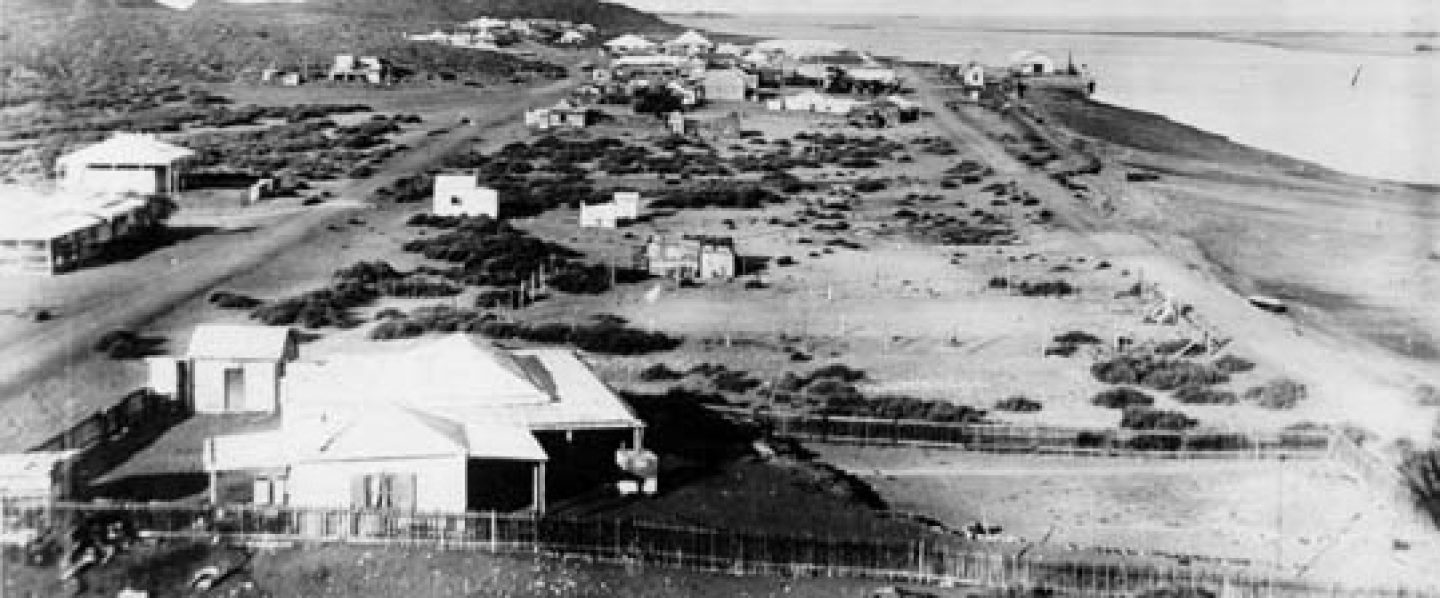
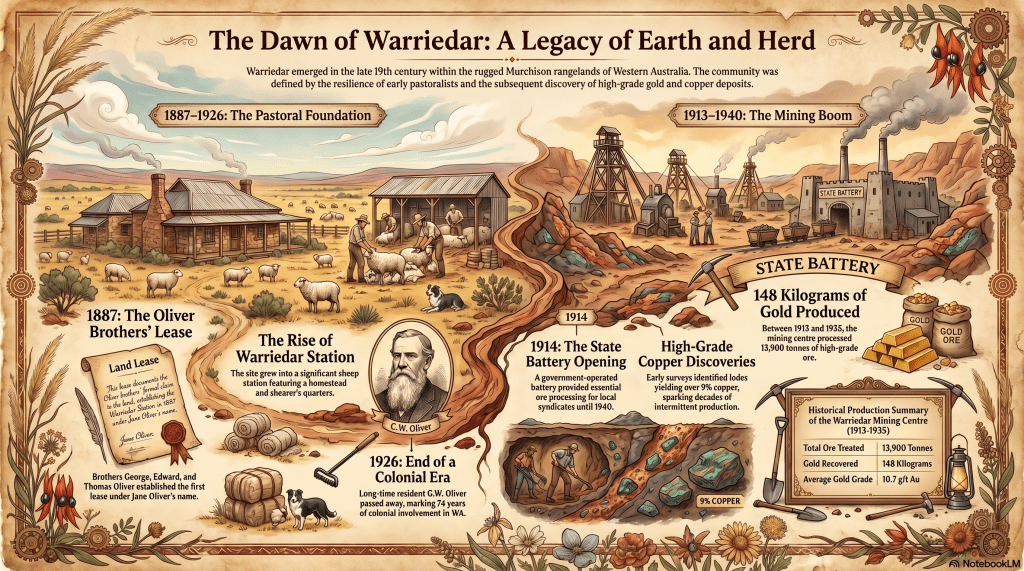
Christine Harris (2026)
Demographics
Region: Mid West
LGA: Perenjori
Industry: Pastoral Station, Mining
Other Names: Warriedar Station, Warriedar Homestead
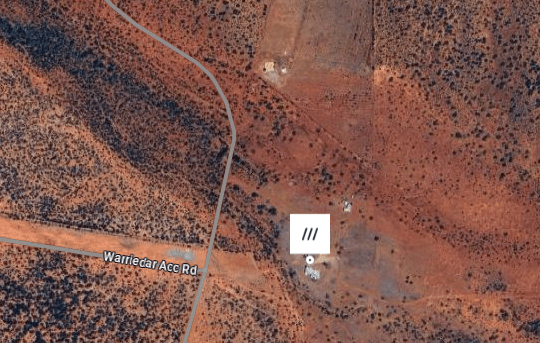
Open Street Map: -29.08942, 117.13077
What3Words: ///rider.controllers.jobless
Settled: 1917
Abstract
Established in 1887 by the Oliver brothers, Warriedar was one of the earliest pastoral leases in the Perenjori district. For over 100 years, its bores provided a reliable lifeline in the semi-arid rangelands, supporting a community that celebrated with city band performances and high-stakes London wool sales. It was a place of human drama, once gripped by the search for three-year-old John Mitherton, who vanished into the surrounding bush in 1933.
In 2006 the Department of Environment and Conservation began returning the 100,000-hectare property to its natural state. By plugging the bores that had run for a century, the homestead was inadvertently transformed into a “corrugated iron tomb”. Animals, drawn by the promise of water, flocked to the homestead only to find dry taps. By 2009, the grounds were littered with sun-bleached bones, rib cages, and the rotting corpses of goats that had crawled into bedrooms seeking shade from the deadly summer heat.
History
Located approximately 400 kilometres north of Perth in the rugged Murchison region, Warriedar stands today as a silent witness to the fluctuating fortunes of Western Australia’s pastoral and mining industries. Now a focal point of the Karara Rangeland Park, the remains of the homestead and the surrounding diggings tell a story of grit, isolated family life, and a constant struggle against a beautiful but unforgiving environment. To understand Warriedar is to look back to the late 19th century, when the first hoofprints of sheep and the first strikes of the pickaxe began to alter the landscape forever.1 2 3 4
The Oliver Dynasty
The documented history of Warriedar began not with gold, but with the pastoral expansion of the 1880s. In 1887, three brothers, George, Edward, and Thomas Oliver, took up the pastoral lease for the land. In a move common for the era’s legal and economic structures, the lease was held in the name of Jane Oliver, wife to one of the brothers. The Olivers were experienced bushmen; Thomas even balanced his pastoral interests by owning an inn at the nearby “Shadow” in Golden Grove.5
The family’s connection to the land was deep and long-lasting. George William Oliver, the patriarch, was a colonist of 74 years who had lived in Geraldton before settling into the station life at Warriedar. His death in September 1926, at the age of 84, marked the end of an era for the local community. His passing was preceded by a final, arduous journey: after attending his son John’s funeral in Yalgoo, George returned home, fell ill, and had to be motored back into Geraldton in a low condition. He left behind a legacy carried on by his surviving children, including Mrs. McNeece of Yalgoo and sons Samuel and Reuben Oliver, who continued to manage Warriedar Station. The family’s presence is still felt by genealogists through records of their registered stock brands, such as the “V0” fire brand used for their horses and cattle.6 7
The Gold Rush and the State Battery
While the Olivers tended their flocks, a different kind of fever was brewing beneath the soil. The district was part of a series of low hills extending to Fields Find, rich in metabasalt, chert, and banded iron formations. Gold was the primary lure, and by the early 1900s, mining syndicates were operating throughout the Warriedar Goldfield.8 9
Historical production between 1913 and 1935 was significant, with 148 kg of gold recovered from roughly 13,900 tonnes of ore. This represented a healthy average grade of 10.7g/t, yet the miners faced chronic economic hurdles. Most were small syndicates working on a campaign basis with very limited access to capital. The townsite itself is known to have flourished between 1920 and 1923, providing a central hub for these artisanal efforts.10 11
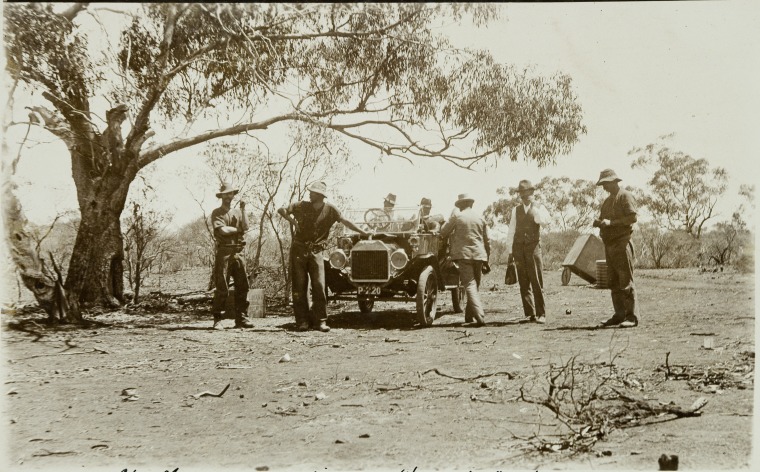
A critical piece of infrastructure during this time was the Warriedar State Battery. However, the very geology that provided the gold also created a technical nightmare. The ore in the region was “cupriferous,” meaning it contained significant amounts of copper. Historically, this copper content caused severe processing problems at the battery, complicating the extraction of gold and hindering the economic viability of some leases. Despite these setbacks, the battery remained a cornerstone of the community until it finally ceased operations around 1940.13 14
A Roll Call of the Community
For those tracing their family history to the region, the records of mining and business leases from 1916 provide a snapshot of the men and women who called Warriedar home. Life in the town was supported by a variety of trades. Thomas Stewart and Thomas White held market garden areas, providing essential fresh produce in a hot, semi-arid climate.
The business district was populated by names that would have been familiar to every resident. Daniel Joseph Egan, May Cain, Henry Herbert Moody, and Charlton Young all held business areas in the town. Other residents included Tista Tongo, Albert John Gericke, and Henry Percy Green. Women played a prominent role in the town’s commercial life; for example, Annie Isabella Fish and May Cain were both active leaseholders. The diversity of the residents, from local labourers like William Ernest Lethlean to those with interests further afield, such as Peter Coyne of Fremantle, speaks to the town’s role as a regional crossroads.15
Anecdotes of Survival
Life at Warriedar was never easy, and the local news of the day frequently highlighted the environmental and social risks. One of the most harrowing stories occurred in September 1933, when Joseph Mitherton of Warriedar Station arrived in Yalgoo at 11 p.m. with devastating news. His three-year-old son, John, had been lost in the bush. The isolation of the station meant that help was 60 miles away, but the community responded immediately. Constable Maddiford and a tracker were dispatched into the scrub to search for the young boy, a reminder of the constant danger the environment posed to the most vulnerable members of the community.16 17
The physical demands of station life also took their toll on the adults. A few years earlier, in 1926, Keith Grant was watching bullocks on the nearby Polela Station when a bullock charged his horse. The horse fell, throwing Grant heavily against a post and causing painful injuries to his face. He was seen in Geraldton days later, his face entirely “swathed in bandages,” a stark image of the everyday violence inherent in working with semi-wild livestock.18
The Copper Transition and Economic Shift
As the gold deposits became harder to work with the limited capital available to local syndicates, the town’s economic focus shifted towards its copper potential. Warriedar eventually became a high-grade copper operation, particularly between 1958 and 1969. During this final industrial boom, the mine produced over 2,200 tonnes of cupreous ore at a remarkably high grade of 9.83% copper.19 20
The landscape around the mine still bears the marks of this era, with two shafts descending to 25 metres and clear signs of small-scale modern mining, including a gravel airstrip and various mullock piles. This period sustained the region’s economic relevance long after the “golden years” of the 1920s had faded into memory.21
The Decline
The environment has always dictated the terms of life at Warriedar. The climate is “Hot semi-arid,” characterized by mean maximum temperatures that frequently exceed 37°C in January. Rainfall is sparse and unreliable, making permanent water sources the single most important factor for both humans and animals.22 23
By the late 20th century, the pastoral era was winding down. In 2006, the Department of Environment and Conservation (DEC) took control of the 100,000-hectare property with the goal of returning it to its natural state. This transition brought about a significant environmental and ethical conflict. As part of the restoration process, the DEC began plugging the bores that had provided water to the region for over a century.24
By 2009, the homestead had been abandoned by its last tenants for six months. The plugging of the final wells proved fatal for the region’s feral animal populations, which had grown dependent on the artificial water sources. Desperate goats and their kids were found huddled near rusted, dry taps on the side of the weatherboard house, and some were found dead inside the dilapidated bedrooms, having sought shade from the “stinking summer heat”. This period represented a dark chapter in the station’s history, where the “siren call” of the old water sources led to a graveyard of bleached bones in the dust.25
Preservation and the Future
Despite the desolation of the early 2000s, a new chapter of conservation has begun. The Warriedar Homestead and its nearby shearers’ quarters are now managed as part of the Karara Rangeland Park. While the park is managed by a small ranger team based at Thunder Lara, the physical preservation of Warriedar’s heritage has largely fallen to the hands of volunteers.26
The group Track Care WA has been instrumental in “breathing new life” into the structures. These volunteers, many of whom are retirees or semi-retired, travel vast distances to perform essential maintenance on buildings that are now over 100 years old. They repair damage from “Willy Willy” storms and clear the “broken glass and children’s toys” that once littered the dry soil. 27 28
Today, visitors can camp at Warriedar and experience a “step back in time”. The homestead remains in good condition, and a well with a hand pump still offers a taste of the life the Olivers once led. During the wildflower season, the red sand comes alive with Drummond’s Everlasting Daisies, Silver Tails, and the brilliant flower heads of Hakea bucculenta, offering a glimpse of the rangelands’ natural beauty that the original pioneers would have known.29
Warriedar is no longer a bustling mining town or a thriving sheep station, but as a site of historical significance, it remains a literal “goldmine” of heritage. Its journey from an 1887 lease to a modern conservation park reflects the broader history of Western Australia – a story of ambitious dreams, environmental reality, and an enduring respect for the people who first dared to call this remote country home.
Timeline
- 1887: Three brothers—George, Edward, and Thomas Oliver—take up the first pastoral lease in the name of Jane Oliver.
- 1899: Mining fatalities recorded at the nearby Fields Find Mine.
- 1913–1935: Period of historical gold production at the Warriedar Mining Centre, yielding 148 kg of gold.
- 1914: A government geologist provides a detailed report on the 18-acre gold and copper leases.
- 1920–1923: The peak period of existence for the gold mining townsite.
- 1926: Death of patriarch George William Oliver, a colonist of 74 years and resident of Warriedar Station.
- 1928: Registration of the “V0” horse and cattle brand to C. R. V. Oliver of Warriedar.
- 1933: A major search is conducted for John Mitherton, a three-year-old lost in the bush near the station.
- ~1940: Closure of the Warriedar State Battery.
- 1958–1969: High-grade copper mining operations produce over 2,200 tonnes of ore.
- 2006: The Department of Environment and Conservation takes control of the 100,000ha property for conservation.
- 2009: Final decommissioning and plugging of the station’s historic bores.
- Recent Years: Major restoration projects undertaken by Track Care WA on the shearers’ quarters and homestead
Map
Sources
- The 4W Driver’s Guide (2024). Warriedar Station Homestead Revival: A Journey of Restoration | Track Care WA. Retrieved 16 Apr 2026 from https://youtu.be/y0JNQ8LWEss?si=A6BPJYHQEsfdg_wM ↩︎
- Tempest Minerals Ltd (2026). Warriedar West. Retrieved 16 Apr 2026 from https://tempestminerals.com/warriedar-west/ ↩︎
- Catanzaro, Joseph (2009). Derelict station a lure to death. Published in The West Australian, 30 Dec 2009; retrieved 16 Apr 2026 from https://thewest.com.au/news/wa/derelict-station-a-lure-to-death-ng-ya-226282 ↩︎
- Heritage Council of WA (2016). inHerit: Warriedar Homestead Ruins (Original). Retrieved 16 Apr 2026 from https://inherit.dplh.wa.gov.au/public/inventory/details/c8481687-187a-43d9-8c24-c76cf629f0e0 ↩︎
- ibid ↩︎
- Geraldton Guardian For Country, Faith and Justice. SATURDAY, SEPTEMBER 18th, 1926. (1926, September 18). Geraldton Guardian (WA : 1906 – 1928), p. 2. Retrieved April 18, 2026, from http://nla.gov.au/nla.news-article67216746 ↩︎
- WA Gov Printer (1928). Government Gazette: Horse and Cattle Brands. p.2546. Retreived on 18 Apr 2026 from https://www.legislation.wa.gov.au/legislation/prod/gazettestore.nsf/FileURL/gg1928_056.pdf/$FILE/Gg1928_056.pdf?OpenElement ↩︎
- Hudson Institute of Mineralogy (2025). Warriedar Mine, Fields Find Goldfield, Warriedar Station, Yalgoo Shire, Western Australia, Australia. Retreived 18 Apr 2026 from https://www.mindat.org/loc-264468.html ↩︎
- Tempest Minerals: refers to early history as well as more recent developments ↩︎
- ibid ↩︎
- Western Australia Now and Then (2026). Warriedar. Retrieved 18 Apr 2026 from https://www.wanowandthen.com/ghost-towns24.html ↩︎
- State Library of Western Australia (n.d.) Photographic record of trips by Sydney J. Yeo to the North-West; BA1837/86. Retrieved 16 Apr 2026 from https://encore.slwa.wa.gov.au/iii/encore/record/C__Rb2600788 ↩︎
- Hudson: refers to State Battery ↩︎
- Tempest Minerals: refers to State Battery ↩︎
- WA Gov Printer: refers to various mining and business dealings ↩︎
- Catanzaro, Joseph (2009). Derelict station a lure to death. The West Australian, 30 Dec 2009 retrieved 19 Apr 2026 from https://thewest.com.au/news/wa/derelict-station-a-lure-to-death-ng-ya-226282 ↩︎
- LITTLE BOY LOST IN BUSH (1933, September 26). Western Argus (Kalgoorlie, WA : 1916 – 1938), p. 23. Retrieved April 19, 2026, from http://nla.gov.au/nla.news-article34622418 ↩︎
- Geraldton Guardian For Country, Faith and Justice. SATURDAY, SEPTEMBER 18th, 1926. (1926, September 18). Geraldton Guardian (WA : 1906 – 1928), p. 2. Retrieved April 19, 2026, from http://nla.gov.au/nla.news-article67216746 ↩︎
- Stockhead (2023). In the Shadow of the Headframe: Warriedar is sitting on a literal goldmine. Retrieved 19 Apr 2026 from https://stockhead.com.au/resources/in-the-shadow-of-the-headframe-warriedar-is-sitting-on-a-literal-goldmine/ ↩︎
- Hudson: refers to later mining period ↩︎
- ibid: refers to continuity of mining activity ↩︎
- ibid: refers to weather statistics ↩︎
- Exploroz (n.d.) Warriedar – WA. Retrieved 19 Apr 2026 from https://www.exploroz.com/places/60179/wa+warriedar ↩︎
- Stockhead: refers to recent activity ↩︎
- Catazaro: refers to ruins ↩︎
- The 4W Drivers Guide: refers to preservation ↩︎
- ibid ↩︎
- Exploroz: refers to volunteer efforts ↩︎
- ibid: refers to local flora ↩︎
- What3Words (2026). ///rider.controllers/jobless. Retrieved 19 Apr 2026 from https://what3words.com/rider.controllers.jobless ↩︎

