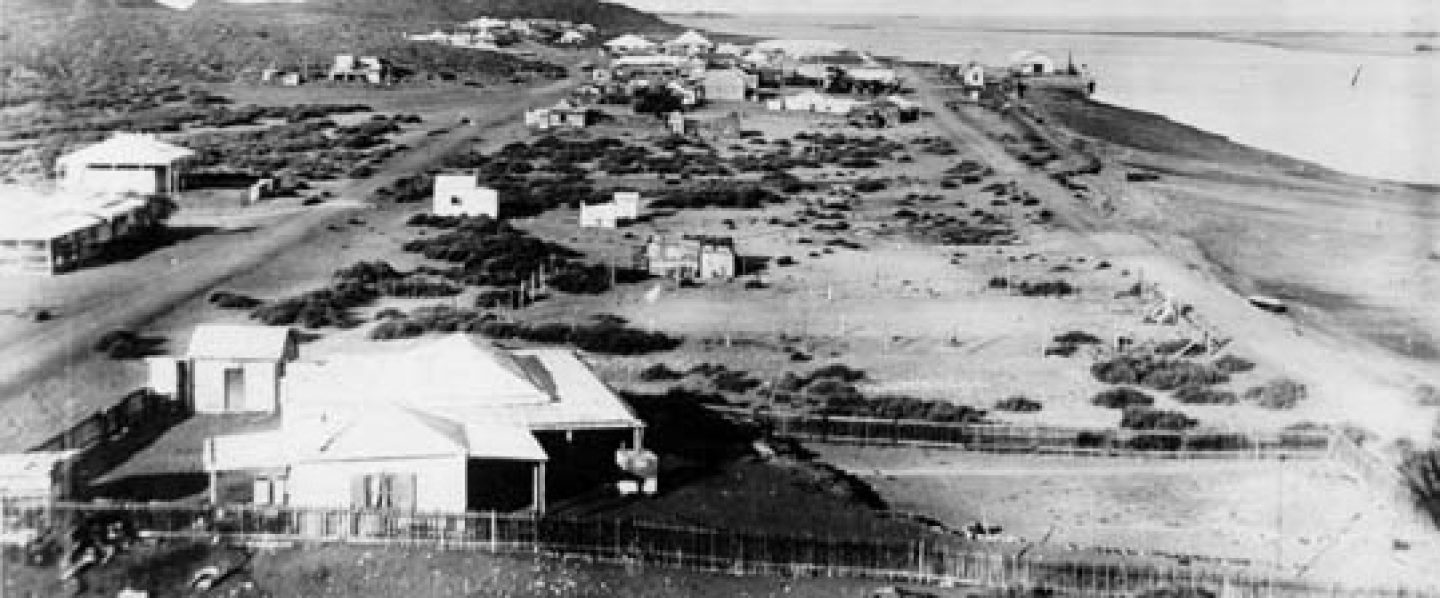
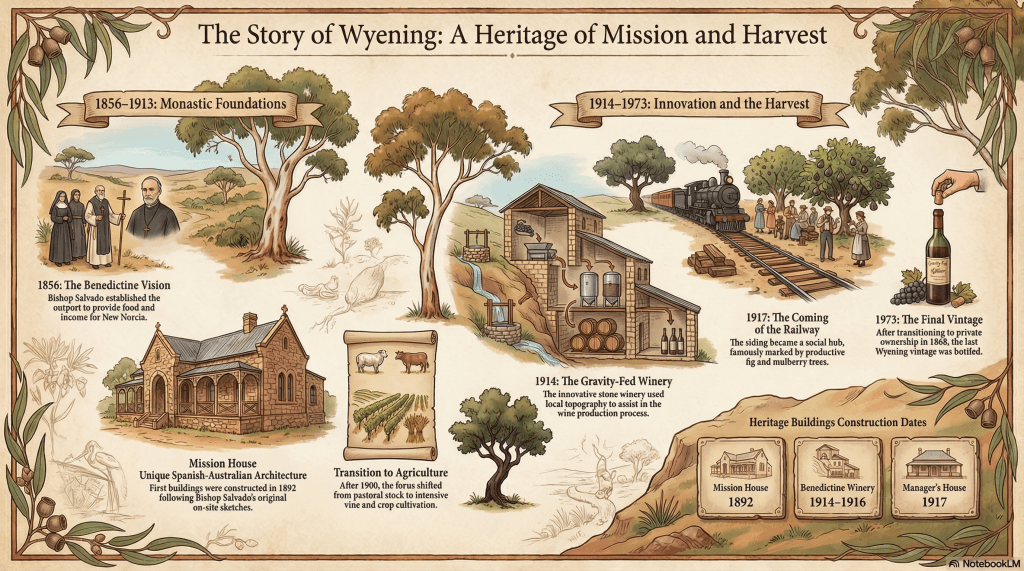
Christine Harris (2026)
Demographics
Region: Wheatbelt
LGA: Victoria Plains
Industry: Mission and Vineyard/Winery
Other Names: Wyaning, Wyening Mission, Wyening Siding, 8 Mile Siding
Open Street Map: -31.184572862035374, 116.48811298512739
What3Words: ///loading.minimalists.shower
Settled: 1856
Gazetted: 1921
Abstract
This article explores the multi-layered history of Wyening, Western Australia, from its origins as traditional Yued Noongar country to its development as a pivotal monastic outstation. Established by Bishop Rosendo Salvado in the mid-1850s, Wyening served as a pastoral anchor for the New Norcia mission before Abbot Fulgentius Torres transformed it into a centre for viticulture in the early 20th century. The narrative traces the town’s economic shifts, from the early pastoral runs of the Phillips and Mackintosh families to the “waving green” wheat fields of the Clarkson brothers and the mechanical innovations of the 1910s.
The article details the environmental and political factors that shaped Wyening, including the arrival of the “8-mile” railway siding in 1916 and the impact of the Midland Railway Company’s land policies. It highlights the social fabric of the community, illustrated through anecdotes of pioneers like the meticulously farming Fred Cook and the prosperous James Twine. A significant portion is dedicated to the Wyening Mission Winery, documenting its technical innovations and the legacy of winemaker August Schwarzbach. Finally, the article examines the town’s transition through the 1969 land swap with the Benedictine community and the modern efforts to preserve its architectural and cultural heritage, ensuring that Wyening’s “place of fear” name is now associated only with a deep respect for its enduring history.
History
Nestled approximately 123 kilometres north-east of Perth within the Shire of Victoria Plains, the locality of Wyening stands as a testament to the diverse forces that shaped the Western Australian Wheatbelt. To the casual observer, it is a landscape of rolling red loam and vast paddocks, but for the local historian and genealogist, Wyening represents a unique intersection of Spanish monastic tradition, Aboriginal survival, and the gritty determination of early pioneers.1 2
Ancient Roots
Long before the first European footprints marked the red soil, the Wyening area was the domain of the Yued people, a sub-group of the Noongar nation. Their spiritual connection to the land is anchored in the “Creation Time,” when the water serpent, the Waugal, carved the bed of the nearby Moore River. For the Yued, water was not merely a resource but the life force of the Waugal itself.3
The name “Wyening”, alternatively spelt Wyaning in early records, carries a heavy etymological weight. In the local Noongar dialect, it is said to mean “place of fear” or “place of snake.” This nomenclature reflects the environmental realities of a landscape that was as treacherous as it was fertile, dominated by thick salmon gum forests and interspersions of York gum and jam trees.4 5
The Benedictines
European history in Wyening began in earnest with the vision of Bishop Rosendo Salvado, the founder of the New Norcia mission. In 1856, Salvado took up the first land at Wyening, establishing it as one of a network of pastoral stations intended to provide the Benedictine community with both food and income.6 7 8
In these early decades, Wyening was a remote frontier. Flocks belonging to families like the Phillips and Mackintoshes wandered the light sandplain country at will. The Benedictine community ran both sheep and horses here, with the first buildings constructed directly from Bishop Salvado’s on-site sketches. These early structures, including barns and stables, were built with a singular purpose: self-sufficiency. The monks shared the land with the Yued people, who often served as shepherds, though the 1905 Aborigines Act would later bring many of these local families under harsh government control, restricting the movements and lives of the very people who had helped the mission survive its infancy.9 10 11 12
The Wheat Boom and the Early Pioneers
As the 19th century gave way to the 20th, the economic focus of the region shifted from the nomadic grazing of sheep to the systematic cultivation of wheat. This transition was driven by pioneers who saw “the finest country in the State” in the rich red loam of the Victoria Plains.
One of the most notable figures was Fred Cook who established his farm, Oaklands, near the mission station. Cook was legendary for his meticulous farming practices. A travelling scribe in 1914 found him busily harrowing a crop that had already been drilled. When questioned, Cook replied simply, “I believe in farming properly”. His dedication paid off; despite decades of continuous tillage, his land in 1913 yielded a handsome 22 bushels of wheat to the acre.13 14
Another success story was James Twine, who struck out into the forests beyond Wyening in 1903. Settling at Yulgering, Twine transformed 4,200 acres of “wilderness” into a showplace homestead. By 1914, he was running a motor car and raising a “fine healthy family,” a feat made possible by his yields of 26 bushels to the acre. Twine was a born farmer, following in the footsteps of his father, one of the earliest settlers between Northam and Toodyay.15
The Clarkson brothers, Lionel, B.L., and H.W., also left an indelible mark on Wyening’s history. Within just four years leading up to 1914, they cleared over 12,000 acres of virgin bush. Their holdings extended from Bolgart to Wyening, creating what observers described as a “continuous waving field of grain” that was an inspiration to all who drove through the district.16
Political and Economic Hurdles
The rapid development of Wyening was not without its political frustrations. For years, huge tracts of land were locked up by the Midland Railway Company, a London-based syndicate that acquired immense blocks to the perceived detriment of local settlers. Settlers looked upon the company’s actions with a great deal of suspicion, feeling that the government had financed a few “impecunious London company promoters” at the expense of the people.18
Furthermore, infrastructure often lagged behind settlement. The Public Works Department’s decision to locate the railway yards in “the only bog-hold in the district” was a source of local mystery and frequent inconvenience.19 20
The Arrival of the Railway
The year 1916 marked a turning point for Wyening with the arrival of the railway extension from Bolgart. The Wyening Siding, also known as the “8-mile siding”, became the town’s heartbeat. It wasn’t just a place for transport; it was a social hub. A large white gum tree near the siding became a favourite spot for residents to sit and have a beer when the cases were unloaded from the trains.21 22
The ganger (railway foreman) was stationed at Wyening, living in a house that also doubled as the post office and telephone exchange. This exchange was a vital lifeline, providing a social link for farm women who were often isolated by the demands of rural life. Even the flora of the siding became part of the local economy; everyone in the area reportedly made jam from the mulberry and fig trees that grew there.23 24
A Spanish Legacy in the Bush
If wheat was Wyening’s economic backbone, wine was its soul. Following the death of Bishop Salvado in 1900, his successor, Abbot Fulgentius Torres, implemented sweeping changes. Ambitious and visionary, Torres pivoted Wyening from a pastoral station to a centre for viticulture.25 26 27
Between 1914 and 1916, the Benedictine Winery was constructed. The stone building was a masterpiece of technical innovation for its time, cleverly using gravity and the local topography to assist in the winemaking process. It was the only vineyard in the Western Australian Wheatbelt and one of only two in Australia owned by a religious organisation.28
For decades, the Wyening Mission provided altar wine for Catholic churches across the State. The monks themselves were famously allowed “half a bottle of wine each, per day.” The winery’s success was revitalised in 1949 with the arrival of August Schwarzbach, a Slovenian merchant and winemaker who migrated from Naples on the ship Anna Salen. Schwarzbach, accompanied by his wife Angela and their sons, settled in Bolgart before taking over the Wyening vintage. His tenure lasted until his retirement in 1973, the same year the last Wyening vintage was bottled.29
Social Life and Education
Community life in Wyening was vibrant and self-made. In March 1921, the Toodyay Herald reported on an annual concert held at the Wyening Mission House. A “splendid programme” was enjoyed by a large audience, showcasing the residents’ commitment to culture despite their rural isolation.30
Recreation was equally important. By 1914, a racecourse and cricket pitch had been established on Fordham Road. These grounds were the scene of many weekend social gatherings, where families from surrounding districts would meet to escape the rigours of farm work.31 32
Education followed the railway. The Wyening School was established in 1919 on Fordham Road. Though it closed in 1938, it remains a point of interest for genealogists, as records list teachers such as Mary Davenport (1920–1922), Freda Brehaut (1926), and Vida Baskerville (1935–1936) who taught generations of local children.33 34
Droughts and Earthquakes
The environment was a stern master. The droughts of 1912 and 1914 were critical tests of survival for the district. Settlers relied heavily on the Bolgart Springs and the government-built dams at the Wyening Reserve. These water sources were so essential that they provided the Calingiri town supply until scheme water was finally connected in 1961.35
The earth itself was not always stable. On 11 March 1952, a magnitude 5.2 earthquake rocked the region, an event felt as far away as Perth. The tremors caused visible damage to the area’s stone architecture, including a collapsed wall at the nearby historic Clunes Flour Mill.36
Today at Wyening
The Benedictine era at Wyening came to an end in 1969. The community negotiated a land swap deal, exchanging Wyening farm for land closer to New Norcia. This brought the property into private ownership for the first time in over a century.38
Today, the Wyening Mission Group, including the Mission House, Winery, Manager’s House, and the “Walkabout Cottage”, is a State Registered heritage site. Though the winery has been quiet since the last vintage in 1973, the spirit of the place is kept alive through annual events. Each March, the Wine and Cheese Night is held, inviting locals and visitors alike to enjoy an evening of music and history.39
The buildings are gradually being restored by their private owners, ensuring that the legacy of Bishops Salvado and Torres, the skill of August Schwarzbach, and the hard work of pioneers like Fred Cook are not forgotten. Wyening remains a profound chapter in the story of Western Australia, a place where the red loam of the Wheatbelt was once stained by the purple of the grape and the sweat of the frontier.
Timeline
- 1836: George Fletcher Moore discovers a spring in the area, describing it as “rich ground covered with active springs.”
- 1856: Bishop Rosendo Salvado takes up the first land at Wyening as a pastoral outstation for New Norcia.
- 1870s: Petty thefts by “Light-fingered Felix” Murphy highlight early social tensions in the wider district.
- 1900: Abbot Fulgentius Torres succeeds Salvado; the mission’s focus shifts from pastoral to agricultural/viticultural.
- 1903: James Twine establishes Yulgering, clearing vast tracts of forest.
- 1909–1913: The Clarkson brothers clear 12,000 acres, pioneering large-scale wheat farming.
- 1914: Construction begins on the Benedictine Winery; the Wyening racecourse and cricket pitch are established.
- 1916: The railway siding (“8-mile siding”) is constructed, and a government dam is built for railway water.
- 1917 (May 24): The railway line from Wyening to Calingiri is officially opened.
- 1919: The Wyening School is established on Fordham Road.
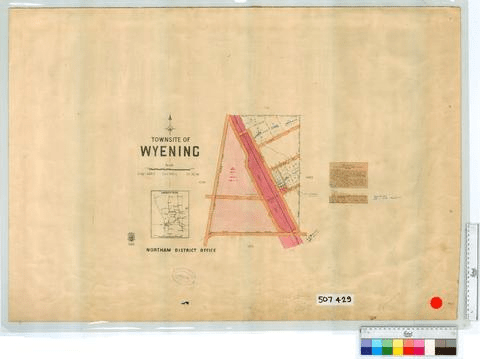
- 1921: The Wyening townsite is formally gazetted.
- 1938: The Wyening School closes.
- 1949: Winemaker August Schwarzbach arrives from Slovenia to revitalise the winery.
- 1952 (March 11): A magnitude 5.2 earthquake strikes the district.
- 1961: Scheme water is connected, ending reliance on the Wyening Reserve dam.
- 1969: The Benedictine community exchanges Wyening farm for land nearer New Norcia; the property becomes privately owned.
- 1973: August Schwarzbach retires, and the last Wyening vintage is bottled.
- 1998 (April 7): The Wyening Mission Group is entered onto the State Register of Heritage Places.
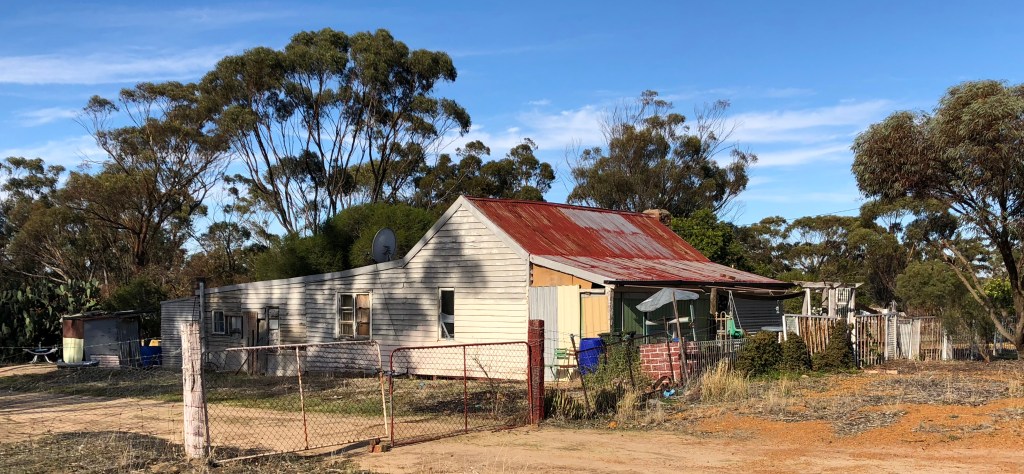
- 2020: The last house at Wyening Siding was destroyed by fire.
Map

Sources
- Through the Wyening Wheat Areas (1914, August 2). Sunday Times (Perth, WA : 1902 – 1955), p. 14. Retrieved April 10, 2026, from http://nla.gov.au/nla.news-article57783201 ↩︎
- Heritage Council of Western Australia (2016). Inherit: Wyening Mission Group. Retrieved 10 Apr 2026 from https://inherit.dplh.wa.gov.au/public/inventory/printsinglerecord/1b2bbcea-00a7-48e6-9ad3-f1c7d3b89bc1 ↩︎
- Preller, Grant and Johnston, Stuart (2019). Report of an Aboriginal heritage survey for Simcoa Operations Pty Ltd for the proposed North Kiaka Quartzite Mine located north of Moora, Western Australia. p.12, 14-15. Retrieved 10 Apr 2026 from https://www.epa.wa.gov.au/sites/default/files/PER_documentation2/Appendix%20P%20-%20V%20sans%20Appendix%20U.pdf ↩︎
- WA Now and Then (n.d.) Bolgart. Retrieved 10 Apr 2026 from https://www.wanowandthen.com/Bolgart.html ↩︎
- Sunday Times (Aug 1914): refers to original vegetation ↩︎
- Heritage Council (2016): refers the New Norcia Benedictines ↩︎
- Shire of Victoria Plains (n.d.) Visit Victoria Plains – The Heart of the Northern Valleys. Retrieved 10 Apr 2026 from https://www.victoriaplains.wa.gov.au/visit.aspx ↩︎
- Railways of WA (2022 Apr 24). Facebook post. Retrieved 3 Apr 2026 from https://www.facebook.com/share/v/1Guv9Ms4WE/ ↩︎
- Sunday Times (Aug 1914): refers to early settlers ↩︎
- Heritage Council (2016): refers to early buildings ↩︎
- Preller & Johnston: p.19 refers to impact on aboriginal families ↩︎
- Gray, Laura (2023). Shire of Victoria Plains: Local Heritage Survey 2025. Retrieved 10 Apr 2026 from https://www.victoriaplains.wa.gov.au/documents/640/local-heritage-survey-2025 ↩︎
- Carnamah Historical Society & Museum (n.d.) WA Livestock Brands 1912-1962. Retrieved 10 Apr 2026 from https://www.carnamah.com.au/livestock-brands?keyword=Wyening ↩︎
- Sunday Times (Aug 1914): refers to Cook ↩︎
- ibid: refers to Twine ↩︎
- ibid: refers to the Clarksons ↩︎
- State Library of Western Australia (n.d.) Townsite maps, Western Australia. Retrieved 27 Jan 2026 from https://encore.slwa.wa.gov.au/iii/encore/record/C__Rb1987590 ↩︎
- BOLGART-WYENING NOTES. (1914, July 10). The Midlands Advertiser (Moora, WA : 1907 – 1930), p. 3. Retrieved April 10, 2026, from http://nla.gov.au/nla.news-article156496001 ↩︎
- Sunday Times (Aug 1914): refers to the location of the siding ↩︎
- Gray (2023): p.3. refers to location of siding ↩︎
- Heritage Council of WA (2017). Inherit: Wyening Siding. Retrieved 10 Apr 2026 from https://inherit.dplh.wa.gov.au/Public/Inventory/PrintSingleRecord/fdebd890-2b67-4b49-a7fc-32e87672b7b2 ↩︎
- Gray (2023): p.14. refers to the extension of the rail line ↩︎
- Heritage Council (2017): refers to the ganger’s house ↩︎
- Gray (2023): p.72. refers to significance of Wyening Siding ↩︎
- Heritage Council (2016): refers to the move towards viticulture ↩︎
- Railways of Australia (2022): refers to the establishment of a winery ↩︎
- Gray (2023) p.23: refers to redevelopment under Torres ↩︎
- ibid: Register No. 2968 p.1-4 refers to Wyening Mission Group and its significance ↩︎
- Western Australian Museum (n.d.) SCHWARZBACH, August. Retrieved 11 Apr 2026 from https://museum.wa.gov.au/welcomewalls/names/schwarzbach-august ↩︎
- Wyening News (1921, March 5). Toodyay Herald (WA : 1912 – 1954), p. 5. Retrieved April 11, 2026, from http://nla.gov.au/nla.news-article148914488 ↩︎
- Preller and Johnston: p.16 ↩︎
- Gray (2023): p.72: refers to the racecourse and cricket pitch ↩︎
- Higham, Geoffrey (2018). WA Schools Gazetteer. p.172. Retrieved 11 Apr 2026 from https://www.geoproject.com.au/News/Schools_gaz_5_excl_preschools_10Dec2018.pdf ↩︎
- Carnamah Historical Society & Museum (n.d.) WA State School Teachers 1900-1980. Retrieved 11 Apr 2026 from https://www.carnamah.com.au/teachers?keyword=Wyening ↩︎
- Gray (2023): p.72: refers to Wyening Reserve ↩︎
- Shire of Victoria Plains (n.d.) Visit Victoria Plains – The Heart of the Northern Valleys. Retrieved 10 Apr 2026 from https://www.victoriaplains.wa.gov.au/visit.aspx ↩︎
- Hort, Jean and Fred (2018). Last House Standing. Retrieved 5 Apr 2026 from https://www.flickr.com/photos/jean_hort/41975504285 ↩︎
- Heritage Council (2016): refers to the end of the Benedictine era ↩︎
- WA Now and Then: refers to modern activities ↩︎
- Google Maps (2026). Wyening Mission Farm. Retrieved 5 Apr 2026 from https://tinyurl.com/2tbz96s9 ↩︎

