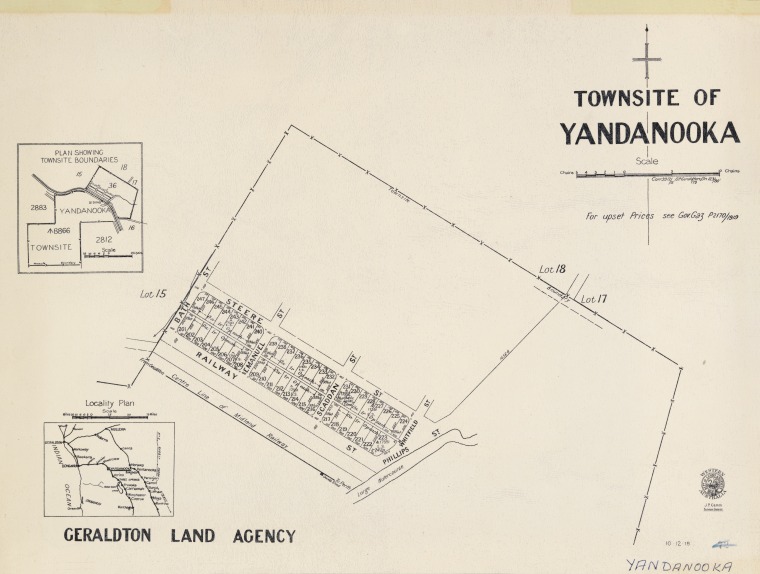
State Library of Western Australia 1
Demographics
Region: Mid West
LGA: Mingenew
Industry: Railway, Agriculture and Soldier Settlement
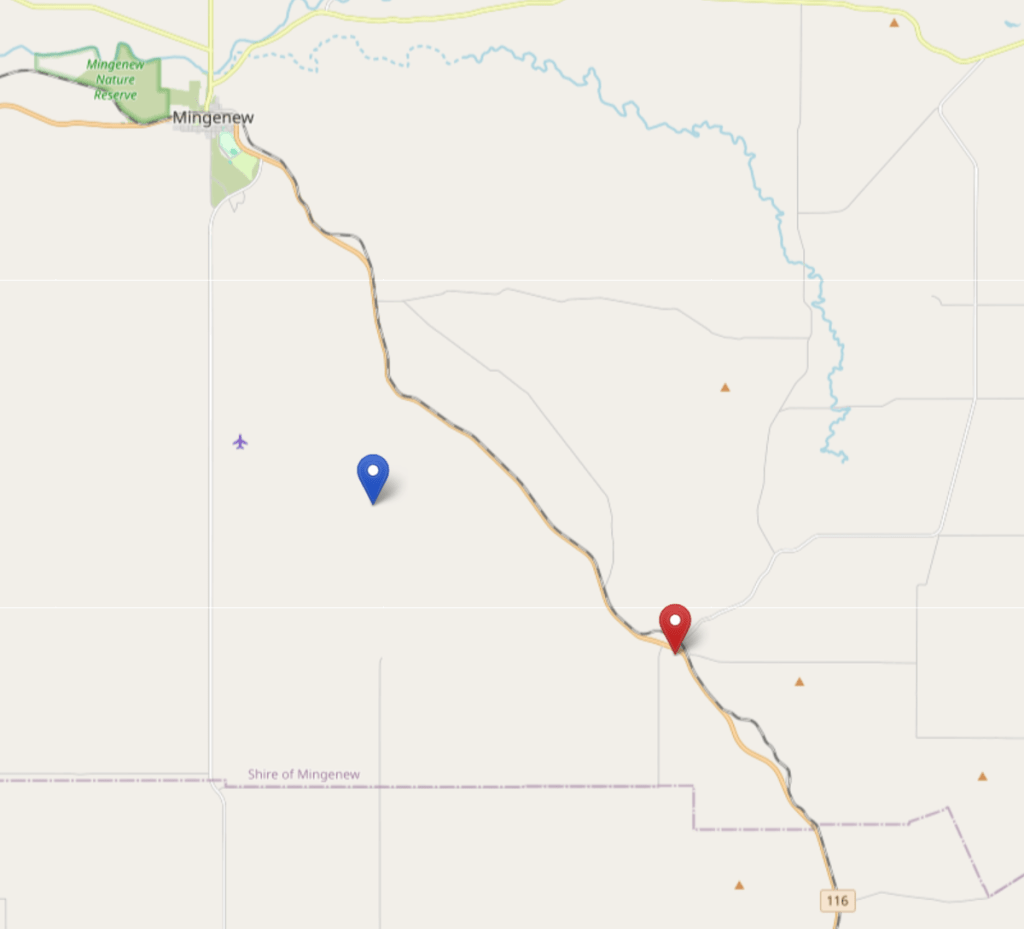
Open Street Map: 29°19’00.0″S 115°34’00.0″E
What3Words: ///mocking.adapting.fanned
Settled: 1854
Gazetted: 1815
Abandoned: 1979
Introduction
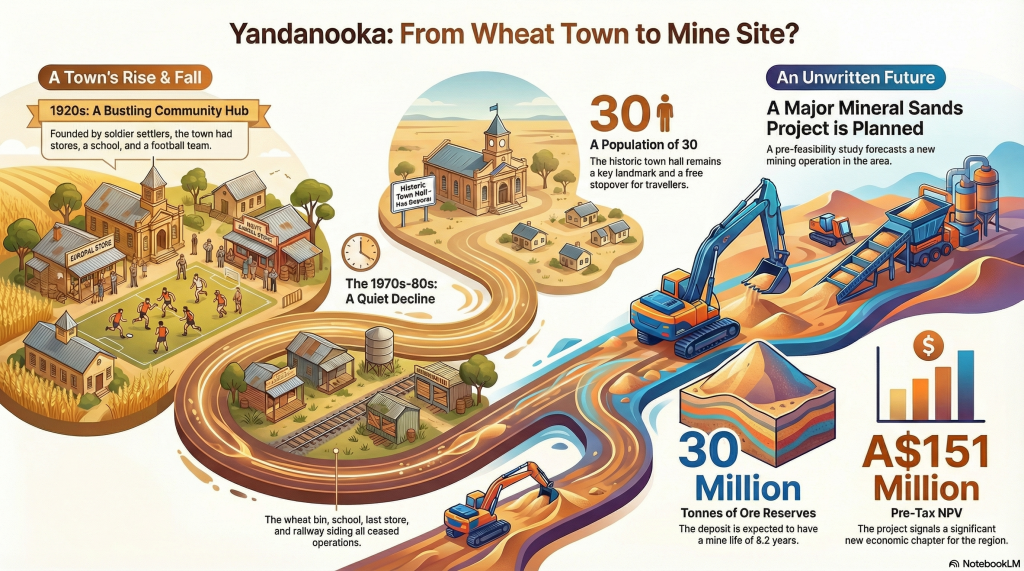
Yandanooka, situated north of Perth, derives its Aboriginal name from terms meaning “Water-in-the-hills” or “Plenty of hilly country in sight”. European settlement began early when Thomas Whitfield took up the station in 1854. The Midland Railway opened in 1884, and the townsite was officially gazetted in 1919, rapidly gaining fifty soldier settlers. This era saw intense development, including the Hall in 1923 and high agricultural yields, with wheat soaring to 80,000 bags by 1925. Yandanooka was also a founding team of the North Midlands Football Association in 1921. However, farm consolidation led to decline: the school closed in 1978 and the last store closed in 1979. Today, Yandanooka is a ghost town, though its historic Hall remains a functioning community hub for its 2021 population of 30.
Christine Harris (2025)
History
Yandanooka, a locality situated in Western Australia’s Mid West region, approximately 348 km (216 mi) north of Perth, holds a rich history rooted in pastoral leases, railway development, and intensive soldier settlement. Its name is derived from the Aboriginal language, believed to signify either “Water-in-the-hills” or “Plenty of hilly country in sight”. Today, Yandanooka is recognized as a ghost town precinct, characterized by its preserved historic core and a sparse but enduring population.2 3
Establishment and the Dawn of Settlement
The history of European interaction with the area began remarkably early, with Yandanooka Station originally taken up by Thomas Whitfield in 1854. Whitfield operated a substantial enterprise; an advertisement placed in 1879, prior to his retirement, detailed a property covering 69,000 acres of prime salt bush and grazing country, well-watered by springs and shallow wells, and secured by 380 acres of freehold land. The station was equipped with a seven-room dwelling house, kitchen, store, woolshed, and sufficient plant for a large operation, carrying approximately 6,900 sheep.4 5 6
Mining interests also briefly touched the area, with leases for copper and lead issued in the Yandanooka Mining District in 1898. However, it was the railway that truly set the stage for the town. The Midland Railway opened for through traffic in 1884, establishing a railway siding in 1895. This siding was subsequently moved four kilometers south in 1902, paving the way for the future townsite. The Post Office opened in 1900, likely at the original Homestead.7 8
Following the Great War, Yandanooka experienced its most significant period of growth, driven by the soldier settlement scheme. Although town lots were surveyed in 1913, only one application was initially received for the 42 lots opened in 1914. The townsite was officially gazetted in 1919, attracting approximately 50 soldier settlers who took up blocks between 1919 and 1922. The town quickly demonstrated its agricultural potential, becoming a district centre after successfully producing a six-bag wheat crop.9 10
The Boom Years: Community and Infrastructure
The 1920s saw the development of vital community infrastructure, often pioneered by the settlers themselves. The first store, Hurley’s, opened in 1920, described as a rustic wood frame with a hessian cover. A second, wood-constructed store, which remains standing today as a residence, opened the same year, serving the community through multiple owners. A third store and boarding house was established around 1925 by a Mr. Bishop, who used a substantial win on “Windbag” in the Melbourne Cup to fund the construction. 11
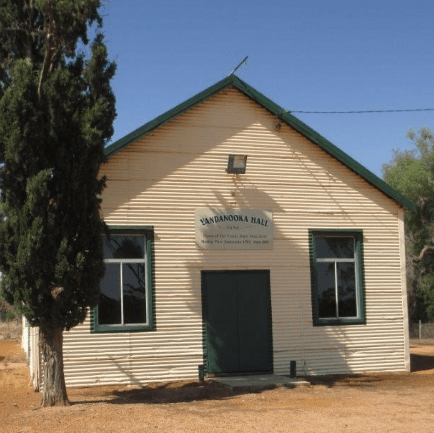
The Yandanooka Hall, opened in 1923 by Mr. C. Maley, MLA, was central to social life and was constructed by the soldier settlers. It initially functioned as the schoolroom, host for all church services, and the venue for social evenings and the annual Christmas Tree party. The loan for the Hall was finally cleared, and a supper room added, in 1929. One beloved local tradition was the annual Christmas Tree party, which featured the same Father Christmas, Mr. H. Chivers, for over 30 years.12 13
Agricultural output soared, illustrating the success of the farming community. Wheat sent by rail jumped from 13,000 bags in 1922 to 80,000 bags by 1925, and was expected to exceed 100,000 bags by 1927. This intensive production required infrastructure, leading to the construction of a CBH wheat bin, weigh bridge, and CBH quarters in 1936. Feats of strength related to this work still circulate, such as the stacker who could carry a bag of wheat under each arm up the sloping ramp.14
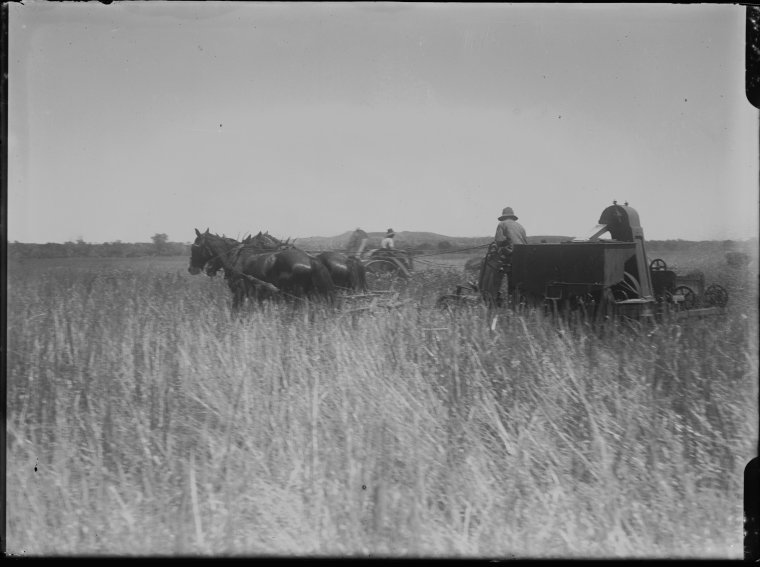
State Library of Western Australia15
The residents were keenly engaged in sports. Yandanooka was a founding team of the North Midlands Football Association in 1921, winning the inaugural premiership.16 The oval was initially behind the store and hall. The town also featured a community-built sheep dip, which required water supplied by a well near the “Old Homestead”. An anecdote survives regarding this facility: the builder reputedly went mad, and local lore suggested his spirit haunted the place due to the actions of some sheep dipped there. Other sports included a 9-hole golf course, opened in 1932, and tennis, with three courts eventually laid on the recreation ground.
The community’s unique challenges often led to social solutions. When Mr. Wainwright, an early contract carter, used a camel team of four, the noise and presence of the camels distressed the district’s horse teams. The settlers were compelled to call a public meeting to ask Mr. Wainwright to use a separate track to avoid upsetting their horses.17
Decline, Consolidation, and Preservation
The initial enthusiasm of soldier settlement waned as settlers realized their allocated holdings were often “too small and over capitalised”. Following numerous meetings, the Minister for Lands, Mr. Troy, intervened, leading to the enlargement of farms and a dramatic relief measure: all interest was credited as principal, and £131,000 was written off the settlers’ debt. Over subsequent decades, neighboring farmers steadily consolidated their properties, creating larger, more economical holdings, but simultaneously decreasing the density of the resident population.18
This agricultural consolidation precipitated the decline of the town center:19 20 21
- The Tennis Club disbanded in 1966 to join Mingenew.
- The CBH wheat bin closed in 1973.
- The Government school closed in 1978 due to a lack of numbers, its transportable classroom relocated to Eneabba.
- The last store closed in 1979.
- In the 1980s, the railway siding officially closed to grain receivals, marking the end of its commercial function.
Yandanooka now fits the designation of a ghost town, defined as a site either uninhabited or occupied by only one resident family not conducting a business.22 23
Despite the cessation of commercial services, the community displayed immense loyalty to its remaining heritage. When the Hall suffered severe cyclone damage in 1979, the Mingenew Shire planned demolition. The Yandanooka community successfully organized a referendum to save the structure, agreeing to take on the financial and maintenance responsibility.24
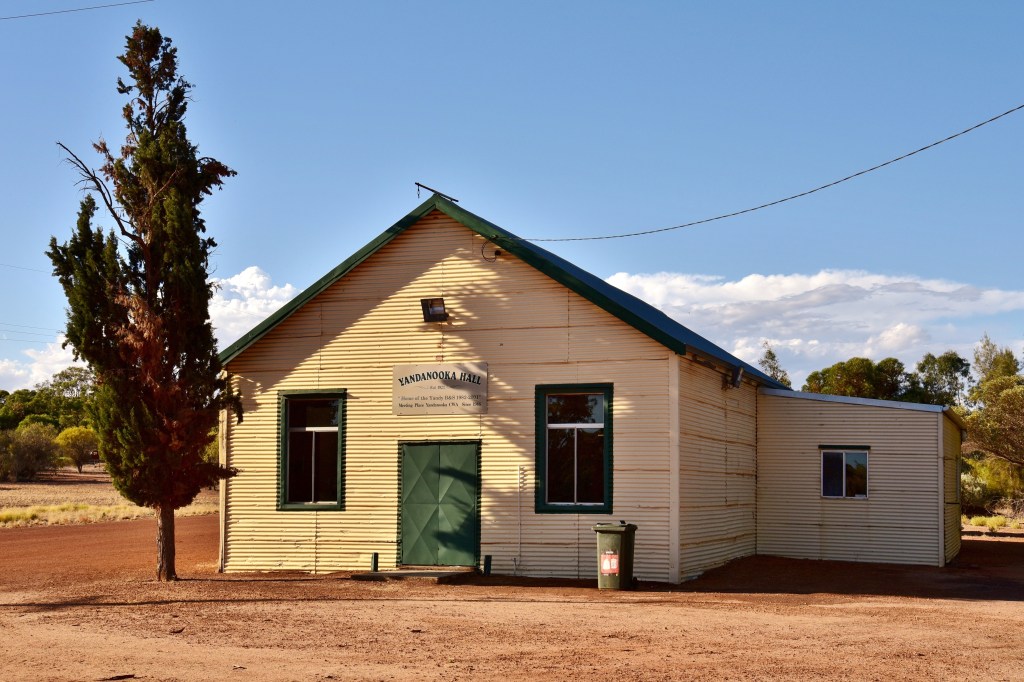
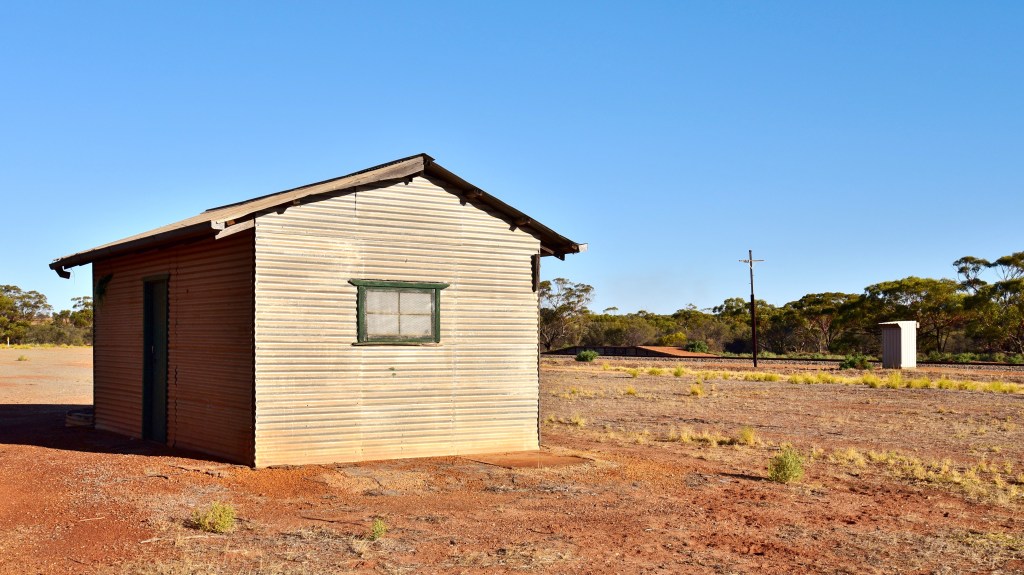
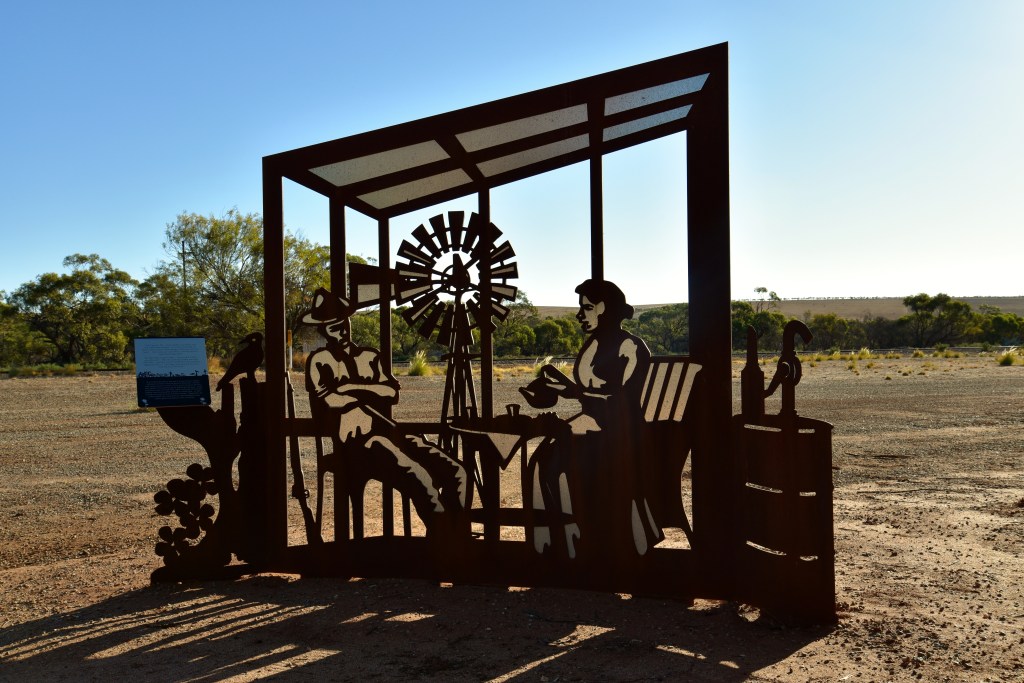
Today, Yandanooka survives as a quiet precinct. The 2021 Census recorded a total population of 30 people.26 The largest remaining structure is the Hall, which continues to be used socially, hosting events like the Family Christmas Tree night and serving as a base for WA University Geology students. The precinct also contains the residence (the former store) and the old school buildings, which are used as an arts workshop and residence, with the School House still occupied.
Timeline
- 1854: Yandanooka Station was originally taken up by Thomas Whitfield.
- 1876: John Forrest selected 5,000 acres of reward land in the area.
- 1879: Thomas Whitfield advertised Yandanooka Station for sale.
- 1884: The Midland Railway opened for through traffic.
- 1895: A railway siding was established on the Midland Railway.
- 1898: Mining leases for copper and lead were issued in the Yandanooka Mining District.
- 1900: The Post Office first opened, presumed to be located at the Homestead.
- 1902: The railway siding was moved 4 kilometers (2.5 mi) south, and land was set aside for a townsite.
- 1919: The townsite was officially gazetted. First soldier settlers began to arrive, including Mr. W. C. Robinson.
- 1920: The first store (Hurley’s) and a second store (later owned by Field) opened.
- 1921: The Football team was formed; Yandanooka became a founding member of the North Midlands Football Association and won the inaugural premiership.
- 1922: Wheat sent by rail reached 13,000 bags.
- 1923: The Yandanooka Hall, built by soldier settlers, was opened and served as the first schoolroom.
- 1925: Community sheep dip and Elders’ stockyards were built. Wheat sent by rail reached 80,000 bags. Mr. Bishop built the third store/boarding house after a Melbourne Cup win.
- 1926: Yandanooka merged with Mingenew to form Mingenew-Yandanooka, which subsequently folded in 1927.
- 1929: The Hall debt was paid off, and a supper room was added. Miss Amy Bishop began lessons in the Hall.
- 1932: A 9-hole golf course was opened.
- 1934: The Government school opened on the present site.
- 1935: The School House was built.
- 1936: CBH constructed a wheat bin, weigh bridge, and quarters.
- 1946: The Yandanooka CWA (Country Women’s Association) was formed.
- 1966: The Tennis Club disbanded.
- 1973: The CBH wheat bin closed.
- 1978: The Government school closed due to lack of numbers.
- 1979: The last store closed. The community successfully prevented the Shire from demolishing the Hall following cyclone damage.
- 1980s: The railway siding ceased to be a receival point for grain.
- 1996: A $10,000 grant was announced to support the Mingenew Shire scheme for shared groundwater usage near the townsite.
- 2021: The Yandanooka locality recorded a population of 30 people.
Sources
- State Library of Western Australia, n.d. Townsite of Yandanooka: Western Australia Department of Lands and Surveys. 1919. Cartographic material. Retrieved on 29 Nov 2025 from https://encore.slwa.wa.gov.au/iii/encore/record/C__Rb1989976?lang=eng ↩︎
- Wikipedia, 2025. Yandanooka, Western Australia. Retrieved 2 Dec 2025 from https://en.wikipedia.org/wiki/Yandanooka,_Western_Australia ↩︎
- Heritage Council of Western Australia, 2017. Yandanooka Hall and Townsite Precinct. Retrieved 2 Dec 2025 from https://inherit.dplh.wa.gov.au/public/inventory/printsinglerecord/23de3446-0cbd-4568-97bc-02afe49a36b6 ↩︎
- ibid. ↩︎
- WA Now and Then, 2025. Yandanooka. Retrieved 2 Dec 2025 from https://www.wanowandthen.com/Yandanooka.html ↩︎
- Wikipedia, Yandanooka: Refers to expansion of infrastructure ↩︎
- ibid. ↩︎
- Heritage Council, Yandanooka: Refers to expansion of infrastructure ↩︎
- ibid: Refers to gazetting of town and to soldier settlements ↩︎
- Wikipedia, Yandanooka. Refers to gazetting of town and to soldier settlements ↩︎
- ibid. Refers to community life in the 1920s ↩︎
- Heritage Council, Yandanooka: Refers to Yandanooka Hall ↩︎
- CMCA, n.d. Yandanooka Town Hall. Retrieved 2 Dec 2025 from https://rvfriendly.cmca.net.au/RVFriendly/ViewRVFriendly?placeuid=6bf8a6f1-e7a5-46c1-859a-cc8453a8baa5 ↩︎
- Wikipedia, Yandanooka: Refers to the success of farming in Yandanooka in the 1920s and 30s ↩︎
- State Library of Western Australia, n.d. Yandanooka. A series of 19 black and white photos published in the Western Mail 18 Feb 1916, p.31, from the Estate of E. L. MItchell. Retrieved 29 Nov 2025 from https://purl.slwa.wa.gov.au/slwa_b2940781 ↩︎
- Wikipedia, 2025. North Midlands Football League. Retrieved 2 Dec 2025 from https://en.wikipedia.org/wiki/North_Midlands_Football_League ↩︎
- Heritage Council, Yandanooka: Refers to provision of community facilities ↩︎
- ibid: Refers to decline and consolidation of soldier settlements ↩︎
- ibid: Refers to closure of tennis club, wheat bin, store and school ↩︎
- WA Now and Then: Refers to closure of wheat bin, store and rail siding ↩︎
- Wikipedia, Yandanooka: Refers to closure of wheat bin, school, store and rail siding ↩︎
- FamilyHistoryWA, 2023. What is a Ghost Town? Retrieved 7 Dec 2025 from https://ghostswa.au/2023/09/16/what-is-a-ghost-town/ ↩︎
- Morawa District Historical Society, n.d. The Ghost Towns and Wayside Inns of Western Australia. Retrieved 7 Dec 2025 from https://morawamuseum.org.au/ghosttowns-intro.html ↩︎
- Heritage Council, Yandanooka: Refers to preservation of the Hall ↩︎
- Wikipedia, 2022. Yandanooka. Retrieved 16 Feb 2026 from https://nl.wikipedia.org/wiki/Yandanooka ↩︎
- Australian Bureau of Statistics, 2021. 2021 Census All Persons QuickStats: Yandanooka. Retrieved 7 Dec 2025 from https://www.abs.gov.au/census/find-census-data/quickstats/2021/SAL51668 ↩︎
 People of Western Australia's Ghost Towns