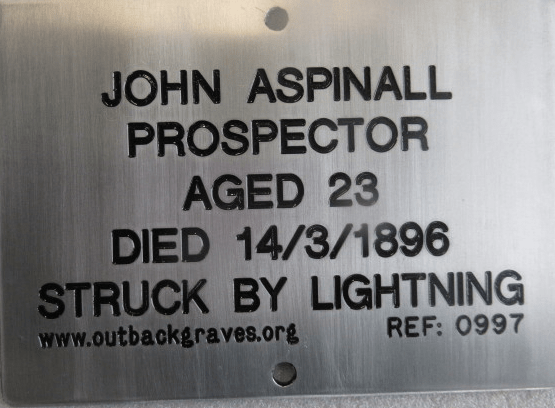
The Western Australian gold rush of the 1890s was a time of grit, glimmer, and gamble. Thousands of young men flocked to the sun-scorched interior, dreaming of “striking it rich.” Among them was John “Johnnie” Aspinall, a 23-year-old New Zealander whose life was as vibrant as it was tragically short.
Gold was in Johnnie’s DNA. Born in 1873 at Skippers Point, Otago, his father, John Snr, was an English prospector who had worked the Bendigo fields before settling on New Zealand’s “River of Gold,” the Shotover. After his father passed in 1890, Johnnie and his brothers worked the family claim, but the allure of the massive WA discoveries eventually proved too strong to ignore.
On 19 February 1895, Johnnie left home, booking steerage passage to Melbourne and then Fremantle. His journey into the WA interior was a classic bush odyssey. He took the train to Southern Cross, enduring a 17-hour trip in a crowded carriage pulled by two engines.
Johnnie was a meticulous chronicler, documenting everything in his journal. He recorded stopping for “bush style” tucker at Northam—”chops mighty tough though!”—and a midnight tea and sandwich from an Irish girl at a shanty in Kellerberrin. By the end of March, he had reached Coolgardie by wagon, ready to begin the real work.
Johnnie didn’t cut corners on equipment. He struck a deal with Gunny Khan for two Australian-bred camels at the “stiff price” of £134. These beasts were tougher than their imported cousins and guaranteed to carry 500 pounds. To help manage them, he hired Amzula, an Afghan camel driver, for 30 shillings a week.
Starting in May 1895, the pair trekked through the heart of the goldfields: Lake Barlee, Mt Malcolm, Yerilla, and Niagara. Johnnie spent months documenting every experience until his final entry on Friday, 13 March 1896, at a place called Hawks Nest.
On 14 March, Johnnie’s body was found just 100 yards from his camp. The scene was peculiar: he was lying on his face, his clothes ripped off one side and one boot missing. For a brief time, the “Hawkes’ Nest Mystery” fueled local speculation.
However, Constable Bradley of Menzies investigated the site on 22 March and provided a grimly simple explanation: Johnnie had been killed by lightning. The sheer force of the strike had likely caused the bizarre state of his clothing and footwear.
Johnnie was buried on 18 March 1896, behind the old Hawk’s Nest Gold Mine in the Laverton district. He remains there today—one of the many “lonely graves” that dot the Australian Outback, a testament to a young man who followed his golden quest to the very end.
Sources
- Outback Graves Markers, 2025. John ASPINALL. Retrieved from https://outbackgraves.org/burial-records/person/1623 on 20 Jun 2025. ↩︎
- COUNTRY. (1896, April 6). The West Australian (Perth, WA : 1879 – 1954), p. 5. Retrieved March 7, 2026, from http://nla.gov.au/nla.news-article3085609 ↩︎
- NEWS of the WEEK. (1896, April 11). The Western Australian Goldfields Courier (Coolgardie, WA : 1894 – 1898), p. 8. Retrieved March 7, 2026, from http://nla.gov.au/nla.news-article253054912 ↩︎
 People of Western Australia's Ghost Towns