In 1872, the government offered a reward of £5,000 for the discovery of the first payable goldfield in the colony of Western Australia1.
In 1879, Alexander Forrest explored the Fitzroy and Ord River areas, and reported excellent grazing land and that gold might be found in the East Kimberleys. John Adams and Phil Saunders managed for find a little gold, but insufficient to be payable. In 1883, a second Forrest expedition included a geologist, Edward Hardman, who showed likely gold deposits on his map of the area.2
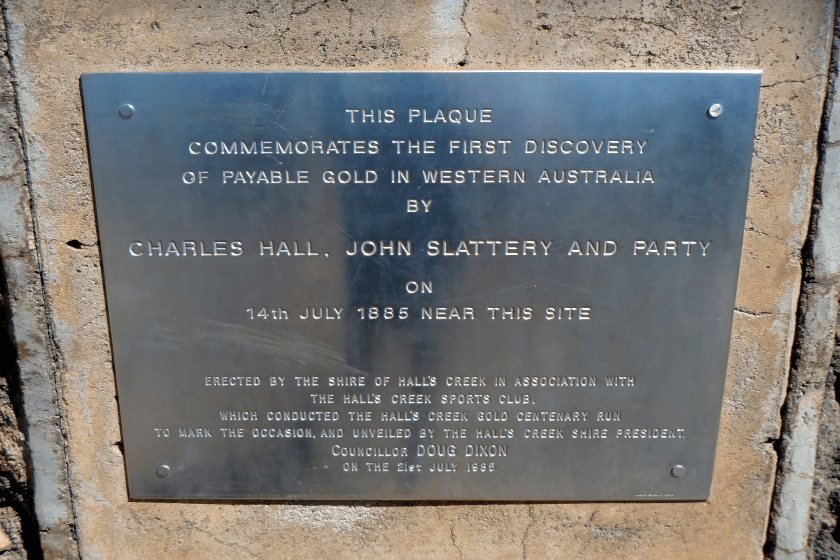
On 14 July 1885, Charles Hall and Jack Slattery, following the leads provided by Hardman, found payable gold at Halls Creek in the Kimberley region. After working for a few weeks, Hall returned to Derby to report his find, and took 200 ounces of gold with him as evidence. The ensuing “Kimberley Rush” encouraged as many as 10,000 men to head to Halls Creek. The field was officially declared on 19 May 18863.
Thousands of men made their way to the Kimberley from other parts of WA, the eastern colonies, and New Zealand. Most arrived by ship in Derby or Wyndham, and then walked to Halls Creek. Others came overland from the Northern Territory. Most had no previous experience in gold prospecting or of life in the bush. Illness and disease were rife, and when the first warden, C. D. Price, arrived on 3 September 1886, he found that “great numbers were stricken down, in a dying condition, helpless, destitute of money, food, or covering, and without mates or friends simply lying down to die”. A few were lucky enough to locate rich alluvial or reef gold, but most had little or no success.
Dr Phillip Playford4
In the early days of the gold rush no records or statistics were recorded for either the arrivals or deaths. Also, no one knows how many died trying to get to Halls Creek across the waterless desert, or how many simply turned back. When men actually arrived at Halls Creek, dysentery, scurvy, sunstroke and thirst continued to take its toll. The Government applied a gold tax of two shillings and sixpence an ounce. It was a very unpopular levy as gold proved so hard to get. The diggers avoided registering and the Government had a great deal of trouble collecting the tax or statistics of any kind. Halls Creek was a shanty town of wood, stone, canvas, tin, bark and spinifex. But it boasted two hotels, a post office and a gold warden.
When Price arrived in September 1886, he reported that about 2,000 remained at the diggings. By the end of 1886, the rush had ceased. When in May 1888 the government considered claims for the reward for discovery of the first payable goldfield, it was decided that the Kimberley goldfield, which had proven disappointing, was insufficient to meet the stipulated conditions of a yield of at least 10,000 ounces (280 kg) of gold in a 2-year period passing through Customs or shipped to England, so no reward was paid out5. A gift of £500 was given to Charles Hall and his party, along with a bequest of the same amount to Hardman’s widow.
The rush lasted only a few years as it was not financially viable to transport the machinery to this remote region. With the discovery of gold in Coolgardie, most prospectors moved on. In 1955, the town site of Halls Creek was relocated 15Kms west.
SOURCES & NOTES
- Playford, Phillip & Ruddock, Ian (1985). Discovery of the Kimberley Goldfield. ↩︎
- Halls Creek Tourism, nd. Halls Creek History. Retrieved 28 Apr 2024 from https://www.hallscreektourism.com.au/information/halls-creek-history ↩︎
- The Western Argus, 1931. Our First Gold Rush : Kimberley, 1886. Published 19 May 1931. Retrieved 28 Apr 2024 from http://nla.gov.au/nla.news-article34582034 ↩︎
- Playford, Phillip. 2005. The Discovery of The East Kimberley Goldfield. Retrieved 25 Apr 2024 from https://kimberleysociety.org/oldfiles/2005/THE%20DISCOVERY%20OF%20THE%20EAST%20KIMBERLEY%20GOLDFIELD%201885%20Mar%2005.pdf ↩︎
- A lot of gold went out of the Kimberley via the Northern territory and it was rumoured that a gold buyer was to have taken 3,000 ounces of gold at a time out of Halls Creek. It is estimated that as much as 23,000 ounces (nearly 650 kg) of gold was taken from the fields around Halls Creek, some unofficial estimates were as 100,000 ounces. ↩︎
 People of Western Australia's Ghost Towns