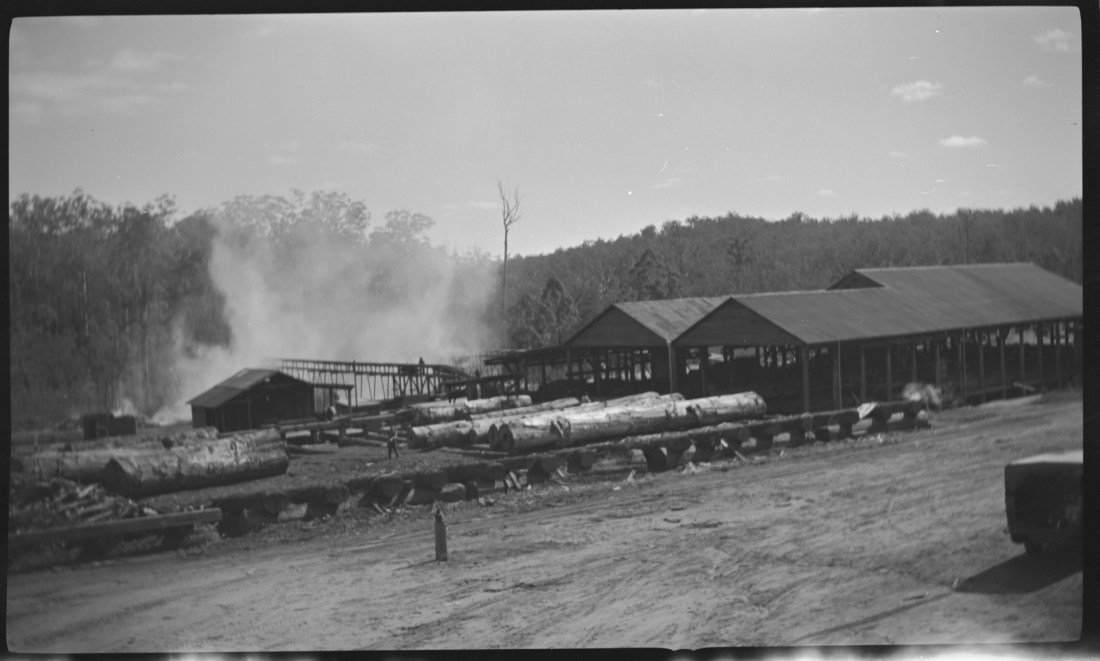
A Chapter in Western Australia’s Timber Past
In the forests of Western Australia, sawmills once rose and fell with the rhythms of the timber they harvested. Some, such as the long-lived operations at Jarrahdale, seemed almost timeless, continually fed by pockets of forest that yielded just enough to keep the saws turning. Others lived quicker, shorter lives. A lifespan of fifteen to twenty years was considered respectable for a mill. By that measure, the East Kirup mill—opened in the autumn of 1910 and closed eighteen years later—had enjoyed a full existence.
When Millars’ Company felled the first tree to clear the site—thirteen miles east of the Kirup railway station—it marked the beginning of a community as much as an industrial undertaking. Within months, hundreds of workers and their families had settled around the new mill, forming a self-contained township with all the domestic and social complexities of an isolated bush settlement. A generation grew up among the hills and forests, only to scatter across the state when the mill’s closure brought the community’s purpose to an end. A smaller mill later replaced it a few miles away, though it operated on a far more modest scale.
East Kirup had been built with the benefit of earlier experience: well-designed, strongly equipped, and surrounded by rich forest capable of supplying magnificent jarrah logs for many years. The district became a centre for sleeper-cutters—those who hewed the heavy wooden sleepers needed for expanding rail networks—and at one time it reportedly hosted more of these workers than any other part of Western Australia.
Designed to turn out about 42,000 super feet of timber a day, the mill often reached that figure in its early years. Over its eighteen-year life, it produced an astonishing 225 million super feet of timber—sleepers, building scantlings, flooring, joinery, and a variety of other essentials. Yet even such impressive output could not fully overcome the challenges inherent in milling Australian hardwoods. Despite their durability and beauty, these timbers yielded relatively low proportions of merchantable wood. Often less than half of each log could be used; sometimes only a third. The remainder was consigned to the fire heap, an unavoidable but striking reminder of waste built into the industry.
Despite such difficulties, the scale of Western Australia’s sawmilling operations set them apart from those in the eastern states. Mills employing 300 to 350 workers were common in the west but virtually unknown in Victoria or New South Wales. East Kirup was among these large and lively centres, set in forested hills and blessed with a cool, bracing climate. Children raised there were remembered for their sturdy health—another small legacy of a community that eventually vanished.
More than £900,000 in wages was paid during the mill’s lifetime, sustaining families and supporting a complex local economy. Much of the mill’s character, however, came from its leaders, particularly James Kelly, a spirited and sharp-witted manager whose booming voice and commanding presence became inseparable from East Kirup’s history. For a time, the mill was also guided by another respected figure, Samuel Drysdale, whose contribution was similarly well regarded.
With its closure, the East Kirup mill passed into history. The noise of saws and locomotives faded, the workers dispersed, and the once-busy clearing slowly returned to the forest from which it had been carved. Yet its legacy endured as a testament to the rugged industry, community spirit, and human character that shaped Western Australia’s timber frontier.
Author’s Note:
This article has been written based on a newspaper article – The End of the Mill – written in 1929 and published in The West Australian. 1
Sources
- THE END OF THE MILL. (1929, November 23). The West Australian (Perth, WA : 1879 – 1954), p. 5. Retrieved November 23, 2025, from http://nla.gov.au/nla.news-article32332383 ↩︎
 People of Western Australia's Ghost Towns