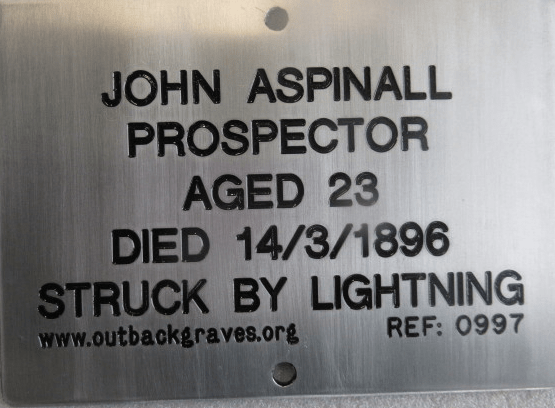
For those with an interest in Australian genealogy and colonial history, the late 19th century represents a period of feverish movement and profound personal sacrifice. While the history books often focus on the vast wealth extracted from the earth, the true story of the gold rushes is found in the “lonely graves” scattered across the arid interior. One such story is that of John “Johnny” Aspinall, a young New Zealander whose life and meticulously kept diary provide a poignant window into the hardships of 1896.4 5 6
Born in 1873 at Skippers Point, Otago, Johnny was no stranger to the mining life. His father, also named John, was an English prospector who had sought fortune in Bendigo before settling in New Zealand’s rugged mountains. Johnny was one of nine children, growing up in a household where gold and grit were daily realities. Following his father’s death in 1890, Johnny and his brothers worked the family claim before the allure of the Western Australian “Great Boom” beckoned.
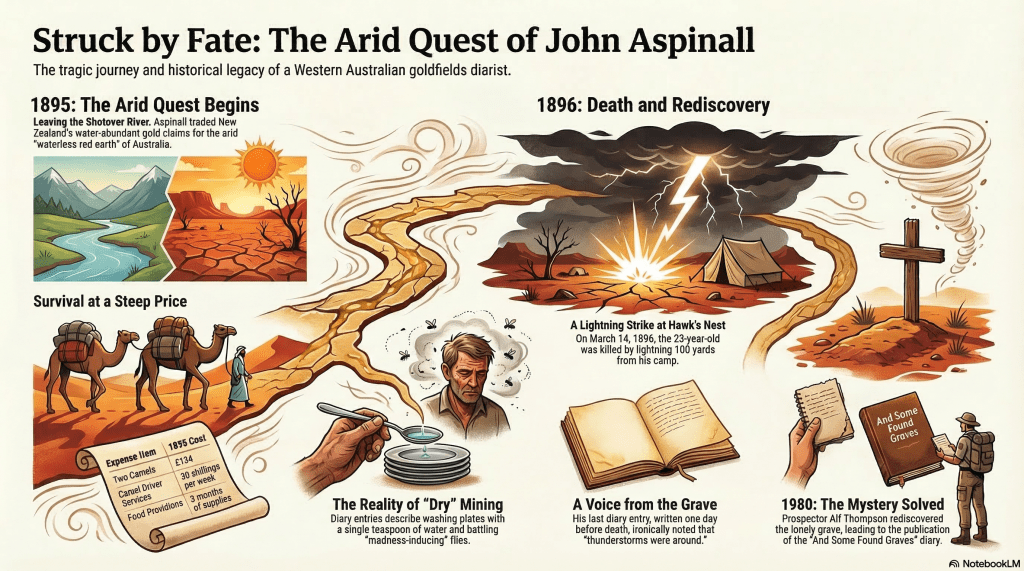
Leaving New Zealand in February 1895, Johnny’s journey to the West was a series of arduous legs. After arriving in Fremantle via Melbourne and Adelaide, he boarded a crowded train to Southern Cross—a seventeen-hour trip where refreshments consisted of “tough” chops served “bush style”. By late March, he had reached Coolgardie, then the bustling heart of the goldfields.
Christine Harris (2026)
To traverse the unforgiving landscape, Johnny demonstrated the practical resourcefulness common to successful prospectors of the era. He concluded a deal with Gunny Khan for two Australian-bred camels at the significant price of £134, noting they were hardier than other breeds. Accompanied by an Afghan driver named Amzula, he set out for the northern fields, documenting his observations of the “foreign” character of Perth and the daily battles with heat, flies, and water scarcity. His diary captures the desperation of the time, including instances of using a mere teaspoon of water to wash a plate and the omnipresent threat of typhoid.
While Johnny was pursuing his “golden quest” in the West, the broader Australian colonies were in a state of constant flux. In Queensland, the Warwick Argus reported on everything from earthquake shocks in Cairns to the introduction of typewriters in Sydney police courts to facilitate the taking of depositions. This was a world transitioning into modernity, yet Johnny remained at the mercy of the elements.7
Tragedy struck in March 1896 at Hawks Nest, near Laverton. On the 14th of March, Johnny’s body was discovered just 100 yards from his camp. The scene was harrowing: he was lying on his face with his clothes partially ripped away and one boot missing. An investigation by Constable Bradley of Menzies confirmed the cause of death was a lightning strike. In a cruel twist of historical irony, Johnny’s final diary entry, dated the 13th of March, mentioned that thunderstorms were in the area.8 9
For nearly a century, Johnny’s story remained buried with him in the red dust. It was not until February 1980 that prospector Alf Thompson rediscovered the grave and its fading inscription: “Sacred to the memory of JOHN ASPINALL… Gone but not forgotten”. Through Thompson’s “detective work,” contact was made with the Aspinall family in New Zealand, leading to the publication of Johnny’s diary under the title And Some Found Graves. Today, Johnny’s legacy endures as a vital primary source for historians, reminding us of the thousands who sought a future in the goldfields but found only a quiet, nameless rest.
Sources
- Outback Graves Markers, 2025. John ASPINALL. Retrieved from https://outbackgraves.org/burial-records/person/1623 on 20 Jun 2025. ↩︎
- COUNTRY. (1896, April 6). The West Australian (Perth, WA : 1879 – 1954), p. 5. Retrieved March 7, 2026, from http://nla.gov.au/nla.news-article3085609 ↩︎
- NEWS of the WEEK. (1896, April 11). The Western Australian Goldfields Courier (Coolgardie, WA : 1894 – 1898), p. 8. Retrieved March 7, 2026, from http://nla.gov.au/nla.news-article253054912 ↩︎
- National Trust of Western Australia, n.d. The Golden Pipeline: John Aspinall. Retrieved 15 Mar 2026 from https://www.goldenpipeline.com.au/the-people/john-aspinall/ ↩︎
- Thompson, A.J. (2019). The Goldfields Diary of John Aspinall – And found some graves. Retrieved 15 Mar 2026 from https://www.caseytours.com.au/news/the-goldfields-diary-of-john-aspinall-and-some-found-graves/ ↩︎
- ibid : retrieved 15 Mar 2026 from https://www.hesperianpress.com/index.php/booklist/titles-a-d/a-titles/31-and-some-found-graves ↩︎
- WA Now and Then (n.d.) The Folklore of Western Australia: John Aspinall. Retrieved 15 Mar 2026 from https://www.wanowandthen.com/Folklore/0081.html ↩︎
- NEWS of the WEEK. (1896, April 11). The Western Australian Goldfields Courier (Coolgardie, WA : 1894 – 1898), p. 8. Retrieved March 15, 2026, from http://nla.gov.au/nla.news-article253054912 ↩︎
- ibid Thompson: refers to thunderstorms. ↩︎
 People of Western Australia's Ghost Towns