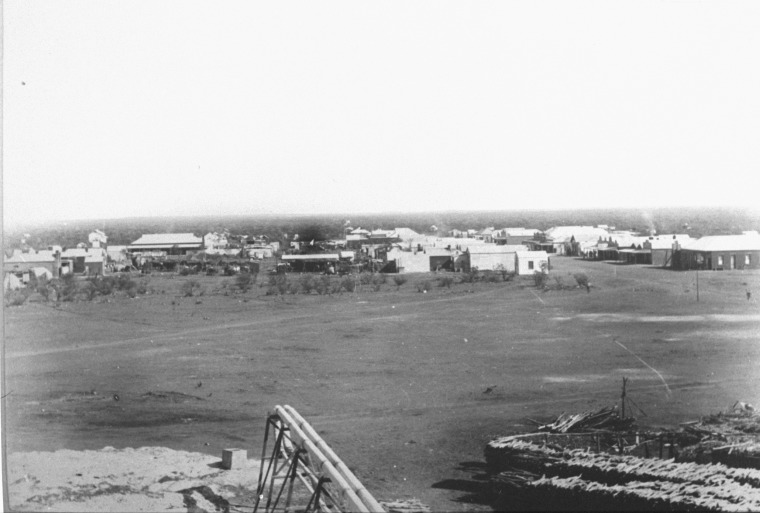
Population of the Northern Goldfields – 1905

Kookynie c1900

Editors Note: This very informative article is reproduced from the Kookynie Press.1

We [the newspaper] recently obtained fascinating population statistics for the North Coolgardie district, courtesy of Inspector Woods, detailing the population as compiled by the police up to June 30. These figures offer a crucial look at the shifting fortunes of the Northern Goldfields communities.

The Overall Trend: A Net Loss for the Region

Compared to the statistics compiled the previous year, the North Coolgardie district as a whole has experienced a loss of 256 people.

While some centers managed to hold steady or even grow, others saw significant decreases in population. Menzies, for instance, managed to remain the same.

The most substantial population losses were recorded in:

  • Kookynie, showing a significant drop of 559 residents.
  • Morgans, which lost 132 residents.
  • Malcolm, which saw a decrease of 125 residents.

However, the outlook was much brighter for several key towns, demonstrating that growth continues in specific pockets of the goldfields. Towns reporting major increases include:

  • Leonora, which gained 240 people.
  • Laverton, which grew by 230 people.
  • Gwalia, which added 100 people.

Substantial increases were also recorded in the areas of Murrin and Yundamindera.


Detailed Population Statistics by District

The following tables provide the detailed breakdown of the population in the North Coolgardie district as of June 30, 1905.

MENZIES DISTRICT

LocationMalesFemalesChildrenTotal
Menzies9984673791,844
Woolgar1445255251
Comet Vale113721
Goongarrle6091079
Mt Ida941515124
TOTAL1,3075464662,314

KOOKYNIE DISTRICT

LocationMalesFemalesChildrenTotal
Kookynie1,0202201751,415
Champion50151883
Britannia1951034
Puzzle112215
Niagara1503122203
Tampa304640
Yerilla10054109
TOTAL1,3902822411,915

MALCOLM DISTRICT

LocationMalesFemalesChildrenTotal
Malcolm2509060400
Webster’s Find60201090
Mertondale2406020320
Dis. gen.811527123
TOTAL631185117933

GWALIA DISTRICT

LocationMalesFemalesChildrenTotal
Gwalia585185160930

LEONORA DISTRICT

LocationMalesFemalesChildrenTotal
Leonora395196140731
Tower Hill93113107
Dis. gen.3374531413
TOTAL8252521741,251

YUNDAMINDERA DISTRICT

LocationMalesFemalesChildrenTotal
Yund’m’n’dra1674548260
Edjudina1152324162
Pingin572059
Dis. gen.853492
TOTAL4247376573

MURRIN DISTRICT

LocationMalesFemalesChildrenTotal
Murrin3703329432

MORGANS DISTRICT

LocationMalesFemalesChildrenTotal
Morgans6652821381,085
Dis gen.103118122
TOTAL7682931461,207

LAVERTON DISTRICT

LocationMalesFemalesChildrenTotal
Laverton2056041306
Euro82313
Craiggiemore55172496
Lancefteld1602036216
Augusta203427
Ida H.802225127
Hawke’s Nest200020
Erlston dis.3382716371
TOTAL8861511491,196

BURTVILLE DISTRICT

LocationMalesFemalesChildrenTotal
Burtville2284230300

SIR SAMUEL DISTRICT

LocationMalesFemalesChildrenTotal
Sir Samuel41310069582

LAWLERS DISTRICT

LocationMalesFemalesChildrenTotal
Lawlers430130110670
Cue’s Patch1151613144
Darlot1402214176
Dis. gen.3084117366
TOTAL9932091541,356

BLACK RANGE DISTRICT

LocationMalesFemalesChildrenTotal
Black Range921911122
Dis. gen.4632423510
TOTAL5554334632

DAVYHURST DISTRICT

LocationMalesFemalesChildrenTotal
Davyhurst62598125848
Callion101213
Siberia Soak6129
Mulwarrie47121372
Ullaring192021
Mulline1302422176
Riverina4851063
TOTAL8851431801,208

Sources

  1. Population of the Northern Goldfields. (1905, July 15). Kookynie Press (WA : 1903 – 1911), p. 1. Retrieved December 15, 2025, from http://nla.gov.au/nla.news-article251123991 ↩︎
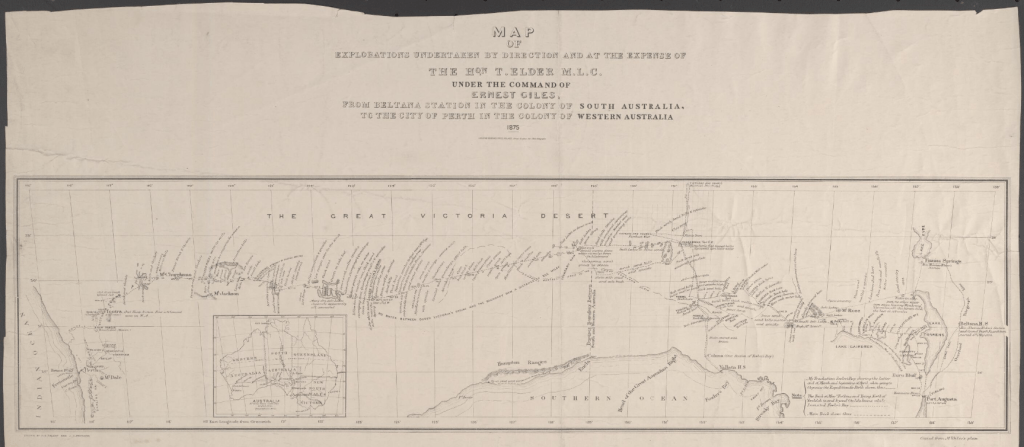
Ernest Giles and the 1875 Expedition Across Australia

Map of Giles’s Route (Surveyor General’s Office, 1875) – Reproduced courtesy of the National Library of Australia.
Digitized and available via the National Library of Australia; this work is out of copyright and free to use for public purposes.

Among the explorers who expanded knowledge of the Australian interior in the nineteenth century, Ernest Giles occupies a distinguished place. His 1875 expedition, financed through the generosity of the South Australian pastoralist and politician Thomas Elder, represented a major advance in geographical discovery, demonstrating both the challenges of crossing the continent’s deserts and the determination required to overcome them.

At the time, vast tracts of inland Australia remained uncharted, and speculation abounded about the potential of the interior for settlement and communication. Earlier surveys by Baron Ferdinand von Mueller and Augustus Gregory in the 1850s had suggested the broad character of these lands, but much remained unknown. Elder, convinced of Giles’s skill as a leader and of the value of camels for desert travel, offered to fund a new expedition to establish as direct a route as possible between South Australia and Western Australia.

The expedition commenced from Port Augusta in May 1875, and the true crossing began on 27 July from Youldeh. Giles’s party included nineteen camels, provisions for eight months, and equipment for carrying water, all vital in a region where survival could never be taken for granted. From the outset, the expedition encountered formidable obstacles. Sandhills, spinifex, and dense mallee scrub made progress slow, while the scarcity of permanent water dictated the pace and direction of travel.

In an early attempt to cover more ground, Giles divided his men: he himself explored westward while William Tietkens and Young struck north in search of the Musgrave Ranges. Both ventures revealed the inhospitality of the land. Giles discovered saline springs and barren scrub, with no signs of animal or human life. His companions fared little better, returning without sighting the Musgraves or finding fresh water.

At one point disaster nearly struck when the camels bolted. The animals were eventually recovered after a long chase, but had they been lost the expedition would have faced almost certain failure. The precariousness of the journey was underlined again in September, when the party endured seventeen days and 325 miles without locating water. Exhaustion and despair led some members to propose slaughtering camels for survival. Giles, however, refused to abandon hope, and perseverance was rewarded when the party discovered a hidden lake. This crucial water source, named Queen Victoria’s Spring, ensured their survival and allowed them to continue.

From this point the nature of the country began to change. Granite outcrops and quartz appeared, bringing with them more reliable supplies of water and pasture. Yet dangers remained. At Ularring, Giles and his men encountered a large and well-organised Aboriginal group who mounted a determined attack. The explorers’ firm defence forced the assailants to withdraw, and the incident remained Giles’s most serious conflict with Indigenous Australians.

Approaching Mount Churchman, Giles noted that the surrounding terrain did not match Augustus Gregory’s earlier chart, which had described the area as flat. Instead, Giles observed ranges of iron-rich and volcanic-looking rock, so magnetic that compass readings proved unreliable. These discrepancies highlighted both the difficulties of accurate surveying and the continuing importance of first-hand exploration.

On 4 November 1875, after a journey of some 2,500 miles, Giles and his party finally reached settled country at Tootra, a sheep station owned by the Clunes brothers in Western Australia. Their safe arrival was greeted with warm public acclaim. Although the expedition had not revealed fertile lands ready for immediate settlement, it had achieved much in both scientific and practical terms. A direct east–west route had been established, new water sources had been identified, and the suitability of camels for such arduous work had been conclusively demonstrated.

The 1875 expedition stands as a testament to Giles’s qualities as an explorer. His leadership, endurance, and refusal to succumb to despair carried his party through regions he described as “utterly devoid of animal life” and “utterly forgotten by God.” While the lands traversed were not destined for agricultural development, the knowledge gained contributed to the broader project of mapping and understanding the Australian interior.

In this respect, Ernest Giles belongs to the company of Gregory, Stuart, and Eyre—men whose journeys across the deserts and ranges expanded the limits of colonial knowledge and shaped the geographical imagination of nineteenth-century Australia. His 1875 crossing of the continent remains one of the most remarkable achievements of its era, demonstrating the extraordinary perseverance required to chart a land as unforgiving as it is vast.

AUTHORS NOTE: This article is based on an 1876 correspondent’s account of Giles’s expedition.1 More recent accounts of the Giles expedition have questioned the contemporary accounts of the Ularring incident.


Sources

  1. ERNEST GILES’S EXPLORATION’S, 1875. (1876, April 22). The Age (Melbourne, Vic. : 1854 – 1954), p. 5. Retrieved August 27, 2025, from http://nla.gov.au/nla.news-article202161961 ↩︎

Tough Conditions and Complicated Lives

Around 1900, regular information came filtering through on the Ularring District and its goldfields, claiming that they were likely to be ‘second to none’ in mining outcomes. Ularring was one of four districts of the North Coolgardie Goldfield, the others being Menzies, Niagara, and Yerilla. The area is now Ularring.

By 1902 a committee had formed to erect and maintain, by subscription for the Ularring District Hospital, including a Female Ward, four-roomed residence for the Doctor, kitchen and Nurses; residence, outbuildings, and medical supplies1.

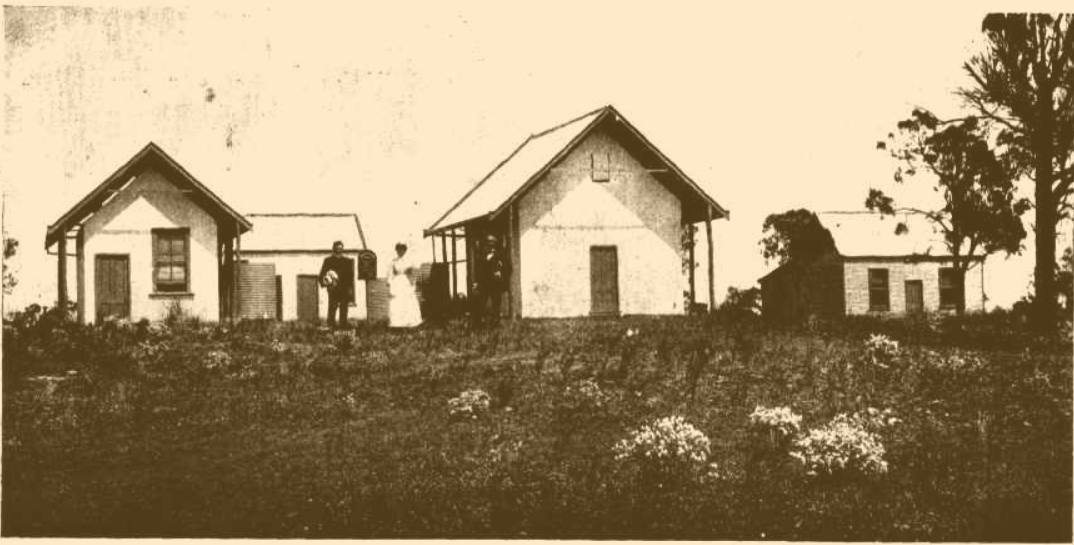
A Doctor had been appointed, The Rev Dr Hunter Finlay, who would receive £400 per annum, and he was described as having ‘…high qualifications and extensive and varied experience’. Nurse Brown (no identifying information available) had the care of patients, and her salary increased to £100 per annum, and she was promoted to Matron. Praise was fulsome for the two holders of these positions, and everything appeared to be going swimmingly. The photo below, (1903) of the hospital, does not mention names, but it’s possible the two figures are that of Dr Finlay and Nurse Brown.

Ularring District Hospital, Mulwarrie (Ideal Studio, Boulder)2

By September of 1903 Dr Finlay had left, and it appears he had been removed from the governing Board of the Hospital but not before an inquiry into the management of the hospital was held. It was concluded that ‘friction between the Resident Medical Officer (Dr Hunter Finlay) and the nurse in charge’ had precipitated his departure. However there was some disquiet about him before this date, judging from various letters to newspapers.3 4

This was not the first time Dr Finlay had been removed from a position – or at least, asked to resign. He was originally both a qualified medical doctor and an ordained Church of England Clergyman who immigrated to Australia in about 1880 with his daughter, Sarah Craig Hunter Finlay. His wife, Sarah Paterson Craig was confined to an asylum in Glasgow, Scotland, and remained there until her death in 1925. For some 20 years prior to his arrival in Western Australia, Dr Finlay was in the news in Queensland – as a bankrupt, charged with fraud, and charged with performing an abortion (he was acquitted of this one) and also malpractice.5 6

Eventually Dr Finlay was disallowed to perform marriages, and dropped the ‘Rev.’ appellation before his name. His relationship with a woman 32 years younger may have raised eyebrows, and the fact that they had three children in Queensland. Careful examination of dates makes the possibility of a third lady being the ‘Mrs Hunter Finlay’ present at Dr Finlays’ funeral in Coolgardie. He had taken up further positions, and pursued his private medical practice specialising in treating women and children around the district before his sudden death in 1906 of a heart attack in his Coolgardie consulting rooms.7 


Sources
  1. MULWARRIE. (1902, September 25). The North Coolgardie Herald and Miners Daily News (Menzies, WA : 1899 – 1904), p. 2. Retrieved May 8, 2024, from http://nla.gov.au/nla.news-article259859802 ↩︎
  2. No Title (1903, November 24). Kalgoorlie Western Argus (WA : 1896 – 1916), p. 22. Retrieved May 8, 2024, from http://nla.gov.au/nla.news-article32736460 ↩︎
  3. CORRESPONDENCE. (1903, April 18). The North Coolgardie Herald and Miners Daily News (Menzies, WA : 1899 – 1904), p. 3. Retrieved May 8, 2024, from http://nla.gov.au/nla.news-article259806982 ↩︎
  4. COUNTRY. (1903, June 17). The West Australian (Perth, WA : 1879 – 1954), p. 5. Retrieved May 8, 2024, from http://nla.gov.au/nla.news-article24826299 ↩︎
  5. PETTY DEBTS COURT. (1899, April 26). Morning Post (Cairns, Qld. : 1897 – 1907), p. 3. Retrieved May 8, 2024, from http://nla.gov.au/nla.news-article42938092 ↩︎
  6. TOWNSVILLE. (1892, March 8). Warwick Argus (Qld. : 1879 – 1901), p. 2. Retrieved May 8, 2024, from http://nla.gov.au/nla.news-article76639366 ↩︎
  7. SUDDEN DEATH (1906, September 6). Coolgardie Miner (WA : 1894 – 1911), p. 3. Retrieved May 8, 2024, from http://nla.gov.au/nla.news-article218125091 ↩︎