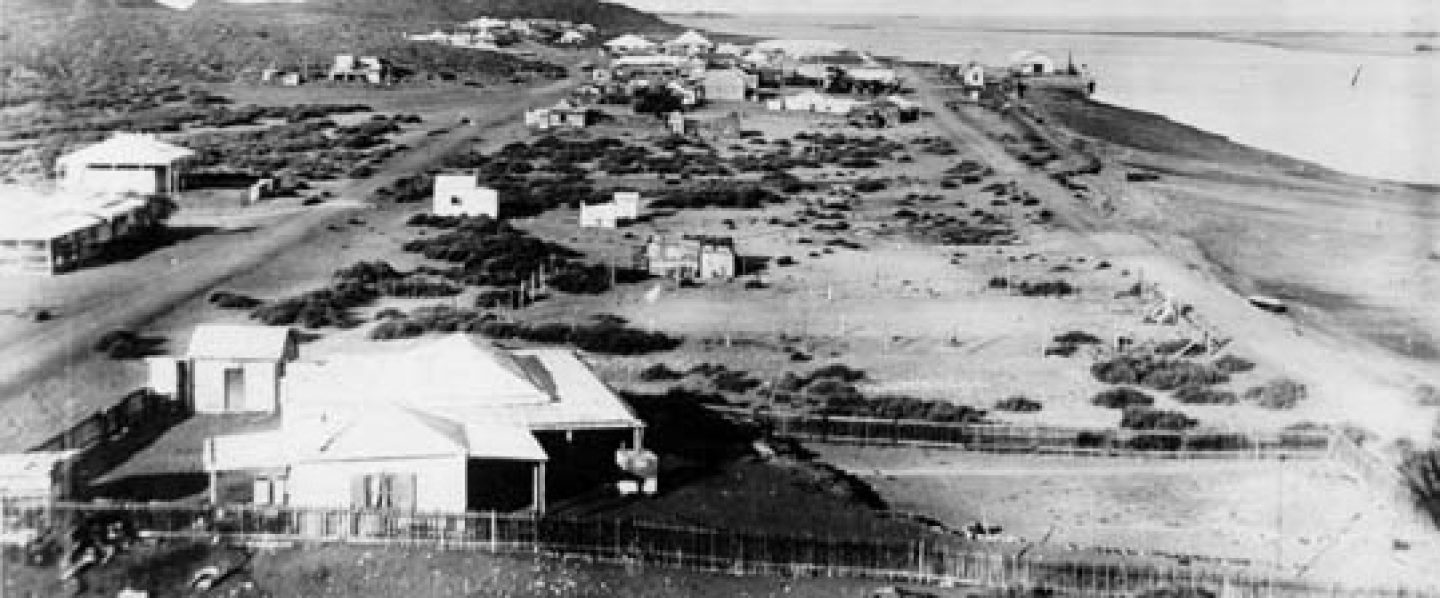
The following article was published by Bruce Elder, of Aussie Towns, on 21 March 20181 and is published here with the permission of the author.
I love the way the algorithms of the internet find the most obscure information. In May, 2017, I wrote a Facebook entry on the non-town of Shay Gap.
The town has always fascinated me because when I first circumnavigated the continent in 1988 I found it and was amazed by its futuristic modernity. When I returned it was gone. Totally. Absolutely. I couldn’t find even a hint of the town. It was a reminder of just how unsentimental mining companies are. When a town is not needed … get rid of it.
Mercifully I still have photos I took in 1988. Look at the houses. They all look as though they were designed by an architect straight out of The Jetsons. Pure 1950s sci-fi with lots of ovoid windows and what looks like plastic. It was a town created by Mount Goldsworthy Mining Associates for workers in their iron ore mines. It was designed in 1970 by an architect named Lawrence Howroyd.
In 1973 it was written about in, of all places, the Canberra Times.2 The following eulogy explains its origins: “Shay Gap is perhaps the most imaginative attempt yet to beat the hostility, if not ferocity, of one of the most inhospitable parts of Australia; but a part that is also one of the richest iron-ore belts in the world.
Shay Gap is in the hot country. Its near-neighbours are Marble Bar and Goldsworthy. which in summer compete day after day to post the highest maximum temperatures on the continent. It lies 120 miles east of the Pilbara’s major iron-ore port, Port Hedland. “The Gap”, as its residents already call it, is built on powdery brown earth lying between low cliffs of red rock that seem to cradle the heat of the day long after the sun has gone down. The temperature can reach 50°C in summer.
Shay Gap is another company town; one of three built by Goldsworthy Mining, the Pilbara iron ore pioneer. Goldsworthy already had a reputation for making the Pilbara bearable for its employees. Among other things it was the first to introduce closed-circuit television. This device gave it a much lower staff turnover than any other Pilbara company and attracted married couples — more stable work units than itinerant young men looking for quick fortunes.
For the new town, the command — to Perth architect, Mr Lawrence Howroyd – was, in effect: “Put down a place in the desert which people will not only find bearable, but attractive”. The result at Shay Gap is what Mr Howroyd calls a “machine for living”, an expression which has overtones of 1984 but which, in fact, is meant to convey that men who are prepared to work the mines should not have to sweat out domestic discomfort when they are off-shift. The town has been designed on the basis that it is a community rather than a collection of individuals — recognition that people are driven by isolation into “togetherness”.
Because the design was not governed by suburban block by-laws, it could be adventurous by suburban standards. One of its revolutionary features is an underground trench that contains all the town’s basic services: irrigation, sewerage, power and telephone and television cables. There is nothing unsightly sticking out of the ground. Mr Howroyd describes the trench as an umbilical cord. There are other features that any progressive town planner would give his eye teeth to be able to implement.
The 101 houses (with as many as four bedrooms) are built in groups of 11 in such a way that people can walk in shade from any part of the town to any other. No resident has to walk more than 200 yards to any facility, including the shopping centre, the school and the club. The average distance anyone has to walk anywhere is 40 yards. Residents are also kept cool with an air-conditioning system based on a communal chilled-water plant. Each house taps the main that ring the town. In addition, each house is pressurised by a fan coil unit; because pressure inside is higher than it is outside, dust and most insects cannot enter.
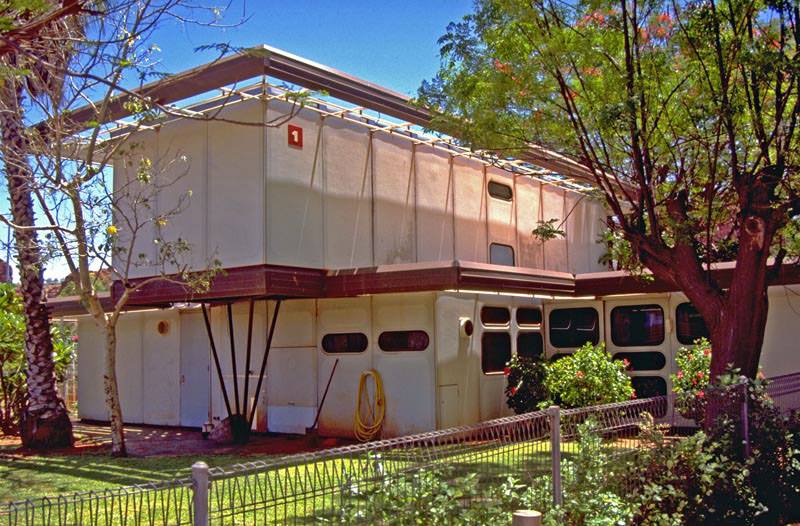
photographed by the author, Bruce Elder
Another refinement is the irrigation system, which provides up to 60 inches of “rain” a year. The watering is done at night from high-level misting devices. The town is expected to develop a green, park-like appearance — an oasis of comfort in a desert.
The building of Shay Gap from the ground up presented a unique opportunity for eliminating the motor car from living areas. The town is completely free of vehicles, yet each house has a lock-up garage. Small electric vehicles are used to provide such services as rubbish disposal.”
The end result was that Lawrence Howroyd won an Award of Merit in 1974 from the Prince Philip Prize for Australian Design.
But, and this is always the moral of the story of mining towns, by 1994 it had been totally demolished and removed. When I returned there was nothing. Absolutely nothing to remind people that once there was an award winning, experimental town in the desert. The transience and unsentimental capitalism of mining. Who cares about the inhabitants. The mine is closed and so is the town.
Now, here’s the mystery. Yesterday some people who lived in Shay Gap actually found my FB entry. They had such fond memories:
Jackie Dimovska wrote: “This was a really interesting read. Best little town to grow up in. Still have dreams about it.”
Then Desmond Leong added “Had the best childhood ever growing up there.”
And Linda Skinner wrote: Still miss the town memories I will have forever and sadness that it’s gone yes a very unique beautiful community town and was great raising my children and will never be forgotten”. With lots of heart emojis.
That makes these Facebook entries worthwhile. I am so glad it has touched people deeply. Maybe I should include it in Aussie Towns so people can remember.
- Elder, Bruce (2018). https://www.facebook.com/share/p/17LEGRnRye/ ↩︎
- Oasis of comfort (1973, June 9). The Canberra Times (ACT : 1926 – 1995), p. 19. Retrieved April 16, 2026, from http://nla.gov.au/nla.news-article110713812 ↩︎
 People of Western Australia's Ghost Towns
I was living in Gap 1982-1984 my name is The Swede Magnus
LikeLike
Hello Magnus
Thank you for your comment and interest in the Shay Gap story. Shay Gap is one of our ghost communities and will be assigned to a project phase to carry out further research and indexing in the near future. We’re always keen to hear from people who may of lived, worked or visited any of our ghost communities. You may have a story, like the one shared by Bruce Elder, or perhaps photographs or interesting facts. We are always grateful to receive information about our ghost communities.
Thank you again for your interest in the project.
Kind regards
Tracie Mulvey
Project Manager
E | ghostswa.pm@fhwa.org.au
W | ghostswa.au
___________________________
PEOPLE OF WESTERN AUSTRALIA’S GHOST TOWNS
A project of FamilyHistoryWA (FHWA)
LikeLike
my name is Derek considine I worked in shay gap in 1977 as a shovel oiler on the 1900B face shovel my mine number was 9188, it was truly a magical place to work I feel so proud that I spent a year of my life there, the people from all over the world I worked with was magnificent, I worked on B shift and aged the brilliant game of cricket for the B SHIFT BLUDGERS, I still have the cricket ball the team signed for me on the last game I played , I left in December 1977 , and still today I never stop talking about the GAP, to day is tue August 4 2026 , and I still look at all the photos I took with great fondness, Although iam a true pomie , my 3 good friends from the gap who where all True aussies came to the UK to se me , Grant odonnald, Angus Gibbson, and , A lad who was a pomie hater was a lad who was married with 2 children became my good friend he was Wayne Cross, he played for another shift but through cricket we became good friends he was a driller on the rigs, he and his wife even threw me my leaving party at his lovely home , I’ve kept all my Shap gap gazette papers given out ever week , telling local news on sports , social events , for aussie rules, , cricket 🏏, the ladies soft ball team , and all the up and coming company news , I have 2 sons and a fantastic wife could jenny Jack and Tom, iam 74 now , and I’ve drove them mad all about Shap gap , another brilliant friend I met was Kevin regan, a fantastic lad with 3 children and his lovely wife also called jenny , we became good mates , as a single lad in the mine, at times it could be quite lonely, but through the beautiful people I Met there I was never alone or home sick , some of the great lads who I worked with on B shift , where Barry Charlesworth, cliff Anderson, studd Dawson , David howe the town plummer, Hollywood George from Brazil, Fred tasker kiwi ,so proud to have met all these brilliant people, I’ve read everything I can about the GAP, it one of the greatest memories in my life , the township was such a magnificent place to be , it was the greatest part of my life , I was 25 , and still today i get very emotional , just looking at the photos the gazette the signed ball the lads gave me , what a absolutely amazing fantastic place to have been there , I loved the beautiful hot 🔥 SHAY GAP, XXXX
LikeLike
Hello Derek
Thank you for sharing your memories of Shay Gap. We’re always keen to hear from people who have lived and worked in our ghost communities. It sounds like you have plenty of stories, photographs and interesting material. We are always grateful to receive information about our ghost communities.
Thank you again for your interest in the project.
Kind regards
Tracie Mulvey
Project Manager
E | ghostswa.pm@fhwa.org.au
W | ghostswa.au
___________________________
PEOPLE OF WESTERN AUSTRALIA’S GHOST TOWNS
A project of FamilyHistoryWA (FHWA)
LikeLike