Editor’s Note: The following account has been thoughtfully researched and brought to life by Gail Thomas, a valued member of the Ghost Project team. It highlights the determination and activism of a group of women from Wagerup and Yalup Brook who worked together not only to improve their local communities and help shape their development, but also to contribute to broader issues affecting Western Australia.
There must have been much excitement on 25 April 1929 at the Yalup Brook Hall when women from Wagerup and Yalup Brook met to form a branch of the Women’s Section of the Primary Producers’ Association (WSPPA).1 These small farming communities were located between the towns of Waroona and Yarloop in W.A.’s south-west. Mrs Pitman was elected president and Mrs Hester secretary and treasurer. The Yalup Brook-Wagerup Branch met monthly and played an active part in the lives of local women until about 1936. Mesdames May, Archibald, Moffatt, Trotter, James, Stephens, Tyler and Miss Ibbotson were some of the other stalwarts of the Branch.
As well as their monthly meetings, members held fund-raising events such as euchre parties, a “Paddy’s Market” and dances. Donations were made to the King Edward Memorial Hospital and funds were used to send delegates to the WSPPA annual conferences in Perth.
Branch members campaigned on local issues which impacted on their farming community, centred on dairy farming, pig production and the growing of crops such as pumpkins and cabbages. In 1930 the women discussed the need for a cool storage van at the railway siding to provide for cream and milk to prevent it from spoiling, at great loss to the producers.2 At the annual state conference that year, Mrs Hester moved that “The Railway Department should be asked to provide conveniences on country lines”.3 At the monthly meeting of 23 June 1932, it was moved that the following resolution be placed before the next state conference – that “the Deputy Postmaster-General be asked to provide direct mails to and from Perth and Wagerup”.4 The women wanted action and they got it! In October, Mr J. H Prowse, M.H.R., wrote to the executive of the WSPPA “advising that the request from the Wagerup branch for a direct mail service with Perth had been placed before the Postmaster-General, who had arranged for this service to be inaugurated daily”.5
Lest it be thought that the women of Wagerup and Yalup Brook were only interested in local issues, nothing could be further from the truth. These women had strong opinions about the governance of their State and weren’t afraid to voice them. They were not keen on the Government – State or Federal. Only a year after the Branch formed, it passed a motion to go to the state conference favouring the secession of Western Australia from the Commonwealth.6 Although the motion was debated at the conference on 15 August 1930, it does not seem to have progressed beyond the committee stage.7
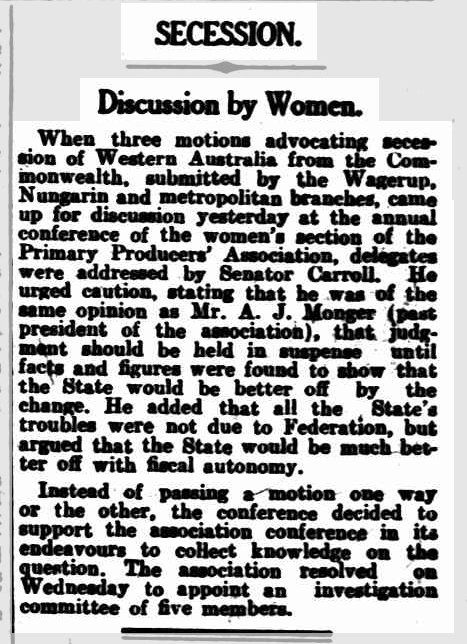
The women of Yalup Brook-Wagerup protested about the high cost of Government and thought that the number of elected members should be reduced, though “without injury to the representation of country areas”.8 9 They deplored “the action of certain Federal members in raising their salaries, while farmers can scarcely make a living”.10
The Branch was still operational in mid-1934, but in June 1935 was re-formed after having been in recess for a year.11 It is probably fitting that what seems to have been one of the women’s last campaigns was for the direct benefit of their local community. In October of that year, the Secretary for Railways informed the WSPPA that as a result of representations made by the Association, “it has been decided to provide hangers at Wagerup siding for protection against attacks by dogs of carcass meat deposited for conveyance by rail until placed in the security of the branke-van (sic)”.12 The Branch does not seem to have continued after 1936. A branch of the Country Women’s Association was formed in Wagerup around that time and perhaps the membership simply relocated.
Despite the relatively short life of the Branch, the spirit of positive activism shown by its members resulted in tangible benefits for their local communities. However, it also placed these women within the broader Western Australian community, as evidenced by their political campaigning. The WSPPA gave the women of Wagerup and Yalup Brook a voice, and they made the most of this opportunity.
Sources
- Primary Producers. Women’s Section Extends (1929, May 3). The Daily News (Perth, WA: 1882-1955), p. 11. Retrieved October 28, 2026, from http://nla.gov.au/nla.news-article85152570 ↩︎
- Work of Women’s Association (1930, January 3). The West Australian (WA: 1879-1954), p.4. Retrieved October 5, 2026, from http://nla.gov.au/nla.news-article32342060 ↩︎
- Producers’ Wives. Annual Conference (1930, August 15). The West Australian (WA: 1879-1954), p. 20. Retrieved October 5, 2026, from http://nla.gov.au/nla.news-article33349101 ↩︎
- Primary Producers. Women’s District Meetings. Yalup Brook-Wagerup (1932, July 1). The West Australian (WA: 1879-1954), p. 5. Retrieved October 5, 2026, from http://nla.gov.au/nla.news-article32556354 ↩︎
- Primary Producers. Women’s Section Meeting (1932, October 21). The West Australian (WA: 1879-1954), p. 9. Retrieved October 5, 2026, from http://nla.gov.au/nla.news-article32540950 ↩︎
- Primary Producers. Work of Women’s Association (1930, July 4). The West Australian (WA: 1879-1954), p. 6. Retrieved October 5, 2026, from http://nla.gov.au/nla.news-article33345383 ↩︎
- Secession. Discussion by Women (1930, August 16). The West Australian (WA: 1879-1954), p. 13. Retrieved October 5, 2026, from http://nla.gov.au/nla.news-article33346099 ↩︎
- Primary Producers. Women’s District Meetings. Yalup Brook-Wagerup, op.cit., p. 5. ↩︎
- Women’s Section. Concluding Day’s Session. Costs of Government (1932, August 19). The West Australian (WA: 1879-1954), p. 14. Retrieved October 5, 2026, from http://nla.gov.au/nla.news-article32547995 ↩︎
- Primary Producers. Women’s Section Notes. Yalup Brook-Wagerup (1933, November 14). The West Australian (WA: 1879-1954), p. 4. Retrieved October 5, 2026, from http://nla.gov.au/nla.news-article32784845 ↩︎
- Primary Producers. Branches’ Annual Meetings. Organising (1935, June 11). The West Australian (WA: 1879-1954), p. 4. Retrieved October 5, 2026, from http://nla.gov.au/nla.news-article32879902 ↩︎
- Railway Concessions for Country Women. (1935, October 3). The West Australian (WA: 1879-1954), p. 4. Retrieved October 5, 2026, from http://nla.gov.au/nla.news-article32901857 ↩︎