Population of the Northern Goldfields – 1905

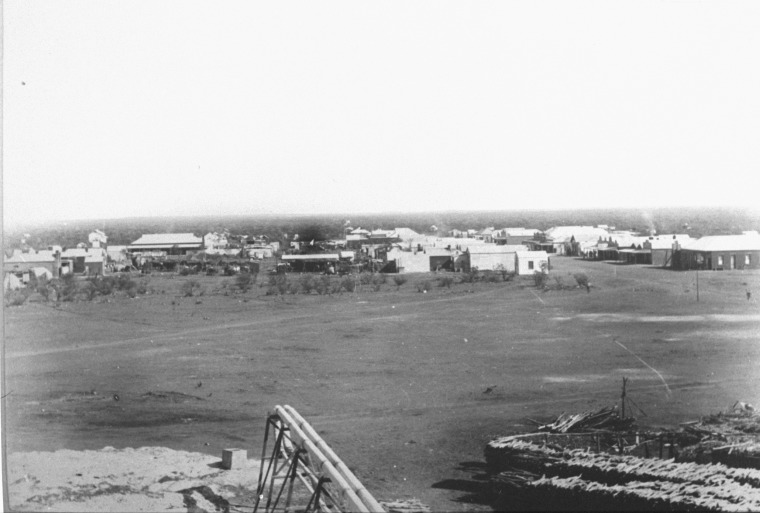
Kookynie c1900

Editors Note: This very informative article is reproduced from the Kookynie Press.1

We [the newspaper] recently obtained fascinating population statistics for the North Coolgardie district, courtesy of Inspector Woods, detailing the population as compiled by the police up to June 30. These figures offer a crucial look at the shifting fortunes of the Northern Goldfields communities.

The Overall Trend: A Net Loss for the Region

Compared to the statistics compiled the previous year, the North Coolgardie district as a whole has experienced a loss of 256 people.

While some centers managed to hold steady or even grow, others saw significant decreases in population. Menzies, for instance, managed to remain the same.

The most substantial population losses were recorded in:

  • Kookynie, showing a significant drop of 559 residents.
  • Morgans, which lost 132 residents.
  • Malcolm, which saw a decrease of 125 residents.

However, the outlook was much brighter for several key towns, demonstrating that growth continues in specific pockets of the goldfields. Towns reporting major increases include:

  • Leonora, which gained 240 people.
  • Laverton, which grew by 230 people.
  • Gwalia, which added 100 people.

Substantial increases were also recorded in the areas of Murrin and Yundamindera.


Detailed Population Statistics by District

The following tables provide the detailed breakdown of the population in the North Coolgardie district as of June 30, 1905.

MENZIES DISTRICT

LocationMalesFemalesChildrenTotal
Menzies9984673791,844
Woolgar1445255251
Comet Vale113721
Goongarrle6091079
Mt Ida941515124
TOTAL1,3075464662,314

KOOKYNIE DISTRICT

LocationMalesFemalesChildrenTotal
Kookynie1,0202201751,415
Champion50151883
Britannia1951034
Puzzle112215
Niagara1503122203
Tampa304640
Yerilla10054109
TOTAL1,3902822411,915

MALCOLM DISTRICT

LocationMalesFemalesChildrenTotal
Malcolm2509060400
Webster’s Find60201090
Mertondale2406020320
Dis. gen.811527123
TOTAL631185117933

GWALIA DISTRICT

LocationMalesFemalesChildrenTotal
Gwalia585185160930

LEONORA DISTRICT

LocationMalesFemalesChildrenTotal
Leonora395196140731
Tower Hill93113107
Dis. gen.3374531413
TOTAL8252521741,251

YUNDAMINDERA DISTRICT

LocationMalesFemalesChildrenTotal
Yund’m’n’dra1674548260
Edjudina1152324162
Pingin572059
Dis. gen.853492
TOTAL4247376573

MURRIN DISTRICT

LocationMalesFemalesChildrenTotal
Murrin3703329432

MORGANS DISTRICT

LocationMalesFemalesChildrenTotal
Morgans6652821381,085
Dis gen.103118122
TOTAL7682931461,207

LAVERTON DISTRICT

LocationMalesFemalesChildrenTotal
Laverton2056041306
Euro82313
Craiggiemore55172496
Lancefteld1602036216
Augusta203427
Ida H.802225127
Hawke’s Nest200020
Erlston dis.3382716371
TOTAL8861511491,196

BURTVILLE DISTRICT

LocationMalesFemalesChildrenTotal
Burtville2284230300

SIR SAMUEL DISTRICT

LocationMalesFemalesChildrenTotal
Sir Samuel41310069582

LAWLERS DISTRICT

LocationMalesFemalesChildrenTotal
Lawlers430130110670
Cue’s Patch1151613144
Darlot1402214176
Dis. gen.3084117366
TOTAL9932091541,356

BLACK RANGE DISTRICT

LocationMalesFemalesChildrenTotal
Black Range921911122
Dis. gen.4632423510
TOTAL5554334632

DAVYHURST DISTRICT

LocationMalesFemalesChildrenTotal
Davyhurst62598125848
Callion101213
Siberia Soak6129
Mulwarrie47121372
Ullaring192021
Mulline1302422176
Riverina4851063
TOTAL8851431801,208

Sources

  1. Population of the Northern Goldfields. (1905, July 15). Kookynie Press (WA : 1903 – 1911), p. 1. Retrieved December 15, 2025, from http://nla.gov.au/nla.news-article251123991 ↩︎
Three Decades

In May 2011, The Weekend West‘s Rod Moran published an article under the banner “The Way We Were”.1 The short article reads:

August 4, 1898

In three decades Goongarrie grew from a camp to a thriving town and finally a ghost town.

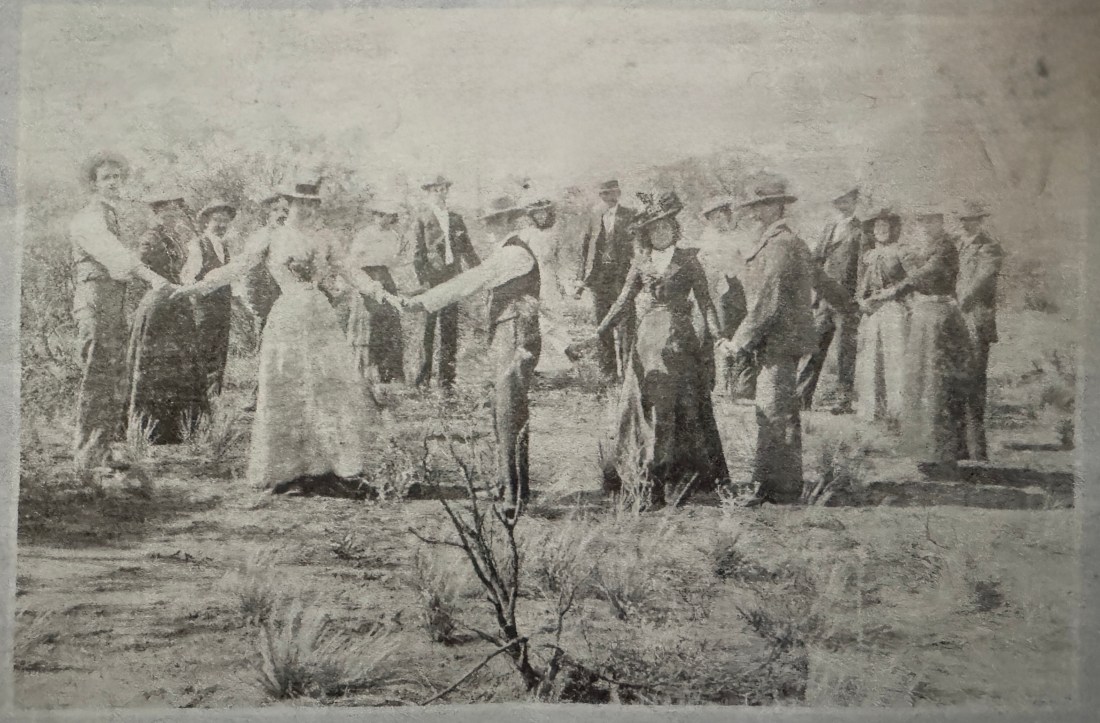
This lighthearted snap shows a picnic gathering at Goongarrie, a flourishing gold-mining site in the back-blocks between Menzies and Kalgoorlie. The first gold discoveries in the area were mde in 1893. The hamlet was also called the Roaring Gimlet, due to the thundering noise of icy desert winds through the gimlet trees. More prosaically, early on it was simply called the 90 Mile camp, its approximate distance from Coolgardie.

Despite its isolation, Goongarrie developed into a thriving little town. By the 1890s it boasted two pubs, as well a other essential services such as a post and telegraph office. In 1898 the Cobb and Co coach from Coolgardie was boosted from a bi-weekly to a daily run. The government rail line opened in the same year. The town also boasted a blacksmith, a carpenter, two butchers, a baker two restaurants and a cool drink manufacturer. But the citizens depicted here at play also had some weighty concerns on their minds in its August 4, 1889 [sic] edition The West Australian reported “Considerable dissatisfaction is expressed in this district at the failure of the Education Department to establish a school at Goongarrie. From 15 to 30 children are now resident here, and…not having any educational facilities whatever, are to a great extent running wild about the country…growing up in almost total ignorance.”

In 1904 the district’s electoral roll listed 109 names. But by 1921 the postal directory had only 21 people on it. even if a school had been built, Goongarrie’s fortunes would have waned as alluvial gold petered out.

The information and accompanying image were said to be taken from the archives of The West Australian. However, a search of Trove for the period in question has not located the original photo. The quoted comment about the lack of a school in Goongarrie can be found in the Kalgoorlie Western Argus 2 along with further details on the issue.

In September 1898, Cyril Jackson, the Inspector General of Schools, responded to a letter from the local Board of Health in which an offer of a suitable building (the Miners’ Institute) was made to house a school free of charge. He said “…the Minister is very anxious indeed to extend education to as many children as possible. It seems impossible, however, in the present state of the funds to establish a school at Goongarrie.”3

Some things, it seems, never change.


Source

  1. Rod Moran, 2011. The Weekend West : The Way We Were. Published 28-29 May, 2011 by The West Australian Newspapers. ↩︎
  2. GOONGARRIE. (1898, August 4). Kalgoorlie Western Argus (WA : 1896 – 1916), p. 9. Retrieved June 28, 2025, from http://nla.gov.au/nla.news-article32194286 ↩︎
  3. Public School at Goongarrie. (1898, October 1). The Menzies Miner (WA : 1896 – 1901), p. 5. Retrieved June 28, 2025, from http://nla.gov.au/nla.news-article233058760 ↩︎

Search Party

I just came across this article in the Sunday Chronicle of 12 Dec 18971. It struck my funny bone and so I wanted to share it with you!! Perhaps, given the sombre nature of the background to the article, that says something rather dark about my sense of humour?

Steps are being taken (says the Morning Herald’s Menzies correspondent) to organise another search party to look for the man M’Innes, who was lost 12 months ago while journeying from Menzies to Donkey Rocks. He is supposed to have perished between Menzies and Goongarrie Lake.

This reads very curiously to us. There were search parties organised about the time that the man was lost and they were unsuccessful. Have the Menzies people become so thoroughly embued with the West Australian spirit that after 12 months they must institute another search? What use would it be, anyhow? If M’Innes perished, which we sincerely hpe he did not, the part could only find his bleaching bones – what earthly use would that do them? Now if they put a record in the archives of Menzies that in the year 3000 a.d., the mayor and councillors of the town are requested to institute a search for a certain man named M’Innes, who was believed to have been lost in the year 1896, they would possibly be doing future generations a certain amount of good, for the suppositionary bleaching bones by that time might have become interesting fossils, that is unless Menzies has fallen neck and crop into the background of oblivion, which does not seem at all unlikely as the world wags.

At the time of the disappearance, The North Coolgardie Herald and Menzies Times reported that Constable Sampson of Bardoc and a black tracker were searching unsuccessfully for the publican John M’Innes2. Mr M’Innes had made the trek through trackless and waterless country successfully on a number of previous occasions, but no trace was found of him after he left for Donkey Rocks in late December.


  1. “THE WEEKLY WHIRL.” Sunday Chronicle (Perth, WA : 1897 – 1899) 12 December 1897: 3. Web. 17 Feb 2024 <http://nla.gov.au/nla.news-article257697205>. ↩︎
  2. “LOST IN THE BUSH.” The North Coolgardie Herald and Menzies Times (WA : 1896 – 1898) 30 December 1896: 2. Web. 17 Feb 2024 <http://nla.gov.au/nla.news-article259770978>. ↩︎

Our Pilot Communities

For a project of this complexity, it is important to get the processes correct right from the beginning. To do this, we need to test our tools and work flows on real examples. So the Project team have chosen four communities that represent different types of settlement, different industries, different population profiles, so that we can work out the bugs before the full teams start work.

Cossack, Goongarrie, Nugadong, Goodwood Timber Mill

Cossack

Before Broome, Cossack, at the mouth of the Harding River in the Pilbara, was the hub of the pearling industry in Western Australia. Originally named Tien Tsin in 1863, the name was changed to Cossack in 18711 and the townsite was officially declared in 1872. The area is also known by the traditional name Bajinhurrba.

Apart from the pearling industry, it was a major port for the Pastoral industry and, in the 1880s, hundreds of prospectors arrived there searching for gold in the Pilbara. The major buildings in area during this period included a stone wharf, the bonded store and customs house, a post and telegraph office, police barracks, court house, school, tramway and a selection of stores. Chinese, Malays, Japanese and Afghans all came to the area, and many of them, including prisoners, were involved in the construction of the Jarman Island Lighthouse2. By the 1890s, Cossack was a thriving community. However, on 4 April 1898 a major cyclone destroyed much of the town34. By 1900 the pearling fleet had moved north to Broome and by 1910 the municipality was dissolved.

That wasn’t the end of the story. In 1910, a site on Butcher’s Inlet was gazetted as a quarantine reserve for a leprosarium and this remained in operation until 1931 when the remaining fourteen patients were transferred to Darwin5.

People continued to live in Cossack in small numbers until after World War II, but by 1950 it had become a ghost town. The remaining buildings have now been restored, and Cossack has become something of a tourist destination in recent years.

Goongarrie

In 1893 a group of goldminers named Frost, Pickersgill, Bennett and Cahill discovered gold in an area6 about 84Km north of Kalgoorlie. Initially known as 90 Mile (the estimated distance to Coolgardie) or Roaring Gimlet (the sound of the wind blowing through the Gimlet trees)7, the town was gazetted in 1895. The town was located on the railway line that ran between Menzies and Kalgoorlie.

At its peak the town had a water supply, police presence, transport services (coach and later rail), post and telegraph, hotels and a boarding house, a miner’s institute including a library, and a full range of retail including two restaurants.

By 1903 the population was down to 66 while the 1921 postal directory contained only 25 entries8. Eventually the town site became first a pastoral station (also known as Goongarrie) and now part of the Goongarrie National Park.

Nugadong

The settlement at Nugadong grew up around a railway siding on the Wongan Hills to Mullewa Railway in 19139. The Gregory brothers first explored the area in 1846 for agricultural and pastoral potential but no settlement took place for many year10s. In 1894 the Midland Railway, linking Perth and Geraldton, was completed and this brought settlers.

Our research into Nugadong hasn’t gone far yet, but we do know that, in 1922, Arthur Jenner and Tom Hodgson took up war service land there, as did Harry & Jesse Atkinson in 1948 who raised a family of six on a farm there11.

Until the 1970s there was a race track called Nugadong in the area, and the Dalwallinu air field is located by the Nugadong Rail Siding.

The town of Dalwallinu was originally called South Nugadong12.

Goodwood Timber Mill

The Goodwood Timber Mill was chosen as a pilot site to represented the many Timber communities in our list. It is proving to be extremely ghostly. What do we know (or think we know) so far – not a lot!

  • Most records refer to the settlement simply as “Goodwood”.
  • We have some births registered at Goodwood between 1885 and 1888
  • We have a drowning in 1886
  • On 11 March 1891, J. A. Evans advertised “All houses, buildings and fences at Goodwood Saw Mill” for immediate sale13.

That’s about it. But the search is ongoing. And, after all, we did want to know the sort of challenges we would face during the project, didn’t we!

Sources:
  1. Aussie Towns. Cossack, WA. https://www.aussietowns.com.au/town/cossack-wa. Accessed 16 Sep 2023 ↩︎
  2. Lighthouses of Australia Inc. Jarman Island Lighthouse. https://lighthouses.org.au/wa/jarman-island-lighthouse/. Accessed 16 Sep 2023 ↩︎
  3. Aussie Towns. Cossack, WA. https://www.aussietowns.com.au/town/cossack-wa. Accessed 16 Sep 2023 ↩︎
  4. The Daily News (Perth, WA). The Storm at Cossack. Terrible Disasters. Tue 5 Apr 1898 p.4. https://trove.nla.gov.au/newspaper/article/82072700# Accessed 16 Sep 2023 ↩︎
  5. inHerit. Cossack Lazarette. http://inherit.stateheritage.wa.gov.au/Public/Inventory/Details/6f71b8fa-05b3-49b8-8149-ae5045b50868. Accessed 17 Sep 2023 ↩︎
  6. WA Now and Then. Goongarrie. http://www.wanowandthen.com/Goongarrie.html. Accessed 16 Sep 2023 ↩︎
  7. Wikipedia. Goongarrie, Western Australia. https://en.wikipedia.org/wiki/Goongarrie,_Western_Australia. Accessed 17 Sep 2023 ↩︎
  8. Outback Family History. Goongarrie – Western Australia : Goongarrie Postal Directory 1921. https://www.outbackfamilyhistory.com.au/records/record.php?record_id=165&town=Goongarrie/%2090%20Mile Accessed 17 Sep 2023 ↩︎
  9. Morawa District Historical Society. The Ghost Towns and Wayside Inns of Western Australia https://morawamuseum.org.au/ghosttowns-intro.html. Accessed 17 Sep 2023 ↩︎
  10. Kitchener 1978. Introduction to Buntine and Nugadong Reserves. p.9. ↩︎
  11. Dalwallinu Shire. Pioneer & Past Family Directory. https://www.dalwallinu.wa.gov.au/explore/about-dalwallinu/pioneer-past-families.aspx. Accessed 17 Sep 2023 ↩︎
  12. Wikipedia. Dalwallinu, Western Australia. https://en.wikipedia.org/wiki/Dalwallinu,_Western_Australia. Accessed 17 Sep 2023 ↩︎
  13. Southern Times, Bunbury WA. Notice. Mon 30 Mar 1891 p.7. Advertising. http://nla.gov.au/nla.news-article16485525. Accessed 14 Sep 2023 ↩︎