Search Party

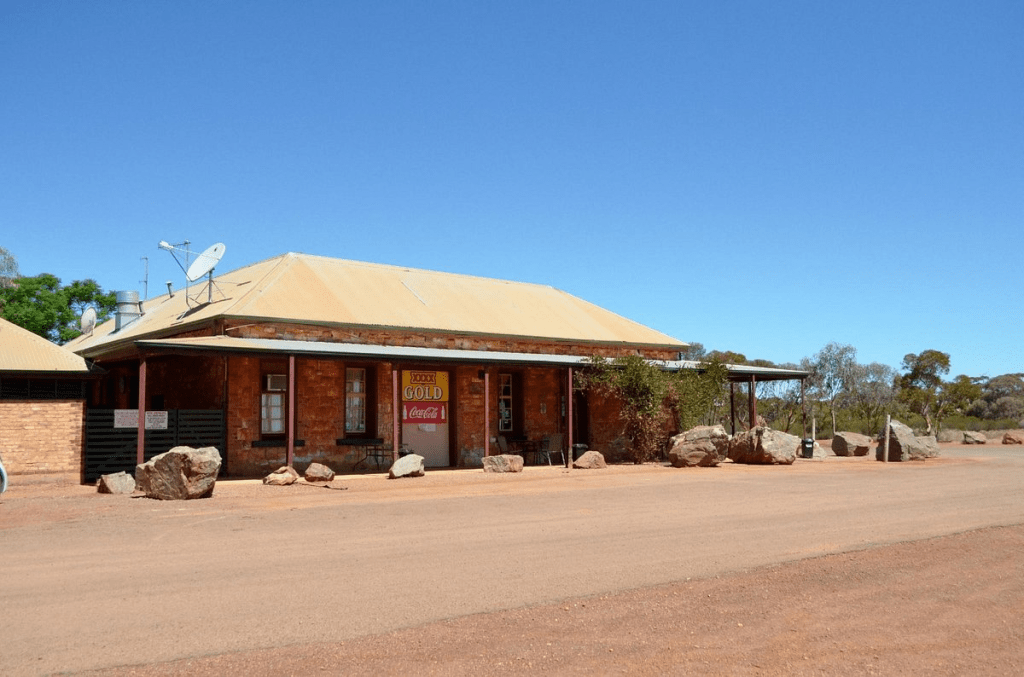
I just came across this article in the Sunday Chronicle of 12 Dec 18971. It struck my funny bone and so I wanted to share it with you!! Perhaps, given the sombre nature of the background to the article, that says something rather dark about my sense of humour?

Steps are being taken (says the Morning Herald’s Menzies correspondent) to organise another search party to look for the man M’Innes, who was lost 12 months ago while journeying from Menzies to Donkey Rocks. He is supposed to have perished between Menzies and Goongarrie Lake.

This reads very curiously to us. There were search parties organised about the time that the man was lost and they were unsuccessful. Have the Menzies people become so thoroughly embued with the West Australian spirit that after 12 months they must institute another search? What use would it be, anyhow? If M’Innes perished, which we sincerely hpe he did not, the part could only find his bleaching bones – what earthly use would that do them? Now if they put a record in the archives of Menzies that in the year 3000 a.d., the mayor and councillors of the town are requested to institute a search for a certain man named M’Innes, who was believed to have been lost in the year 1896, they would possibly be doing future generations a certain amount of good, for the suppositionary bleaching bones by that time might have become interesting fossils, that is unless Menzies has fallen neck and crop into the background of oblivion, which does not seem at all unlikely as the world wags.

At the time of the disappearance, The North Coolgardie Herald and Menzies Times reported that Constable Sampson of Bardoc and a black tracker were searching unsuccessfully for the publican John M’Innes2. Mr M’Innes had made the trek through trackless and waterless country successfully on a number of previous occasions, but no trace was found of him after he left for Donkey Rocks in late December.


  1. “THE WEEKLY WHIRL.” Sunday Chronicle (Perth, WA : 1897 – 1899) 12 December 1897: 3. Web. 17 Feb 2024 <http://nla.gov.au/nla.news-article257697205>. ↩︎
  2. “LOST IN THE BUSH.” The North Coolgardie Herald and Menzies Times (WA : 1896 – 1898) 30 December 1896: 2. Web. 17 Feb 2024 <http://nla.gov.au/nla.news-article259770978>. ↩︎
Ghost town schools

What was school like for the children and teachers of Western Australia’s Ghost Towns?

 In the years of rapid growth of mining communities, timber camps and the railways, (which encouraged the opening up of much agricultural land), schools opened and closed rapidly, sometimes even in the same community as the population grew and shrunk and grew again.  Schools were indeed perfect barometers of the rise and fall of centres of population.1

During the years of the early 1900s, Western Australia was fortunate to have a head of the Education Department who believed that every child in Western Australia, no matter how remote their home was, should have access to education.2 This thinking caused many tiny schools to open. Sometimes as few as 10 children were needed before a school could be established. Schools were in tents, slab huts, transportable buildings with canvas walls and a tin roof, in the back rooms of halls or churches and in school buildings, which were often erected by the community.

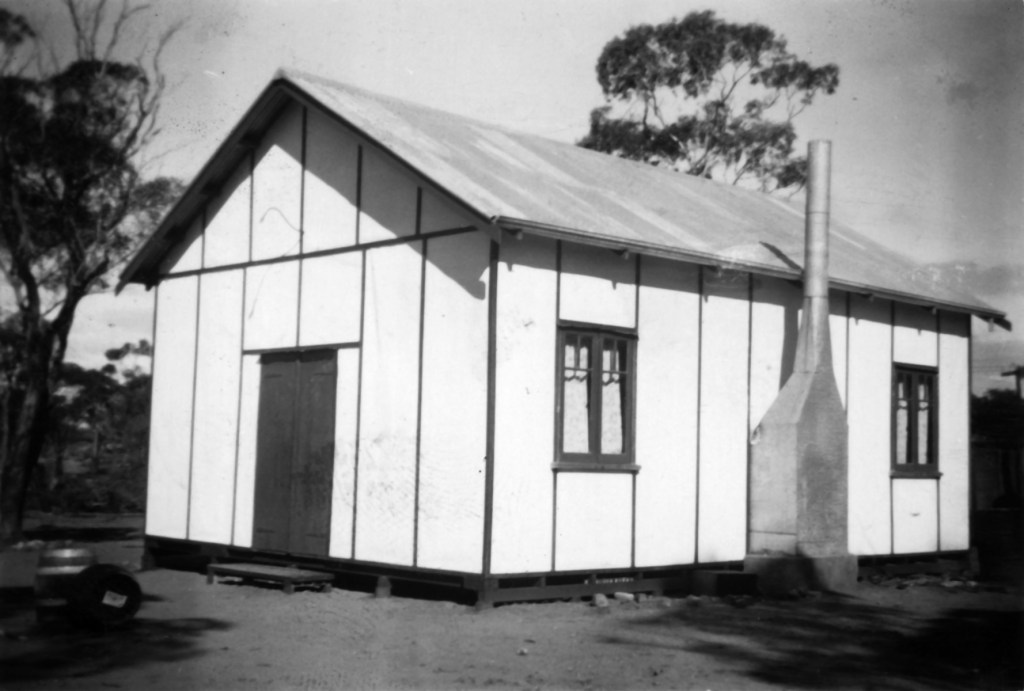
Spargoville School House, c19403

Both the pupils and their teachers did it tough in these bush schools. Pupils often walked long distances to school  or if they were lucky rode horses. Pupils were expected to attend school if they lived 2 or 3 miles away, (the younger children under 9 were only expected to walk 2 miles, while those over 9 could walk longer distances).  School ‘buildings’ got very hot in summer and were freezing in the winter months. School rooms were also home to local wildlife such as mosquitos, flies, frogs, lizards, mice, and snakes.

Teachers were under pressure to not only teach but keep the school grounds looking good, either making a garden or, at the minimum, planting trees. Sometimes this resulted in children spending a lot of their school time in the bush gathering materials for fencing the school, missing out on their education, and ruining their clothes.4

A teacher’s first difficulty when appointed to a bush school was finding out where the school was and then how to get there. Once they arrived at a remote railway siding most of the community were there to meet them, especially if the teacher was a young female.

Housing for the teachers was also a problem. A community that wanted a school had to supply accommodation for the teacher. Often the teacher boarded with a local family, and most families lived in very basic houses.  The teacher sometimes shared a room with older children and female teachers were usually expected to assist with household chores as well as paying board.  Teachers got to school the same way as their pupils, by walking up to three miles or in some places riding a horse.   

Once the teachers got to school they had the daily challenge of teaching a class of pupils whose ages ranged from 5 to 14. After the school day was finished the bush school teachers needed to clean the school, (for which they were paid a little extra, and complete hours of paperwork – such as ensuring attendance records were up to date, writing letters to the Education Department or answering such letters, and having written plans in place for all grade levels they taught.

Up until the 1930s the majority of schools outside West Australian towns had less than 20 pupils. The government of that day put education as their second highest priority, after ensuring a satisfactory food supply for the state.5   Eventually as people began moving to larger towns, there was a move to centralise schooling and pupils began to be bussed to larger schools.

The era of small schools in the bush was drawing to a close.  Thousands of children attended small bush schools in Western Australia. Did they receive an education that was comparable to the children in the larger towns? In many cases yes, due to the efforts of their intrepid teachers and their parents who ensured that their children were up and off to school. 

As children across Western Australia return to school this week in their air-conditioned classrooms, let’s take a moment to remember what it was like for many of the children in years gone by in lonely schools down the dusty tracks or forest paths.

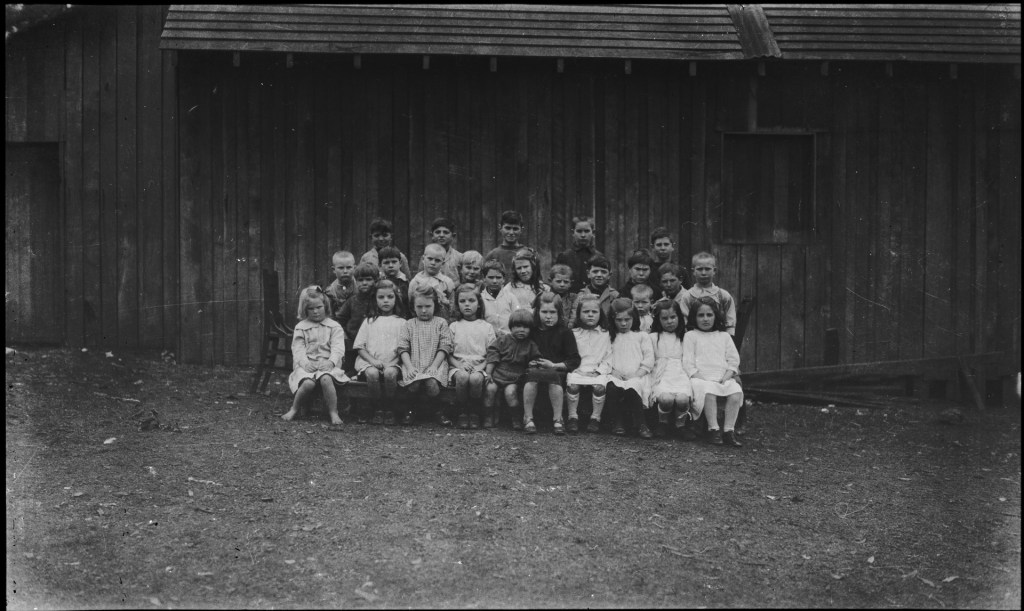
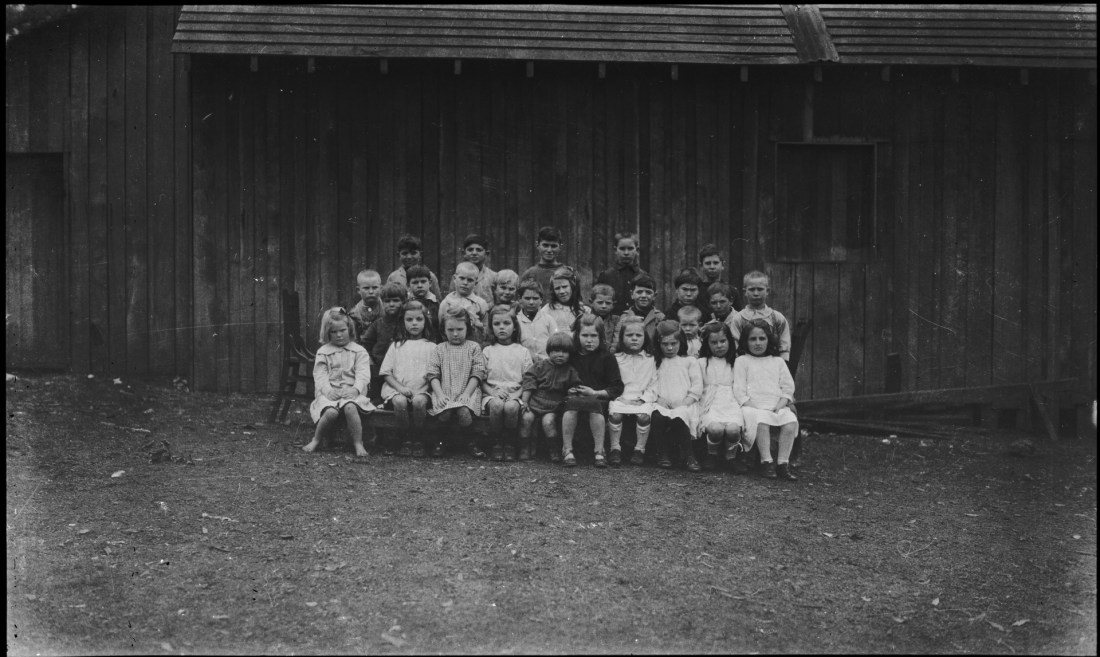
School children at the Lewis and Reid No.2 Mill, near Allanson, c19206

SOURCES

  1. Quote attributed to an Inspector Miles in 1912 in McKenzie, J.A. (1987). Old bush schools: life and education in the small schools of Western Australia 1893 to 1961. Doubleview, Australia: Western Australian College of Advanced Education. P. 7. https://ro.ecu.edu.au/ecuworks/7075 ↩︎
  2. Cecil Andrews, an Oxford graduate, was head of the Western Australian Education Department from 1913 to 1927. ↩︎
  3. State Library of Western Australia. Spargoville School. Retrieved from https://purl.slwa.wa.gov.au/slwa_b1974926_3 on 29 Jan 2024. ↩︎
  4. Bush Schools: A Plea for the Children. Letter to the editor of the Bunbury Herald and Blackwood Express, 26 November 1920. p.6 ↩︎
  5. McKenzie, J.A. (1987). Old bush schools: life and education in the small schools of Western Australia 1893 to 1961. Doubleview, Australia: Western Australian College of Advanced Education. P. 14. https://ro.ecu.edu.au/ecuworks/7075 ↩︎
  6. State Library of Western Australia. School children, Lewis and Reid No. 2 Mill, near Allanson, Western Australia, ca. 1920. Photograph retrieved from https://purl.slwa.wa.gov.au/slwa_b6797766_2 on 29 Jan 2024. ↩︎

Tuckanarra Reef

The original story of how Tuckanarra, the celebrated 24 ounce to the ton mine, was found in 1898, as told by Jim Boyd (one of the owners) was published in the Murchison Advocate, 27 May 1899, p3.  The town site was gazetted in 1899 after a state battery was installed in 1898.

In the March of 1896, the weather in the Murchison was really wet and a mining warden was travelling.  The bad weather stopped him from reaching his destination and on the way back to Cue he camped overnight in what was later known as Cork Tree Flat and then Tuckanarra. Either he or his companion, (a native tracker),  picked up a small piece of gold near their buggy.   Once they arrived in Cue the news of their find leaked out and several prospectors left Cue in the middle of the night to try to be the first on the scene. However, they were looking for alluvial gold and came back into Cue after a few days saying the find was no good.

Two days later Jim Boyd’s mate, George Moore, went out to Cork Tree Flat to see what the fuss was about. Instead of looking for alluvial gold, he looked for reefs. He came across a reef, broke a few pieces off it and brought it into Cue for Jim Boyd to look at. The quartz pieces had enough colour in them for Boyd and Moore to go back out to Cork Tree Flat for several weeks of prospecting, but not enough colour to suggest high hopes of finding a great find.

They arrived in Cork Tree Flat on Good Friday 1896 and Moore went in one direction and Boyd went in the other direction. Boyd hadn’t walked more than three or four hundred yards when he saw something that looked like yellow moss on a quartz outcrop. Of course, it was gold and that was the story of Boyd and Moore’s Tuckanarra mine began.

The Miracle of Bonnie Vale

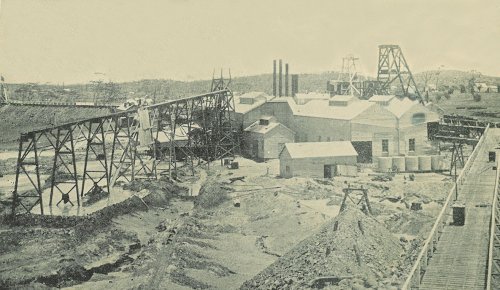
Bonnie Vale or Bonnievale near Coolgardie was the site of the Westralia gold mine. Bonnie Vale was gazetted in 1897 but became famous in March 1907 when unusually heavy rainfall flooded the mine with 160 miners inside. All the miners managed to get out before the main shaft was flooded with water, except for one.  Only Modesto (Charlie) Varischetti remained inside.

The Westralia Gold Mine.
Photo retrieved from Outback Family History

What followed was a thrilling mine rescue that may be unfamiliar to readers because it happened so long ago.   

At first Varischetti was presumed dead with no chance of survival unless he was in an area of the mine where there was an air pocket. Two days after the freak storm and flooding the rescuers heard Varischetti tapping. Varischetti became known to newspaper readers across the world as the Entombed Man.

A steam pump was rushed to the mine but only reduced the water level very slowly. The mine manager estimated that it would take a week to clear the shaft and there was no hope of rescue.  Allegedly the mine manager’s seven-year-old son asked his father about using a diver to rescue the trapped man and this idea was taken up by the Mining Inspector who was on site.

Divers were sourced in Fremantle and two miners from Kalgoorlie who were experienced in both mining and diving offered their assistance as well. A special train was put on to get the Fremantle divers and the equipment needed for the rescue to Bonnie Vale as fast as possible. The ‘Rescue Special’ steamed to Coolgardie arriving two hours faster than the regular trains. Fast horses were waiting to meet the train and raced to the mine in Bonnie Vale. It was only four days after the flooding of the mine shaft that the first diver made his initial exploratory dive. By day six, the divers had reached Varischetti and gave him food, candles, a powerful lamp, and other necessities.  Special Italian dishes were cooked for him by the wife of another Italian miner.


The Rescue Team at Bonnie Vale
https://purl.slwa.wa.gov.au/slwa_b6355955_2

It was considered too dangerous to put Varischetti into a diving suit and take him through the flooded mine.  Instead, the divers visited him each day while the mine was being pumped out. On the ninth day it was considered safe enough to tie a rope around Varischetti and help him walk out through the remaining water and sludge. In reality he was so weak one of the divers carried him for most of the distance.

hen the doctors in attendance examined Varischetti they pronounced his chief trouble was ‘a nervous prostration of a purely temporary character’ and gave him a sleeping draught.  The newspapers reported that he did look much better the next morning.

The divers who rescued Varischetti were feted and showered with laurel wreathes and expensive gifts, such as gold watches and purses of gold sovereigns. Gifts came from grateful miners across the country.

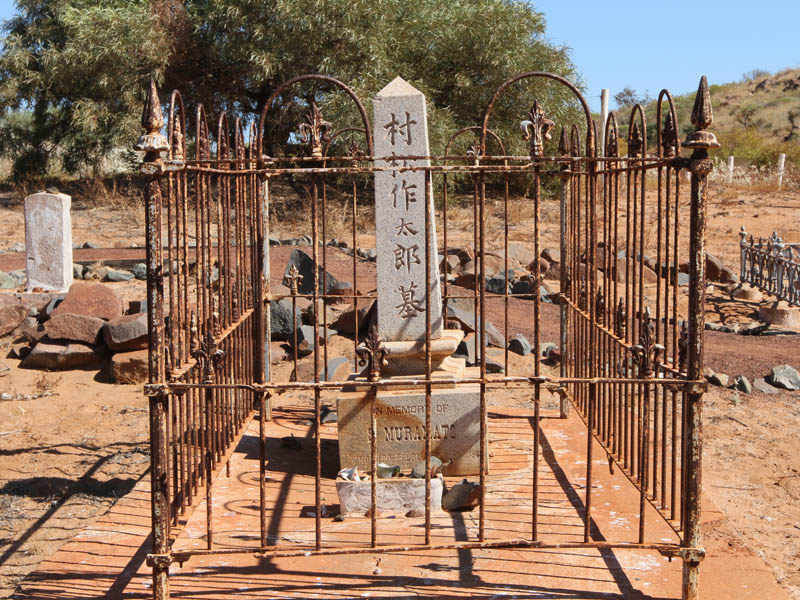
Varischetti on the other hand back to work down the mines and died from fibrosis in 1920. There is a memorial to him in the Coolgardie cemetery. 

Just as many of us watched the progress of the Thai cave rescue of the soccer team by Australian divers, in 1907 readers across the world eagerly awaited news of the ‘entombed man’ of Bonnie Vale.  In the years since there has been a film made about the story, a graphic novel written about the rescue and even a song celebrating the miracle of Bonnie Vale.


Further Reading

Bell, Lex, n.d. Miracle at Bonnievale. Retrieved from https://purl.slwa.wa.gov.au/slwa_b3096636_1 on 23 Dec 2023

Western Australian Museum, 2016. A Miraculous Rescue. Retrieved from https://museum.wa.gov.au/explore/wa-goldfields/dangerous-life/miraculous-rescue 23 Dec 2023.

Zanthus

There’s more to Zanthus than its position at the end of every list of Western Australian place names. The name is derived from the latin name for the Kangaroo Paw, Western Austalia’s floral emblem1.

Zanthus appears to have started life as a depot and rail siding during the construction of the Trans Australian Railway. Materials needed for the construction of the railway were sent to Zanthus from Kalgoorlie. Work started on the line (that would join Port Augusta to Kalgoorlie) in 1912 and the line opened in 1917.

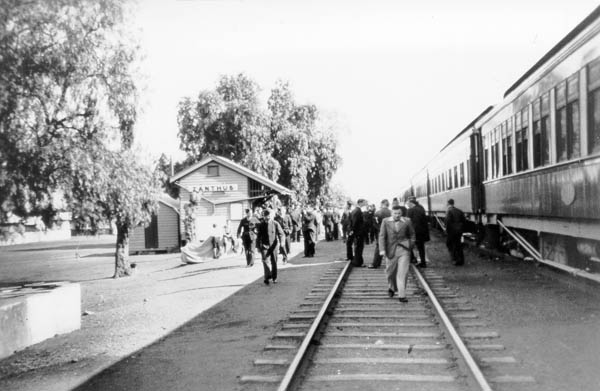
The Trans Australian Railway was the main route for the movement of Australian troops during World War II. Here RAAF personnel enjoy a stopover, probably to allow the steam locomotive to take on water, at Zanthus circa 1940
Photo from P Rogers Collection.

In 1921, the census recorded 24 people living at Zanthus and in 1933 there were 26 males and 21 females occupying the same 9 dwellings2. It must have been very crowded! That is the last time Zanthus appears in the census records. However, post 1933 census records carry a couple of caveats. The first is that only localities “in which at least 50 persons were enumerated” are included and that the record is “exclusive of full-blood Aboriginals and of dwellings occupied solely by them”3.

Even so life at Zanthus has never been dull. A quick search of Trove reveals a number of rail-related incidents over the years. In 1948, passengers were stranded when floodwaters washed away tracks and some of the passengers completed their trip in a Golden Airways airplane, and 50 workmen were required to repair the damage4. A derailment in 1953 resulted in tracks being torn up and repair crews worked through the night to have a deviation in place by the following day5. Rain from Cyclone Trixie in 1975 resulted once again in a major washaway, this time requiring construction of a new bridge in just two weeks6. And, as recently as 1999, the Indian Pacific collided with a stationary train on the tracks7. The speed with which each of these incidents was resolved speaks volumes about the continuing importance of the only transcontinental rail link8.

Today, the population of Zanthus is 09 and it appears that it has been that way for a very long time. and Zanthus is a crossing point on the railway where one train pulls off the main line to allow another heading in the opposite direction to pass.


Sources
  1. WA Now and Then. Zanthus. http://www.wanowandthen.com/zanthus.html. Accessed 20 Sep 2023 ↩︎
  2. Australian Bureau of Statustics. Census Bulletin No.25 Population and Occupied Dwellings in Localities. 30 Jun 1933. 21 Jan 1936, p.91. https://www.ausstats.abs.gov.au/ausstats/free.nsf/. Accessed 20 Sep 2023 ↩︎
  3. ibid. Part VIII. – Population and occupied dwellings in localities. 1947. 5 Apr 1949, p.497 https://www.ausstats.abs.gov.au/ausstats/free.nsf/. Accessed 20 Jun 2023 ↩︎
  4. The Daily News (Perth WA). Aircraft brings rail passengers from Zanthus. 25 Feb 1948, p.5. http://nla.gov.au/nla.news-article79680738. Accessed 20 Sep 2023 ↩︎
  5. The West Australian (Perth WA). Trans trains stranded at Zanthus. 25 Feb 1953 http://nla.gov.au/nla.news-article49082438. Accessed 20 Sep 2023 ↩︎
  6. The Canberra Times (ACT). Closure of shipping link exacerbates WA’s isolation. 19 Mar 1976, p.2. http://nla.gov.au/nla.news-article110808955. Accessed 20 Sep 2023 ↩︎
  7. Australian Transport Safety Bureau. Collision between Indian Pacific Passenger Train 3AP88 and Freight Train 3PW4N, Zanthus, WA, 18 August 1999. https://www.atsb.gov.au/publications/investigation_reports. Accessed 20 Sep 2023 ↩︎
  8. Insurance Business. Trans-Australian railway reopens but supply chain strain continues. 16 Feb 2022 https://www.insurancebusinessmag.com/au/news/breaking-news/transaustralian-railway-reopens. Accessed 20 Sep 2023 ↩︎
  9. ibid. Zanthus (Suburb and Locality) Australian Census 2016. http://www.censusdata.abs.gov.au/census_services/getproduct/census/2016/quickstat/SSC51682. Accessed 20 Sep 2023 ↩︎

New towns added

Over the weekend we added 29 more names to the Ghost Towns list. We don’t expect them to be the last. A number of the new listings are schools that have closed in the Shire of Esperance. The list now totals 539. If you know anything about these towns, or know of any that we haven’t yet picked up on, please let us know.

Yes, we actually missed Ora Banda!!!

The new names are:

CommunityRegionLGA
AgnewGoldfields-EsperanceLeonora (Shire
Bonnie ValeGoldfields-EsperanceCoolgardie (Shire)
BoorabbinGoldfields-EsperanceCoolgardie (Shire)
BuldaniaGoldfields-EsperanceDundas (Shire)
BullfinchWheatbeltYilgarn (Shire)
Bungarun LeprosariumKimberleyDerby-West Kimberley (Shire)
Circle Valley SchoolGoldfields-EsperanceEsperance (Shire)
ColreavyWheatbeltYilgarn (Shire)
East Circle Valley SchoolGoldfields-EsperanceEsperance (Shire)
East Dowak SchoolGoldfields-EsperanceEsperance (Shire)
GindalbieGoldfields-EsperanceKalgoorlie-Boulder (City)
Golden Ridge
GordonGoldfields-EsperanceKalgoorlie-Boulder (City
Grass Patch SchoolGoldfields-EsperanceEsperance (Shire)
Horseshoe
Karrajong (or perhaps Kurrajong)
KintoreGoldfields-EsperanceCoolgardie (Shire)
Kumarl SchoolGoldfields-EsperanceEsperance (Shire)
KundanaGoldfields-EsperanceCoolgardie (Shire)
KurrawangGoldfields-EsperanceCoolgardie (Shire)
LakesideGoldfields-EsperanceKalgoorlie Boulder (City)
LakewoodGoldfields-EsperanceKalgoorlie Boulder (City)
Ora BandaGoldfields-EsperanceKalgoorlie Boulder (City)
Red Lake SchoolGoldfields-EsperanceEsperance (Shire)
Rich Meadows SchoolGoldfields-EsperanceEsperance (Shire)
Salmon Gums SchoolGoldfields-EsperanceEsperance (Shire)
Truslove SchoolGoldfields-EsperanceEsperance (Shire)
Ularring
West Scadden SchoolGoldfields-EsperanceEsperance (Shire)

Nungarin North

Nungarin North was a small settlement about 2Km north of the current town of Nungarin1.

On 21 Aug 1912, a correspondent from the Merredin Mercury and Central Districts Index reported that that Mr A C McCorry had 700 acres of land to the north of the railway siding at Nungarin. The report continued with the news that Mr McCorry was “erecting a store, a blacksmith’s shop and a stone hotel containing 20 rooms at a cost of £4,000 “2. That roughly equates to $550,000 in today’s money!

This investment seems to have been aimed at encouraging people to move into the area north of the siding as he was also creating several half acre blocks near to the hotel site. The Commissioner of Railways had visited the site and promised to upgrade the Nungarin Siding with the addition of a good shed, lavatories, an extended ramp and the appointment of a man in charge.

Mr McCorry was also a driving force behind the building of an agricultural hall in the area, hosting a fund-raising dance at his home on the 31st March, 1912.

So what happened to Mr McCorry’s entrepreneurial enterprise? Hopefully our ongoing research will tell us and we will let you know.

Source
  1. Joukovsky-Vaisvila, Olga, 1978. Around the Rock: A History of the Shire of Nungarin, Western Australia. ↩︎
  2. Merredin Mercury and Central Districts Index, Wed 21 Aug 1912, p.3. Nungarin. http://nla.gov.au/nla.news-article155995515. Accessed 17 Sep 2023 ↩︎

Our Pilot Communities

For a project of this complexity, it is important to get the processes correct right from the beginning. To do this, we need to test our tools and work flows on real examples. So the Project team have chosen four communities that represent different types of settlement, different industries, different population profiles, so that we can work out the bugs before the full teams start work.

Cossack, Goongarrie, Nugadong, Goodwood Timber Mill

Cossack

Before Broome, Cossack, at the mouth of the Harding River in the Pilbara, was the hub of the pearling industry in Western Australia. Originally named Tien Tsin in 1863, the name was changed to Cossack in 18711 and the townsite was officially declared in 1872. The area is also known by the traditional name Bajinhurrba.

Apart from the pearling industry, it was a major port for the Pastoral industry and, in the 1880s, hundreds of prospectors arrived there searching for gold in the Pilbara. The major buildings in area during this period included a stone wharf, the bonded store and customs house, a post and telegraph office, police barracks, court house, school, tramway and a selection of stores. Chinese, Malays, Japanese and Afghans all came to the area, and many of them, including prisoners, were involved in the construction of the Jarman Island Lighthouse2. By the 1890s, Cossack was a thriving community. However, on 4 April 1898 a major cyclone destroyed much of the town34. By 1900 the pearling fleet had moved north to Broome and by 1910 the municipality was dissolved.

That wasn’t the end of the story. In 1910, a site on Butcher’s Inlet was gazetted as a quarantine reserve for a leprosarium and this remained in operation until 1931 when the remaining fourteen patients were transferred to Darwin5.

People continued to live in Cossack in small numbers until after World War II, but by 1950 it had become a ghost town. The remaining buildings have now been restored, and Cossack has become something of a tourist destination in recent years.

Goongarrie

In 1893 a group of goldminers named Frost, Pickersgill, Bennett and Cahill discovered gold in an area6 about 84Km north of Kalgoorlie. Initially known as 90 Mile (the estimated distance to Coolgardie) or Roaring Gimlet (the sound of the wind blowing through the Gimlet trees)7, the town was gazetted in 1895. The town was located on the railway line that ran between Menzies and Kalgoorlie.

At its peak the town had a water supply, police presence, transport services (coach and later rail), post and telegraph, hotels and a boarding house, a miner’s institute including a library, and a full range of retail including two restaurants.

By 1903 the population was down to 66 while the 1921 postal directory contained only 25 entries8. Eventually the town site became first a pastoral station (also known as Goongarrie) and now part of the Goongarrie National Park.

Nugadong

The settlement at Nugadong grew up around a railway siding on the Wongan Hills to Mullewa Railway in 19139. The Gregory brothers first explored the area in 1846 for agricultural and pastoral potential but no settlement took place for many year10s. In 1894 the Midland Railway, linking Perth and Geraldton, was completed and this brought settlers.

Our research into Nugadong hasn’t gone far yet, but we do know that, in 1922, Arthur Jenner and Tom Hodgson took up war service land there, as did Harry & Jesse Atkinson in 1948 who raised a family of six on a farm there11.

Until the 1970s there was a race track called Nugadong in the area, and the Dalwallinu air field is located by the Nugadong Rail Siding.

The town of Dalwallinu was originally called South Nugadong12.

Goodwood Timber Mill

The Goodwood Timber Mill was chosen as a pilot site to represented the many Timber communities in our list. It is proving to be extremely ghostly. What do we know (or think we know) so far – not a lot!

  • Most records refer to the settlement simply as “Goodwood”.
  • We have some births registered at Goodwood between 1885 and 1888
  • We have a drowning in 1886
  • On 11 March 1891, J. A. Evans advertised “All houses, buildings and fences at Goodwood Saw Mill” for immediate sale13.

That’s about it. But the search is ongoing. And, after all, we did want to know the sort of challenges we would face during the project, didn’t we!

Sources:
  1. Aussie Towns. Cossack, WA. https://www.aussietowns.com.au/town/cossack-wa. Accessed 16 Sep 2023 ↩︎
  2. Lighthouses of Australia Inc. Jarman Island Lighthouse. https://lighthouses.org.au/wa/jarman-island-lighthouse/. Accessed 16 Sep 2023 ↩︎
  3. Aussie Towns. Cossack, WA. https://www.aussietowns.com.au/town/cossack-wa. Accessed 16 Sep 2023 ↩︎
  4. The Daily News (Perth, WA). The Storm at Cossack. Terrible Disasters. Tue 5 Apr 1898 p.4. https://trove.nla.gov.au/newspaper/article/82072700# Accessed 16 Sep 2023 ↩︎
  5. inHerit. Cossack Lazarette. http://inherit.stateheritage.wa.gov.au/Public/Inventory/Details/6f71b8fa-05b3-49b8-8149-ae5045b50868. Accessed 17 Sep 2023 ↩︎
  6. WA Now and Then. Goongarrie. http://www.wanowandthen.com/Goongarrie.html. Accessed 16 Sep 2023 ↩︎
  7. Wikipedia. Goongarrie, Western Australia. https://en.wikipedia.org/wiki/Goongarrie,_Western_Australia. Accessed 17 Sep 2023 ↩︎
  8. Outback Family History. Goongarrie – Western Australia : Goongarrie Postal Directory 1921. https://www.outbackfamilyhistory.com.au/records/record.php?record_id=165&town=Goongarrie/%2090%20Mile Accessed 17 Sep 2023 ↩︎
  9. Morawa District Historical Society. The Ghost Towns and Wayside Inns of Western Australia https://morawamuseum.org.au/ghosttowns-intro.html. Accessed 17 Sep 2023 ↩︎
  10. Kitchener 1978. Introduction to Buntine and Nugadong Reserves. p.9. ↩︎
  11. Dalwallinu Shire. Pioneer & Past Family Directory. https://www.dalwallinu.wa.gov.au/explore/about-dalwallinu/pioneer-past-families.aspx. Accessed 17 Sep 2023 ↩︎
  12. Wikipedia. Dalwallinu, Western Australia. https://en.wikipedia.org/wiki/Dalwallinu,_Western_Australia. Accessed 17 Sep 2023 ↩︎
  13. Southern Times, Bunbury WA. Notice. Mon 30 Mar 1891 p.7. Advertising. http://nla.gov.au/nla.news-article16485525. Accessed 14 Sep 2023 ↩︎