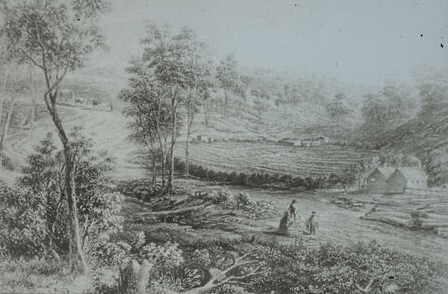
Old John Hunter

“The only man who ever made Coolgardie blossom like a rose”

Something rarely mentioned about the Eastern Goldfields is – how did people get fresh veggies?

It’s hard to imagine life without fresh or frozen greens at dinner nowadays, but just imagine how it was in the 1890s. The conditions were very hot, the rainfall was unreliable. Those of you who have ever grown your own vegetables will know how quickly they can wilt and die on very hot days. Throw in a scarcity of water and growing your own becomes a labour of survival.

Water was carted into communities by camels bearing barrels of water from the closest place that it could be found – often from 500 km away in Northam, but this was obviously extremely expensive.

Water Condensers

Desalination plants were quickly built by enterprising people. Salt water was taken from nearby lakes, put into corrugated iron tanks and using local timber boiled and condensed. The condensed water was still very poor quality and needed to be further boiled to make it drinkable. This water was liquid gold at the price of 9p per gallon. It was even more expensive than beer!1 Eventually the Government built condensers but water was still not plentiful.
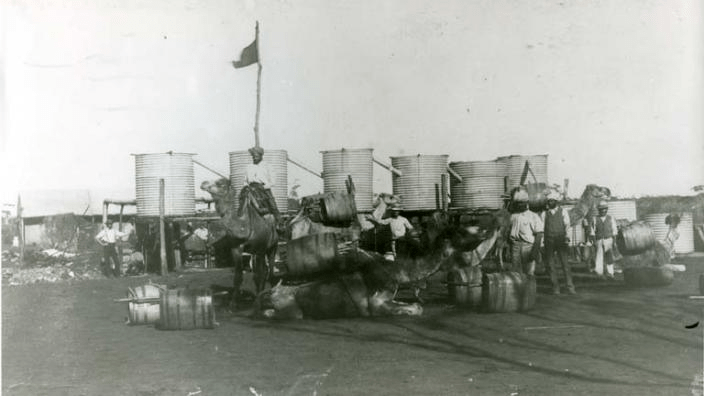
Typical scene of loading water onto camels at a condenser
Image copyright WA Museum 2

Into this hot and harsh environment comes Old John Hunter, who we only learn about from his death. His obituary in 1927 reads:

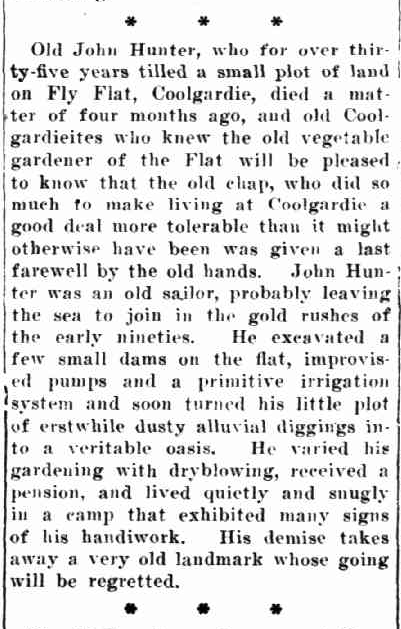
Old John Hunter, who for over thirty-five years tilled a small plot of land on Fly Flat, Coolgardie, died a matter of four months ago, and old Coolgardieites who knew the old vegetable gardener of the Flat will be pleased to know that the old chap, who did so much to make a living at Coolgardie a good deal more tolerable than it might otherwise have been was given a last farewell by the old hands. John Hunter was an old sailor, probably leaving the sea to join in the gold rushes of the early nineties. He excavated a few small dams on the flat, improvised pumps and a primitive irrigation system and soon turned his little plot of erstwhile dusty alluvial diggings into a veritable oasis. He varied his gardening with dryblowing, received a pension, and lived quietly and snugly in a camp that exhibited many signs of his handiwork. His demise takes away a very old landmark whose going will be regretted. 3

Another writer said of John:

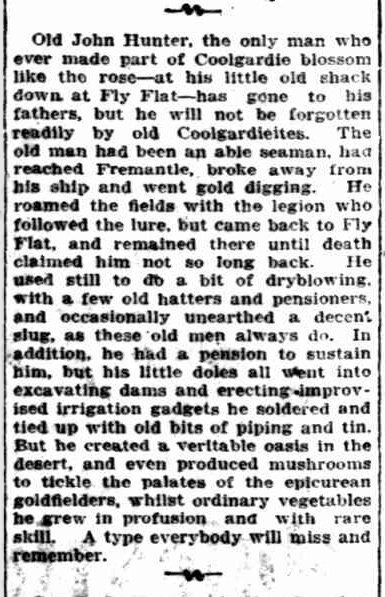
He created a veritable oasis in the desert and even produced mushrooms to tickle the palates of the epicurean goldfielders, whilst ordinary vegetables he grew in profusion and with rare skill. A type everybody will miss and remember. 4

Old John Hunter was born circa 1836. He must have been a remarkable man to have been tilling his garden since 1892. He was 91 when he died.
Sources

  1. Shire of Coolgardie Liquid Gold in Coolgardie, 10 August 2023. Accessed 3 April 2025. https://www.coolgardie.wa.gov.au/news/liquid-gold-in-coolgardie/20477 ↩︎
  2. Western Australian Museum, 2025. Condensing. Retrieved 19 May 2025 from https://museum.wa.gov.au/explore/wa-goldfields/water-arid-land/condensing ↩︎
  3. PERSONALIA (1927, May 6). The Leader (Perth, WA : 1923 – 1928), p. 2. Retrieved May 19, 2025, from http://nla.gov.au/nla.news-article256985122 ↩︎
  4. PEEPS at PEOPLE (1927, May 8). Sunday Times (Perth, WA : 1902 – 1954), p. 14. Retrieved May 19, 2025, from http://nla.gov.au/nla.news-article58318621 ↩︎
What’s a State Battery?

As I have been researching ghost towns, I have often come across the phrase “state battery”. Without actually taking the time out to discover what this was, ideas that flittered through my mind included some sort of power generation facility or a method of providing fresh eggs and chickens in the outback.

Today is the day. I have found out what a state battery is, and I’m going to share it here because there could be others like me who have no clue!! And please, if I have made any incorrect assumptions or conclusions, tell me!!

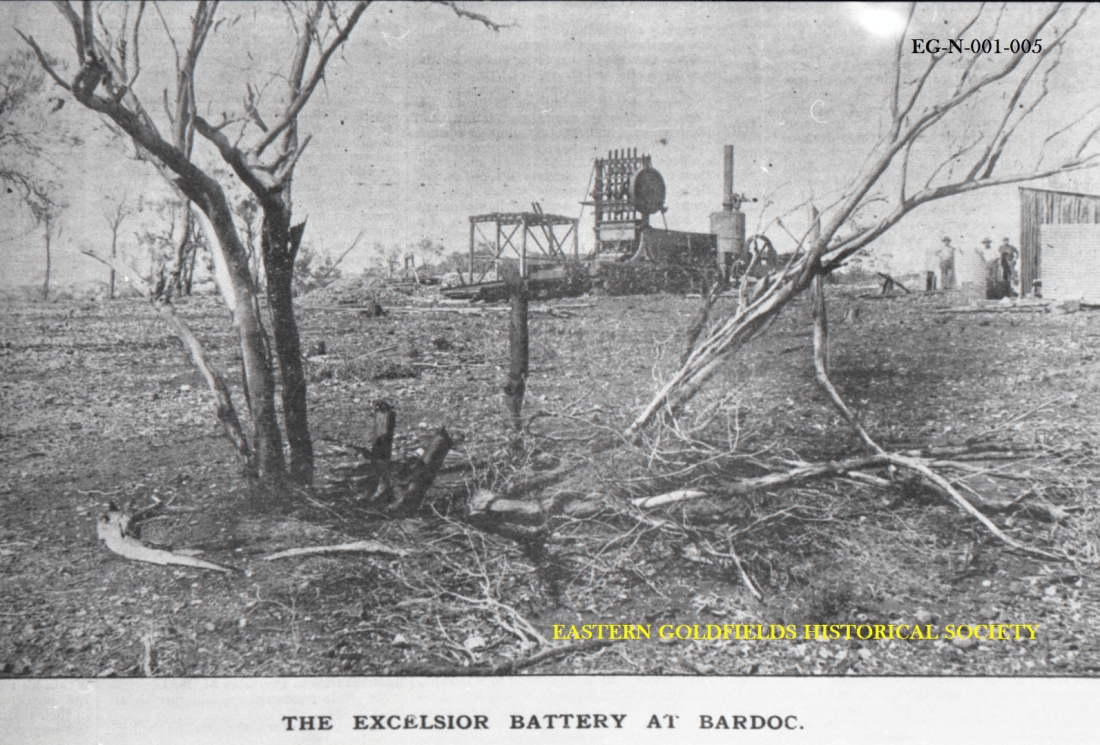
Photo is from the Eastern Goldfields Historical Society’s digitized collection of 60,000 negatives1.

In Western Australia a state battery was a government owned and operated crushing facility that crushed the ore found by prospectors and dug from small mines in the area. The Western Australian Department of Mines were the government agency responsible for their operation. Some of the batteries were only operating for one or two years, while others were in place for 5o or more years. Western Australia was the only state in Australia to provide this type of facility.

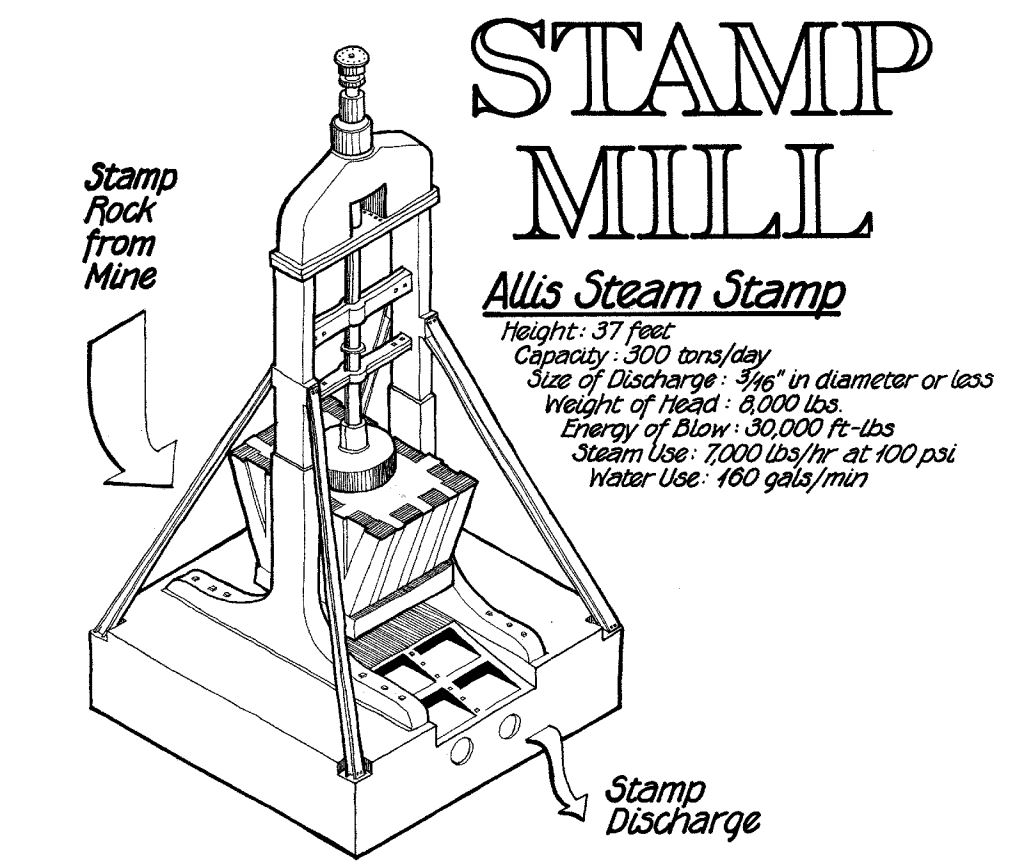
A battery (aka stamp battery, stamp mill or stamping mill) crushes ore by pounding rather than grinding. Each stamp head consists of a set of heavy steel stamps in a vertical frame. The stamp slides up and down crushing the rock.
Batteries were gauged by the number of heads, hence a 10-head battery has 10 stamp heads crushing ore.

The first public battery (as they were originally known) was opened at Norsemam in 18982. Prior to this privately owned and operated batteries were the norm. In considering the legislation to establish public batteries, some last minute adjustments to the wording gave the administrators discretion to “assist” private batteries in certain cases3.

I haven’t been able to find out how many state batteries were established, but by the 1930s the total number of batteies (public and private) was close to 100, dropping to less than 50 by 1958. By 1982 a government review of state battery operations resulted in closure of all by 19874. In 1996 the battery at Ora Banda was rebuilt and reopened. Unfortunately, it never crushed any ore and in 2000 it was badly damaged by bombing and has not been rebuilt5.

As at April 2012, Wikipedia published a list of known state batteries in Western Australia (see below) but this list is believed to be incomplete. Do you know of any more? If you do please let us know at ghostswa@fhwa.org.au. While our focus, as always, is on the ghost towns, for completeness this list includes those state batteries that were located at all known sites, ghostly or otherwise!

List of State Batteries known to have existed in Western Australia
BambooLavertonNannineSouth Greenbushes
Black RangeLeonoraNiagaraSouthern Cross
BulongLindenNorsemanTuckabianna
CarlamindaMarble BarOra BandaTuckanurra
CoolgardieMarvel LochPaddingtonWarriedar
CueMeekatharraPaynes FindWidgiemooltha
DarlotMessengers PatchPaynesvilleWiluna
DesdemonaMenziesPig wellYalgoo
DevonMt EgertonPinjinYarri
DonnybrookMt IdaQuinnsYerilla
DuketonMt KeithRandallsYouanmi
Dumpling GullyMt Sir SamuelRavelstone – Peak HillYundamindera
KalgoorlieMullineRavensthorpe* Mt Jackson
KalpiniMulwarrieSandstone* Siberia
From Wikipedia article – State Batteries in Western Australia, 2012
* Updated 26 Nov 2023 with additional locations from Gone West by Geoffrey Higham.
Closer view of the head frame at a State Battery6


Sources
  1. Eastern Goldfields Historical Society, 2023. The Excelsior Battery at Bardoc. Digitized photograph EG-N-001-005. Accessed online 26 Nov 2023 at https://www.facebook.com/photo/?fbid=662634742545097&set=a.456121176529789. ↩︎
  2. The Western Australian Goldfields Courier, Coolgardie, WA : 1894-1898. Norseman Public Battery. 10 Sep 1898, p.23. Retrieved from http://nla.gov.au/nla.news-article251211132 on 26 Nov 2023  ↩︎
  3. The Golden Age, Coolgardie, WA : 1894-2898. The Public Batteries. 11 Dec 1897, p.3. Retrieved from http://nla.gov.au/nla.news-article256754516 on 26 Nov 2023 ↩︎
  4. Wikipedia, 2023. State Batteries in Western Australia. Retrieved 26 Nov 2023 from https://en.wikipedia.org/wiki/State_Batteries_in_Western_Australia ↩︎
  5. Eastern Goldfields Historical Society, 2017. State Batteries in Western Australia. Video and notes accessed online 26 Nov 2023 https://www.facebook.com/kalgoorliehistory/videos/1489501291104966 ↩︎
  6. F.A.Sharr, 1983. Image Details – State Battery closer view of headframe. Digitized photograph from Heritage Council. Accessed online 26 Nov 2023 at https://inherit.dplh.wa.gov.au/Public/inventory/Image/5ad57a39-0d86-413f-be02-75b1657bc925 ↩︎