Cossack – 12 June 1897

The following is a detailed report of a cricket match that took place on this day in 1897 at Cossack between the Cossack and Roebourne teams. It was published in  Northern Public Opinion and Mining and Pastoral News on Saturday, 19 June 1897.1

CATCHES.
By “SHORT SLIP.”

The Boebourne Rovers “trammed” to Cossack on Saturday. The first association match played at the port this season took place.

The game was well contested, and good feeling made for a close and exciting finish. A good number watched the game, but the fair sex had only one representative present. ‘Tis true for the poet when he describes the petticoat sporting fraternity as a “sit-me-on-the-bicycle sort of push.”

The Rovers proved the victors by eleven runs.
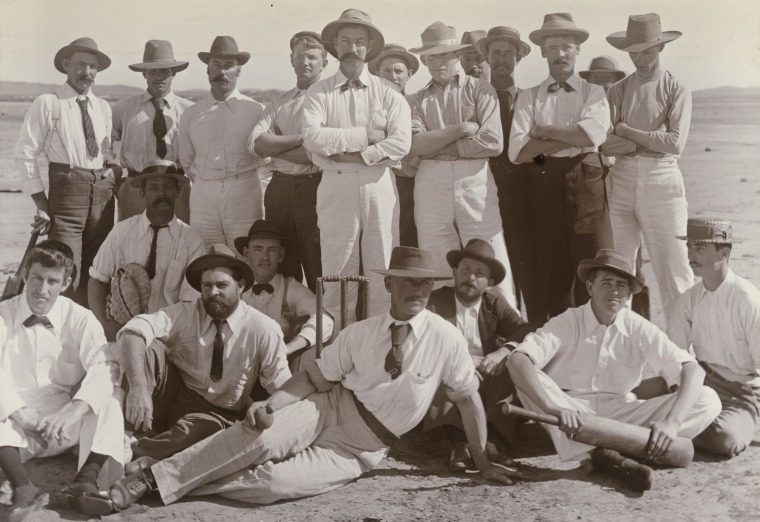
This photo shows the Roebourne & Cossack cricket teams three years later in 1900.2

“Watty,” the Cossack barracker, was all there in his usual bass voice and sung himself hoarse. “Snap-shot” Renold, with his camera, took a “shot” at both teams, and “never smiled again.” He should have thrown the “X-rays” on them.

Like the “Arizona Kicker,” good old “Sol.” blessed the players with a beautiful day, and the Cossackites prepared a good wicket for the Boebourne boys.

Through the instrumentality of a few members of the home team, led by indefatigable “Donny,” a shed was erected on the ground, and the scorers were accommodated with a “cose” and a few “ax.l.” boxes to squat down on.

The Union Jack—or perhaps the Cossack coat-of-arms-out-of-pocket—was flying on top of the shed, whilst the decorations at the bottom comprised two fine jars of water (not of Babel, but of Nature).

There is no denying the fact that the pitch at Cossack, and also the fielding ground, is far superior to that of Boebourne, and if it always remained in the condition it was on Saturday, all matches could be played on the marsh.

The Rovers played a really well-combined game and deserved to win, whilst the Cossack lads defended splendidly and did everything in their power to avert defeat.

“Luck was agin’ them,” said Watty, after a whiskey and soda.

Whilst travelling with the cricketers on Saturday (not a Parliamentary team), our worthy and much-respected member, Mr. H. W. Sholl, M.L.A., opened his many-a-time generous heart and proved to those who travelled by the tram that he was a sportsman as well as a “Member of Parliament,” and a gentleman as well as a public “sarvint.” He informed the members of the B.C.C. that he was that day presenting a bat to the individual, of either team, who made the highest score in the match, for the sake of evincing some interest among the batsmen.

This goes to show that Mr. Sholl’s heart and soul were with them in their recreation, and he deserves the thanks of all true and honest sportsmen in both Boebourne and Cossack.

I may state that the genial skipper of the Rovers, “Sam” Hemingway, won the bat to which I refer, his score being 81, made by sterling cricket. I offer him my heartiest congratulations.

One of the most pleasing sights that I have yet seen on a North-West cricket ground appeared before me on Saturday. It was simply the Cossack “willow wielders” turning out in their true colours—wearing scalp-caps of yellow and black hue, and with a green kerchief (ould Oirish, begorra) round their waists.

It reminded me of an old English cricketer (Dr. Grace), who, when in Australia, had, on entering the Melbourne ground, decked himself with blue dungaree pants, and what he termed an “old physician’s waistband” (green). When the spectators eyed him, they shouted out, “We bar the Irish navvy!” But the good old medico held his peace, and the crowd silenced down.

The query is asked—”Why don’t the Boebourne teams play in their colours?” Echo answers—”They have none!”

At two o’clock, both captains met, and the coin was tossed, turning in favour of George Snook, who elected to bat. “Sam” Hemingway then led his men into the field, and at twenty minutes past two, a start was made.

“Uncle” Harding and “Bob” Selway were the first men to pad up and take strike for Cossack, while “Jim” Hubbard and “Jack” Keogh took the cudgels for the Rovers.

“Bob” did not celebrate a record reign at the crease. Taking strike to Hubbard, he received the dreaded “duck,” which he has for so long been unaccustomed to. This was rather unlucky for Cossack, to lose their best man by the first bell of the day, and there was “weeping and gnashing of teeth” when Bob returned to the shed.

“It was a splendidly pitched ball, and broke to the off, beating me all the way.” – Selway

“Donny” took the vacancy and, after making a dozen, was clean bowled by “Tommy” Molster, who was brought in from long-field to do the trundling. “Uncle” soon followed, being caught and bowled by “Sam” Hemingway. He had made nine by good cricket.

“Georgy” Fry and “Georgy” Brown, the two pavilion cricketers, made four and eight respectively. They were off duty (cricket, I mean) and did not take much advantage of their “staff.”

“Snoofie,” the skipper, played a free bat and made some very pretty strokes, notching fourteen before he drove one very hard to Jack Keogh, who accepted it. It was a splendid catch, and Jack received an ovation.

“Jum” Louden fell a victim to Tommy Molster, after breaking the shell of the “duck.”

“Watty” Moore surprised everyone by his fine exhibition, his leg hits being marvellous, and he received a cheer when he had carried out his bat for thirteen.

“Slurry” Wilson and “Carbine” Moore both succumbed to Hubbard before they had scored and joined the ranks of “Short-slip’s” spoon competition.

An amusing thing occurred while “Carbine” was batting. He played the first ball of Hubbard’s onto his cranium, and with a cricketer’s oath, the next one gave him a clip in the ear, but the third one hit the—w-i-c-k-e-t.

“Herb.” Birch, who was put in last wicket down (who should have followed the seventh man), just reached double figures when he was snapped up by Jim Hubbard.

Tommy Molster, in the long field, made a “bolster,” fell down, and got stuck in a mud-hole. Here’s to him, with “Short-slip’s” sympathy!

The ball went off the cricket bat,
And travelled far away!
“Tom” Molster in his big white hat
Fell on it in the clay.

The clay was soft, the ball was round,
Poor “Tom” he couldn’t stir,
So all the boys they stood around
And left him in despair.

He with the ball at last did rise
With language that was wicked,
And told them that he’d cause surprise
When he got at the wicket.

Covered with mud, he took the ball
And bowled a maiden over,
And in the next surprised them all
By scattering bails in clover.

For fielding, Church, Naish, and Hemingway were excellent, and it speaks well for Cossack’s wicket-keeper that a bye was not recorded in the innings.

The bowling honours for the Rovers were carried off by Jim Hubbard, who came out of the cupboard (his shell, I mean), and got the splendid average of 5 wickets for 11 runs. A word of praise is also due to Tommy Molster, his 2 wickets only costing him 7 runs.

After a blow, the Rovers commenced their innings, having to make 72 to win. “Bannerman” Raymond and “Sam” Hemingway were the first representatives, and the bowlers were Brown and Louden.

“Banner,” after his usual careful play, had the misfortune to snick one of Louden’s into the hands of Brown and retired with four to his credit.

The skipper played a very useful innings. It was really a treat to watch his well-timed strokes and neat cuts, and when he had reached 81, he was captured by Selway. “Sam” was received with three times three when he reached the shed.

“Jim” Hubbard, after making seven, was foolishly run out. “Bert” Naish trebled his misfortune on Saturday, falling a victim to Brown for a duck.

“Herb.” Church, who had received a nasty blow on the left cheek through coming into contact with the ball, played a good innings and was bowled by Fry for a well-made 18.

“Jack” Keogh fell a victim to Fry for five, and “Burly” bowed to the same bowler for a unit. “Dawesie,” who must be credited with making the winning hit, cried ‘nough to Fry for 11. A.E.D. hit a fiver, which was the biggest hit of the day.

“Willie” Fuller threw his bat at Donny (unintentionally), and after making a single was bowled by Walter Moore. “Jack” Wotherspoon “spooned” the ball into the “dukes” of Fry.

Pass along the banjo!
“Oh Jack, why did you hit that ball?”
Cried Boebourne Rovers one and all.
“I went to place it to the leg,”
Said poor old “Wother,” with his egg.
The game was o’er, the match was won—
So it didn’t matter what he done.
But on this man there was a doom,
Because his name was Wotherspoon.

“Tom” Molster carried his bat to the wicket, but had no chance to use it.

George Fry did the trundling for the home team, bagging 6 wickets for 22 runs. Selway and Walter Moore also bowled well. Little “Donny” was the best man in the field, ably assisted by Brown and Harding, while “Snookie” performed well behind the sticks.

Owing to the bogey condition of the Cossack cricket ground, caused by the high tide at the port, the Civil Service–Cossack match has been postponed till today week.

Some of our local cricketers, I learn, are striving to arrange an all-day match (one end of the town against the other), for Wednesday next. It is to be hoped that “both ends will meet.”

“Short-slip” was met by an indignant cricketer the other day, and was thus warned:

“Look here you blonky (hic) quill-driver, if you (hic) say a word about me in the (hic) paper, I’ll punch your blinky nose (hic)… take it from me.”

I don’t think he was—d-r-u-n-k.


Source

  1. CATCHES. (1897, June 19). Northern Public Opinion and Mining and Pastoral News (Roebourne, WA : 1894 – 1902), p. 3. Retrieved June 11, 2025, from http://nla.gov.au/nla.news-article255736548 ↩︎
  2. State Library of Western Australia, 2025. Cossack and Roebourne Cricket Teams. Photograph taken 1900 in the North West Australian series. Retrieved June 11, 2025 from
    North West Australia ; BA338/1/36
    ↩︎
The Pearl Fisheries at Tien-Tsin, North-West Australia

It is always fascinating to read about one of our Ghost Communities in a publication that was originally written as it was all happening. The article that follows was written in 1870 and published on 26 May in The Sydney Morning Herald1. You can find it on Trove and I encourage you to seek out the original (using the link below) and view it online in its original format. However I do understand that it is difficult to read and so I have recreated it here verbatim without any claim to the content which is entirely the intellectual property of the publishers.

Tien-Tsin was the original name of Cossack after the barque that carried Walter Padbury and his party. In May 1863, Padbury landed his stock at the mouth of the Harding River near the present site of Cossack. The ship that brought the state’s governor, Frederick Weld, in December 1871 was named HMS Cossack, and the town adopted this name in 1872 (officially 1873). Cossack was the first port in the North West, and was critical to the development of the pastoral industry in the region2.

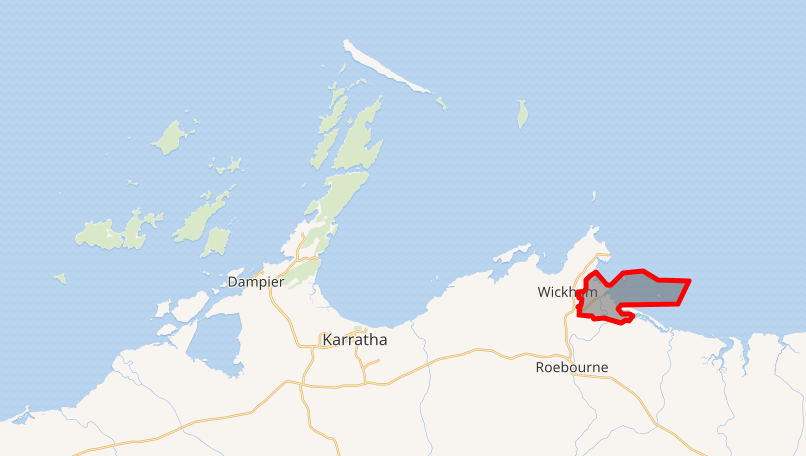
The location of Cossack3

CONTENT WARNING: Before proceeding, please be aware that this is a transcript of the original text and contains concepts that may be offensive to some readers. It is not our intention to offend, but we believe it is important to understand that this was the language and content of the time and needs to be read in that context. It does not in any way reflect the opinions of the project team.


“An account of a new settlement is always interesting, but when Australian colonists venture into an entirely new country, and in addition to settling and stocking the land, discover a new industry that employs hundreds of men—both black and white—it becomes even more fascinating. Just two years ago, many parts of the district to be described here were only accessible by armed bands. Enterprising settlers are now sending down pearl shells and wool from the very spot where Panter, Harding, and Goldwire, the surveyors, were murdered by the aboriginals without provocation.

“The settlement of the Nicol Bay district, as it is known, has been quicker than any other part of Australia. It is heartening to note that the relationship between the aboriginals and the white settlers is now more friendly and satisfactory than can be seen elsewhere on the island. The prosperity of the largest part of the community relies entirely on the preservation and assistance of the natives; without their help, the settlers might explore the reefs but would not collect enough shells to repay their investment. The natives’ sharp eyesight and the large numbers in which they can be employed make their cooperation invaluable. Their usefulness serves as the best guarantee for their proper treatment. In fact, any injustice is often more likely to be borne by the whites than the blacks. Many natives gather food for themselves and their families during neap tides and walk away just when their services are needed.

“Port Walcott, the headquarters of the small boats engaged in pearl fishing and the port of entry for vessels from Fremantle that supply the settlement with stores, is located about a mile inside Butcher’s Inlet, or Tien-Tsin Creek, named after the first significant vessel that ever anchored in the bay outside. It is situated at latitude 20°40’ south and longitude 115° east, about 180 miles east of the North-West Cape. Despite bearing the high-sounding name of Port Walcott, the settlement has no better claim to the title than a single house and the hull of the New Perseverance, with several smaller dwellings that resemble mia-mias. However, as a government township has been surveyed and partly sold, it is likely that the town will soon have at least an orthodox hotel, a store, and a doctor’s shop. For now, Messrs. Knight and Shenton’s place of business onshore, and the cabin of the hulk, serve all purposes. Butcher’s Inlet has enough water on the bar to admit vessels of a hundred tons at high tide. During low water spring tides, the inlet can almost be crossed on foot. The tide along the northwest coast ranges from 17 to over 30 feet, a stark contrast to the west coast, where there is barely any rise or fall.

“During the fishing season, which begins around the first week in September and ends in April, the port is rather dull and unremarkable. However, at the close of the season, or during the neap tides, if any festivities are expected in Roebourne, the area comes alive with bustle and activity. The scene is a perfect representation of tropical Australian life. A wide mangrove creek is lined with a dozen boats, ranging from 3 to 10 tons, moored along the bank, or lying helplessly in the muddy sand at low tide. Perhaps a larger Swan River trader will be docked with clean-scraped spars and an awning spread. White settlers, dressed as minimally as decency permits, walk about, wearing fly-veils to protect their faces from the swarming flies. Aborigines from all parts of the coast are present, some cleaning and sorting pearl shells, chipping off sharp, colorless edges and tossing them as though they were worth little—when in fact, they are worth at least £150 per ton. Others are practicing spear throwing with small reeds or giges. The failure of any party to deflect a spear with their shield leads to uproarious yells of derision from one side and joy from the other. But the majority are lying on the hot sand, singing monotonous chants, accompanied by the scraping of a shell against a piece of stick held against their shoulder like a fiddle.

“Roebourne, the capital of the new country as Western Australians term the district, is located 11 miles southward, inland of Port Walcott. For some distance, the road crosses a marsh covered by the tide at high springs, making for difficult travel. All goods for the stations are brought up the creek to a jetty. From there, it is just five miles to Roebourne, and with the exception of one small marsh, the road is not too bad. The township of Roebourne consists of about twenty houses built at the base of Mount Welcome. The resident magistrate’s house and the government offices are the most prominent buildings, sitting higher up the mount and away from the threat of malaria or floods from the Harding River, whose waters sometimes get too close for comfort during heavy tropical rains. There are two rough but comfortable hotels, three stores, a butcher’s shop, a blacksmith’s forge, a large stockyard, and, of all things in such a place, a hairdressing salon. This is the current capital of North-West Australia.

“Roebourne is not without its charm, especially when the desert pea—native to the area—blooms in full flower. It has two key scenic features: mountains and a river. The Harding River is a permanent freshwater source. Races are held on the plain near the township every June, during which time nearly all the settlers and pearl fishers, numbering about a hundred, gather. The races may not be of great significance in such a small district, but for joviality and good cheer, a Roebourne race meeting could serve as an example for larger communities. Indeed, there is a noticeable absence of the ruffianism often found in new Australian settlements.

“The nearest station to Roebourne is Mr. Leake Burges’s, located 24 miles away, and carrying some 7,000 sheep. The main station is the “Mill Stream” on the Upper Fortescue, owned by Messrs. McRae, Howlitt, and Mackenzie, formerly from Victoria. Mr. Hooly had squatted on the Ashburton River, 200 miles westward and 80 miles from any neighbor, but constant attacks by the blacks, who are perhaps the most savage and untamable in Australia, forced him to move his flock to the Fortescue. The murder of the third shepherd last year led Mr. Sholl, the magistrate, to swear in a party of special constables to apprehend the murderers or, failing that, teach them a lesson. A party of six men set out to the scene of the murder and “dispersed” some of the hostile natives, who were caught spearing horses and cattle, though not without determined resistance.

“It is still uncertain whether station properties in this part of Australia will repay the investment. It has yet to do so, despite the encouragement of leases at nominal rents and other privileges given by the West Australian Government. This is partly due to the difficulty in preparing wool, the high cost of shipment to Fremantle, and the need for transshipment to England. The region also lacks mechanical means of wool preparation. Communication with Swan River is possible by land. During one food shortage in the settlement, a party rode to Perth to dispatch a vessel, and Mr. Hooly, alone and unaccompanied, completed a remarkable feat considering that the country for over 500 miles is uninhabited except by wild and potentially hostile blacks.

“There is a great scarcity of fresh water on the west coast, though the Nicol Bay country does not suffer as much in this regard. The primary drawback is that the best grazing areas are also the driest. Approximately twenty boats, mostly under eight tons, are engaged in pearl fishing. With the wind from the southward and south-east for most of the year, any vessel with a deck, no matter how small, can easily run before it until the North-West Cape is rounded, where the water remains calm due to the continuous reefs and islands. These boats generally carry two white men, who, before setting out to gather the shells, pick up as many aboriginals as possible along the coast. However, the number of boats involved in the trade, combined with losses from smallpox and other factors, has made it difficult to find enough aboriginals to properly search for the pearl oysters. As a result, the trade is no longer as profitable as it once was. Even for the most experienced fishermen, under the most favorable conditions, it is only a fair return on their investment.

“This season, two vessels from Sydney went to the fisheries but have since returned and are now in quarantine due to smallpox. Even if they had returned in good health, the expense of a trip to the South Sea Islands, where natives must be returned, as well as the cost of provisions, boats, wear and tear, and wages, makes the return on the investment not comparable. The “Kate Kearney” returned with eight tons, worth £150 per ton, and the Melanie, a large vessel, only brought back ten tons. New ground may still be found, as the fisheries currently range from Exmouth Gulf to the Annapanam Shoals, and it is known that Malay proas have visited the north coast of Australia for many years. A schooner named the Argo was outfitted from Swan River last season and ventured as far east as Camden Harbour. However, the aboriginals they had brought along ran away just as they had found valuable shell. These unfortunate men would likely never return home, as they would be speared by the first strong camp they encountered.

“Aboriginals, though well-treated, often long to return to their native lands. When taken to Fremantle, they are shown the pleasures of civilization, and, after a week, they are eager to return north. Their language is easy to learn, though dialects differ from river to river. The Eastern dialect is considered the standard, and both whites and blacks accommodate themselves to it. This means that a good understanding of the language used between Butcher’s Inlet and the De Grey River allows communication with natives from any part of the fishing coast.

“The natives primarily eat nalgo, a bulb from a species of grass. It is very palatable and resembles chestnuts when roasted. Women gather it from sandy spots along river beds or marshes. The men use two types of spear: a lighter hunting spear, thrown from a rest, and a fighting spear, thrown by hand. They also use boomerangs, clubs, and a short stick, which they throw with great dexterity. Their marriage customs are quite curious, and any breach of the intermarriage rules is punishable by death. They are divided into four great tribes or families, and in the event of a death in a camp, they may kill a fighting man from a neighboring tribe to balance their strength. They also kill those afflicted with contagious diseases, such as smallpox, which recently struck the South Sea Islanders aboard a Sydney vessel. Their dietary laws are strictly observed, and nothing will induce a native to eat tabooed food. Superstition plays a large role in their lives; they are in constant fear of a demon named Juna, responsible for all death and disease. It is believed that Juna chokes his victims.

“In their own way, the natives are great astronomers, with names for all the major constellations, such as the Large and Lesser Kangaroo and the Emu. They can distinguish fixed stars from planets. When answering questions, they tend to exaggerate, and they have legends of extraordinary men from far inland. This brief description of this fascinating race only scratches the surface, but more detailed accounts will intrigue those interested in ethnology.

“The pearl shell is not an oyster but an “avicula,” composed of nacreous laminae. It can be cut and polished in any part and is in high demand in England and on the Continent for inlaying and ornamental purposes. The shell is typically half embedded in the sandy mud and can only be harvested at low water during spring tides. Several large pearls have been found, one of which was sold in England for £260 last year.”


Source

  1. THE PEARL FISHERIES AT TIEN-TSIN, NORTH-WEST AUSTRALIA. (1870, May 26). The Sydney Morning Herald (NSW : 1842 – 1954), p. 5. Retrieved December 29, 2024, from http://nla.gov.au/nla.news-article13205905 ↩︎
  2. Wikipedia. Cossack, Western Australia. Retrieved December 29, 2024, from https://en.wikipedia.org/wiki/Cossack%2C_Western_Australia ↩︎
  3. Wikimedia. Retrieved December 29, 2024 from https://foundation.wikimedia.org/wiki/Maps_Terms_of_Use ↩︎

Mr Stanley’s Opera Troupe

Cossack in 1886 was a frontier town in one of the most isolated colonies in the world.  It was a centre for pearling and pearl shell fishing and the entry point for pastoralists who established extensive stations.  By 1886 Cossack had a stone wharf and several other stone buildings such as the Post and Telegraph Office and a Mercantile Store, but not a lot of other substantial buildings. How did it attract an operatic performance by the most popular Opera Troupe of the decade?    

Perth loved Mr Stanley’s Opera Troupe. It played to huge audiences and received mostly glowing reviews.  The Railway employees took up a collection so they could present Mr and Mrs Stanley a gold ring and earrings as a token of their esteem and appreciation1. A Fremantle harbour official stole flowers, roses, and bouquets to bestow upon sundry members of Stanley’s Opera Troupe before they left Perth2. An ode of farewell to the players was written and published in the Perth news in October 18853.

Mr Stanley’s Opera Troupe and other itinerant theatre groups used the coastal steamers to travel around Australia4.  In early 1886, Mr Stanley was taking his Opera Troupe to Singapore and to get there travelled on a coastal steamer that called in at Champion Bay, Gascoyne, and Cossack before leaving Australia.  

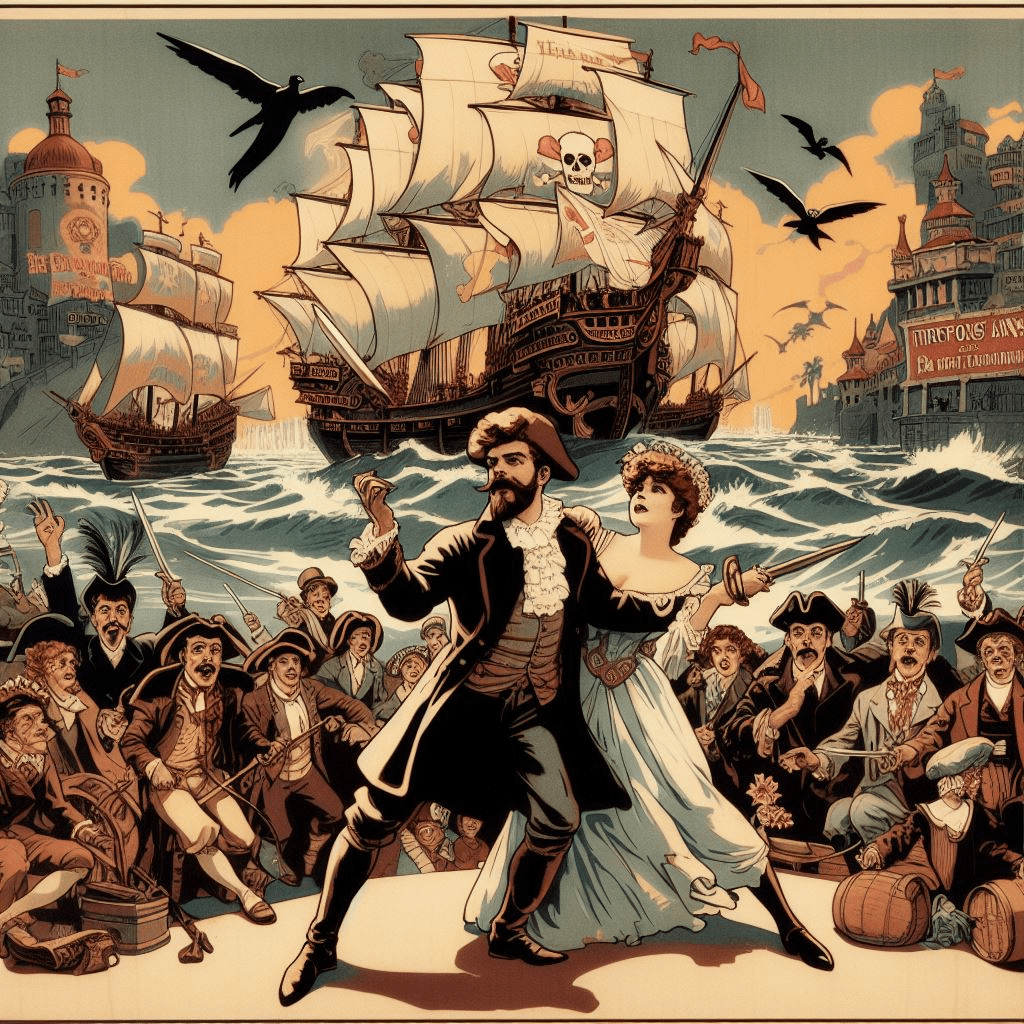
Ever the entrepreneur, Mr Stanley used his time in port in Cossack to his advantage and had his Opera Troupe perform two shows at Roebourne before performing their last show in Cossack.   The Cossack show was a performance of Gilbert and Sullivan’s Pirates of Penzance and took place on Saturday 13 March 18865.

I have been unable to find a review of the Cossack performance of this opera, but when it was performed in Perth the previous October it received a review that said –

 The acting was very spirited, the costumes pretty, the children acquitted themselves admirably in their dancing, but the actors said their words very quickly, and some songs were ‘absolutely gabbled’.6

Image generated by DALL-E

Who was Mr Stanley and how did he get into show business? The only biography I can find of Harry Stanley was supplied by him to a Perth newspaper in 18857. His life had so many self-reported highlights and makes me wonder if he embellished his life story.  

Stanley was born in England but after a childhood supposedly touring Europe he joined the Royal Navy and served in the Crimean War. He came to Australia in the mid-1850s, worked on a steamship out of Melbourne before heading for the goldfields, where he was stuck up by the notorious bushranger Black Johnston. After failing to find his fortune, Stanley joined a Theatrical Troupe where he found success playing the character of Rob Roy. He moved from Troupe to Troupe, in various roles before forming his company and managing the Lyceum Theatre and Hotel in Sandhurst.

Stanley travelled to South Africa in 1870 with the American War Panorama Troupe but was unfortunately shipwrecked on the way. Luckily he saved the Panorama and just so happened to be on the diamond fields of Kimberley when they raised the British flag. Stanley was received by African presidents and kings during that trip. He spent time as a guest of the Nizam at Hyderabad and was asked to lecture on war to the Sikh regiments. Stanley then went to Burma, where he was presented with a medal from the King and subsequently travelled to Siam, where he stayed at the palaces of the kings.

Perhaps colourful renditions of life stories come with show business. After leaving Cossack it was reported that Mr Stanley was struck insensible by lightning for three hours while on deck of the SS Natal8. Fortunately, Stanley had recovered by the time he reached Singapore.

Stanley and his Opera Troupe seem to have spent the next few years performing in the East, visiting “the colonial port cities with large European populations where there was a high demand for the sort of shows he staged9.

Stanley returned to Australia to settle some business in 1896, but while in Newcastle his heart condition suddenly worsened, and he died (without a will). Stanley was nearly 60 years old10.   The Freemasons in Calcutta raised money for his wife and daughters to return to Australia.  Entertainments such as Mr Stanley’s Opera Troupe were facing competition from newer forms of entertainment such as roller skating.  The story of Harry Stanley and his Opera Troupe is a colourful one.  What other larger than life people’s stories are awaiting discovery in Western Australia’s Ghost Towns?


Sources
  1. Presentation to Mr and Mrs Stanley. The Inquirer and Commercial News, February 1886, p. 5. ↩︎
  2. Perth Local Court. Western Mail, 2 January 1886, p. 10. ↩︎
  3. Farewell to Stanley’s Opera Troupe. The Daily News, 6 November 1885, p. 3. ↩︎
  4. YU Elysia, 2020. Australian Itinerant Theatres as Colonial Cultural Assimilation https://www.tca.hku.hk/post/australian-itinerant-theatres-as-colonial-cultural-assimilation
    Accessed 20 March 2024. ↩︎
  5. Roebourne Letter. Western Mail, 13 March 1886, p. 16. ↩︎
  6. The Pirates of Penzance. The West Australian, 12 October 1885, p. 3. ↩︎
  7. Biography of Mr. Harry Stanley (1885, September 26). The Herald (Fremantle, WA : 1867 – 1886), p. 3. Retrieved April 13, 2024, from http://nla.gov.au/nla.news-article110070728 ↩︎
  8. Local. The West Australian 13 April 1886, p. 3 ↩︎
  9. YU Elysia, 2020. Australian Itinerant Theatres as Colonial Cultural Assimilation https://www.tca.hku.hk/post/australian-itinerant-theatres-as-colonial-cultural-assimilation. ↩︎
  10. Newcastle News. The Maitland Weekly Mercury, 2 May 1896, p. 5. ↩︎