The original story of how Tuckanarra, the celebrated 24 ounce to the ton mine, was found in 1898, as told by Jim Boyd (one of the owners) was published in the Murchison Advocate, 27 May 1899, p3. The town site was gazetted in 1899 after a state battery was installed in 1898.
In the March of 1896, the weather in the Murchison was really wet and a mining warden was travelling. The bad weather stopped him from reaching his destination and on the way back to Cue he camped overnight in what was later known as Cork Tree Flat and then Tuckanarra. Either he or his companion, (a native tracker), picked up a small piece of gold near their buggy. Once they arrived in Cue the news of their find leaked out and several prospectors left Cue in the middle of the night to try to be the first on the scene. However, they were looking for alluvial gold and came back into Cue after a few days saying the find was no good.
Two days later Jim Boyd’s mate, George Moore, went out to Cork Tree Flat to see what the fuss was about. Instead of looking for alluvial gold, he looked for reefs. He came across a reef, broke a few pieces off it and brought it into Cue for Jim Boyd to look at. The quartz pieces had enough colour in them for Boyd and Moore to go back out to Cork Tree Flat for several weeks of prospecting, but not enough colour to suggest high hopes of finding a great find.
They arrived in Cork Tree Flat on Good Friday 1896 and Moore went in one direction and Boyd went in the other direction. Boyd hadn’t walked more than three or four hundred yards when he saw something that looked like yellow moss on a quartz outcrop. Of course, it was gold and that was the story of Boyd and Moore’s Tuckanarra mine began.
As I have been researching ghost towns, I have often come across the phrase “state battery”. Without actually taking the time out to discover what this was, ideas that flittered through my mind included some sort of power generation facility or a method of providing fresh eggs and chickens in the outback.
Today is the day. I have found out what a state battery is, and I’m going to share it here because there could be others like me who have no clue!! And please, if I have made any incorrect assumptions or conclusions, tell me!!
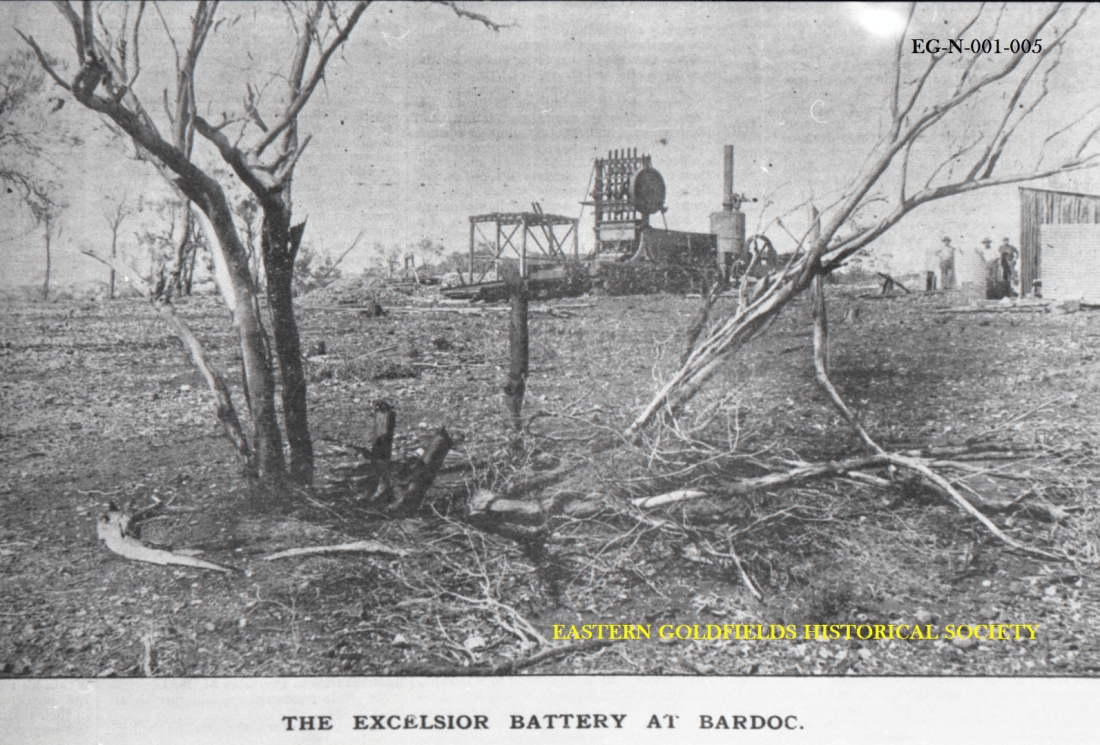
Photo is from the Eastern Goldfields Historical Society’s digitized collection of 60,000 negatives1.
In Western Australia a state battery was a government owned and operated crushing facility that crushed the ore found by prospectors and dug from small mines in the area. The Western Australian Department of Mines were the government agency responsible for their operation. Some of the batteries were only operating for one or two years, while others were in place for 5o or more years. Western Australia was the only state in Australia to provide this type of facility.
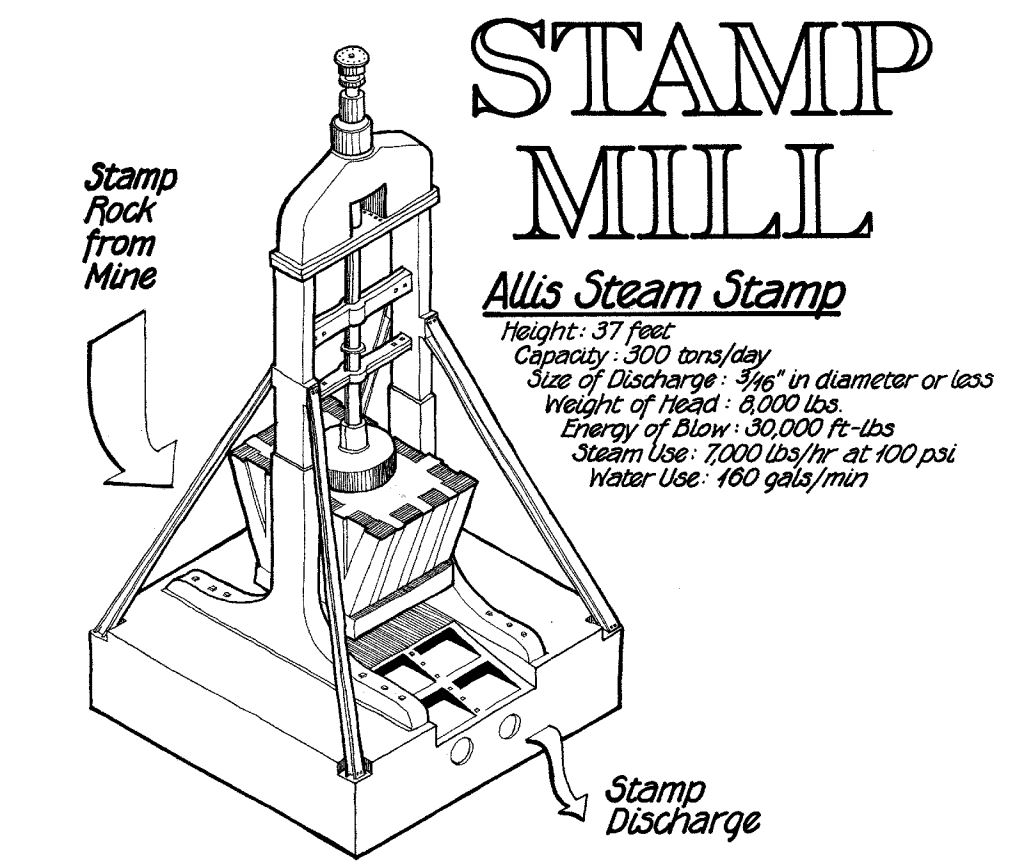
A battery (aka stamp battery, stamp mill or stamping mill) crushes ore by pounding rather than grinding. Each stamp head consists of a set of heavy steel stamps in a vertical frame. The stamp slides up and down crushing the rock. Batteries were gauged by the number of heads, hence a 10-head battery has 10 stamp heads crushing ore.
The first public battery (as they were originally known) was opened at Norsemam in 18982. Prior to this privately owned and operated batteries were the norm. In considering the legislation to establish public batteries, some last minute adjustments to the wording gave the administrators discretion to “assist” private batteries in certain cases3.
I haven’t been able to find out how many state batteries were established, but by the 1930s the total number of batteies (public and private) was close to 100, dropping to less than 50 by 1958. By 1982 a government review of state battery operations resulted in closure of all by 19874. In 1996 the battery at Ora Banda was rebuilt and reopened. Unfortunately, it never crushed any ore and in 2000 it was badly damaged by bombing and has not been rebuilt5.
As at April 2012, Wikipedia published a list of known state batteries in Western Australia (see below) but this list is believed to be incomplete. Do you know of any more? If you do please let us know at ghostswa@fhwa.org.au. While our focus, as always, is on the ghost towns, for completeness this list includes those state batteries that were located at all known sites, ghostly or otherwise!
List of State Batteries known to have existed in Western Australia
Bamboo
Laverton
Nannine
South Greenbushes
Black Range
Leonora
Niagara
Southern Cross
Bulong
Linden
Norseman
Tuckabianna
Carlaminda
Marble Bar
Ora Banda
Tuckanurra
Coolgardie
Marvel Loch
Paddington
Warriedar
Cue
Meekatharra
Paynes Find
Widgiemooltha
Darlot
Messengers Patch
Paynesville
Wiluna
Desdemona
Menzies
Pig well
Yalgoo
Devon
Mt Egerton
Pinjin
Yarri
Donnybrook
Mt Ida
Quinns
Yerilla
Duketon
Mt Keith
Randalls
Youanmi
Dumpling Gully
Mt Sir Samuel
Ravelstone – Peak Hill
Yundamindera
Kalgoorlie
Mulline
Ravensthorpe
* Mt Jackson
Kalpini
Mulwarrie
Sandstone
* Siberia
From Wikipedia article – State Batteries in Western Australia, 2012 * Updated 26 Nov 2023 with additional locations from Gone West by Geoffrey Higham.
The Western Australian Goldfields Courier, Coolgardie, WA : 1894-1898. Norseman Public Battery. 10 Sep 1898, p.23. Retrieved from http://nla.gov.au/nla.news-article251211132 on 26 Nov 2023 ↩︎



 People of Western Australia's Ghost Towns