Christine Harris 2026
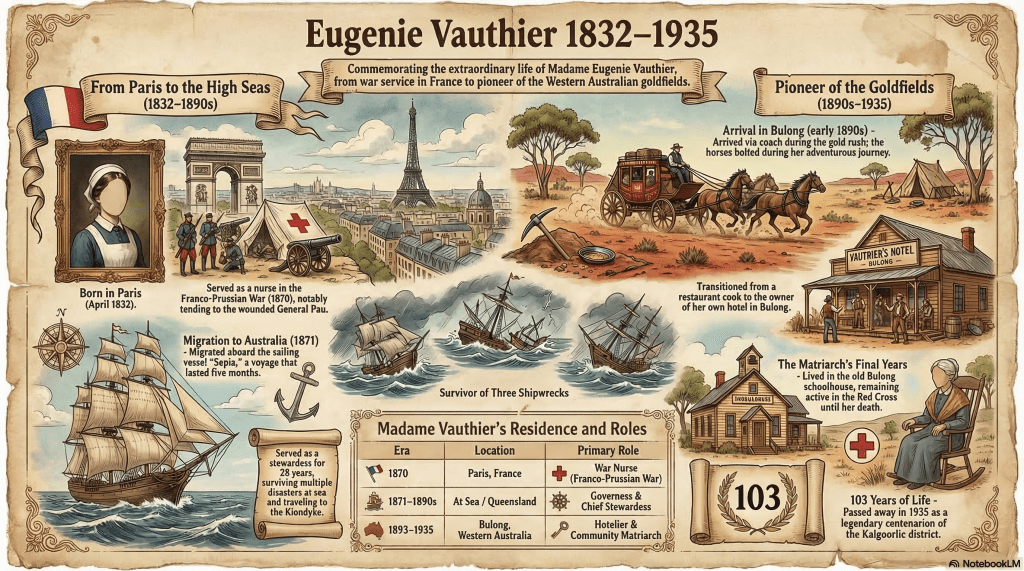
Madame Eugenie Vauthier, a remarkable woman whose life spanned more than a century and two continents, passed away in Kalgoorlie just before Christmas in 1935.1 Born in Paris, likely in the early 1830s, she was educated at the Sisters of Mercy in her home city.2 Her family history was marked by a sudden tragedy in 1870 when both her father, Joseph Vauthier, and her mother died within the same week. Despite this personal loss, she remained in Paris during the Franco-Prussian War, where she witnessed the harrowing Siege of Paris. During this conflict, she served as an army nurse, tending to casualties including a then-humble soldier who would later become the eminent General Pau. She is noted to have nursed him when he famously lost his arm.3 4
Following the conclusion of the war, she sought a new life and sailed for Australia in 1871. The journey aboard the sailing vessel Sepia was an arduous one, taking five months to reach its destination. Upon her arrival, she migrated to Queensland, where she found employment as a governess at a station homestead in Port Mackay for five years. This role preceded a long and adventurous career at sea. For twenty-eight years, she worked as a stewardess for the A.U.S.N. company, serving on coastal steamers that plied the waters between Sydney, Brisbane, and Melbourne. Her life as a mariner was not without peril, as she survived three separate sshipwrecks. She took great pride in this vocation; even in her final days in the hospital, she kept near her a perfectly preserved jacket she had worn as a chief stewardess, adorned with dozens of bright buttons and gaudy braid. Furthermore, her travels took her far beyond Australian shores, including a voyage from Sydney to the Klondyke during the height of the gold rush.5 6
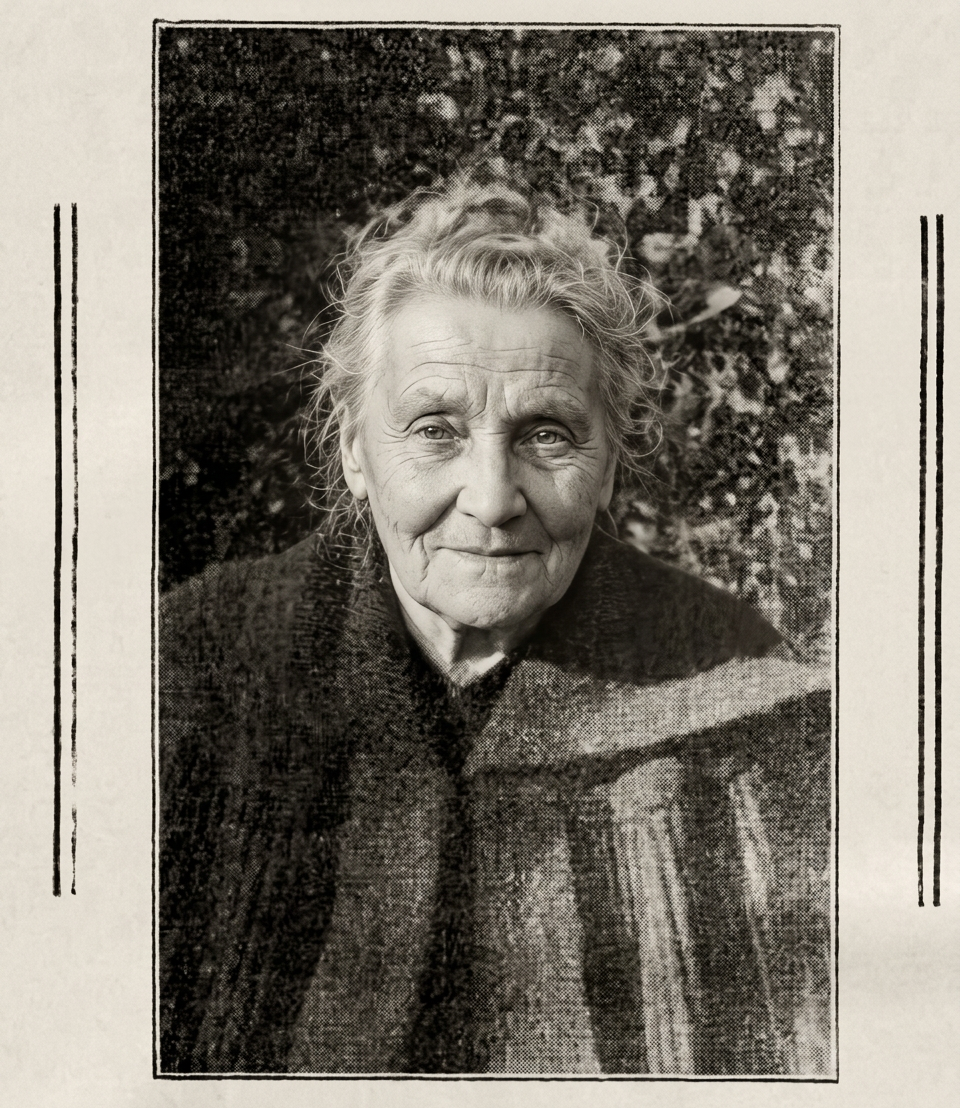
Madame Eugene Vauthier, Goldfields Observer, December 29, 1935
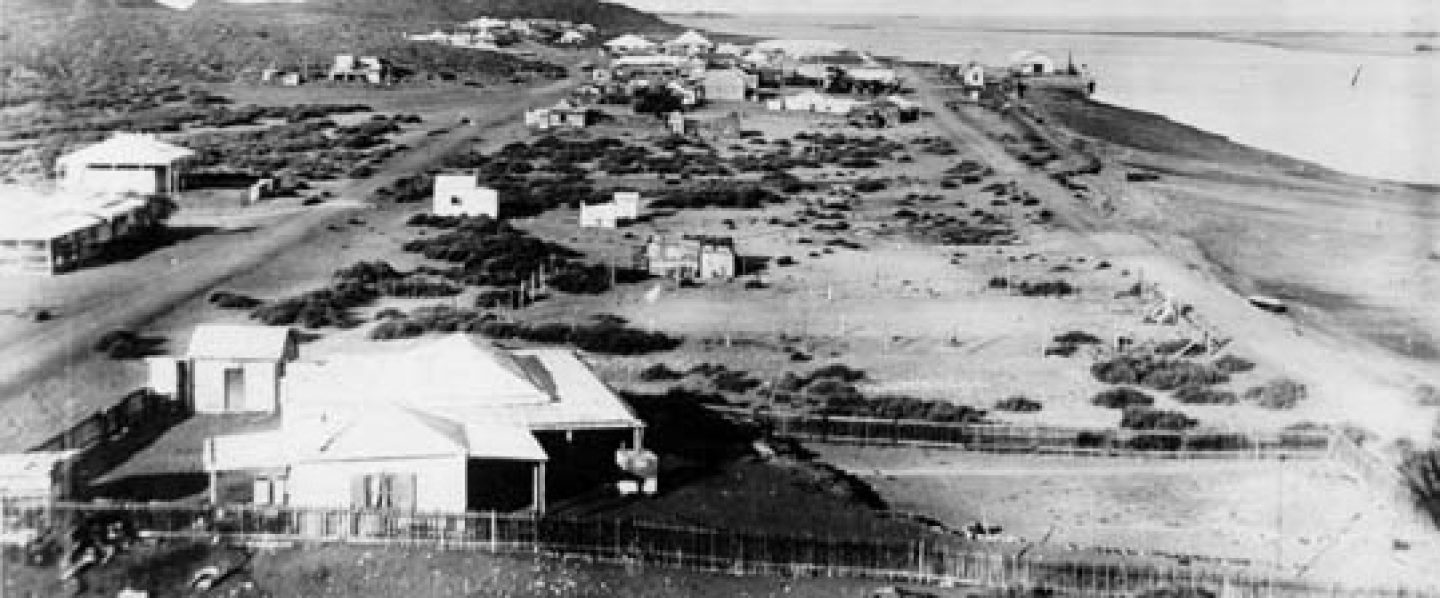
The discovery of gold at Coolgardie in the early 1890s eventually drew her footsteps toward Western Australia. Her arrival in the West was brief; she reportedly spent only a single hour in Perth and never returned to the capital city again. She moved almost immediately to Bulong, which at that time was a prosperous alluvial field. The trip to the goldfields was not without incident, as the horses drawing her coach bolted during the journey. Once settled in Bulong, she initially worked as a cook at a local restaurant. She eventually acquired and maintained the Globe Hotel until the district’s mining industry began to decline.7 8
Madame Vauthier spent the remainder of her long life in Bulong, eventually moving into the town’s old schoolhouse, which she purchased from the Education Department. Despite her advancing years, she remained exceptionally active well into her nineties. She spent her time tending to a garden and a flock of fowls, even carrying the water needed for her vegetables and fruit trees from a nearby dam in tins. Her longevity was attributed to a simple life and a diet that prominently featured fruit, particularly bananas. Even at the age of one hundred, she continued to use a treadle sewing machine and retained her sight, hearing, and memory. Throughout her decades on the goldfields, she remained a staunch supporter of Great Britain and was a keen worker for the Red Cross during the Great War.9 10 11
Sources
- PERTH (1936, January 11). The Australasian (Melbourne, Vic. : 1864 – 1946), p. 9 (METROPOLITAN EDITION). Retrieved March 14, 2026, from http://nla.gov.au/nla.news-article141768020 ↩︎
- ITEMS OF NEWS (1933, April 18). Western Argus (Kalgoorlie, WA : 1916 – 1938), p. 18. Retrieved March 14, 2026, from http://nla.gov.au/nla.news-article34615273 ↩︎
- CENTENARIAN DIES. (1935, December 23). The West Australian (Perth, WA : 1879 – 1954), p. 21. Retrieved March 14, 2026, from http://nla.gov.au/nla.news-article32961766 ↩︎
- PEEPS at PEOPLE (1927, March 13). Sunday Times (Perth, WA : 1902 – 1955), p. 14. Retrieved March 14, 2026, from http://nla.gov.au/nla.news-article58325242 ↩︎
- PERTH (1936, January 11). The Australasian (Melbourne, Vic. : 1864 – 1946), p. 9 (METROPOLITAN EDITION). Retrieved March 14, 2026, from http://nla.gov.au/nla.news-article141768020 ↩︎
- Woman of 104 Who Nursed General Pau in Franco-Prussian War Lies Dying in Hospital (1935, December 26). The Telegraph (Brisbane, Qld. : 1872 – 1947), p. 13 (LATEST FINAL CABLES). Retrieved March 14, 2026, from http://nla.gov.au/nla.news-article179943054 ↩︎
- CENTENARIAN DIES. (1935, December 23). The West Australian (Perth, WA : 1879 – 1954), p. 21. Retrieved March 14, 2026, from http://nla.gov.au/nla.news-article32961766 ↩︎
- CENTENARIAN PASSES (1935, December 23). The Kalgoorlie Miner (WA : 1895 – 1954), p. 2. Retrieved March 14, 2026, from http://nla.gov.au/nla.news-article95010218 ↩︎
- PEEPS at PEOPLE (1927, March 13). Sunday Times (Perth, WA : 1902 – 1955), p. 14. Retrieved March 14, 2026, from http://nla.gov.au/nla.news-article58325242 ↩︎
- CENTENARIAN DIES. (1935, December 23). The West Australian (Perth, WA : 1879 – 1954), p. 21. Retrieved March 14, 2026, from http://nla.gov.au/nla.news-article32961766 ↩︎
- CENTENARIAN PASSES (1935, December 23). The Kalgoorlie Miner (WA : 1895 – 1954), p. 2. Retrieved March 14, 2026, from http://nla.gov.au/nla.news-article95010218 ↩︎


Bloody hell.She deserves a statue at the very least!!
How did you find her!
LikeLike
Madame Eugenie’s story was discovered by one of our Project Team who was working on newspaper reports from Bulong!
LikeLike