Every town or district has its quirks, and often the name carries a story of its own. In the case of Dattening—sometimes mistakenly called Taylor’s Well—the history lingers in the words people still use. Here’s how that tangle came to be, shared by a correspondent of the time: 1
Most readers are wondering where “Dattening” is, writes a correspondent. Well it is erroneously known as “Taylor’s Well.”
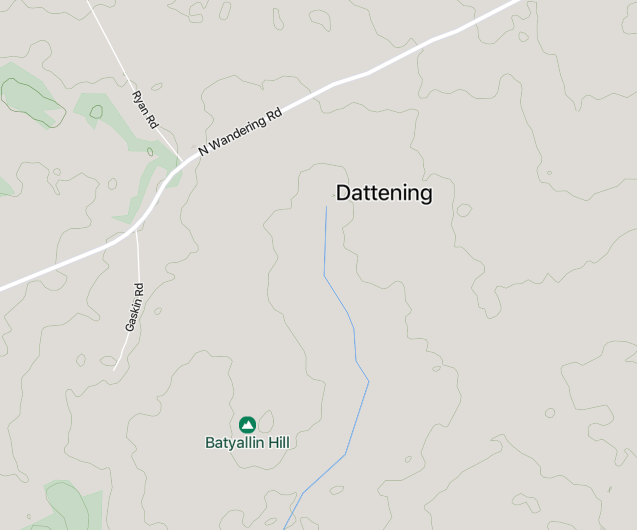
There’s such a tangle here that a word of explanation would not be out of place. Look on the map 2; the place is named “Dattening,” and Dattening is the real name.
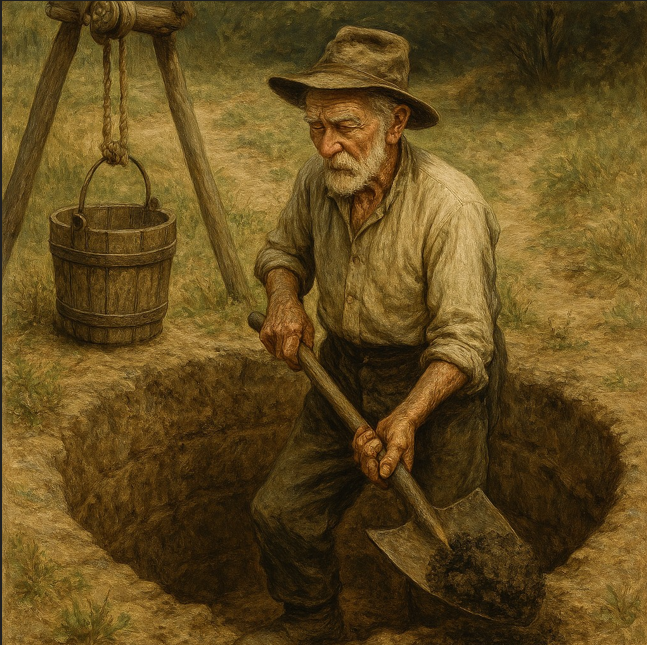
How it came to be called “Taylor’s Well” is thus. Years ago, old Norry Taylor dug a well there for use when travelling stock, and it was a real tip top supply of fresh water, and in those days, before much clearing was done, water was not too plentiful so the early pioneers used to cart their supply of “Adam’s Ale” from the well, and as they went to “Ole Norry Taylor’s Well” to get it, gradually became known as Taylor’s Well.
However, the post office and the telephone exchange are known as “Dattening,” it behoves you to get used to calling it “Dattening.”
Dattening, Western Australia [cartographic material] / prepared under the direction of the Surveyor General, Department of Lands and Surveys, Western Australia. Retrieved August 27, 2025, from https://catalogue.nla.gov.au/catalog/5786516↩︎
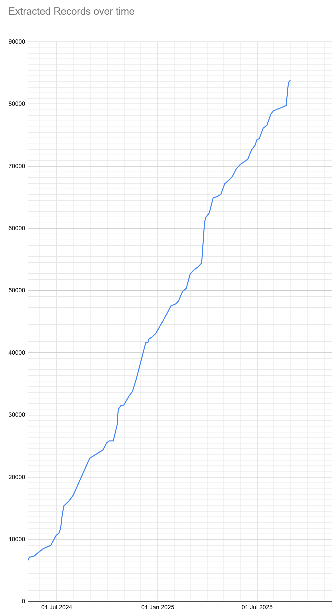
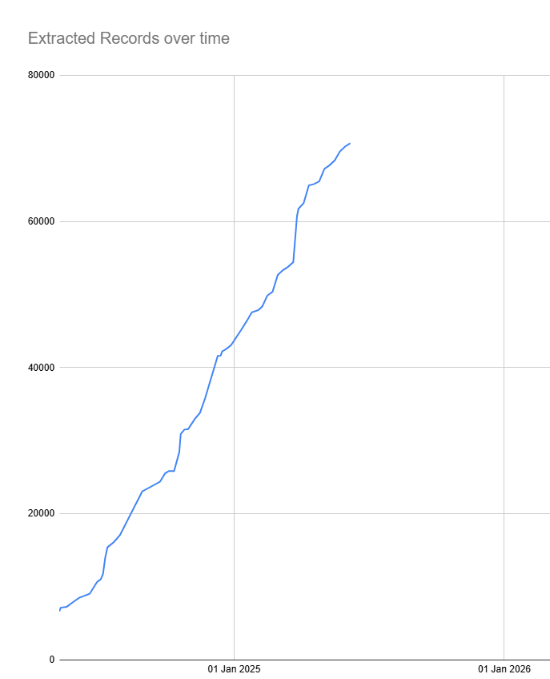
The total records captured up to 31 July 2025 is 83,781. During the past month, the communities of Argyle (and Argyle Police Station), Boogardie, Craiggiemore, Derdebin, Howatharra, Kwelkan, Lancefield, Merilup, Noman’s Lake, Shay Gap, Stratherne, Sunday Island Mission, Tardun, Trafalgar, Ullaring, White Well, Wittenoom and Yarri have found their way into our captured list.
Our project team are working hard to capture as many records as possible of the people in WA’s ghost communities. Once our website and search engine is fully operational you will be able to access some of these records. Here are the latest figures followed by a simple line graph showing the growth in total numbers:
Quick Tip: to quickly see if your favourite ghost town is already in this list, press CTRL+f [find].
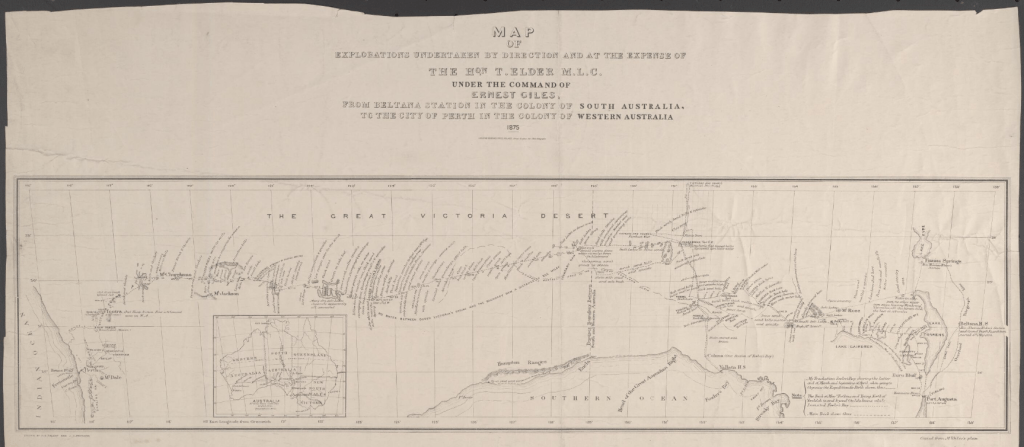
Map of Giles’s Route (Surveyor General’s Office, 1875) – Reproduced courtesy of the National Library of Australia. Digitized and available via the National Library of Australia; this work is out of copyright and free to use for public purposes.
Among the explorers who expanded knowledge of the Australian interior in the nineteenth century, Ernest Giles occupies a distinguished place. His 1875 expedition, financed through the generosity of the South Australian pastoralist and politician Thomas Elder, represented a major advance in geographical discovery, demonstrating both the challenges of crossing the continent’s deserts and the determination required to overcome them.
At the time, vast tracts of inland Australia remained uncharted, and speculation abounded about the potential of the interior for settlement and communication. Earlier surveys by Baron Ferdinand von Mueller and Augustus Gregory in the 1850s had suggested the broad character of these lands, but much remained unknown. Elder, convinced of Giles’s skill as a leader and of the value of camels for desert travel, offered to fund a new expedition to establish as direct a route as possible between South Australia and Western Australia.
The expedition commenced from Port Augusta in May 1875, and the true crossing began on 27 July from Youldeh. Giles’s party included nineteen camels, provisions for eight months, and equipment for carrying water, all vital in a region where survival could never be taken for granted. From the outset, the expedition encountered formidable obstacles. Sandhills, spinifex, and dense mallee scrub made progress slow, while the scarcity of permanent water dictated the pace and direction of travel.
In an early attempt to cover more ground, Giles divided his men: he himself explored westward while William Tietkens and Young struck north in search of the Musgrave Ranges. Both ventures revealed the inhospitality of the land. Giles discovered saline springs and barren scrub, with no signs of animal or human life. His companions fared little better, returning without sighting the Musgraves or finding fresh water.
At one point disaster nearly struck when the camels bolted. The animals were eventually recovered after a long chase, but had they been lost the expedition would have faced almost certain failure. The precariousness of the journey was underlined again in September, when the party endured seventeen days and 325 miles without locating water. Exhaustion and despair led some members to propose slaughtering camels for survival. Giles, however, refused to abandon hope, and perseverance was rewarded when the party discovered a hidden lake. This crucial water source, named Queen Victoria’s Spring, ensured their survival and allowed them to continue.
From this point the nature of the country began to change. Granite outcrops and quartz appeared, bringing with them more reliable supplies of water and pasture. Yet dangers remained. At Ularring, Giles and his men encountered a large and well-organised Aboriginal group who mounted a determined attack. The explorers’ firm defence forced the assailants to withdraw, and the incident remained Giles’s most serious conflict with Indigenous Australians.
Approaching Mount Churchman, Giles noted that the surrounding terrain did not match Augustus Gregory’s earlier chart, which had described the area as flat. Instead, Giles observed ranges of iron-rich and volcanic-looking rock, so magnetic that compass readings proved unreliable. These discrepancies highlighted both the difficulties of accurate surveying and the continuing importance of first-hand exploration.
On 4 November 1875, after a journey of some 2,500 miles, Giles and his party finally reached settled country at Tootra, a sheep station owned by the Clunes brothers in Western Australia. Their safe arrival was greeted with warm public acclaim. Although the expedition had not revealed fertile lands ready for immediate settlement, it had achieved much in both scientific and practical terms. A direct east–west route had been established, new water sources had been identified, and the suitability of camels for such arduous work had been conclusively demonstrated.
The 1875 expedition stands as a testament to Giles’s qualities as an explorer. His leadership, endurance, and refusal to succumb to despair carried his party through regions he described as “utterly devoid of animal life” and “utterly forgotten by God.” While the lands traversed were not destined for agricultural development, the knowledge gained contributed to the broader project of mapping and understanding the Australian interior.
In this respect, Ernest Giles belongs to the company of Gregory, Stuart, and Eyre—men whose journeys across the deserts and ranges expanded the limits of colonial knowledge and shaped the geographical imagination of nineteenth-century Australia. His 1875 crossing of the continent remains one of the most remarkable achievements of its era, demonstrating the extraordinary perseverance required to chart a land as unforgiving as it is vast.
AUTHORS NOTE: This article is based on an 1876 correspondent’s account of Giles’s expedition.1 More recent accounts of the Giles expedition have questioned the contemporary accounts of the Ularring incident.
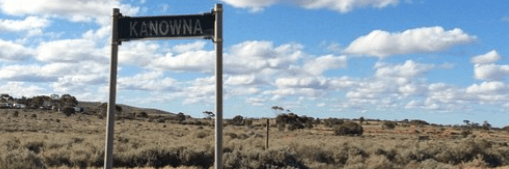
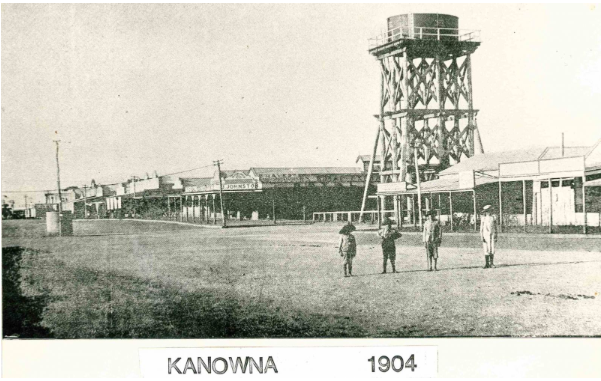
On Friday 29 August, 2025, we will move into Phase 4 of our project and that adds 16 new communities to the list of communities on which we are already working. The biggest community in this phase is Kanowna. If you have any information about these communities, or any of the communities on our master list, please contact us.
Image from our project partner Eastern Goldfields Historical Society
The new 16 in alphabetical order
4 Mile (Leonora)
Bootenal (aka Boolungu, Bootanoo, Bootanu and the Bootenal Railway Siding)
Buldania
Coonara (aka the Coonara Railway Siding)
Gabanintha
Gums (aka The Gums)
Hawks Nest (aka Hawk’s Nest, Hawkes Nest and the Hawkes Nest Gold Mine)
Jibberding
Jitarning (aka Geetaring)
Kanowna (aka White Feather and Cement Workings)
Kodj Kodjin (aka North Baandee)
Londonderry (aka Golden Hole Mine)
Pilbarra (aka Pilbarra Creek, Pilbarra Pool, Yandeyarra Hotel and Yule River, but NOT Pilbara)
Pingarning
Plavins (aka Plavins Timber Mill and Plavins Railway Siding)
Woolgar (aka Yundaga, Yundagga, Yunndaga and Yunndega)
Previous phases have covered the following communities:
I have noticed something today while researching the ghost community of Woop Woop. The name “Woop Woop” has often been used as a humorous or derogatory adjective.
If you have been following along with our project, you will already know that Woop Woop is one of the communities included in Phase 2. Woop Woop was a timber mill situated about 70Km south of Collie, and just a couple of Kms from the little town of Wilga, in the Shire of Boyup Brook. It only last for three years (1925-1928) but in that time it had six huts for single men, two houses, a boarding house, an office, and the Mill itself.
So today I have been working through a publication call The Guardian that has been published in Perth since 1937. While doing this I came across these “references” to Woop Woop – not to the place, but in a completely different context.
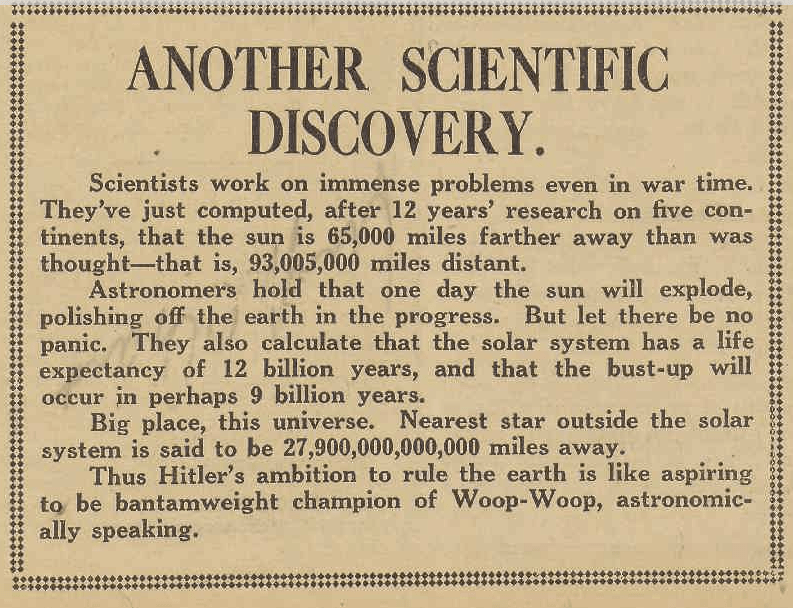
On 27 November, 1942, a random report about a scientific discovery related to the size of the solar system (and the universe) was concluded with a pretty obscure reference to Adolf Hitler as the bantamweight champion of Woop-Woop. 1
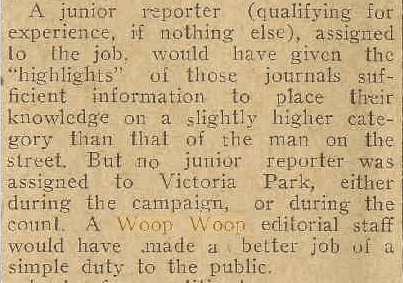
In February 1945, in a report decrying poor quality journalism in relation to reports on the distribution of preferences in Victoria Park. Claiming that any junior reporter would have done a better job than the senior reporters tasked with informing the public. The report concludes with the statement “A Woop Woop editorial staff would have made a better job of a simple duty to the public”. 2
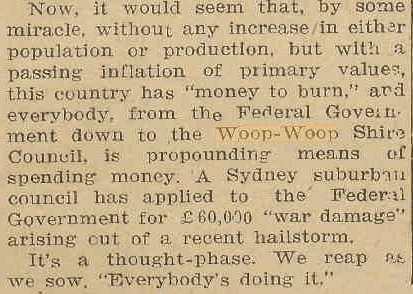
Elections once again figure in a report from January 1947, where everyone from the Federal Government all the way down to “the Woop Woop Shire Council” is looking for a handout. 3
These stories may have been meant to be humorous, but between 1937 and 1954, seven times the name “Woop Woop” was used in a way that, if I had been a local resident, would have seen me writing a letter to the editor to demand an apology. And, perhaps, in this litigious age, seeking compensation.
A LAST NOTE: The seven articles are all in The Guardian. There are probably hundreds in the 365 other Western Australian newspapers currently digitised on Trove. Have a look for yourself and see what you can find.
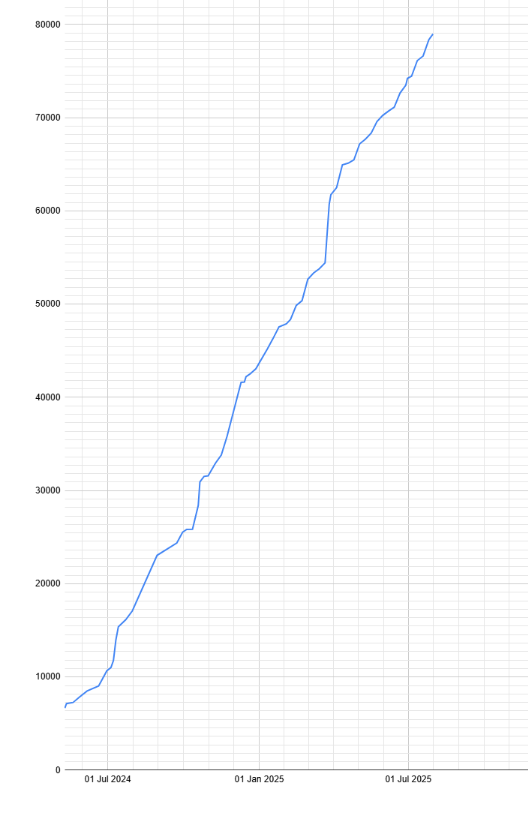
The total records captured up to 31 July 2025 is 78,987. During the past month, the communities of Black Range, Burbridge, Cork Tree Flat, Culham, Dattening, Garden Gully, Gum Creek, Hawk’s Nest, Kintore, Kudardup, Linden, Paynesville, Red Lake School, Spargoville, Warriedar, Wyening, and Zanthus have found their way into our captured list.
Our project team are working hard to capture as many records as possible of the people in WA’s ghost communities. Once our website and search engine is fully operational you will be able to access some of these records. Here are the latest figures followed by a simple line graph showing the growth in total numbers:
Quick Tip: to quickly see if your favourite ghost town is already in this list, press CTRL+f [find].
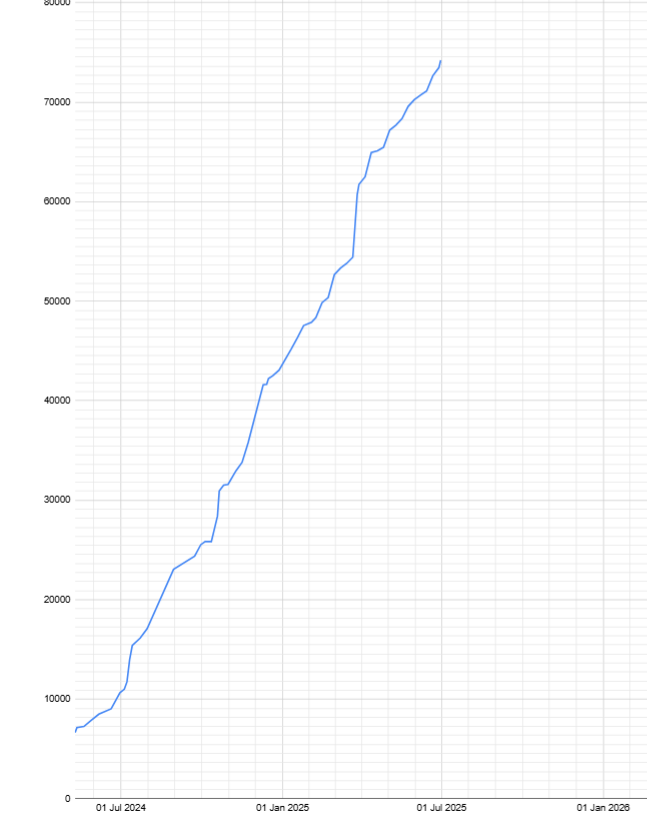
The total records captured up to 30 June 2025 is 74,222. During the past month, the communities of Barton, Bummers Creek, Cuddingwarra, Davyhurst, East Kirup Timber Mill, Fly Flat, Galena Bridge, Kathleen, Kathleen Valley, Mount Ida, Mulgabbie, Naretha Railway Siding, Niagara North, Pingin, Pinjin, Sandstone, Sir Samuel, Surprise South, Webb’s Patch, and Yundamindera have found their way into our captured list.
Our project team are working hard to capture as many records as possible of the people in WA’s ghost communities. Once our website and search engine is fully operational you will be able to access some of these records. But for now, here are the latest figures along with a graph showing the growth in total numbers:
Quick Tip: to quickly see if your favourite ghost town is already in this list, press CTRL+f [find].
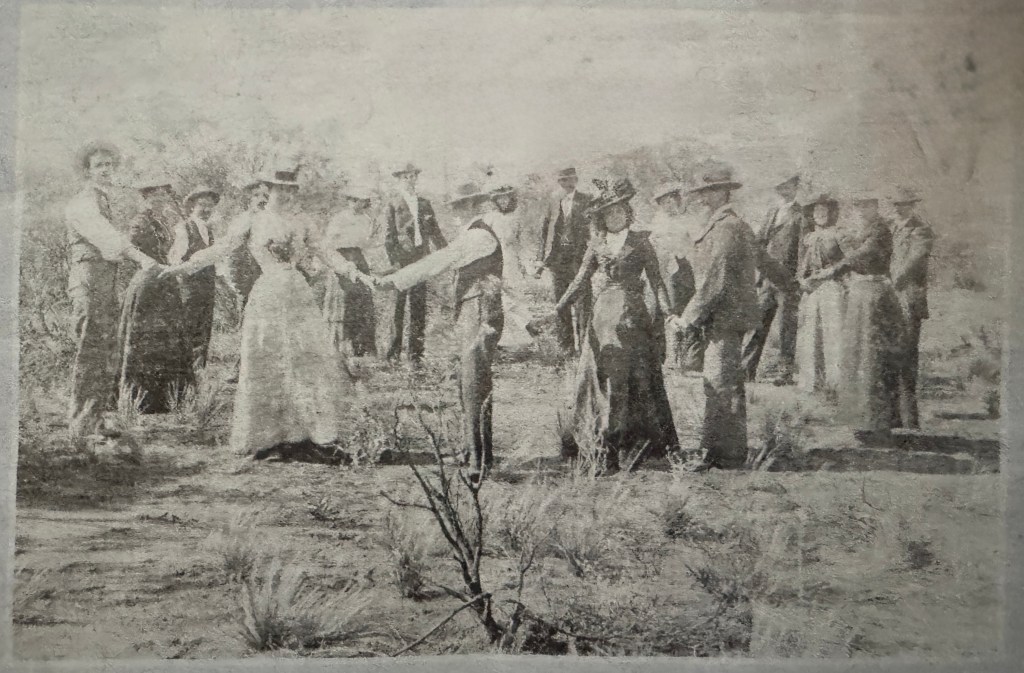
In May 2011, The Weekend West‘s Rod Moran published an article under the banner “The Way We Were”.1 The short article reads:
August 4, 1898
In three decades Goongarrie grew from a camp to a thriving town and finally a ghost town.
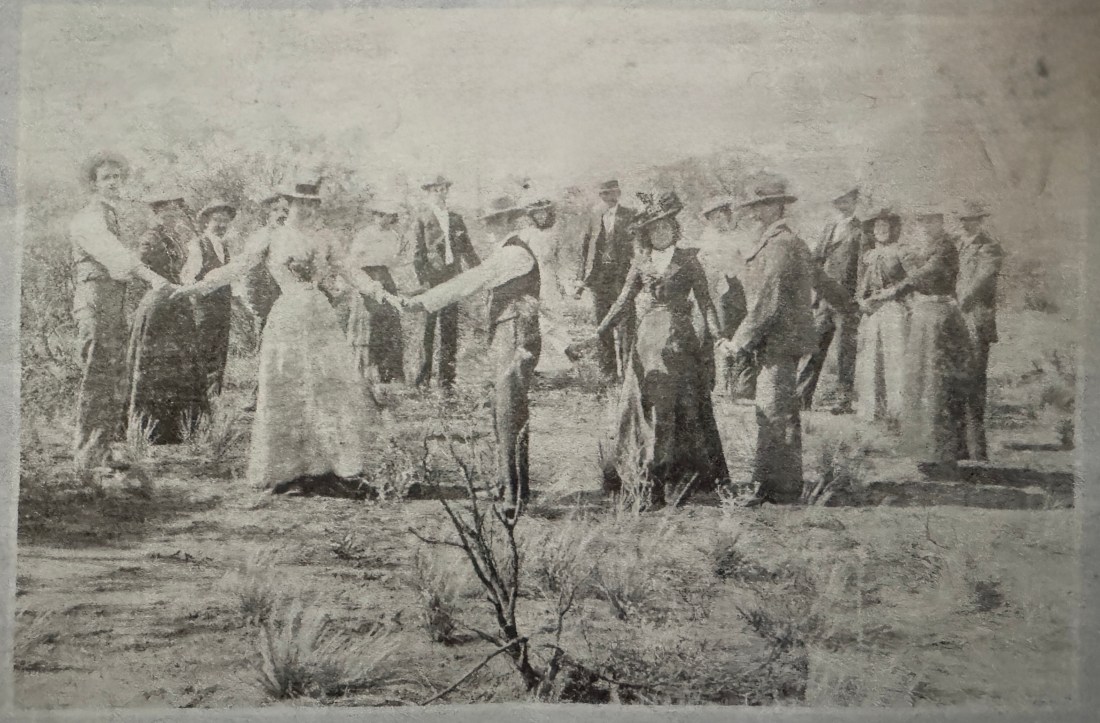
This lighthearted snap shows a picnic gathering at Goongarrie, a flourishing gold-mining site in the back-blocks between Menzies and Kalgoorlie. The first gold discoveries in the area were mde in 1893. The hamlet was also called the Roaring Gimlet, due to the thundering noise of icy desert winds through the gimlet trees. More prosaically, early on it was simply called the 90 Mile camp, its approximate distance from Coolgardie.
Despite its isolation, Goongarrie developed into a thriving little town. By the 1890s it boasted two pubs, as well a other essential services such as a post and telegraph office. In 1898 the Cobb and Co coach from Coolgardie was boosted from a bi-weekly to a daily run. The government rail line opened in the same year. The town also boasted a blacksmith, a carpenter, two butchers, a baker two restaurants and a cool drink manufacturer. But the citizens depicted here at play also had some weighty concerns on their minds in its August 4, 1889 [sic] edition The West Australian reported “Considerable dissatisfaction is expressed in this district at the failure of the Education Department to establish a school at Goongarrie. From 15 to 30 children are now resident here, and…not having any educational facilities whatever, are to a great extent running wild about the country…growing up in almost total ignorance.”
In 1904 the district’s electoral roll listed 109 names. But by 1921 the postal directory had only 21 people on it. even if a school had been built, Goongarrie’s fortunes would have waned as alluvial gold petered out.
The information and accompanying image were said to be taken from the archives of The West Australian. However, a search of Trove for the period in question has not located the original photo. The quoted comment about the lack of a school in Goongarrie can be found in the Kalgoorlie Western Argus2 along with further details on the issue.
In September 1898, Cyril Jackson, the Inspector General of Schools, responded to a letter from the local Board of Health in which an offer of a suitable building (the Miners’ Institute) was made to house a school free of charge. He said “…the Minister is very anxious indeed to extend education to as many children as possible. It seems impossible, however, in the present state of the funds to establish a school at Goongarrie.”3
Some things, it seems, never change.
Source
Rod Moran, 2011. The Weekend West : The Way We Were. Published 28-29 May, 2011 by The West Australian Newspapers. ↩︎
The following is a detailed report of a cricket match that took place on this day in 1897 at Cossack between the Cossack and Roebourne teams. It was published in Northern Public Opinion and Mining and Pastoral News on Saturday, 19 June 1897.1
CATCHES. By “SHORT SLIP.”
The Boebourne Rovers “trammed” to Cossack on Saturday. The first association match played at the port this season took place.
The game was well contested, and good feeling made for a close and exciting finish. A good number watched the game, but the fair sex had only one representative present. ‘Tis true for the poet when he describes the petticoat sporting fraternity as a “sit-me-on-the-bicycle sort of push.”
The Rovers proved the victors by eleven runs.
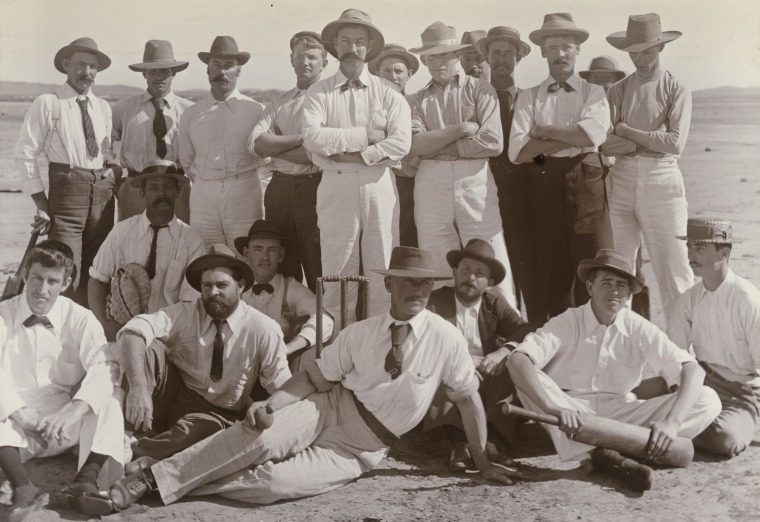
This photo shows the Roebourne & Cossack cricket teams three years later in 1900.2
“Watty,” the Cossack barracker, was all there in his usual bass voice and sung himself hoarse. “Snap-shot” Renold, with his camera, took a “shot” at both teams, and “never smiled again.” He should have thrown the “X-rays” on them.
Like the “Arizona Kicker,” good old “Sol.” blessed the players with a beautiful day, and the Cossackites prepared a good wicket for the Boebourne boys.
Through the instrumentality of a few members of the home team, led by indefatigable “Donny,” a shed was erected on the ground, and the scorers were accommodated with a “cose” and a few “ax.l.” boxes to squat down on.
The Union Jack—or perhaps the Cossack coat-of-arms-out-of-pocket—was flying on top of the shed, whilst the decorations at the bottom comprised two fine jars of water (not of Babel, but of Nature).
There is no denying the fact that the pitch at Cossack, and also the fielding ground, is far superior to that of Boebourne, and if it always remained in the condition it was on Saturday, all matches could be played on the marsh.
The Rovers played a really well-combined game and deserved to win, whilst the Cossack lads defended splendidly and did everything in their power to avert defeat.
“Luck was agin’ them,” said Watty, after a whiskey and soda.
Whilst travelling with the cricketers on Saturday (not a Parliamentary team), our worthy and much-respected member, Mr. H. W. Sholl, M.L.A., opened his many-a-time generous heart and proved to those who travelled by the tram that he was a sportsman as well as a “Member of Parliament,” and a gentleman as well as a public “sarvint.” He informed the members of the B.C.C. that he was that day presenting a bat to the individual, of either team, who made the highest score in the match, for the sake of evincing some interest among the batsmen.
This goes to show that Mr. Sholl’s heart and soul were with them in their recreation, and he deserves the thanks of all true and honest sportsmen in both Boebourne and Cossack.
I may state that the genial skipper of the Rovers, “Sam” Hemingway, won the bat to which I refer, his score being 81, made by sterling cricket. I offer him my heartiest congratulations.
One of the most pleasing sights that I have yet seen on a North-West cricket ground appeared before me on Saturday. It was simply the Cossack “willow wielders” turning out in their true colours—wearing scalp-caps of yellow and black hue, and with a green kerchief (ould Oirish, begorra) round their waists.
It reminded me of an old English cricketer (Dr. Grace), who, when in Australia, had, on entering the Melbourne ground, decked himself with blue dungaree pants, and what he termed an “old physician’s waistband” (green). When the spectators eyed him, they shouted out, “We bar the Irish navvy!” But the good old medico held his peace, and the crowd silenced down.
The query is asked—”Why don’t the Boebourne teams play in their colours?” Echo answers—”They have none!”
At two o’clock, both captains met, and the coin was tossed, turning in favour of George Snook, who elected to bat. “Sam” Hemingway then led his men into the field, and at twenty minutes past two, a start was made.
“Uncle” Harding and “Bob” Selway were the first men to pad up and take strike for Cossack, while “Jim” Hubbard and “Jack” Keogh took the cudgels for the Rovers.
“Bob” did not celebrate a record reign at the crease. Taking strike to Hubbard, he received the dreaded “duck,” which he has for so long been unaccustomed to. This was rather unlucky for Cossack, to lose their best man by the first bell of the day, and there was “weeping and gnashing of teeth” when Bob returned to the shed.
“It was a splendidly pitched ball, and broke to the off, beating me all the way.” – Selway
“Donny” took the vacancy and, after making a dozen, was clean bowled by “Tommy” Molster, who was brought in from long-field to do the trundling. “Uncle” soon followed, being caught and bowled by “Sam” Hemingway. He had made nine by good cricket.
“Georgy” Fry and “Georgy” Brown, the two pavilion cricketers, made four and eight respectively. They were off duty (cricket, I mean) and did not take much advantage of their “staff.”
“Snoofie,” the skipper, played a free bat and made some very pretty strokes, notching fourteen before he drove one very hard to Jack Keogh, who accepted it. It was a splendid catch, and Jack received an ovation.
“Jum” Louden fell a victim to Tommy Molster, after breaking the shell of the “duck.”
“Watty” Moore surprised everyone by his fine exhibition, his leg hits being marvellous, and he received a cheer when he had carried out his bat for thirteen.
“Slurry” Wilson and “Carbine” Moore both succumbed to Hubbard before they had scored and joined the ranks of “Short-slip’s” spoon competition.
An amusing thing occurred while “Carbine” was batting. He played the first ball of Hubbard’s onto his cranium, and with a cricketer’s oath, the next one gave him a clip in the ear, but the third one hit the—w-i-c-k-e-t.
“Herb.” Birch, who was put in last wicket down (who should have followed the seventh man), just reached double figures when he was snapped up by Jim Hubbard.
Tommy Molster, in the long field, made a “bolster,” fell down, and got stuck in a mud-hole. Here’s to him, with “Short-slip’s” sympathy!
The ball went off the cricket bat, And travelled far away! “Tom” Molster in his big white hat Fell on it in the clay.
The clay was soft, the ball was round, Poor “Tom” he couldn’t stir, So all the boys they stood around And left him in despair.
He with the ball at last did rise With language that was wicked, And told them that he’d cause surprise When he got at the wicket.
Covered with mud, he took the ball And bowled a maiden over, And in the next surprised them all By scattering bails in clover.
For fielding, Church, Naish, and Hemingway were excellent, and it speaks well for Cossack’s wicket-keeper that a bye was not recorded in the innings.
The bowling honours for the Rovers were carried off by Jim Hubbard, who came out of the cupboard (his shell, I mean), and got the splendid average of 5 wickets for 11 runs. A word of praise is also due to Tommy Molster, his 2 wickets only costing him 7 runs.
After a blow, the Rovers commenced their innings, having to make 72 to win. “Bannerman” Raymond and “Sam” Hemingway were the first representatives, and the bowlers were Brown and Louden.
“Banner,” after his usual careful play, had the misfortune to snick one of Louden’s into the hands of Brown and retired with four to his credit.
The skipper played a very useful innings. It was really a treat to watch his well-timed strokes and neat cuts, and when he had reached 81, he was captured by Selway. “Sam” was received with three times three when he reached the shed.
“Jim” Hubbard, after making seven, was foolishly run out. “Bert” Naish trebled his misfortune on Saturday, falling a victim to Brown for a duck.
“Herb.” Church, who had received a nasty blow on the left cheek through coming into contact with the ball, played a good innings and was bowled by Fry for a well-made 18.
“Jack” Keogh fell a victim to Fry for five, and “Burly” bowed to the same bowler for a unit. “Dawesie,” who must be credited with making the winning hit, cried ‘nough to Fry for 11. A.E.D. hit a fiver, which was the biggest hit of the day.
“Willie” Fuller threw his bat at Donny (unintentionally), and after making a single was bowled by Walter Moore. “Jack” Wotherspoon “spooned” the ball into the “dukes” of Fry.
Pass along the banjo! “Oh Jack, why did you hit that ball?” Cried Boebourne Rovers one and all. “I went to place it to the leg,” Said poor old “Wother,” with his egg. The game was o’er, the match was won— So it didn’t matter what he done. But on this man there was a doom, Because his name was Wotherspoon.
“Tom” Molster carried his bat to the wicket, but had no chance to use it.
George Fry did the trundling for the home team, bagging 6 wickets for 22 runs. Selway and Walter Moore also bowled well. Little “Donny” was the best man in the field, ably assisted by Brown and Harding, while “Snookie” performed well behind the sticks.
Owing to the bogey condition of the Cossack cricket ground, caused by the high tide at the port, the Civil Service–Cossack match has been postponed till today week.
Some of our local cricketers, I learn, are striving to arrange an all-day match (one end of the town against the other), for Wednesday next. It is to be hoped that “both ends will meet.”
“Short-slip” was met by an indignant cricketer the other day, and was thus warned:
“Look here you blonky (hic) quill-driver, if you (hic) say a word about me in the (hic) paper, I’ll punch your blinky nose (hic)… take it from me.”
I don’t think he was—d-r-u-n-k.
Source
CATCHES. (1897, June 19). Northern Public Opinion and Mining and Pastoral News (Roebourne, WA : 1894 – 1902), p. 3. Retrieved June 11, 2025, from http://nla.gov.au/nla.news-article255736548↩︎
State Library of Western Australia, 2025. Cossack and Roebourne Cricket Teams. Photograph taken 1900 in the North West Australian series. Retrieved June 11, 2025 from North West Australia ; BA338/1/36↩︎
Our project team are working hard to capture as many records as possible of the people in WA’s ghost communities. Once our website and search engine is fully operational you will be able to access some of these records. But for now, here are the latest figures along with a graph showing the growth in total numbers:
Quick Tip: to quickly see if your favourite ghost town is already in this list, press CTRL+f [find].
 People of Western Australia's Ghost Towns