The Rutherford Family of Ninghan

Searching for the ghost town/area Ninghan (occasionally spelled Ningan) I found a story which indicates the everyday dangers always present in outback Western Australia. When she was 11 years old, Hazel Rutherford, of Ninghan Station via Yalgoo wrote in to ‘Aunt Mary’ (children’s letters to the Silver Chain) about where she lived. She told of the spring near their homestead, the garden of poppy flowers, and her kitten. Hazel had five brothers and a sister. She also had a friend, Iris Vickery, and they went for long walks together. Ninghan Station still exists, and the descriptions of it are as picturesque now as they were in 1925.
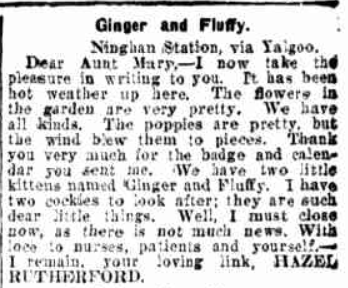
Childrens Corner conducted by “Aunt Mary”1

A few years later, Hazel’s name was again in the newspaper, but this time the information was not so benign. She was listed as family mourning the death of her twin brother, Harold Arthur Rutherford, who had died riding home from his day’s work as a stockman – he was 17 and six months. Harold was laid to rest where he was found, at Ninghan Station, which at the time was owned by Tom Elder Barr Smith. By that time, the Rutherford family seem to have moved to Bungar Station, Paynes Find which is still in the area. This I could not find. Perhaps the name has changed, or the land is divided now.
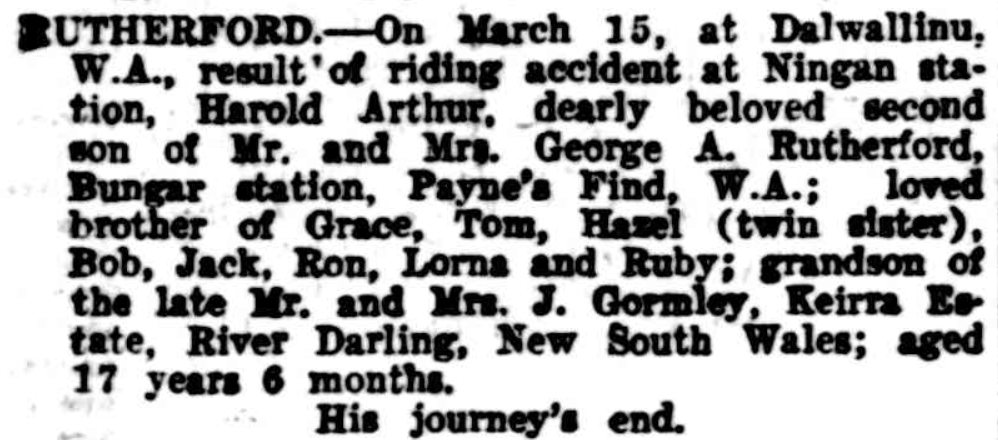
Family Notices 2

A postscript to this story was a request for compensation for Harold’s death, put forward by his father, George Arthur Rutherford, to Tom Elder Barr Smith, heir to a fortune in pastoral properties and owner of Ninghan Station. £75 was awarded under the Workers Compensation Act, on the grounds that Harold had partially supported his father and the family by some of his wages at the time he died. Iris Vickery, a bookkeeper to Mr Barr Smith, corroborated the information.
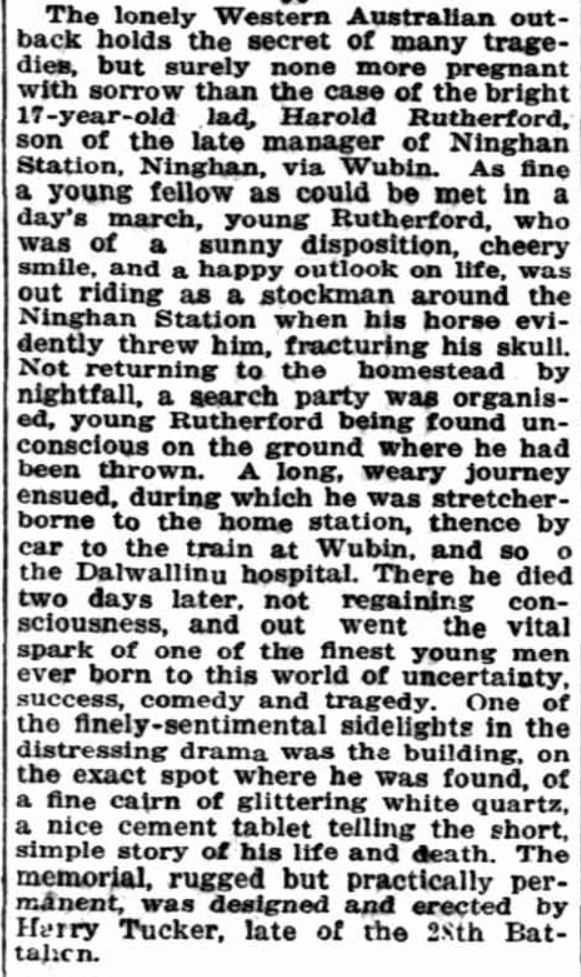
Peeps at People 3

The Dalwallinu Register of Burials notes the grave, and also that the ashes of a relative, George Edward Rutherford, who died in 1990, were also interred there4


Sources
  1. Ginger and Fluffy. (1926, January 21). Western Mail (Perth, WA : 1885 – 1954), p. 29. Retrieved August 20, 2024, from http://nla.gov.au/nla.news-article37644656 ↩︎
  2. Family Notices (1932, April 14). The West Australian (Perth, WA : 1879 – 1954), p. 1. Retrieved August 20, 2024, from http://nla.gov.au/nla.news-article32643172 ↩︎
  3. Peeps at People (1932, April 10). Sunday Times (Perth, WA : 1902 – 1954), p. 7 (First Section). Retrieved August 20, 2024, from http://nla.gov.au/nla.news-article58661172 ↩︎
  4. Shire of Dalwallinu Burial Register ↩︎
What’s a State Battery?

As I have been researching ghost towns, I have often come across the phrase “state battery”. Without actually taking the time out to discover what this was, ideas that flittered through my mind included some sort of power generation facility or a method of providing fresh eggs and chickens in the outback.

Today is the day. I have found out what a state battery is, and I’m going to share it here because there could be others like me who have no clue!! And please, if I have made any incorrect assumptions or conclusions, tell me!!

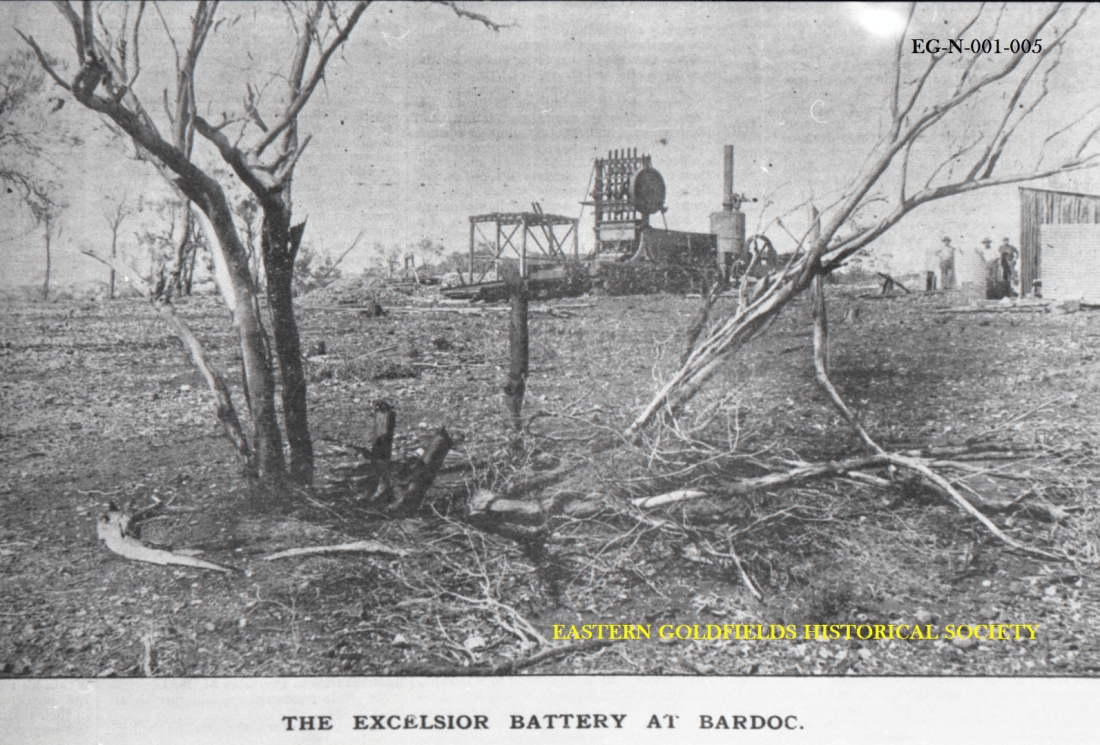
Photo is from the Eastern Goldfields Historical Society’s digitized collection of 60,000 negatives1.

In Western Australia a state battery was a government owned and operated crushing facility that crushed the ore found by prospectors and dug from small mines in the area. The Western Australian Department of Mines were the government agency responsible for their operation. Some of the batteries were only operating for one or two years, while others were in place for 5o or more years. Western Australia was the only state in Australia to provide this type of facility.

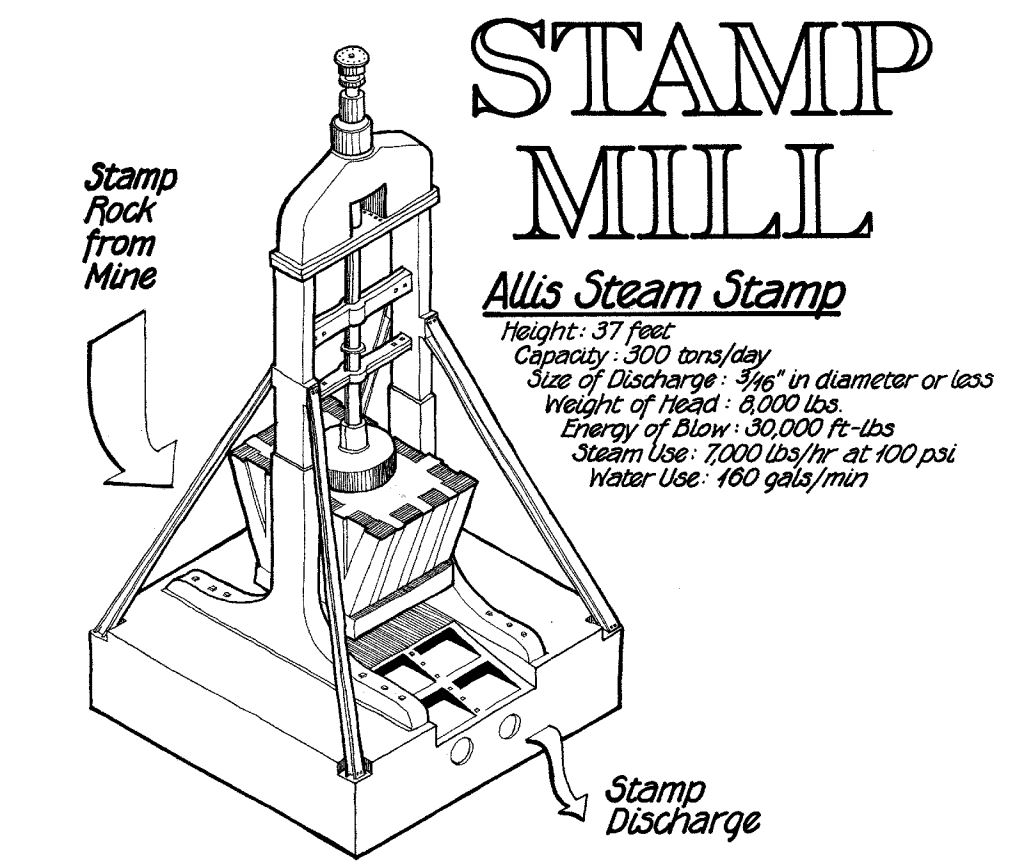
A battery (aka stamp battery, stamp mill or stamping mill) crushes ore by pounding rather than grinding. Each stamp head consists of a set of heavy steel stamps in a vertical frame. The stamp slides up and down crushing the rock.
Batteries were gauged by the number of heads, hence a 10-head battery has 10 stamp heads crushing ore.

The first public battery (as they were originally known) was opened at Norsemam in 18982. Prior to this privately owned and operated batteries were the norm. In considering the legislation to establish public batteries, some last minute adjustments to the wording gave the administrators discretion to “assist” private batteries in certain cases3.

I haven’t been able to find out how many state batteries were established, but by the 1930s the total number of batteies (public and private) was close to 100, dropping to less than 50 by 1958. By 1982 a government review of state battery operations resulted in closure of all by 19874. In 1996 the battery at Ora Banda was rebuilt and reopened. Unfortunately, it never crushed any ore and in 2000 it was badly damaged by bombing and has not been rebuilt5.

As at April 2012, Wikipedia published a list of known state batteries in Western Australia (see below) but this list is believed to be incomplete. Do you know of any more? If you do please let us know at ghostswa@fhwa.org.au. While our focus, as always, is on the ghost towns, for completeness this list includes those state batteries that were located at all known sites, ghostly or otherwise!

List of State Batteries known to have existed in Western Australia
BambooLavertonNannineSouth Greenbushes
Black RangeLeonoraNiagaraSouthern Cross
BulongLindenNorsemanTuckabianna
CarlamindaMarble BarOra BandaTuckanurra
CoolgardieMarvel LochPaddingtonWarriedar
CueMeekatharraPaynes FindWidgiemooltha
DarlotMessengers PatchPaynesvilleWiluna
DesdemonaMenziesPig wellYalgoo
DevonMt EgertonPinjinYarri
DonnybrookMt IdaQuinnsYerilla
DuketonMt KeithRandallsYouanmi
Dumpling GullyMt Sir SamuelRavelstone – Peak HillYundamindera
KalgoorlieMullineRavensthorpe* Mt Jackson
KalpiniMulwarrieSandstone* Siberia
From Wikipedia article – State Batteries in Western Australia, 2012
* Updated 26 Nov 2023 with additional locations from Gone West by Geoffrey Higham.
Closer view of the head frame at a State Battery6


Sources
  1. Eastern Goldfields Historical Society, 2023. The Excelsior Battery at Bardoc. Digitized photograph EG-N-001-005. Accessed online 26 Nov 2023 at https://www.facebook.com/photo/?fbid=662634742545097&set=a.456121176529789. ↩︎
  2. The Western Australian Goldfields Courier, Coolgardie, WA : 1894-1898. Norseman Public Battery. 10 Sep 1898, p.23. Retrieved from http://nla.gov.au/nla.news-article251211132 on 26 Nov 2023  ↩︎
  3. The Golden Age, Coolgardie, WA : 1894-2898. The Public Batteries. 11 Dec 1897, p.3. Retrieved from http://nla.gov.au/nla.news-article256754516 on 26 Nov 2023 ↩︎
  4. Wikipedia, 2023. State Batteries in Western Australia. Retrieved 26 Nov 2023 from https://en.wikipedia.org/wiki/State_Batteries_in_Western_Australia ↩︎
  5. Eastern Goldfields Historical Society, 2017. State Batteries in Western Australia. Video and notes accessed online 26 Nov 2023 https://www.facebook.com/kalgoorliehistory/videos/1489501291104966 ↩︎
  6. F.A.Sharr, 1983. Image Details – State Battery closer view of headframe. Digitized photograph from Heritage Council. Accessed online 26 Nov 2023 at https://inherit.dplh.wa.gov.au/Public/inventory/Image/5ad57a39-0d86-413f-be02-75b1657bc925 ↩︎