Old John Hunter

“The only man who ever made Coolgardie blossom like a rose”

Something rarely mentioned about the Eastern Goldfields is – how did people get fresh veggies?

It’s hard to imagine life without fresh or frozen greens at dinner nowadays, but just imagine how it was in the 1890s. The conditions were very hot, the rainfall was unreliable. Those of you who have ever grown your own vegetables will know how quickly they can wilt and die on very hot days. Throw in a scarcity of water and growing your own becomes a labour of survival.

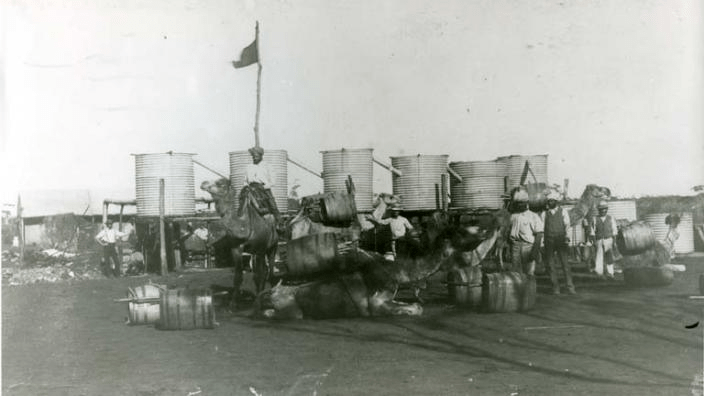
Water was carted into communities by camels bearing barrels of water from the closest place that it could be found – often from 500 km away in Northam, but this was obviously extremely expensive.

Water Condensers

Desalination plants were quickly built by enterprising people. Salt water was taken from nearby lakes, put into corrugated iron tanks and using local timber boiled and condensed. The condensed water was still very poor quality and needed to be further boiled to make it drinkable. This water was liquid gold at the price of 9p per gallon. It was even more expensive than beer!1 Eventually the Government built condensers but water was still not plentiful.

Typical scene of loading water onto camels at a condenser
Image copyright WA Museum 2

Into this hot and harsh environment comes Old John Hunter, who we only learn about from his death. His obituary in 1927 reads:

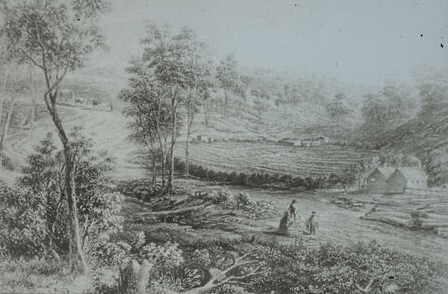
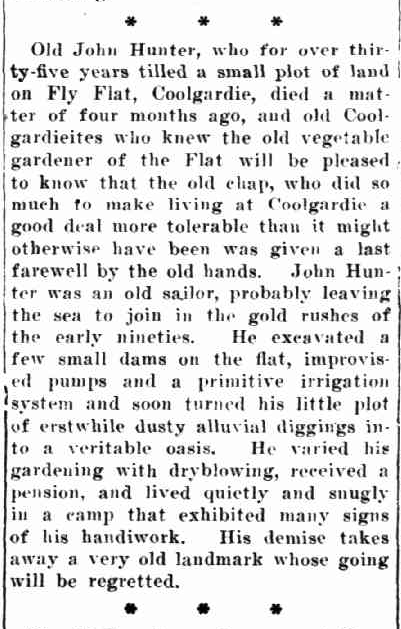
Old John Hunter, who for over thirty-five years tilled a small plot of land on Fly Flat, Coolgardie, died a matter of four months ago, and old Coolgardieites who knew the old vegetable gardener of the Flat will be pleased to know that the old chap, who did so much to make a living at Coolgardie a good deal more tolerable than it might otherwise have been was given a last farewell by the old hands. John Hunter was an old sailor, probably leaving the sea to join in the gold rushes of the early nineties. He excavated a few small dams on the flat, improvised pumps and a primitive irrigation system and soon turned his little plot of erstwhile dusty alluvial diggings into a veritable oasis. He varied his gardening with dryblowing, received a pension, and lived quietly and snugly in a camp that exhibited many signs of his handiwork. His demise takes away a very old landmark whose going will be regretted. 3

Another writer said of John:

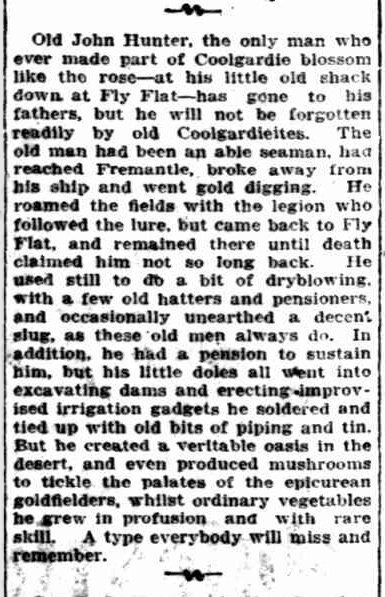
He created a veritable oasis in the desert and even produced mushrooms to tickle the palates of the epicurean goldfielders, whilst ordinary vegetables he grew in profusion and with rare skill. A type everybody will miss and remember. 4

Old John Hunter was born circa 1836. He must have been a remarkable man to have been tilling his garden since 1892. He was 91 when he died.


Sources

  1. Shire of Coolgardie Liquid Gold in Coolgardie, 10 August 2023. Accessed 3 April 2025. https://www.coolgardie.wa.gov.au/news/liquid-gold-in-coolgardie/20477 ↩︎
  2. Western Australian Museum, 2025. Condensing. Retrieved 19 May 2025 from https://museum.wa.gov.au/explore/wa-goldfields/water-arid-land/condensing ↩︎
  3. PERSONALIA (1927, May 6). The Leader (Perth, WA : 1923 – 1928), p. 2. Retrieved May 19, 2025, from http://nla.gov.au/nla.news-article256985122 ↩︎
  4. PEEPS at PEOPLE (1927, May 8). Sunday Times (Perth, WA : 1902 – 1954), p. 14. Retrieved May 19, 2025, from http://nla.gov.au/nla.news-article58318621 ↩︎

Phase 3 starts

On 28th March 2025, our project team started phase 3. This new phase of the project adds 16 new communities to the existing communities from the pilot (4) and phase 2 (15). To see the full listing of phase 3 communities can be found here.

If you are interested in joining the project team, or if you have information about any of the communities on our list, please email ghostswa@fhwa.org.au

Kundip Dreaming

Wyn Green was born in Kundip in Feb 1911. In later years she wrote a poem called “The Ghost Town of My Dreams” which you can find, in full, in the book “Kundip 1901-2001” by R Goldfinch1. This is an excerpt…

The gorge still breathes its glory swathed in purpose and in gold
Rocks I climbed so many times their majesty still hold
There’s a lone crow a-cawing on a distant hill
Where the sombre mines with their rotting lines loom, eerie, and so still.

I hear the joyous notes of childhood wafted on the air
Occupants of homesteads which are dotted here and there
But Alas! The vision passes, again the streets are bare –
Homes have gone – have crumbled and none are there to care.

Wherever I may wander guided by my schemes
Kundip, I will remember – the ghost town of my dreams

Abandoned Mine at Kundip 2

Sources

  1. Ravensthorpe Historical Society, 2001. Kundip 1901-2001. pp24-25 ↩︎
  2. State Library of Western Australia. Jack Mallet Collection. Retrieved 11 Mar 2025 from https://encore.slwa.wa.gov.au/iii/encore/search/C__SJack%20Mallett%20collection%20of%20photographs%20SMCLN__Orightresult?lang=eng&suite=def ↩︎

The Pearl Fisheries at Tien-Tsin, North-West Australia

It is always fascinating to read about one of our Ghost Communities in a publication that was originally written as it was all happening. The article that follows was written in 1870 and published on 26 May in The Sydney Morning Herald1. You can find it on Trove and I encourage you to seek out the original (using the link below) and view it online in its original format. However I do understand that it is difficult to read and so I have recreated it here verbatim without any claim to the content which is entirely the intellectual property of the publishers.

Tien-Tsin was the original name of Cossack after the barque that carried Walter Padbury and his party. In May 1863, Padbury landed his stock at the mouth of the Harding River near the present site of Cossack. The ship that brought the state’s governor, Frederick Weld, in December 1871 was named HMS Cossack, and the town adopted this name in 1872 (officially 1873). Cossack was the first port in the North West, and was critical to the development of the pastoral industry in the region2.

The location of Cossack3

CONTENT WARNING: Before proceeding, please be aware that this is a transcript of the original text and contains concepts that may be offensive to some readers. It is not our intention to offend, but we believe it is important to understand that this was the language and content of the time and needs to be read in that context. It does not in any way reflect the opinions of the project team.


“An account of a new settlement is always interesting, but when Australian colonists venture into an entirely new country, and in addition to settling and stocking the land, discover a new industry that employs hundreds of men—both black and white—it becomes even more fascinating. Just two years ago, many parts of the district to be described here were only accessible by armed bands. Enterprising settlers are now sending down pearl shells and wool from the very spot where Panter, Harding, and Goldwire, the surveyors, were murdered by the aboriginals without provocation.

“The settlement of the Nicol Bay district, as it is known, has been quicker than any other part of Australia. It is heartening to note that the relationship between the aboriginals and the white settlers is now more friendly and satisfactory than can be seen elsewhere on the island. The prosperity of the largest part of the community relies entirely on the preservation and assistance of the natives; without their help, the settlers might explore the reefs but would not collect enough shells to repay their investment. The natives’ sharp eyesight and the large numbers in which they can be employed make their cooperation invaluable. Their usefulness serves as the best guarantee for their proper treatment. In fact, any injustice is often more likely to be borne by the whites than the blacks. Many natives gather food for themselves and their families during neap tides and walk away just when their services are needed.

“Port Walcott, the headquarters of the small boats engaged in pearl fishing and the port of entry for vessels from Fremantle that supply the settlement with stores, is located about a mile inside Butcher’s Inlet, or Tien-Tsin Creek, named after the first significant vessel that ever anchored in the bay outside. It is situated at latitude 20°40’ south and longitude 115° east, about 180 miles east of the North-West Cape. Despite bearing the high-sounding name of Port Walcott, the settlement has no better claim to the title than a single house and the hull of the New Perseverance, with several smaller dwellings that resemble mia-mias. However, as a government township has been surveyed and partly sold, it is likely that the town will soon have at least an orthodox hotel, a store, and a doctor’s shop. For now, Messrs. Knight and Shenton’s place of business onshore, and the cabin of the hulk, serve all purposes. Butcher’s Inlet has enough water on the bar to admit vessels of a hundred tons at high tide. During low water spring tides, the inlet can almost be crossed on foot. The tide along the northwest coast ranges from 17 to over 30 feet, a stark contrast to the west coast, where there is barely any rise or fall.

“During the fishing season, which begins around the first week in September and ends in April, the port is rather dull and unremarkable. However, at the close of the season, or during the neap tides, if any festivities are expected in Roebourne, the area comes alive with bustle and activity. The scene is a perfect representation of tropical Australian life. A wide mangrove creek is lined with a dozen boats, ranging from 3 to 10 tons, moored along the bank, or lying helplessly in the muddy sand at low tide. Perhaps a larger Swan River trader will be docked with clean-scraped spars and an awning spread. White settlers, dressed as minimally as decency permits, walk about, wearing fly-veils to protect their faces from the swarming flies. Aborigines from all parts of the coast are present, some cleaning and sorting pearl shells, chipping off sharp, colorless edges and tossing them as though they were worth little—when in fact, they are worth at least £150 per ton. Others are practicing spear throwing with small reeds or giges. The failure of any party to deflect a spear with their shield leads to uproarious yells of derision from one side and joy from the other. But the majority are lying on the hot sand, singing monotonous chants, accompanied by the scraping of a shell against a piece of stick held against their shoulder like a fiddle.

“Roebourne, the capital of the new country as Western Australians term the district, is located 11 miles southward, inland of Port Walcott. For some distance, the road crosses a marsh covered by the tide at high springs, making for difficult travel. All goods for the stations are brought up the creek to a jetty. From there, it is just five miles to Roebourne, and with the exception of one small marsh, the road is not too bad. The township of Roebourne consists of about twenty houses built at the base of Mount Welcome. The resident magistrate’s house and the government offices are the most prominent buildings, sitting higher up the mount and away from the threat of malaria or floods from the Harding River, whose waters sometimes get too close for comfort during heavy tropical rains. There are two rough but comfortable hotels, three stores, a butcher’s shop, a blacksmith’s forge, a large stockyard, and, of all things in such a place, a hairdressing salon. This is the current capital of North-West Australia.

“Roebourne is not without its charm, especially when the desert pea—native to the area—blooms in full flower. It has two key scenic features: mountains and a river. The Harding River is a permanent freshwater source. Races are held on the plain near the township every June, during which time nearly all the settlers and pearl fishers, numbering about a hundred, gather. The races may not be of great significance in such a small district, but for joviality and good cheer, a Roebourne race meeting could serve as an example for larger communities. Indeed, there is a noticeable absence of the ruffianism often found in new Australian settlements.

“The nearest station to Roebourne is Mr. Leake Burges’s, located 24 miles away, and carrying some 7,000 sheep. The main station is the “Mill Stream” on the Upper Fortescue, owned by Messrs. McRae, Howlitt, and Mackenzie, formerly from Victoria. Mr. Hooly had squatted on the Ashburton River, 200 miles westward and 80 miles from any neighbor, but constant attacks by the blacks, who are perhaps the most savage and untamable in Australia, forced him to move his flock to the Fortescue. The murder of the third shepherd last year led Mr. Sholl, the magistrate, to swear in a party of special constables to apprehend the murderers or, failing that, teach them a lesson. A party of six men set out to the scene of the murder and “dispersed” some of the hostile natives, who were caught spearing horses and cattle, though not without determined resistance.

“It is still uncertain whether station properties in this part of Australia will repay the investment. It has yet to do so, despite the encouragement of leases at nominal rents and other privileges given by the West Australian Government. This is partly due to the difficulty in preparing wool, the high cost of shipment to Fremantle, and the need for transshipment to England. The region also lacks mechanical means of wool preparation. Communication with Swan River is possible by land. During one food shortage in the settlement, a party rode to Perth to dispatch a vessel, and Mr. Hooly, alone and unaccompanied, completed a remarkable feat considering that the country for over 500 miles is uninhabited except by wild and potentially hostile blacks.

“There is a great scarcity of fresh water on the west coast, though the Nicol Bay country does not suffer as much in this regard. The primary drawback is that the best grazing areas are also the driest. Approximately twenty boats, mostly under eight tons, are engaged in pearl fishing. With the wind from the southward and south-east for most of the year, any vessel with a deck, no matter how small, can easily run before it until the North-West Cape is rounded, where the water remains calm due to the continuous reefs and islands. These boats generally carry two white men, who, before setting out to gather the shells, pick up as many aboriginals as possible along the coast. However, the number of boats involved in the trade, combined with losses from smallpox and other factors, has made it difficult to find enough aboriginals to properly search for the pearl oysters. As a result, the trade is no longer as profitable as it once was. Even for the most experienced fishermen, under the most favorable conditions, it is only a fair return on their investment.

“This season, two vessels from Sydney went to the fisheries but have since returned and are now in quarantine due to smallpox. Even if they had returned in good health, the expense of a trip to the South Sea Islands, where natives must be returned, as well as the cost of provisions, boats, wear and tear, and wages, makes the return on the investment not comparable. The “Kate Kearney” returned with eight tons, worth £150 per ton, and the Melanie, a large vessel, only brought back ten tons. New ground may still be found, as the fisheries currently range from Exmouth Gulf to the Annapanam Shoals, and it is known that Malay proas have visited the north coast of Australia for many years. A schooner named the Argo was outfitted from Swan River last season and ventured as far east as Camden Harbour. However, the aboriginals they had brought along ran away just as they had found valuable shell. These unfortunate men would likely never return home, as they would be speared by the first strong camp they encountered.

“Aboriginals, though well-treated, often long to return to their native lands. When taken to Fremantle, they are shown the pleasures of civilization, and, after a week, they are eager to return north. Their language is easy to learn, though dialects differ from river to river. The Eastern dialect is considered the standard, and both whites and blacks accommodate themselves to it. This means that a good understanding of the language used between Butcher’s Inlet and the De Grey River allows communication with natives from any part of the fishing coast.

“The natives primarily eat nalgo, a bulb from a species of grass. It is very palatable and resembles chestnuts when roasted. Women gather it from sandy spots along river beds or marshes. The men use two types of spear: a lighter hunting spear, thrown from a rest, and a fighting spear, thrown by hand. They also use boomerangs, clubs, and a short stick, which they throw with great dexterity. Their marriage customs are quite curious, and any breach of the intermarriage rules is punishable by death. They are divided into four great tribes or families, and in the event of a death in a camp, they may kill a fighting man from a neighboring tribe to balance their strength. They also kill those afflicted with contagious diseases, such as smallpox, which recently struck the South Sea Islanders aboard a Sydney vessel. Their dietary laws are strictly observed, and nothing will induce a native to eat tabooed food. Superstition plays a large role in their lives; they are in constant fear of a demon named Juna, responsible for all death and disease. It is believed that Juna chokes his victims.

“In their own way, the natives are great astronomers, with names for all the major constellations, such as the Large and Lesser Kangaroo and the Emu. They can distinguish fixed stars from planets. When answering questions, they tend to exaggerate, and they have legends of extraordinary men from far inland. This brief description of this fascinating race only scratches the surface, but more detailed accounts will intrigue those interested in ethnology.

“The pearl shell is not an oyster but an “avicula,” composed of nacreous laminae. It can be cut and polished in any part and is in high demand in England and on the Continent for inlaying and ornamental purposes. The shell is typically half embedded in the sandy mud and can only be harvested at low water during spring tides. Several large pearls have been found, one of which was sold in England for £260 last year.”


Source

  1. THE PEARL FISHERIES AT TIEN-TSIN, NORTH-WEST AUSTRALIA. (1870, May 26). The Sydney Morning Herald (NSW : 1842 – 1954), p. 5. Retrieved December 29, 2024, from http://nla.gov.au/nla.news-article13205905 ↩︎
  2. Wikipedia. Cossack, Western Australia. Retrieved December 29, 2024, from https://en.wikipedia.org/wiki/Cossack%2C_Western_Australia ↩︎
  3. Wikimedia. Retrieved December 29, 2024 from https://foundation.wikimedia.org/wiki/Maps_Terms_of_Use ↩︎

An amusing tale

I have just run across a gently amusing newspaper cutting from 19331 that I want to share with you…

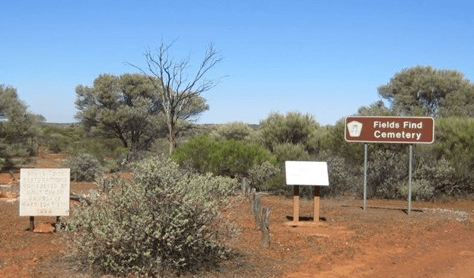
Coley Crane, a well-known Perth citizen, is interested in a very promising mining venture at Field’s Find. Recently he was showing a visitor round the ine and drew attention to the ore dump beneath the whim legs. “It is nice ore,” said Coley. “Ah well,” condoned the newcomer, “it all takes time, and while the improvised plant might be improved upon that will come in time; it will all come in time.”

“I don’t think,” said Coley, “you quite understood what I said – I remarked that this was a nice ore.” The visitor agreed, but continued: “But I wouldn’t worry about that. You’ll have everything spick and span later on.”

Coley was still puzzled. “I was referring,” he persisted, “to the quartz in the lump here.”

“Oh,” exclaimed the man from Perth, elucidation dawning upon him, “I thought you were referring to the superstructure and that you were saying it was an eye-sore!”

Field’s Find Cemetery, Yalgoo2

Sources

  1. ON THE SKYLINE (1933, January 8). Sunday Times (Perth, WA : 1902 – 1954), p. 9 (First Section). Retrieved November 2, 2024, from http://nla.gov.au/nla.news-article58671587 ↩︎
  2. Shire of Yalgoo, 2024. Image Gallery – Field’s Find. Retrieved November 2, 2024 from https://www.yalgoo.wa.gov.au/image-gallery/fields-find/35 ↩︎

Symonds or Simounds?

A group of people posing for a photo

Description automatically generated

This is a delightful wedding group, with the bride, Miss Maggie Symonds, wearing “…a pretty dress of white silk with point lace, a tulle veil, and a coronet of orange blossoms…the presents were both numerous and costly”. Some 80 guests partook of breakfast, then attended a ball in the evening at the Anaconda Hotel1, 2,3.

Less than a year before, Alfred Frederick Thompson, her new husband, the landlord at the Anaconda Hotel, was in custody, charged with unlawfully shooting and wounding John Clinton. He was acquitted – it was decided that he needed to protect himself with a revolver against some of his customers who were “attempting to take possession of the hotel”. This was definitely the Wild West, and one wonders if his bride was prepared for this behaviour, not uncommon, and including “outrages with dynamite” on the billiard hall and also the hotel4, 5, 6, 7, 8, 9.

Over time, Anaconda has been known by various names, including Eulaminna, Murrin and Murrin Murrin. Lots were originally surveyed in 1900 to serve the nearby Murrin Murrin Copper Mine that was known as the Anaconda Copper Mine at the time. By 1903 there were 64 residential lots and a population of about 350. A Police Station was also established in 1903 and the town boasted two hotels, two stores a chemist and a newsagent. A mail receiver was in place but no telegraph station.

Researchers – if this is your family, the bride’s name is misspelled – she is really Margaret Robina (or Rosina) Simounds. If you know more about this family, please let us know at ghostswa@fhwa.org.au.


Sources

  1. Kalgoorlie Western Argus, 1903. District News. Published 29 Sep 1903, p.12. Retrieved 23 Oct 2024 from https://trove.nla.gov.au/newspaper/article/32734679?searchTerm=Maggie%20Symonds ↩︎
  2. Kalgoorlie Miner, 1903. Wedding at Anaconda. Published 26 Sep 1903, p.4. Retrieved 23 Oct 2024 from https://trove.nla.gov.au/newspaper/article/88873557?searchTerm=Maggie%20Symonds ↩︎
  3.  Kalgoorlie Western Argus (WA : 1896 – 1916),(1903, October 20) Wedding Group, Anaconda, Murrin Murrin. Thompson-Symnonds. p. 23. Retrieved October 25, 2024, from http://nla.gov.au/nla.news-page4123379 ↩︎
  4. SHOOTING AFFRAY AT ANACONDA (1902, March 7). The Malcolm Chronicle and Leonora Advertiser (WA : 1897 – 1905), p. 3. Retrieved October 23, 2024, from http://nla.gov.au/nla.news-article228044349 ↩︎
  5. Shooting Affray. (1902, March 13). The Evening Star (Boulder, WA : 1898 – 1921), p. 3. Retrieved October 23, 2024, from http://nla.gov.au/nla.news-article203481548 ↩︎
  6. News of the Week. (1902, March 14). The Malcolm Chronicle and Leonora Advertiser (WA : 1897 – 1905), p. 2. Retrieved October 23, 2024, from http://nla.gov.au/nla.news-article228044368 ↩︎
  7. MALCOLM POLICE COURT. (1902, March 21). The Malcolm Chronicle and Leonora Advertiser (WA : 1897 – 1905), p. 3. Retrieved October 23, 2024, from http://nla.gov.au/nla.news-article228044382 ↩︎
  8. THE ANACONDA FRACAS. (1902, March 28). The Malcolm Chronicle and Leonora Advertiser (WA : 1897 – 1905), p. 2. Retrieved October 23, 2024, from http://nla.gov.au/nla.news-article228044400 ↩︎
  9. THE ANACONDA FRACAS. (1902, June 27). The Malcolm Chronicle and Leonora Advertiser (WA : 1897 – 1905), p. 3. Retrieved October 23, 2024, from http://nla.gov.au/nla.news-article228044723 ↩︎

Announcing Phase 2

On 23 October 2024, our team will start Phase 2 of the project. Following the completion of the Pilot Phase (Phase 1) on 30 September, the findings of the pilot were assessed and a report was submitted to the FamilyHistoryWA Management Committee recommending that the project proceed. This new phase of the project will add 15 new communities to the existing list of 4 communities that are being researched. Full details of the 15 new communities can be found here.

If you are interested in joining the project team, or if you have information about any of the communities on our list, please email ghostswa@fhwa.org.au.

Mr Stanley’s Opera Troupe

Cossack in 1886 was a frontier town in one of the most isolated colonies in the world.  It was a centre for pearling and pearl shell fishing and the entry point for pastoralists who established extensive stations.  By 1886 Cossack had a stone wharf and several other stone buildings such as the Post and Telegraph Office and a Mercantile Store, but not a lot of other substantial buildings. How did it attract an operatic performance by the most popular Opera Troupe of the decade?    

Perth loved Mr Stanley’s Opera Troupe. It played to huge audiences and received mostly glowing reviews.  The Railway employees took up a collection so they could present Mr and Mrs Stanley a gold ring and earrings as a token of their esteem and appreciation1. A Fremantle harbour official stole flowers, roses, and bouquets to bestow upon sundry members of Stanley’s Opera Troupe before they left Perth2. An ode of farewell to the players was written and published in the Perth news in October 18853.

Mr Stanley’s Opera Troupe and other itinerant theatre groups used the coastal steamers to travel around Australia4.  In early 1886, Mr Stanley was taking his Opera Troupe to Singapore and to get there travelled on a coastal steamer that called in at Champion Bay, Gascoyne, and Cossack before leaving Australia.  

Ever the entrepreneur, Mr Stanley used his time in port in Cossack to his advantage and had his Opera Troupe perform two shows at Roebourne before performing their last show in Cossack.   The Cossack show was a performance of Gilbert and Sullivan’s Pirates of Penzance and took place on Saturday 13 March 18865.

I have been unable to find a review of the Cossack performance of this opera, but when it was performed in Perth the previous October it received a review that said –

 The acting was very spirited, the costumes pretty, the children acquitted themselves admirably in their dancing, but the actors said their words very quickly, and some songs were ‘absolutely gabbled’.6

Image generated by DALL-E

Who was Mr Stanley and how did he get into show business? The only biography I can find of Harry Stanley was supplied by him to a Perth newspaper in 18857. His life had so many self-reported highlights and makes me wonder if he embellished his life story.  

Stanley was born in England but after a childhood supposedly touring Europe he joined the Royal Navy and served in the Crimean War. He came to Australia in the mid-1850s, worked on a steamship out of Melbourne before heading for the goldfields, where he was stuck up by the notorious bushranger Black Johnston. After failing to find his fortune, Stanley joined a Theatrical Troupe where he found success playing the character of Rob Roy. He moved from Troupe to Troupe, in various roles before forming his company and managing the Lyceum Theatre and Hotel in Sandhurst.

Stanley travelled to South Africa in 1870 with the American War Panorama Troupe but was unfortunately shipwrecked on the way. Luckily he saved the Panorama and just so happened to be on the diamond fields of Kimberley when they raised the British flag. Stanley was received by African presidents and kings during that trip. He spent time as a guest of the Nizam at Hyderabad and was asked to lecture on war to the Sikh regiments. Stanley then went to Burma, where he was presented with a medal from the King and subsequently travelled to Siam, where he stayed at the palaces of the kings.

Perhaps colourful renditions of life stories come with show business. After leaving Cossack it was reported that Mr Stanley was struck insensible by lightning for three hours while on deck of the SS Natal8. Fortunately, Stanley had recovered by the time he reached Singapore.

Stanley and his Opera Troupe seem to have spent the next few years performing in the East, visiting “the colonial port cities with large European populations where there was a high demand for the sort of shows he staged9.

Stanley returned to Australia to settle some business in 1896, but while in Newcastle his heart condition suddenly worsened, and he died (without a will). Stanley was nearly 60 years old10.   The Freemasons in Calcutta raised money for his wife and daughters to return to Australia.  Entertainments such as Mr Stanley’s Opera Troupe were facing competition from newer forms of entertainment such as roller skating.  The story of Harry Stanley and his Opera Troupe is a colourful one.  What other larger than life people’s stories are awaiting discovery in Western Australia’s Ghost Towns?


Sources
  1. Presentation to Mr and Mrs Stanley. The Inquirer and Commercial News, February 1886, p. 5. ↩︎
  2. Perth Local Court. Western Mail, 2 January 1886, p. 10. ↩︎
  3. Farewell to Stanley’s Opera Troupe. The Daily News, 6 November 1885, p. 3. ↩︎
  4. YU Elysia, 2020. Australian Itinerant Theatres as Colonial Cultural Assimilation https://www.tca.hku.hk/post/australian-itinerant-theatres-as-colonial-cultural-assimilation
    Accessed 20 March 2024. ↩︎
  5. Roebourne Letter. Western Mail, 13 March 1886, p. 16. ↩︎
  6. The Pirates of Penzance. The West Australian, 12 October 1885, p. 3. ↩︎
  7. Biography of Mr. Harry Stanley (1885, September 26). The Herald (Fremantle, WA : 1867 – 1886), p. 3. Retrieved April 13, 2024, from http://nla.gov.au/nla.news-article110070728 ↩︎
  8. Local. The West Australian 13 April 1886, p. 3 ↩︎
  9. YU Elysia, 2020. Australian Itinerant Theatres as Colonial Cultural Assimilation https://www.tca.hku.hk/post/australian-itinerant-theatres-as-colonial-cultural-assimilation. ↩︎
  10. Newcastle News. The Maitland Weekly Mercury, 2 May 1896, p. 5. ↩︎

Ghostly Scrabble

One of the most frequent questions that is asked is how do we decide what communities are included on our list of Ghost Towns. Other frequently asked questions are – how do you choose what towns to work on? and when will my favourite town be included? So I thought I might run through the process from start to finish to help everyone to understand what is going on in the background.

So we started at least eight months ago now, with a preliminary list of Ghost Towns that numbered about 250. It was only ever a starting point, but it was a great way to kick everything off. We created a master list that included, not only the name of the town, but any/all alternative names. Some of the towns only ever had one name (as far as we know) but others have, over time, been known by two, three, four or even five different names. The main name for a community is known as Primary, while all the rest are known as Secondary.

A couple of great examples of this are included in our Pilot. Cossack was originally known as Tien Tsin, and by the traditional name of Bajinhurrba. In some records it is recorded as Tien Tsin Harbour or Butcher’s Inlet. And other records talk about the Lazarette (the Cossack Leprosarium). Goongarrie was originally called 90 Mile or Ninety Mile, as well as Roaring Gimlet and sometimes called Canegrass or Canegrass Swamp. When we are researching Cossack and Goongarrie, we have to also research all of the alternative names to make certain we don’t miss anyone. So the original list of 250 grew very quickly to 500 or more. Once we launched the Facebook group and started to get media coverage we received lots more leads, so that, by the time the Pilot started to actually collect data the list was nearing 700.

We chose the first four communities that are part of the Pilot early on. They were chosen because they represent a cross section of the types of community that will be found in the full list. But the question now arose – How do we decide the order in which we will proceed through the list? We needed to come up with a process that spread the workload evenly and was not influenced by any indivduals personal preference for any of the towns.

Step 1 – estimating how much work might be involved in processing any particular town on the list.

For this we turned to the State Records Office of Western Australia. SRO’s archives contain records of much of the life and history of our State, including our Ghost Towns. So we did a search on their site to determine how many records would be involved in researching each of the communities on our Master List. Of course, this won’t be the only place where we will be researching, but it gave us an idea of how big or small the task might be.

The tasks were ranked as High – more than 200 records, Medium – between 76 and 199 records, Low – between 26 and 75 records, and Small – less than 25 records. To spread the workload, we made the decision that each phase of the project would include:

  • High – 1 communities
  • Medium – 2 communities
  • Low – 4 to 6 communities
  • Small – 6 or more communities
Step 2 – Determining the order in which the communities will be processed

And now the fun starts. How do you choose the communities for each phase without fear or favour. We considered pulling names out of a hat, but then we came up with a fun game that made a very long, potentially tedious, task become fun – Scrabble tiles (just 26 tiles, no duplicates).

Starting with the list of High Primaries, we drew the first tile. G. And just like that we had the first town for Phase 2 – Gwalia. Putting the G back into the bag, we filtered the list so that we had Medium Primaries. Then we drew two tiles – B and E. And so it went all the way through the list until every community was prioritised. It took several days, but by the end we had a prioritised list.

New communities being added to the list

Since that was done nearly 100 more communities have been suggested to be added to the project. These will be considered by the Project Board and, if suitable, will be added to the prioritised list. Of course, the pressure is off as they will, of course, be added to the latest phases of the project.

Right now, we are working on the Pilot and it is going very well.

And, let me be the first to thank our wonderful Volunteers. You guys rock!