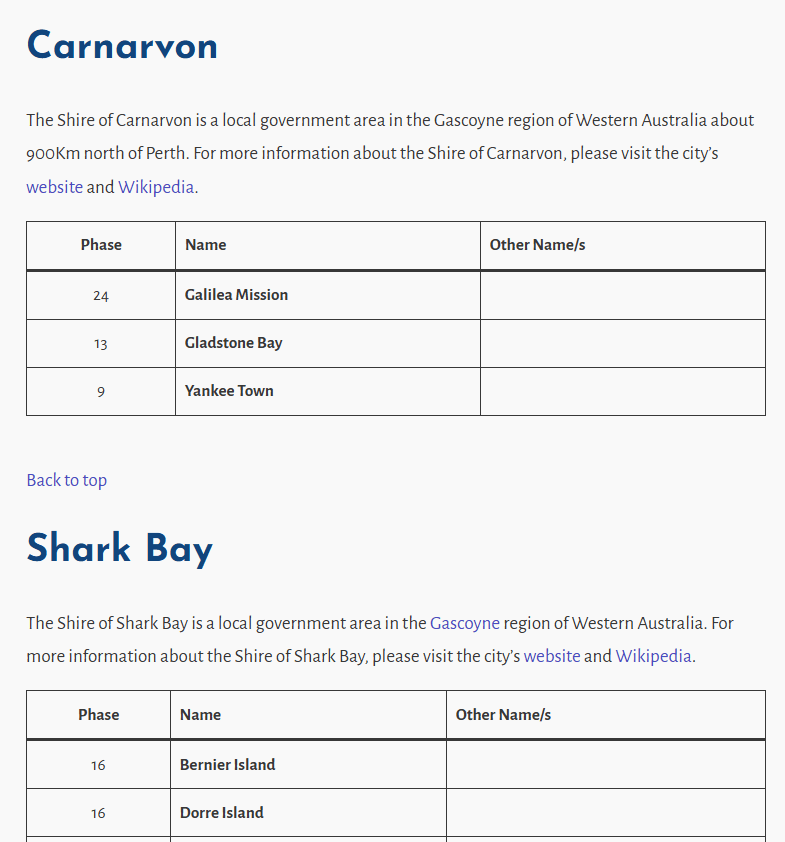
Here on our website we have a great resource called WA’s Ghost Towns by Location. This document lists all communities included in our project (to date) by Administrative Region and Local Government Authority. At the bottom of the list, you can find a list of communities that are still being researched.
If you are planning a road trip and want to visit some Ghost Towns on the way, you can search by region or by shire name and find what is around you.
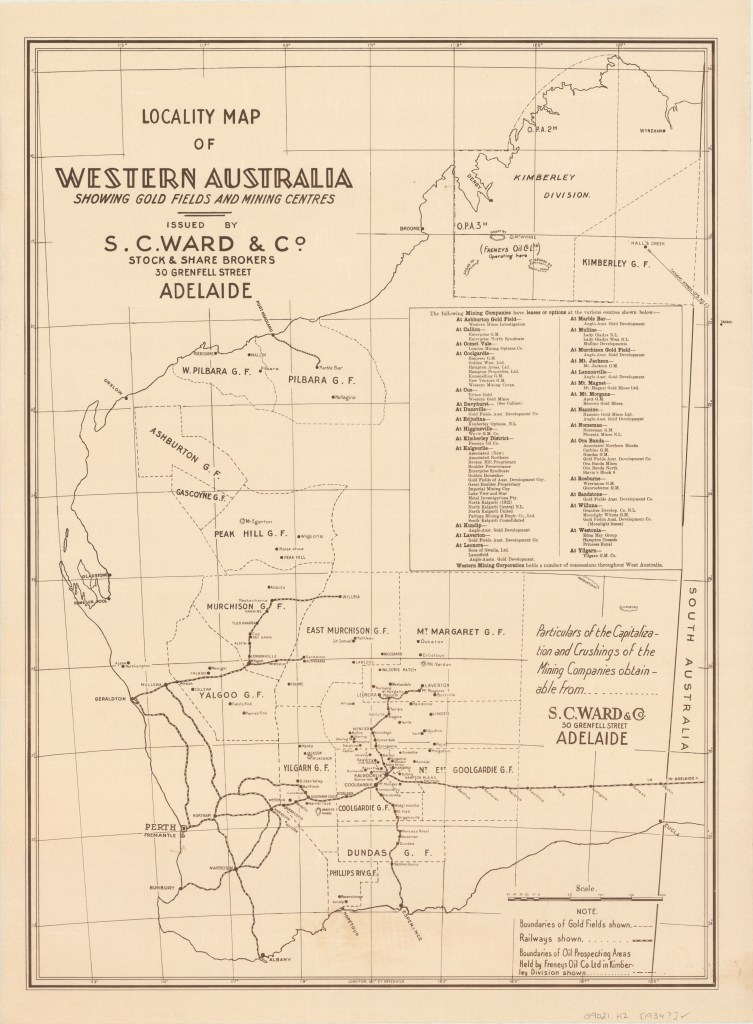
If you want a view of how things looked a century ago, here’s a map of Western Australia by Locality produced in 1934.
S.C. Ward & Co., issuing body. (1934). Locality map of Western Australia showing gold fields and mining centres Retrieved March 22, 2026, from http://nla.gov.au/nla.obj-1485547591
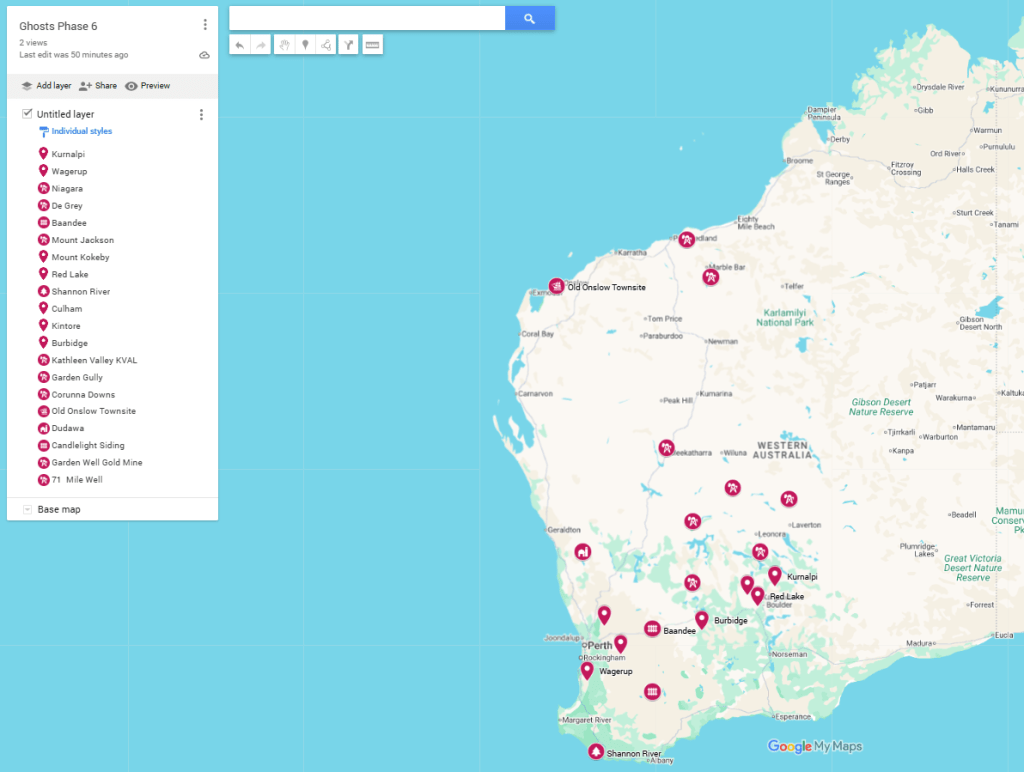
1 March 2026 is the launch of Phase 6 of the project and 20 new ghost communities have been added to the list of towns that are being actively researched.
If you know anything more about any of these places, or any others on our please, please contact us via our contact page. And if you find anything that you think is incorrect on any of our pages, we need to know!!
And don’t forget to subscribe to this page to receive updates on the project.
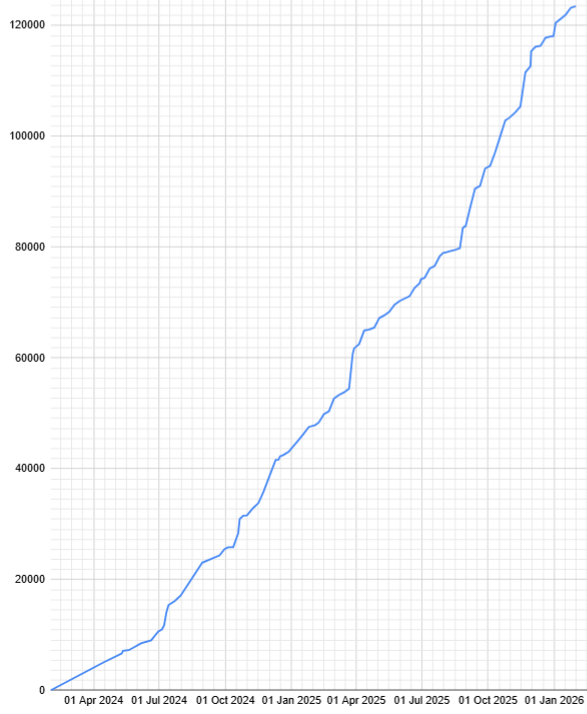
The total number of records captured as at 31 January 2026 was 123,471. Now that the very typical slow down over the festive season is past we will be seeing the also very typical ramp up in number of records collected. Congratulations to the project team who are working so hard to make this project great!!
Since the end of November, we have added about 40 new communities to the list of captured records – ranging (alphabetically) from Barrow Island to Yule River, and spread geographically all over our state.
As you can see from the list below, some of the record numbers are very low. This happens when we are researching one community and come across records for another community that is on our list. We capture the strays as we go along because we don’t want to miss anything!!
Once our website and search engine is fully operational you will be able to access some of these records. Here are the latest figures followed by a simple line graph showing the growth in total numbers:
The Nallan Wood Strike of 1908 was a significant three-month industrial dispute in the Murchison goldfields of Western Australia that brought the massive Great Fingall mine to a complete standstill. Triggered by demands for increased wood-cutting rates, the strike highlighted deep-seated grievances among a culturally diverse workforce and underscored the critical dependence of the mining industry on wood fuel for its operations.1
The Tinderbox
The conflict was rooted in deteriorating working conditions and economic frustrations that had been building for years. By 1908, woodcutters—who were predominantly of Italian and South European descent—faced increasingly difficult labor for stagnant or diminishing returns.
Key factors included:
“Cleaning Out” Policies: Employers shifted from allowing “picking” (selective cutting) to requiring “cleaning out,” where workers had to clear entire areas. This forced cutters to spend hours on difficult, low-yield “snags” for very little pay.
Weighing and Payment Disputes: Cutters were paid by weight, but wood was often left on the line for months to dry. As the wood lost moisture, its weight decreased, directly reducing the workers’ earnings.
Failure of Arbitration: A 1904 Arbitration Court award had notoriously sided with employers, suggesting that wages were already too high and even recommending reductions. This left workers with a deep distrust of the legal arbitration system.
Resource Monopolies: Mining companies and firewood suppliers jointly controlled access to wood and water on Crown land, leaving cutters with little leverage outside of direct action.
The Standstill
The strike at Nallan began in late 1908, with cutters demanding higher rates for their labor. The impact on the local economy was immediate and severe, particularly for the townsite of Day Dawn, which was almost entirely dependent on the Great Fingall Mine.23
When the firewood supply was cut off, the Great Fingall management announced the mine would close down at 8:00 AM on Tuesday, November 17, 1908. This decision rendered approximately 500 men idle, throwing the community into a state of “disquietude”. While the mine staff and a few maintenance workers were retained, the bulk of the workforce was forced to leave town or wait for a resolution.4
Business circles in Day Dawn expressed considerable disappointment as the strike dragged on, with rumors of settlements repeatedly proving false. The mine management refused to restart operations until enough wood was stacked on the lease to guarantee several weeks of continuous work.
The Intervention
As the strike became an “industrial disaster,” various levels of government were forced to intervene.
Law Enforcement: Police presence was heavy. Inspector Sellinger was stationed in readiness with 25 police officers, many of them mounted, to handle impending trouble. In a move described as a “harsh suppression,” six Italian strikers were arrested at Nallan. They were initially refused bail by the Warden and were only released by an order from the Supreme Court.56
Government Arbitration: Warden Troy was appointed as an arbitrator and spent days taking “voluminous evidence” from both sides. Additionally, Premier Newton Moore became personally involved, suggesting a settlement based on a daily wage of 12s and a 25% limit on contract labor.78
Local Representation: Mr. Lewis, the Mayor of Day Dawn, and Mr. E. E. Heitmann, MLA, petitioned the Premier to enforce agreements with the Firewood Company to prevent a total collapse of the district’s economy. Heitmann notably argued that the company was not acting in good faith, withdrawing offers just as settlements appeared likely.9
The Resolution
The strike was characterized by a tug-of-war between the Firewood Company, which wanted to adhere to the Warden’s original award, and the workers, who sought a slight increase of approximately 1d per ton or a shift to a daily wage.1011
The dispute eventually reached a settlement prospect in November 1908, with a proposed rate of 12s 1d per day for cutters. This was part of a broader shift where woodcutters began to reject the “red tape” of the Arbitration Court in favor of direct bargaining and strike action.1213
The Aftermath
The aftermath of the Nallan Wood Strike had lasting implications:
Militancy and Recognition: The success of the “foreign element” in standing up to the powerful Chamber of Mines earned them new respect within the wider Labor movement.14
Judicial Precedent: The harsh sentences handed down to strikers—including hard labor for leaders—were intended by magistrates like John Michael Finnerty to “impress upon the foreigners” the necessity of following British law.15
Unionization: Within a few years, woodcutters were integrated into the formal trade union movement, ending their previous isolation from the mine workforce.16
The Nallan Wood Strike serves as a stark reminder of the fragile balance of the early 20th-century goldfields, where a handful of woodcutters could bring a global mining giant to its knees in their quest for industrial justice.
Nallan Wood Strike. (1908, November 24). The Murchison Times and Day Dawn Gazette (Cue, WA : 1894 – 1925), p. 2. Retrieved January 25, 2026, from http://nla.gov.au/nla.news-article233449382↩︎
Nallan Wood Strike. (1908, November 24). The Murchison Times and Day Dawn Gazette (Cue, WA : 1894 – 1925), p. 2. Retrieved January 25, 2026, from http://nla.gov.au/nla.news-article233449382↩︎
The People of Western Australia’s Ghost Towns project team are pleased to announce the launch of Phase 5 on 7 December 2025. Phase 5 will add 19 new communities to those already in progress.
Click on the name of the town to find out what we know about it – so far. Our research continues and we will be keeping all our content up to date with our latest discoveries!
Do you know anything about any of these communities? Do you have pictures, stories, documents, records of any type? Please let us know via the comments panel.
The total number of records captured during the month of November, 2025 was 11,984 – that’s our best month since the project started. Congratulations to the project team who are working so hard to make this project great!!
The list of captured records now includes ten new communities for which we have found people who are now part of the permanent dataset. These communities are Austin plus The Island Lake Austin, Balkuling, Bila Railway Siding, Haig, Harris, Jindong, Lennox, Old Onslow, and Yaloginda.
As you can see from the list below, some of the record numbers are very low. This happens when we are researching one community and come across records for another community that is on our list. We capture the strays as we go along because we don’t want to miss anything!!
Once our website and search engine is fully operational you will be able to access some of these records. Here are the latest figures followed by a simple line graph showing the growth in total numbers:
First of all, an apology. Due to a number of circumstances, we did not publish our statistical report as at 30 Sep 2025. So this report covers our progress for the two months since 31 August 2025.
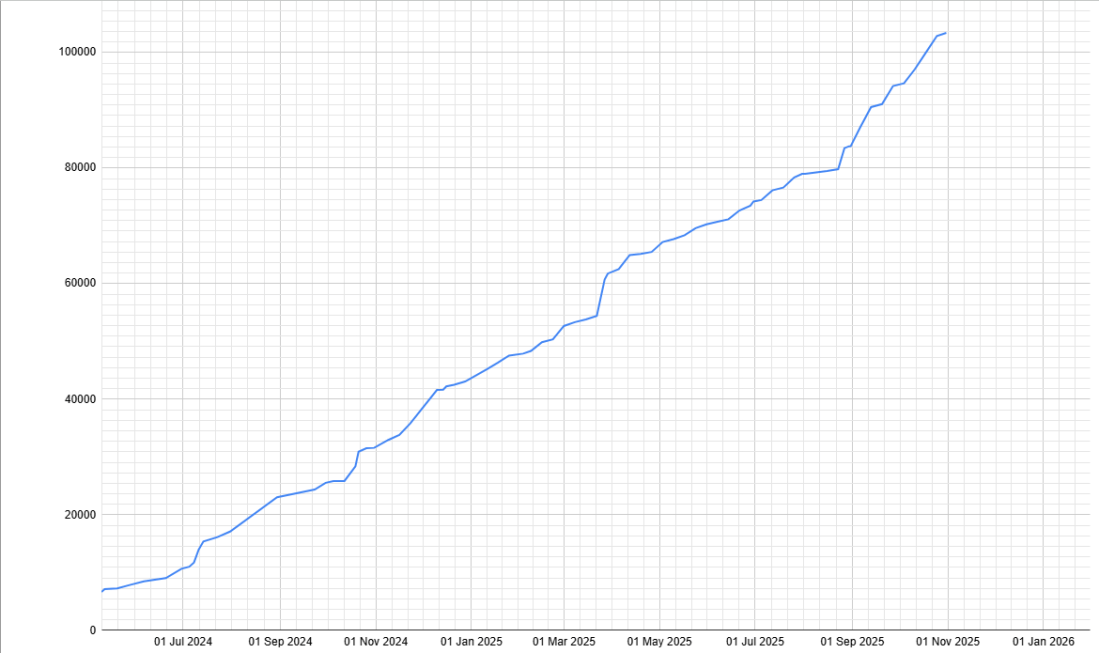
As previously announced during the month of October, we reach the major milestone of 100,000 records captured by our team. Congratulations to all project team members for a magnificent effort.
The total records captured up to 31 October 2025 is 103,384. During the past two months, about 30 communities have been added to the list of those communities who have any records captured. These new communities are highlighted in the list below.
As at 31 Oct 2025, our Master List shows we have identified 617 ghost towns, plus 833 alternative names relating to 396 of the 617 towns. Our task means that we research and record people associated with all 1,450 of those town names.
Our project team are working hard to capture as many records as possible of the people in WA’s ghost communities. Once our website and search engine is fully operational you will be able to access some of these records. Here are the latest figures followed by a simple line graph showing the growth in total numbers:
Recorded as Bandee in error. This will be corrected to Baandee in the future. ↩︎
More recent research requires a re-examination of these records. They will be updated once the differentiation between the Lazarettes at Cossack and Derby is fully understood. ↩︎
These records relate to Ferguson Mill school/s. Unable to determine which location. ↩︎
Recorded as North Bandee in error. This will be corrected to North Baandee in the future. ↩︎
Every town or district has its quirks, and often the name carries a story of its own. In the case of Dattening—sometimes mistakenly called Taylor’s Well—the history lingers in the words people still use. Here’s how that tangle came to be, shared by a correspondent of the time: 1
Most readers are wondering where “Dattening” is, writes a correspondent. Well it is erroneously known as “Taylor’s Well.”
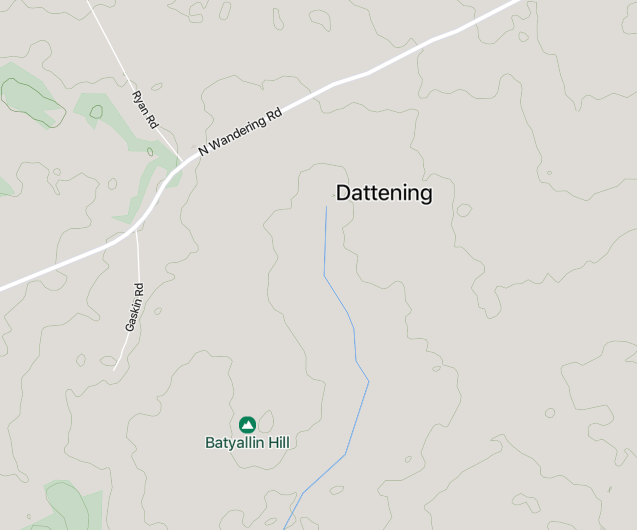
There’s such a tangle here that a word of explanation would not be out of place. Look on the map 2; the place is named “Dattening,” and Dattening is the real name.
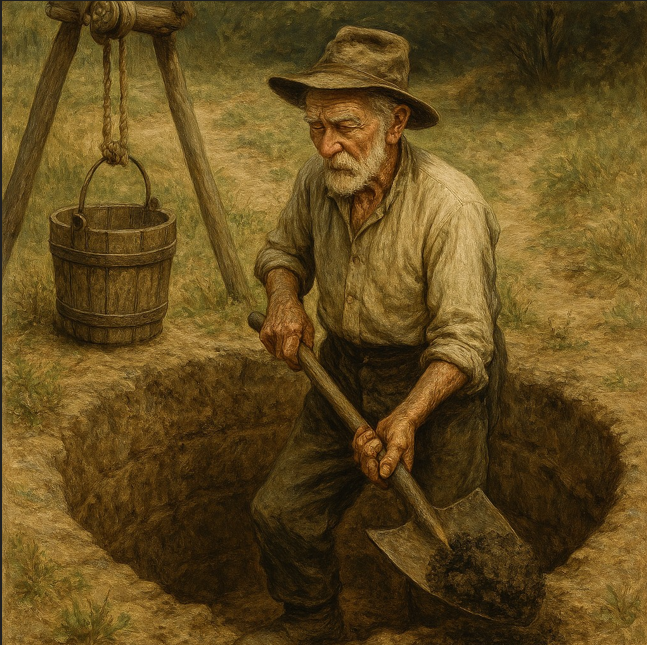
How it came to be called “Taylor’s Well” is thus. Years ago, old Norry Taylor dug a well there for use when travelling stock, and it was a real tip top supply of fresh water, and in those days, before much clearing was done, water was not too plentiful so the early pioneers used to cart their supply of “Adam’s Ale” from the well, and as they went to “Ole Norry Taylor’s Well” to get it, gradually became known as Taylor’s Well.
However, the post office and the telephone exchange are known as “Dattening,” it behoves you to get used to calling it “Dattening.”
Dattening, Western Australia [cartographic material] / prepared under the direction of the Surveyor General, Department of Lands and Surveys, Western Australia. Retrieved August 27, 2025, from https://catalogue.nla.gov.au/catalog/5786516↩︎
The total records captured up to 31 July 2025 is 83,781. During the past month, the communities of Argyle (and Argyle Police Station), Boogardie, Craiggiemore, Derdebin, Howatharra, Kwelkan, Lancefield, Merilup, Noman’s Lake, Shay Gap, Stratherne, Sunday Island Mission, Tardun, Trafalgar, Ullaring, White Well, Wittenoom and Yarri have found their way into our captured list.
Our project team are working hard to capture as many records as possible of the people in WA’s ghost communities. Once our website and search engine is fully operational you will be able to access some of these records. Here are the latest figures followed by a simple line graph showing the growth in total numbers:
Quick Tip: to quickly see if your favourite ghost town is already in this list, press CTRL+f [find].
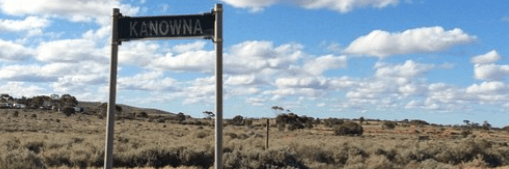
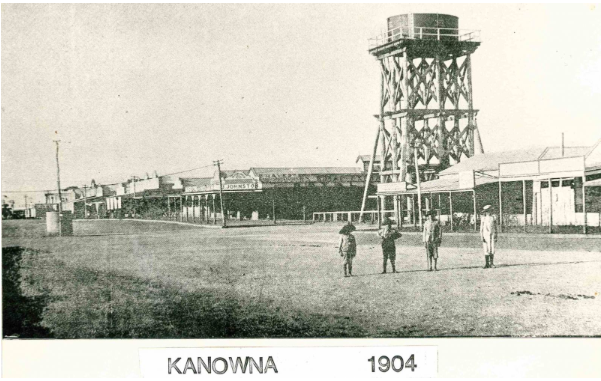
On Friday 29 August, 2025, we will move into Phase 4 of our project and that adds 16 new communities to the list of communities on which we are already working. The biggest community in this phase is Kanowna. If you have any information about these communities, or any of the communities on our master list, please contact us.
Image from our project partner Eastern Goldfields Historical Society
The new 16 in alphabetical order
4 Mile (Leonora)
Bootenal (aka Boolungu, Bootanoo, Bootanu and the Bootenal Railway Siding)
Buldania
Coonara (aka the Coonara Railway Siding)
Gabanintha
Gums (aka The Gums)
Hawks Nest (aka Hawk’s Nest, Hawkes Nest and the Hawkes Nest Gold Mine)
Jibberding
Jitarning (aka Geetaring)
Kanowna (aka White Feather and Cement Workings)
Kodj Kodjin (aka North Baandee)
Londonderry (aka Golden Hole Mine)
Pilbarra (aka Pilbarra Creek, Pilbarra Pool, Yandeyarra Hotel and Yule River, but NOT Pilbara)
Pingarning
Plavins (aka Plavins Timber Mill and Plavins Railway Siding)
Woolgar (aka Yundaga, Yundagga, Yunndaga and Yunndega)
Previous phases have covered the following communities:




 People of Western Australia's Ghost Towns