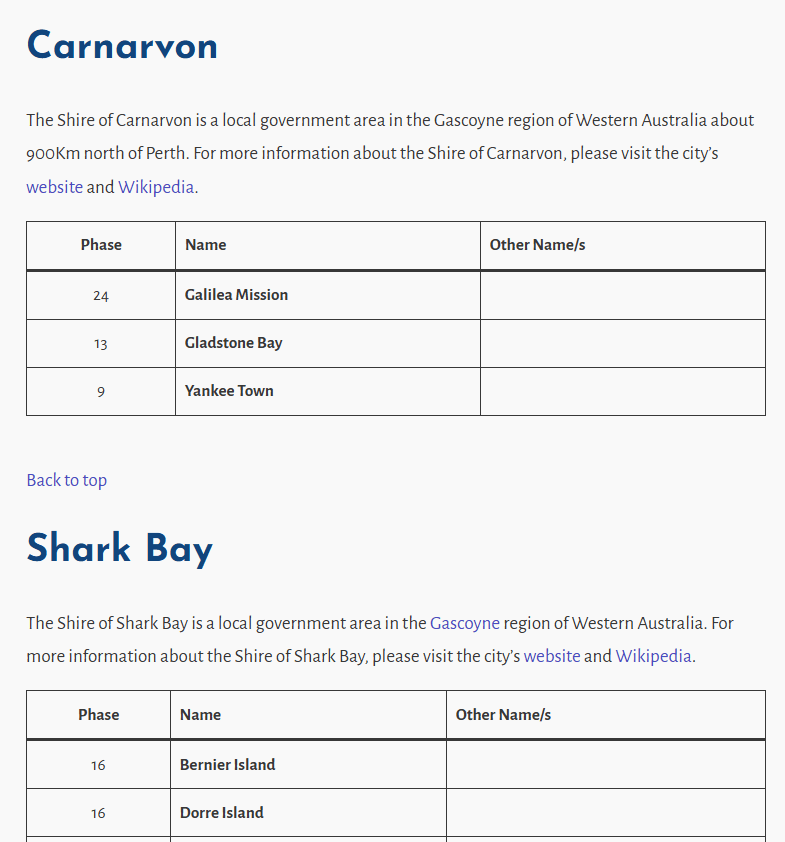
Here on our website we have a great resource called WA’s Ghost Towns by Location. This document lists all communities included in our project (to date) by Administrative Region and Local Government Authority. At the bottom of the list, you can find a list of communities that are still being researched.
If you are planning a road trip and want to visit some Ghost Towns on the way, you can search by region or by shire name and find what is around you.
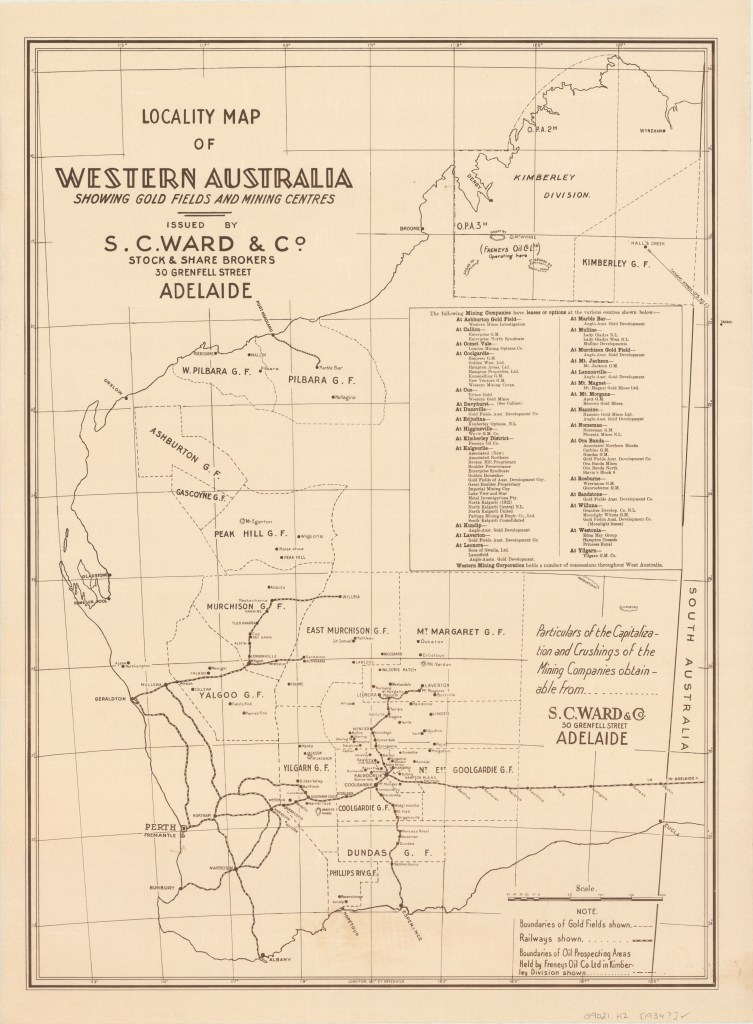
If you want a view of how things looked a century ago, here’s a map of Western Australia by Locality produced in 1934.
S.C. Ward & Co., issuing body. (1934). Locality map of Western Australia showing gold fields and mining centres Retrieved March 22, 2026, from http://nla.gov.au/nla.obj-1485547591
In the mid-1890s, the Murchison goldfields of Western Australia were a landscape of frantic industry and hope. However, in March 1896, the mining community of Lennonville, near Mount Magnet, was struck by tragedy at the New Chum Mine. What began as a typical shift ended in a “phenomenally heavy” storm that claimed the lives of three men and left a community in mourning.23
The disaster unfolded on a Tuesday afternoon when a violent storm broke over the district. The mine, which lacked adequate surface drainage and sat in the direct course of a natural water flow, was defenceless. Within just fifteen minutes of the rain starting, a torrent poured down the main shaft. The water rose an incredible 60 to 80 feet in less than an hour, extinguishing the boiler fires and stopping the engines.4
At the time, six men were working underground. On the No. 3 level, the lowest part of the mine, George Henderson and his mate William Campbell were suddenly engulfed. In a desperate bid for life, Henderson managed to climb the sets through “torrents of water” to reach the No. 2 level. Exhausted and battered, he survived, but Campbell was not so fortunate; he failed in his attempt and fell back into the rapidly rising floodwaters. Meanwhile, at the No. 2 level, Arthur Daniels and Roger Cook rushed for the cage, but it was not there. Whether the cage had been raised prematurely or had fallen, the two men stepped into the void and fell to the No. 3 level, where they drowned.5678
The three victims were all men from the eastern colonies who had come to the Murchison seeking their fortunes. Roger Cook (also referred to as Arthur or Bolger Cook) was the only married man of the three, leaving behind a wife and children in Newcastle, New South Wales. William Campbell hailed from Mittagong, New South Wales. Arthur Daniels was from Linton, near Ballarat in Victoria. He had only recently arrived on the goldfields with his brother who was in Cue at the time and tragically learned of his sibling’s death only after reading the local newspaper.910
The aftermath was a grim, 48-hour operation of constant pumping and baling to recover the bodies. When the water was finally lowered, the miners were found “earthed up” by the debris. A coroner’s inquest, held by Mr Raymond Gee, J.P., eventually returned a verdict of accidental drowning, or “misadventure,” clearing the management of legal fault. However, the disaster sparked significant local comment regarding mine safety, particularly as the Inspector of Mines, Frank Reed, noted he had previously warned that the requirements of the Mines Regulation Act “must be carried out”.11
The victims were interred at the Mount Magnet cemetery. Their funeral was a somber affair, attended by over 300 residents and fellow miners, reflecting the deep “gloom” that the disaster had cast over the entire Murchison district.12
Sources
Editor’s note: There are more than 650 newspapers reports in Trove of the New Chum Mining Disaster.
FATAL ACCIDENT AT THE NEW CHUM MINE. (1896, March 21). The Murchison Times and Day Dawn Gazette (Cue, WA : 1894 – 1925), p. 3. Retrieved March 17, 2026, from http://nla.gov.au/nla.news-article233239175↩︎
ACCIDENT AT THE NEW CHUM MINE, MURCHISON. (1896, March 28). Northern Public Opinion and Mining and Pastoral News (Roebourne, WA : 1894 – 1902), p. 3. Retrieved March 17, 2026, from http://nla.gov.au/nla.news-article255734266↩︎
mindat.org (n.d.) New Chum Gold Mine, Boogardie Goldfield, Mount Magnet, Mount Magnet Shire, Western Australia, Australia. Retrieved 17 Mar 2026 from https://www.mindat.org/loc-264772.html↩︎
FATAL ACCIDENT AT THE NEW CHUM MINE. (1896, March 21). The Murchison Times and Day Dawn Gazette (Cue, WA : 1894 – 1925), p. 3. Retrieved March 17, 2026, from http://nla.gov.au/nla.news-article233239175↩︎
MOUNT MAGNET MINING ACCIDENT. (1896, March 27). The Inquirer and Commercial News (Perth, WA : 1855 – 1901), p. 4. Retrieved March 17, 2026, from http://nla.gov.au/nla.news-article72378881↩︎
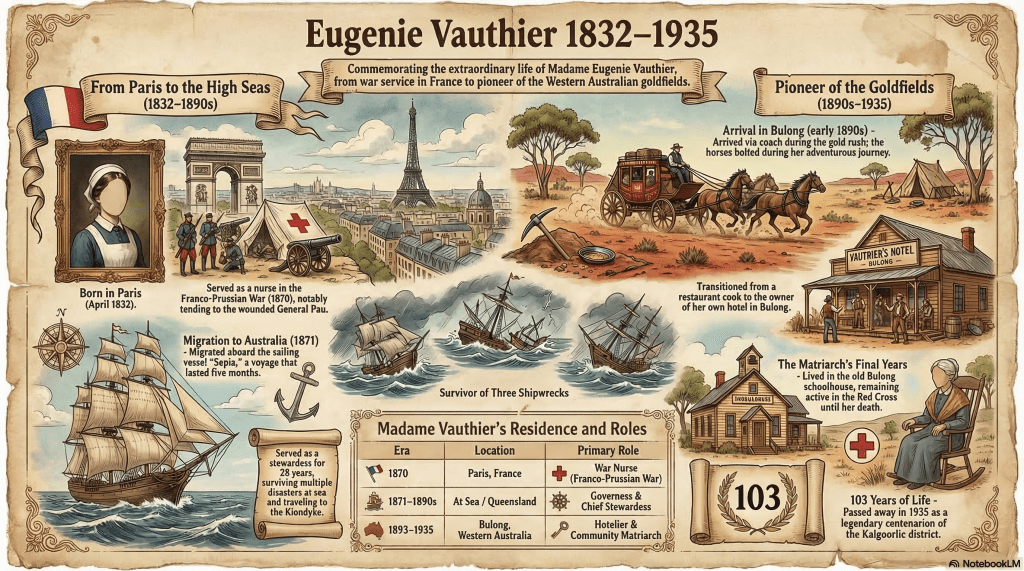
Infographic generated using NotebookLM Christine Harris 2026
Madame Eugenie Vauthier, a remarkable woman whose life spanned more than a century and two continents, passed away in Kalgoorlie just before Christmas in 1935.1 Born in Paris, likely in the early 1830s, she was educated at the Sisters of Mercy in her home city.2 Her family history was marked by a sudden tragedy in 1870 when both her father, Joseph Vauthier, and her mother died within the same week. Despite this personal loss, she remained in Paris during the Franco-Prussian War, where she witnessed the harrowing Siege of Paris. During this conflict, she served as an army nurse, tending to casualties including a then-humble soldier who would later become the eminent General Pau. She is noted to have nursed him when he famously lost his arm.34
Following the conclusion of the war, she sought a new life and sailed for Australia in 1871. The journey aboard the sailing vessel Sepia was an arduous one, taking five months to reach its destination. Upon her arrival, she migrated to Queensland, where she found employment as a governess at a station homestead in Port Mackay for five years. This role preceded a long and adventurous career at sea. For twenty-eight years, she worked as a stewardess for the A.U.S.N. company, serving on coastal steamers that plied the waters between Sydney, Brisbane, and Melbourne. Her life as a mariner was not without peril, as she survived three separate shipwrecks. She took great pride in this vocation; even in her final days in the hospital, she kept near her a perfectly preserved jacket she had worn as a chief stewardess, adorned with dozens of bright buttons and gaudy braid. Furthermore, her travels took her far beyond Australian shores, including a voyage from Sydney to the Klondyke during the height of the gold rush.56
The discovery of gold at Coolgardie in the early 1890s eventually drew her footsteps toward Western Australia. Her arrival in the West was brief; she reportedly spent only a single hour in Perth and never returned to the capital city again. She moved almost immediately to Bulong, which at that time was a prosperous alluvial field. The trip to the goldfields was not without incident, as the horses drawing her coach bolted during the journey. Once settled in Bulong, she initially worked as a cook at a local restaurant. She eventually acquired and maintained the Globe Hotel until the district’s mining industry began to decline.78
Madame Vauthier spent the remainder of her long life in Bulong, eventually moving into the town’s old schoolhouse, which she purchased from the Education Department. Despite her advancing years, she remained exceptionally active well into her nineties. She spent her time tending to a garden and a flock of fowls, even carrying the water needed for her vegetables and fruit trees from a nearby dam in tins. Her longevity was attributed to a simple life and a diet that prominently featured fruit, particularly bananas. Even at the age of one hundred, she continued to use a treadle sewing machine and retained her sight, hearing, and memory. Throughout her decades on the goldfields, she remained a staunch supporter of Great Britain and was a keen worker for the Red Cross during the Great War.91011
Sources
PERTH (1936, January 11). The Australasian (Melbourne, Vic. : 1864 – 1946), p. 9 (METROPOLITAN EDITION). Retrieved March 14, 2026, from http://nla.gov.au/nla.news-article141768020↩︎
PERTH (1936, January 11). The Australasian (Melbourne, Vic. : 1864 – 1946), p. 9 (METROPOLITAN EDITION). Retrieved March 14, 2026, from http://nla.gov.au/nla.news-article141768020↩︎
Woman of 104 Who Nursed General Pau in Franco-Prussian War Lies Dying in Hospital (1935, December 26). The Telegraph (Brisbane, Qld. : 1872 – 1947), p. 13 (LATEST FINAL CABLES). Retrieved March 14, 2026, from http://nla.gov.au/nla.news-article179943054↩︎
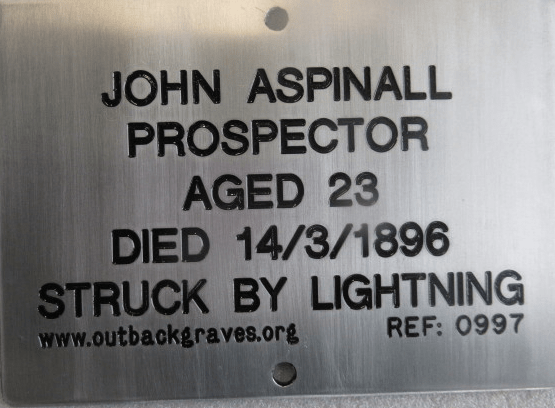
On this day in 1896, John Aspinall was struck by lightning at his camp at Hawk’s Nest.123
For those with an interest in Australian genealogy and colonial history, the late 19th century represents a period of feverish movement and profound personal sacrifice. While the history books often focus on the vast wealth extracted from the earth, the true story of the gold rushes is found in the “lonely graves” scattered across the arid interior. One such story is that of John “Johnny” Aspinall, a young New Zealander whose life and meticulously kept diary provide a poignant window into the hardships of 1896.456
Born in 1873 at Skippers Point, Otago, Johnny was no stranger to the mining life. His father, also named John, was an English prospector who had sought fortune in Bendigo before settling in New Zealand’s rugged mountains. Johnny was one of nine children, growing up in a household where gold and grit were daily realities. Following his father’s death in 1890, Johnny and his brothers worked the family claim before the allure of the Western Australian “Great Boom” beckoned.
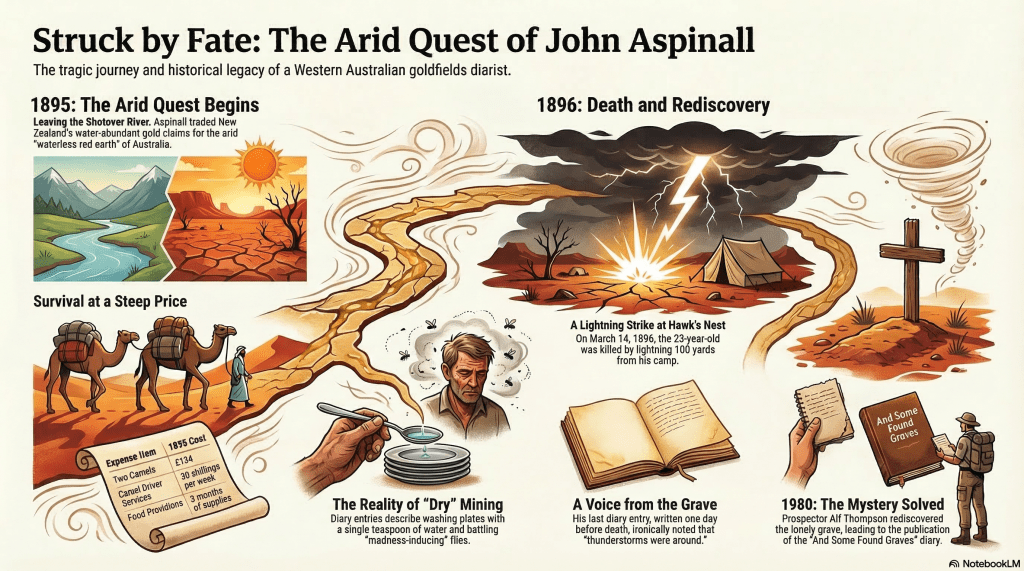
Leaving New Zealand in February 1895, Johnny’s journey to the West was a series of arduous legs. After arriving in Fremantle via Melbourne and Adelaide, he boarded a crowded train to Southern Cross—a seventeen-hour trip where refreshments consisted of “tough” chops served “bush style”. By late March, he had reached Coolgardie, then the bustling heart of the goldfields.
Infographic created using NotebookLM Christine Harris (2026)
To traverse the unforgiving landscape, Johnny demonstrated the practical resourcefulness common to successful prospectors of the era. He concluded a deal with Gunny Khan for two Australian-bred camels at the significant price of £134, noting they were hardier than other breeds. Accompanied by an Afghan driver named Amzula, he set out for the northern fields, documenting his observations of the “foreign” character of Perth and the daily battles with heat, flies, and water scarcity. His diary captures the desperation of the time, including instances of using a mere teaspoon of water to wash a plate and the omnipresent threat of typhoid.
While Johnny was pursuing his “golden quest” in the West, the broader Australian colonies were in a state of constant flux. In Queensland, the Warwick Argus reported on everything from earthquake shocks in Cairns to the introduction of typewriters in Sydney police courts to facilitate the taking of depositions. This was a world transitioning into modernity, yet Johnny remained at the mercy of the elements.7
Tragedy struck in March 1896 at Hawks Nest, near Laverton. On the 14th of March, Johnny’s body was discovered just 100 yards from his camp. The scene was harrowing: he was lying on his face with his clothes partially ripped away and one boot missing. An investigation by Constable Bradley of Menzies confirmed the cause of death was a lightning strike. In a cruel twist of historical irony, Johnny’s final diary entry, dated the 13th of March, mentioned that thunderstorms were in the area.89
For nearly a century, Johnny’s story remained buried with him in the red dust. It was not until February 1980 that prospector Alf Thompson rediscovered the grave and its fading inscription: “Sacred to the memory of JOHN ASPINALL… Gone but not forgotten”. Through Thompson’s “detective work,” contact was made with the Aspinall family in New Zealand, leading to the publication of Johnny’s diary under the title And Some Found Graves. Today, Johnny’s legacy endures as a vital primary source for historians, reminding us of the thousands who sought a future in the goldfields but found only a quiet, nameless rest.
NEWS of the WEEK. (1896, April 11). The Western Australian Goldfields Courier (Coolgardie, WA : 1894 – 1898), p. 8. Retrieved March 7, 2026, from http://nla.gov.au/nla.news-article253054912↩︎
NEWS of the WEEK. (1896, April 11). The Western Australian Goldfields Courier (Coolgardie, WA : 1894 – 1898), p. 8. Retrieved March 15, 2026, from http://nla.gov.au/nla.news-article253054912↩︎
In the dusty heart of the North Eastern Goldfields, 1896 was a year defined by gold fever and a volatile “wild west” atmosphere. While Niagara is often remembered for its unique four-corner hotels and the ambitious Niagara Dam, new archival reports from the Kalgoorlie Miner1 reveal a darker side to the settlement: a chilling account of frontier justice and a near-lynching.
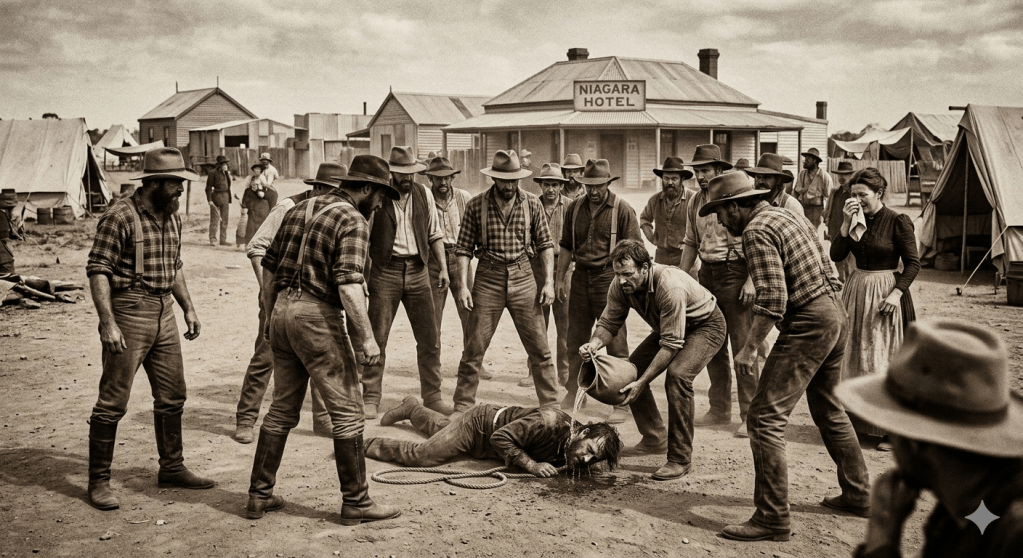
In May 1896, the town was “periodically given over to the mob” due to a complete lack of police protection. The tension boiled over when a “scoundrel” attempted to break into a local barmaid’s bedroom. When a bystander intervened, the intruder began hurlng bottles with “terrific force”. One bottle shattered against a door, sending a fragment into the barmaid’s eye; a doctor later confirmed the eye would be lost.
The community’s reaction was swift and brutal. A mob seized the man, placing a rope around his neck in a determined attempt to strangle him. The only thing that saved the perpetrator from a full lynching was a lack of a suitable place to suspend the rope. Instead, the crowd turned to physical violence, kicking the man nearly to death. In a final act of cruelty, one onlooker forced water down the victim’s throat to prove he was feigning death rather than actually deceased.
This incident highlights the raw, ungoverned nature of Niagara before formal law was established. With the Menzies police taking no action and no local arrests made, the town was left to its own devices. Such stories of “bush justice” provide a haunting layer to the history of this now-abandoned ghost town, proving that life in the goldfields was as dangerous as it was potentially lucrative.
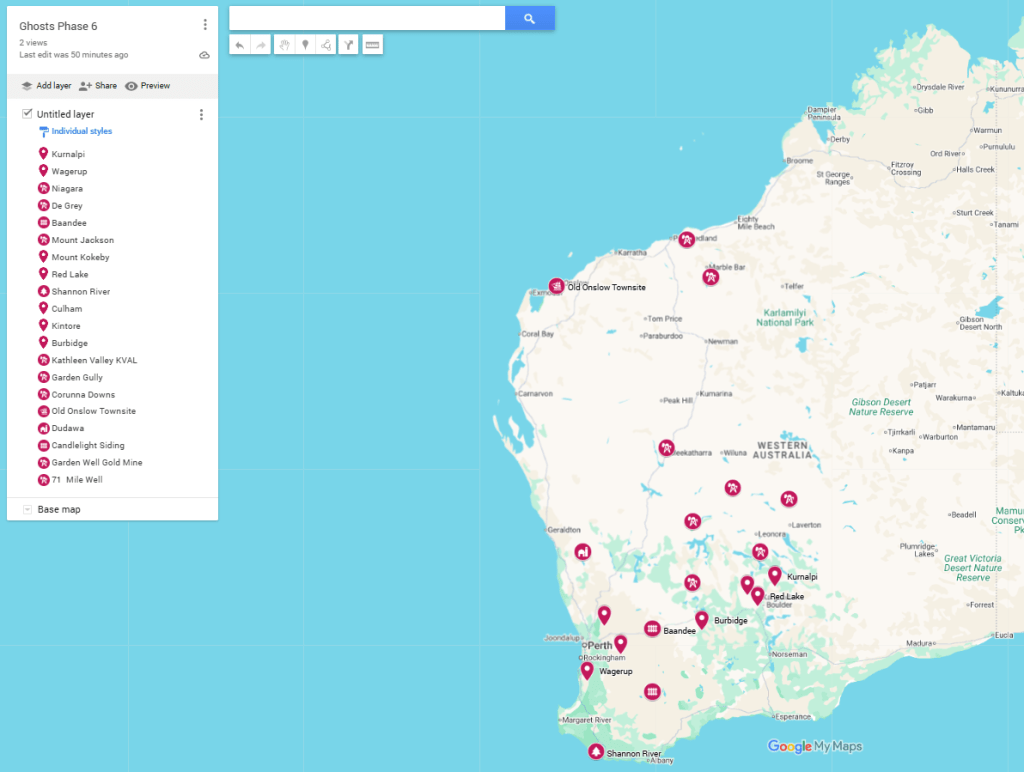
1 March 2026 is the launch of Phase 6 of the project and 20 new ghost communities have been added to the list of towns that are being actively researched.
If you know anything more about any of these places, or any others on our please, please contact us via our contact page. And if you find anything that you think is incorrect on any of our pages, we need to know!!
And don’t forget to subscribe to this page to receive updates on the project.
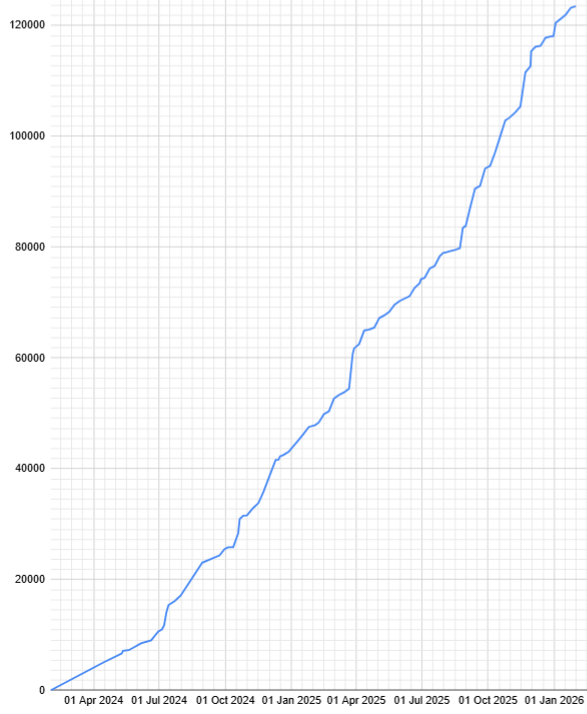
The total number of records captured as at 31 January 2026 was 123,471. Now that the very typical slow down over the festive season is past we will be seeing the also very typical ramp up in number of records collected. Congratulations to the project team who are working so hard to make this project great!!
Since the end of November, we have added about 40 new communities to the list of captured records – ranging (alphabetically) from Barrow Island to Yule River, and spread geographically all over our state.
As you can see from the list below, some of the record numbers are very low. This happens when we are researching one community and come across records for another community that is on our list. We capture the strays as we go along because we don’t want to miss anything!!
Once our website and search engine is fully operational you will be able to access some of these records. Here are the latest figures followed by a simple line graph showing the growth in total numbers:
The Unsung Pioneer of the Yilgarn: The Story of Richard Greaves
The history of Western Australia is inextricably linked to the glitter of gold. While names like Bayley and Ford often dominate the narrative of the great 1890s rushes, the foundations of these discoveries were laid years earlier by men whose names are less frequently celebrated. One such figure was Richard Greaves, a Victorian miner whose grit and keen eye for geology helped unlock the Yilgarn goldfield, paving the way for the legendary wealth of Coolgardie and Kalgoorlie.
The Early Spark of Discovery
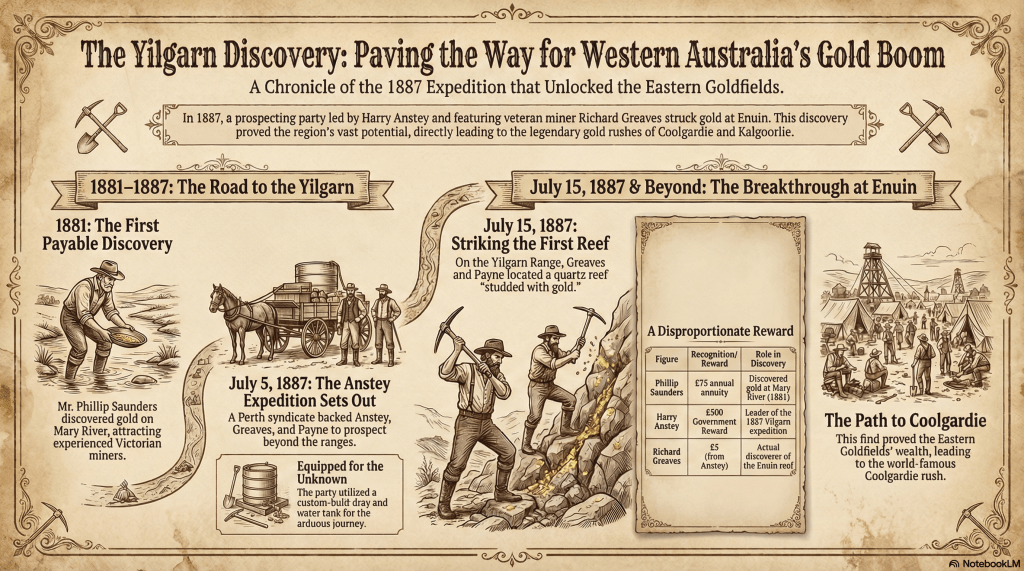
Before the Yilgarn was even on the map, Western Australia’s golden potential was largely a series of rumors and small-scale finds. The first “payable” quantity of gold was discovered in 1881 by Phillip Saunders on the Mary River in Kimberley. Though the Kimberley field was never a massive producer, it proved that the state held more than just traces of gold, acting as a magnet for experienced prospectors from the eastern colonies.
Among these arrivals was Richard Greaves. He landed in Western Australia in 1885 at the age of 35, bringing with him a lifetime of experience gained by following his father through the famous Victorian gold rushes. For a time, he worked as a plasterer in Perth, but the call of the “outback” was too strong to ignore.
The Lawrence Syndicate and the Trek East
In 1887, Greaves’ life took a pivotal turn when he met William Lawrence, a Perth boatbuilder who had seen promising gold specimens from the north. Lawrence, sensing an opportunity, formed a high-profile syndicate to fund an expedition. This group included several prominent Perth citizens, such as Dr. Scott (the Mayor of Perth) and future Premier George Leake.
The expedition was led by Harry Anstey, a metallurgist. Greaves and his partner, Edward Payne, were the hands-on prospectors. The terms were modest: thirty shillings a week, food, and a one-eighth share of any find. On July 5, 1887, the party set out from St. George’s Terrace in Perth, equipped with a specialized dray and a water tank, heading toward the unknown beyond the Toodyay ranges.
July 15, 1887: A Fateful Discovery
The journey was not easy. The party met other prospectors, like a man named Colreavy, who were so discouraged they urged Anstey’s team to turn back. However, Greaves and Payne pushed forward to Enuin, then part of George Lukin’s station.
The breakthrough occurred on the slopes of the Yilgarn Range. Greaves later recounted the moment they found a “floater” (a piece of ore detached from the main reef). As he and Payne worked the outcrop, they realized the magnitude of their find:
The First Speck: Payne spotted a visible speck of gold in a sample.
The “Half-Solid” Gold: Greaves turned over another piece of rock with his pick, discovering it was nearly half solid gold.
The Reef: Within ten minutes, they located the main reef, finding quartz heavily studded with the precious metal.
This was the first payable gold ever found in the Eastern Goldfields.
Controversy and the “Cordelia” Mine
While the find was historic, it was also the source of long-standing bitterness. The Western Australian Government paid a £500 reward for the discovery, but it went to Harry Anstey as the leader of the party. Greaves later claimed he was the actual discoverer, but his official claim for recognition was rejected by the Mines Department on the grounds that he was a “paid servant” of the syndicate.
Greaves’ luck with official recognition didn’t improve. After the Enuin find, he and Payne discovered another rich outcrop about 12 miles away, which Greaves named the Cordelia mine. To mark the site, he dragged a log over the reef and set it on fire, leaving a heap of ashes as a marker.
For “old time’s sake,” Greaves shared the location of the Cordelia with Colreavy, the man he had met earlier on the trail. Shortly after, Colreavy announced a discovery at a place he called Golden Valley, which Greaves insisted was his Cordelia mine. Colreavy received a government reward; Greaves did not.
The Path to Coolgardie
Perhaps the most poignant part of Greaves’ story is how close he came to discovering Coolgardie. While at Enuin, an Aboriginal woman named Maggie told him of a place called “Coolgoon,” where she claimed there was “plenty of similar stuff”.
Greaves intended to investigate, but his health failed him. After multiple operations and being forced to wear a “leather waistcoat” for support, he attempted to return to the field but was too weak to continue. He was forced to turn back just as Bayley and Ford—who were eventually guided by native locals—made the find that would “stagger the world”.
Legacy of a Prospector
Richard Greaves never achieved the immense wealth that his discoveries generated for the state. He eventually found a quieter life as the caretaker of the James-street school and gained a reputation as a champion rifle-shot.
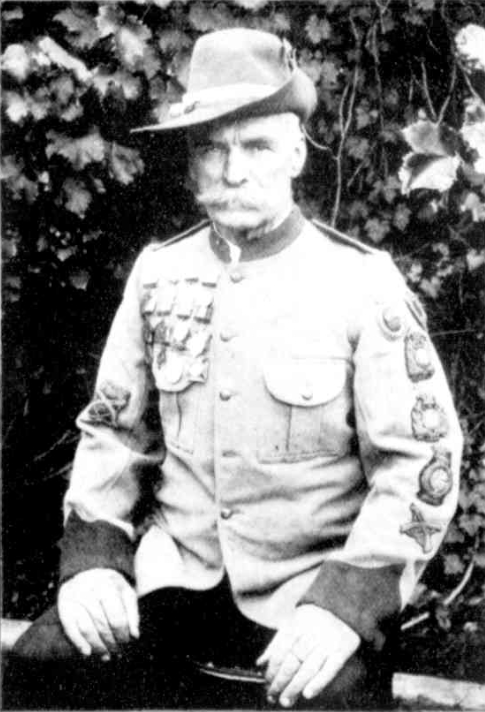
Richard Greaves
He died in 1916, but his 1903 book detailing his experiences ensures that his role in the Yilgarn—and his hand in the first reef found in the Eastern Goldfields—remains a matter of historical record. For history enthusiasts and casual readers alike, Greaves represents the thousands of “forgotten” miners whose persistence built the foundations of modern Western Australia.
Editor’s Note: This story was taken from an article that appeared in The West Australian on 2 July, 1936.1 If it interests you, then I recommend that you read the story in full on Trove.
The Nallan Wood Strike of 1908 was a significant three-month industrial dispute in the Murchison goldfields of Western Australia that brought the massive Great Fingall mine to a complete standstill. Triggered by demands for increased wood-cutting rates, the strike highlighted deep-seated grievances among a culturally diverse workforce and underscored the critical dependence of the mining industry on wood fuel for its operations.1
The Tinderbox
The conflict was rooted in deteriorating working conditions and economic frustrations that had been building for years. By 1908, woodcutters—who were predominantly of Italian and South European descent—faced increasingly difficult labor for stagnant or diminishing returns.
Key factors included:
“Cleaning Out” Policies: Employers shifted from allowing “picking” (selective cutting) to requiring “cleaning out,” where workers had to clear entire areas. This forced cutters to spend hours on difficult, low-yield “snags” for very little pay.
Weighing and Payment Disputes: Cutters were paid by weight, but wood was often left on the line for months to dry. As the wood lost moisture, its weight decreased, directly reducing the workers’ earnings.
Failure of Arbitration: A 1904 Arbitration Court award had notoriously sided with employers, suggesting that wages were already too high and even recommending reductions. This left workers with a deep distrust of the legal arbitration system.
Resource Monopolies: Mining companies and firewood suppliers jointly controlled access to wood and water on Crown land, leaving cutters with little leverage outside of direct action.
The Standstill
The strike at Nallan began in late 1908, with cutters demanding higher rates for their labor. The impact on the local economy was immediate and severe, particularly for the townsite of Day Dawn, which was almost entirely dependent on the Great Fingall Mine.23
When the firewood supply was cut off, the Great Fingall management announced the mine would close down at 8:00 AM on Tuesday, November 17, 1908. This decision rendered approximately 500 men idle, throwing the community into a state of “disquietude”. While the mine staff and a few maintenance workers were retained, the bulk of the workforce was forced to leave town or wait for a resolution.4
Business circles in Day Dawn expressed considerable disappointment as the strike dragged on, with rumors of settlements repeatedly proving false. The mine management refused to restart operations until enough wood was stacked on the lease to guarantee several weeks of continuous work.
The Intervention
As the strike became an “industrial disaster,” various levels of government were forced to intervene.
Law Enforcement: Police presence was heavy. Inspector Sellinger was stationed in readiness with 25 police officers, many of them mounted, to handle impending trouble. In a move described as a “harsh suppression,” six Italian strikers were arrested at Nallan. They were initially refused bail by the Warden and were only released by an order from the Supreme Court.56
Government Arbitration: Warden Troy was appointed as an arbitrator and spent days taking “voluminous evidence” from both sides. Additionally, Premier Newton Moore became personally involved, suggesting a settlement based on a daily wage of 12s and a 25% limit on contract labor.78
Local Representation: Mr. Lewis, the Mayor of Day Dawn, and Mr. E. E. Heitmann, MLA, petitioned the Premier to enforce agreements with the Firewood Company to prevent a total collapse of the district’s economy. Heitmann notably argued that the company was not acting in good faith, withdrawing offers just as settlements appeared likely.9
The Resolution
The strike was characterized by a tug-of-war between the Firewood Company, which wanted to adhere to the Warden’s original award, and the workers, who sought a slight increase of approximately 1d per ton or a shift to a daily wage.1011
The dispute eventually reached a settlement prospect in November 1908, with a proposed rate of 12s 1d per day for cutters. This was part of a broader shift where woodcutters began to reject the “red tape” of the Arbitration Court in favor of direct bargaining and strike action.1213
The Aftermath
The aftermath of the Nallan Wood Strike had lasting implications:
Militancy and Recognition: The success of the “foreign element” in standing up to the powerful Chamber of Mines earned them new respect within the wider Labor movement.14
Judicial Precedent: The harsh sentences handed down to strikers—including hard labor for leaders—were intended by magistrates like John Michael Finnerty to “impress upon the foreigners” the necessity of following British law.15
Unionization: Within a few years, woodcutters were integrated into the formal trade union movement, ending their previous isolation from the mine workforce.16
The Nallan Wood Strike serves as a stark reminder of the fragile balance of the early 20th-century goldfields, where a handful of woodcutters could bring a global mining giant to its knees in their quest for industrial justice.
Nallan Wood Strike. (1908, November 24). The Murchison Times and Day Dawn Gazette (Cue, WA : 1894 – 1925), p. 2. Retrieved January 25, 2026, from http://nla.gov.au/nla.news-article233449382↩︎
Nallan Wood Strike. (1908, November 24). The Murchison Times and Day Dawn Gazette (Cue, WA : 1894 – 1925), p. 2. Retrieved January 25, 2026, from http://nla.gov.au/nla.news-article233449382↩︎
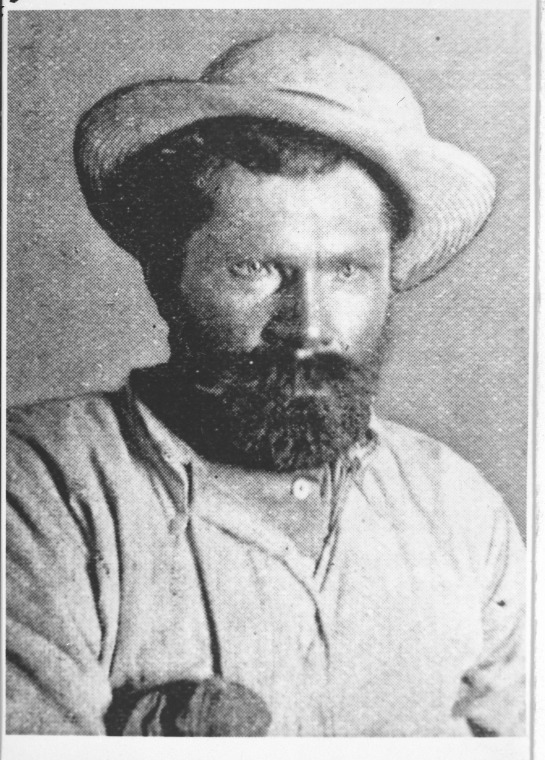
His name was “Russian Jack” although his real name was Ivan Fredericks, but that wouldn’t do in the Aussie outback, would it!!
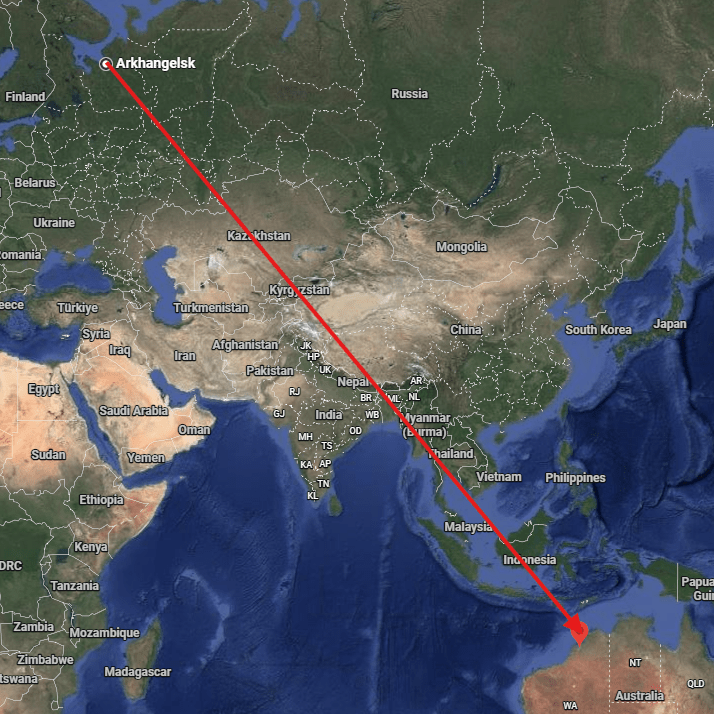
He came from the mostly frozen city of Arkhangelisk (located on the north coast of Russia), not far from Siberia. In the early 1880s he decided to head for Derby in the far North West of Western Australia. You could hardly find two locations more different and further from one another in the whole world.
Those who knew him described him as “a magnificent specimen of a man” he was said to be just under 7 feet tall and weighing a lean 18 stone in weight. He was believed to be “the strongest man in Australia” at that time.
He loved his food, consuming enormous amounts in a single sitting. Three pounds (1.5kg) of steak, a dozen eggs, a loaf of bread and a pound of butter (and that was just his entree!!). He supposedly liked emu eggs. “There was a lot more eating in them” he would often say.
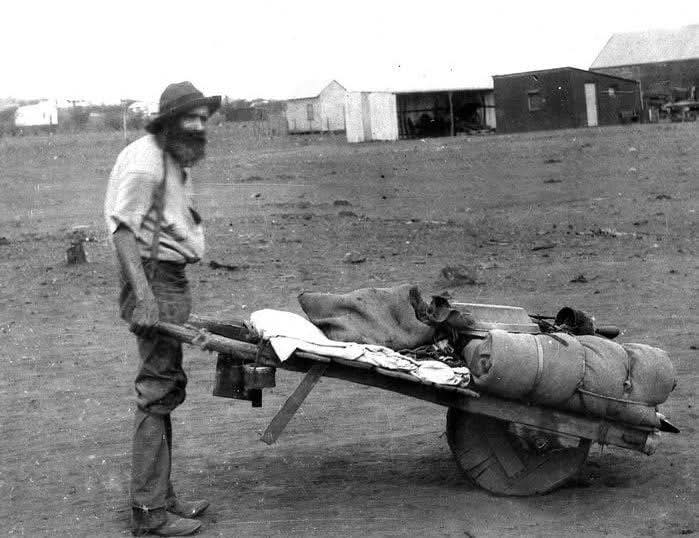
In the small town of Derby, Jack constructed an abnormally large wheelbarrow, with shafts/handles over 2 metres long. A specially carved wooden (wide) wheel made it easier to negotiate both soft soils and the rough country of the outback, areas where he went searching for gold.
The long low wheelbarrow with straight shafts resembled a sled and it would most likely have been easier to pull than to push. With the friction on the wooden wheel, the average man had difficulty in moving the barrow at all, even when empty! Russian Jack would often push loads well in excess of 80 kilograms, and at times loads far greater than that!! (as you will see).
A pic of Jack later in his life with one of his trusty “Wheelbarrows”. It shows the wheel to be a cut section of a thick log, bored through the centre, around a foot thick.
When he and a mate were halfway to the Kimberley country, his companion fell ill. Jack loaded his mate’s swag and stores, on top of his already laden wheelbarrow, allowing the sick man to walk alongside.
Having travelled over 60 kms, his friend became too sick to walk any further, so Jack put him on top of the load and wheeled him along the track, sadly not long after that his mate died. He buried him beside the track and continued his journey alone.
“His feats symbolise the mateship and endurance of the pioneers of the region, then lacking all the amenities of civilisation.”2
During one of his early overland trips, Jack came across two elderly prospectors who were too exhausted to carry their swags and gear any further, they were resting in the shade of a tree waiting for death to end their suffering. He loaded their gear on to his wheelbarrow and helped them get to the nearest settlement some 50 ks further on.
On another occasion Jack saved another stricken gold prospector, (all of this rescuing must have been a real pain for him, but due to his kind nature, he just couldn’t leave anyone in need).
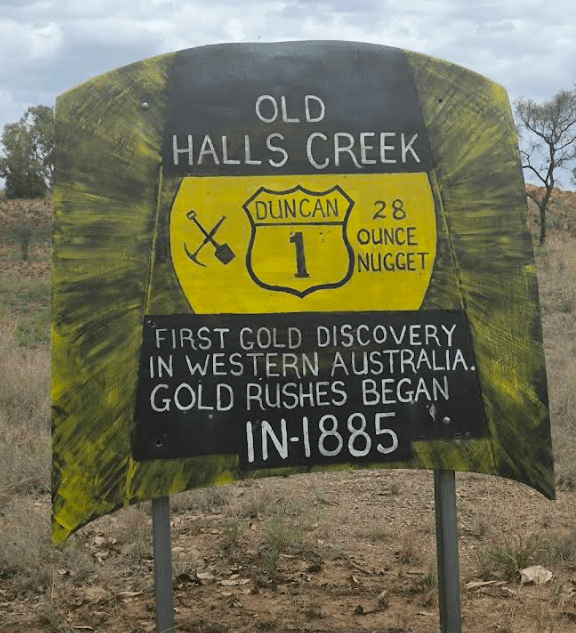
This man was called Halliday, he was found lying semi-conscious beside a lonely track in the Kimberley near Fitzroy Crossing, a victim of typhoid fever. Jack helped the sick man on to his wheelbarrow and pushed him and their combined camping gear across a few hundred kms of rugged country to the tiny township of Halls Creek. (Old Halls Creek, not where Halls Creek is today), there the sick man was given medical treatment and lived to tell the tale.
Old Halls Creek Duncan Road, Ord River Lat/Long: -18.24854484895759, 127.78225683864191
One other recorded event was when Jack and a mate were returning from an unsuccessful prospecting venture inland when their food supply ran really low. His mate decided to chase a Roo on foot, tripped and broke his leg. In typical fashion Jack lifted his injured mate onto his wheelbarrow and pushed him to safety.
When they arrived in town, one of the locals mentioned that Jack must have travelled over a particular rough track, one that had heaps of pot holes and gullies along it. Jack told the admiring on-lookers, “I pushed him over a hundred miles (160 kms) in that damn wheelbarrow.” his mate with the broken leg, still sitting on it remarked drily, “Yes, and I’ll swear he hadn’t missed a rock or hole on the whole track.”
Jack was one of the first arrivals on the Murchison goldfields and at Cue, (roughly 700 ks north of Perth. The police “station” was just two tents and a rough enclosure for their horses. It was decided to get a large tree stump or log from some distance away, and transport it back to Cue on a wagon.
The log was set up near the police tents, they then fastened a strong chain to it and that became the Cue Gaol.
Jack was prospecting in the area when he came into town for supplies on one occasion. Prior to returning to his camp about 12 ks out of town, he decided to stop at the pub for a beer or three!! His enormous wheelbarrow was loaded with all his groceries, a bag of potatoes, drilling gear and a wooden box full of explosives. On top of that was casually placed a tin of 50 firing caps (extremely sensitive objects) particularly dangerous sitting on top of sticks of dynamite!!!
With the slightest jolt the firing caps could easily have caused a major explosion. Jack didn’t mind for when he left in the early evening he was happily drunk. He effortlessly took up the shafts of his great wheelbarrow and headed off, but being a bit under the weather (so to speak) he weaved all over the track trying to push it in the right direction towards his camp.
A policeman saw that he’d had a “few” so decided to help him get safely out of town. He then spotted the firing caps sitting precariously on top of the load. For his and everyone else’s safety the policeman wanted to detain him so he could sober up a bit.
He was unsure how to do it for Jack being so big and strong, he had to be handled cautiously at the best of times. His continued staggering all over the road whilst loudly singing a song in his raucous, booming voice had the “Copper” a tad nervous!! As they drew near the police tents he got his police mates to help stop Jack, they suggested quietly and diplomatically that he should re-pack his barrow.
By this time Jack was thirsty again so agreed to sit down quietly for a spell. As Jack rested, he dozed off and fell asleep. The police re-packed his barrow properly then handcuffed him to the huge log, wanting to restrain him until he had sobered up, he could then (hopefully) make his own way back to his camp in the bush the next morning.
Overnight the policemen were urgently called out of town to a disturbance. Somehow they completely forgot about Jack being chained to the large log near the police tents. Later the next day the policeman who had detained him suddenly remembered that he had left Jack secured to the log back at Cue.
Riding quickly back to town the policeman was stunned to find that Jack was gone, AND SO WAS THE LOG!! It would have taken four men to lift it so he reasoned that some of the residents had moved the log and Jack to a shady spot out of the sun.
The policeman conducted a quick search for him finding him quietly sitting at the bar of the open air pub. He was having a beer and a chat with the owner, the log was beside Jack, who was still chained to it!!
Apparently Jack woke up during the night with a terrible thirst, he could see a water bag hanging near one of the police tents and called out for a drink. There was no response so heaved the great log up on to his shoulder and walked to the tent. He then emptied the water bag and went back to sleep.
When he woke, the hot sun was beating down on him. “Dying” for a drink and not particularly fussed how he got it, he again heaved the huge tree stump off the ground, balanced it on his shoulder and headed off to the nearest pub a half a mile away.(far out, big time)!!
When it opened there was Jack, chained to the log asking for a cool ale to prevent him from dying of thirst. That’s where the policeman later found him saying “I thought I left you in goal, Jack”. “So you did,” he replied, “but it was a low act of you to leave me all night with no drink. Have a drink with me now and I’ll go back to goal.” With the amazed police officer in tow, Jack again shouldered the goal log and strolled back to the police tents where he restored the makeshift “goal” to its original position.
The officer then removed Jack’s chain and put a billy on a campfire and shared a cuppa, The policeman said to him: “You had better go back to your show (goldmine) now but next time you want to have a few drinks, don’t buy explosives at the same time” Later Jack thanked the police for preventing him leaving town with his firing caps unsecured.
He was asked what he would most like to achieve in his life. His reply was, “I would like to retire near a city and grow lots of vegetables, then sit down by myself and eat the lot”
Following Russian Jack’s death in 1904 at the age of 40, (apparently from pneumonia) an obituary in a Fremantle newspaper said: “Russian Jack, if there are Angels in Heaven who record the good deeds done on earth, thou wouldst have sufficient to thy credit to wipe out the many faults that common flesh is heir to.” How nice was that !!.
His death certificate records his profession as “market gardener,” revealing that the big man seemingly fulfilled his life-long ambition to have his own private vegetable supply.
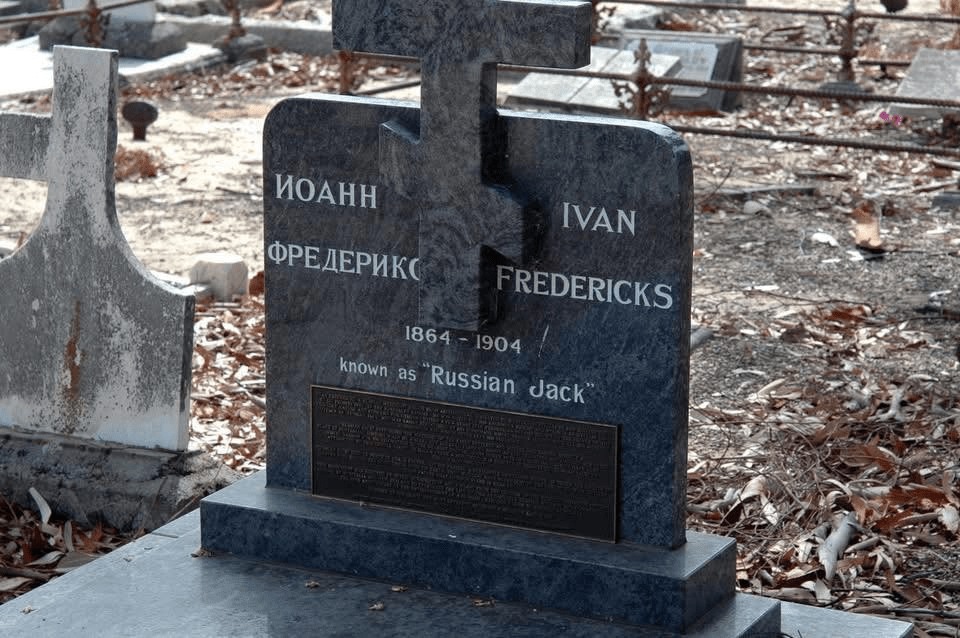
Jack was buried in a paupers grave as he had no next of kin and very little wealth. Around 2015 money was raised and a suitable headstone was placed over his grave, to honour one of West Australia’s and indeed Australia’s most colourful characters and pioneers.
Russian Jack’s grave in Fremantle
Today 122 years on from his death, Russian Jack’s loyalty to his fellow workers, mates4 and even people he didn’t know is still remembered and has become legendary in Australian folklore.
I hoped you enjoyed reading about one of the most remarkable characters to ever live and walk our fair land.
State Library of Western Australia, n.d. George Spences Compton collection of photographs of the Eastern Goldfields; 5001B/59. ↩︎
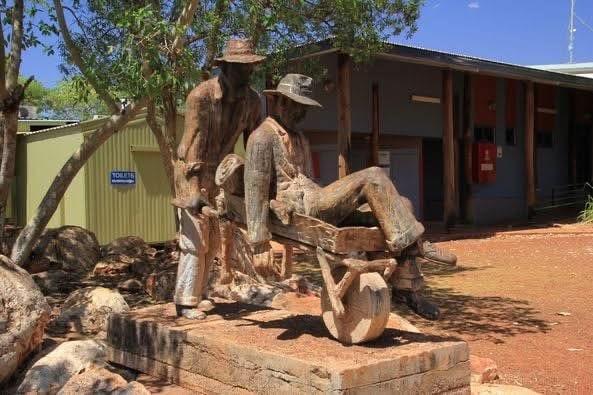
Outside Halls Creek shire offices in the far north-west of Western Australia, this memorial to Russian Jack can be found. It commemorates his feats of carrying those needing assistance on his wheelbarrow. The sculpture cost over $20,000 (a fair bit of dough back when it was unveiled in 1979, it is not to scale as it would have been far too expensive to do so!! ↩︎
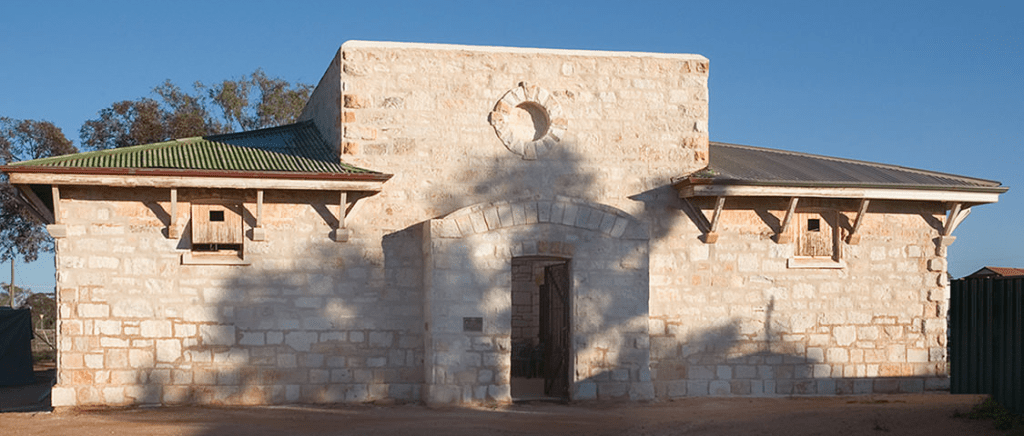
Today the Cue Caravan Park houses the old gaol built in 1896. It was a temporary home to prisoners being transported from outback lock ups in the north until its official closed in 1914. It was however, still used as a lock up until the 1930s. (Shire of Cue) ↩︎
One of the those events was the time that he pushed his sick mate over 300 kilometres in his wheelbarrow to Hall’s Creek. In reality it is thought to be closer to 60 ks that he pushed him, (Not sure that lessens the legend of the great man, still a Herculean effort I reckon!!). ↩︎
Peter Bridge has recently published a book called “Russian Jack” it has a wealth of researched information on Ivan Fredericks. It points out that some of the stories and myths about him may have been exaggerated by those telling his story many years ago, (having a little bit of Mao added!). ↩︎

 People of Western Australia's Ghost Towns