The People of Western Australia’s Ghost Towns project team are pleased to announce the launch of Phase 5 on 7 December 2025. Phase 5 will add 19 new communities to those already in progress.
Click on the name of the town to find out what we know about it – so far. Our research continues and we will be keeping all our content up to date with our latest discoveries!
Do you know anything about any of these communities? Do you have pictures, stories, documents, records of any type? Please let us know via the comments panel.
In the early days of January 1907, the quiet mining town of Higginsville, Western Australia, found itself at the centre of a curious legal drama. Nestled in the Goldfields-Esperance region, Higginsville had only recently been gazetted as a townsite that same year. Named after prospector Patrick Justice Higgins, the settlement was a modest but active hub for goldfield workers, with a population that hovered around a few dozen. Life in Higginsville revolved around the rhythms of mining, the railway, and the local hotel—often the social heart of such frontier towns.
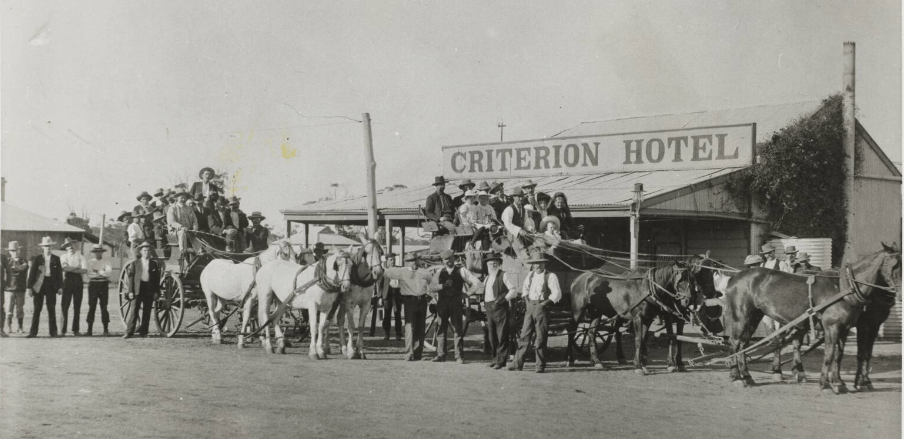
Criterion Hotel, Higginsville 1908 Photograph in the collection of the State Library of Western Australia1
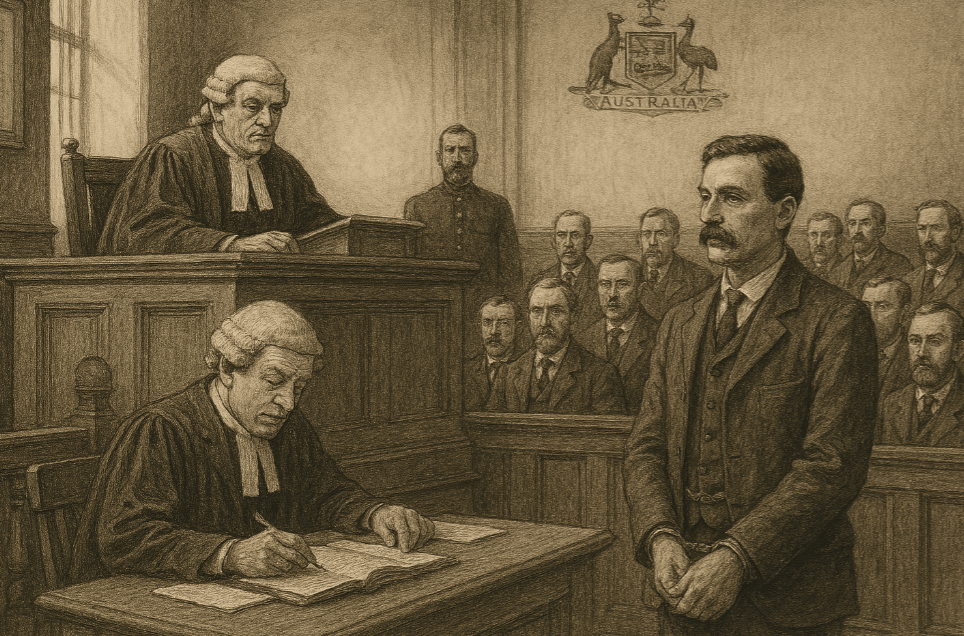
It was at this hotel that the alleged crime took place. On the night of January 3rd, Charles Jacobson, a carpenter and long-time resident of the goldfields, was accused of breaking and entering the licensed premises of Hannah Warburton with intent to commit a crime. The trial commenced the following afternoon before the Chief Justice and a jury of twelve, with Crown Solicitor A. E. Barker prosecuting and Mr. F. H. Rickarby defending the accused.
According to the prosecution, Jacobson had been among the last patrons in the hotel bar before closing. Later that night, a disturbance was heard by one of Warburton’s sons, who, along with another man, discovered that entry had been forced through the beer cellar. Jacobson was found inside, barefoot, with his boots left outside the flap—an odd detail that would become central to the case.
The Crown argued that the cellar flap had been opened with force, suggesting intent. Jacobson’s proximity—his camp lay just 50 yards away—added to the suspicion. Though he claimed to have fallen into the cellar and struck his head, the prosecution questioned his motives. “If he only wanted to steal a drink,” Barker noted, “it was a crime.”
Testimonies from Hannah Warburton and her family, as well as Harry King and Constable Finch, supported the prosecution’s narrative. Jacobson, however, maintained that he had no recollection of entering the cellar, attributing his condition to drunkenness and fatigue. He insisted he had returned home to his two young sons after the incident.
The defence leaned heavily on the testimony of Jacobson’s children. Carl Jacobson, aged 11, recounted seeing his father leave the camp after being invited for a drink by an unknown man. He described watching his father from a hole in the tent wall and later witnessing him return, bruised and disoriented. His twin brother, Thomas, corroborated the account.
Mr. Rickarby, in his address to the jury, emphasized the lack of clear intent and the possibility of an accident. Mr. Barker, confident in the simplicity of the case, chose not to offer a rebuttal.
The court adjourned at 4:15 p.m. on 22 March 1907, with the Chief Justice set to deliver his summation the following morning. When proceedings resumed, the jury returned a verdict of acquittal. Jacobson’s story—that he had accidentally fallen into the cellar and had no knowledge of any attempted robbery—was ultimately believed. The case closed not with condemnation, but with a reminder of how easily circumstance can be mistaken for intent.
Author’s Note
This article was prepared from contemporary accounts found in newspapers from Kalgoorlie 2, Adelaide 3 and Sydney.4
I have just run across a gently amusing newspaper cutting from 19331 that I want to share with you…
Coley Crane, a well-known Perth citizen, is interested in a very promising mining venture at Field’s Find. Recently he was showing a visitor round the ine and drew attention to the ore dump beneath the whim legs. “It is nice ore,” said Coley. “Ah well,” condoned the newcomer, “it all takes time, and while the improvised plant might be improved upon that will come in time; it will all come in time.”
“I don’t think,” said Coley, “you quite understood what I said – I remarked that this was a nice ore.” The visitor agreed, but continued: “But I wouldn’t worry about that. You’ll have everything spick and span later on.”
Coley was still puzzled. “I was referring,” he persisted, “to the quartz in the lump here.”
“Oh,” exclaimed the man from Perth, elucidation dawning upon him, “I thought you were referring to the superstructure and that you were saying it was an eye-sore!”
In 1872, the government offered a reward of £5,000 for the discovery of the first payable goldfield in the colony of Western Australia1.
In 1879, Alexander Forrest explored the Fitzroy and Ord River areas, and reported excellent grazing land and that gold might be found in the East Kimberleys. John Adams and Phil Saunders managed for find a little gold, but insufficient to be payable. In 1883, a second Forrest expedition included a geologist, Edward Hardman, who showed likely gold deposits on his map of the area.2
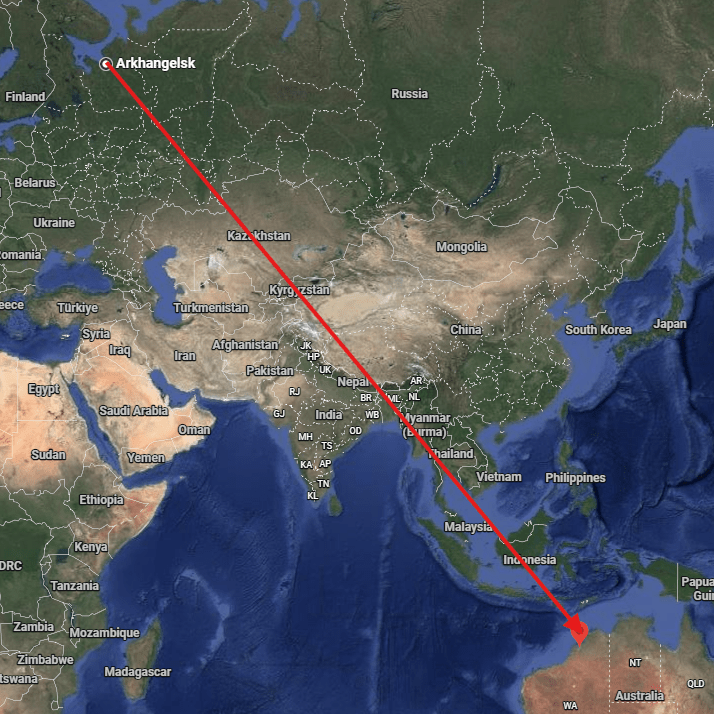
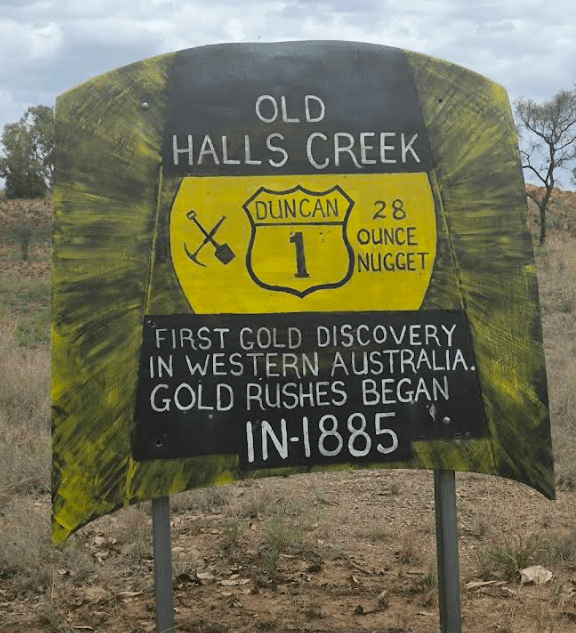
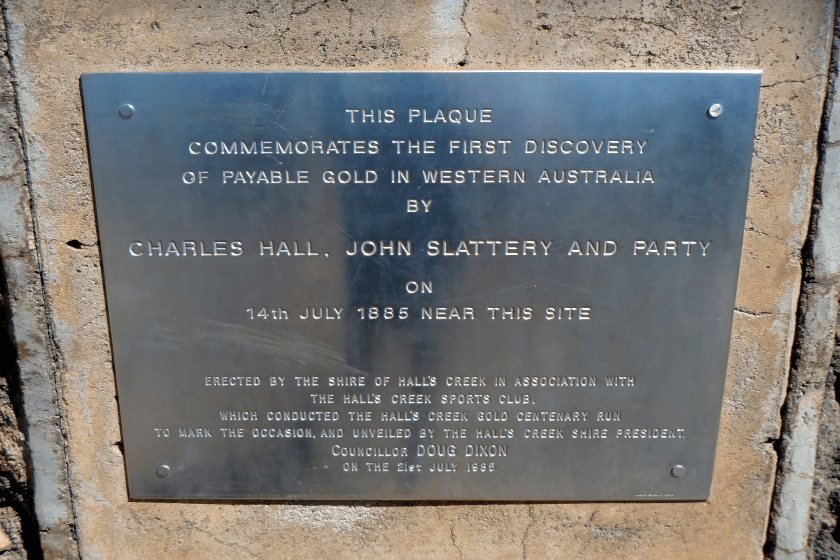
On 14 July 1885, Charles Hall and Jack Slattery, following the leads provided by Hardman, found payable gold at Halls Creek in the Kimberley region. After working for a few weeks, Hall returned to Derby to report his find, and took 200 ounces of gold with him as evidence. The ensuing “Kimberley Rush” encouraged as many as 10,000 men to head to Halls Creek. The field was officially declared on 19 May 18863.
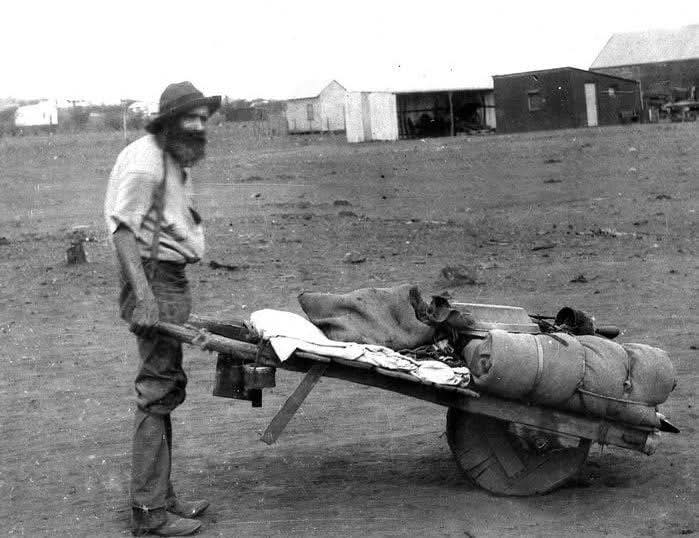
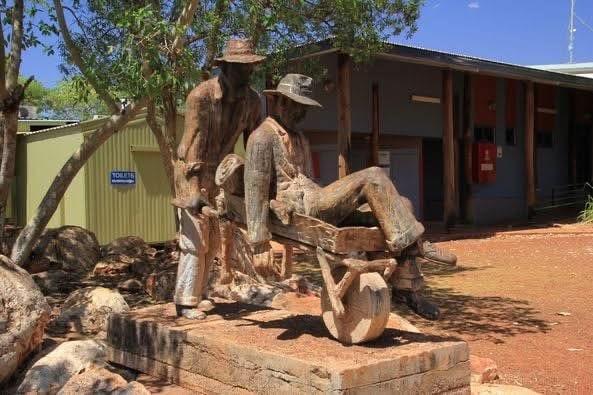
Thousands of men made their way to the Kimberley from other parts of WA, the eastern colonies, and New Zealand. Most arrived by ship in Derby or Wyndham, and then walked to Halls Creek. Others came overland from the Northern Territory. Most had no previous experience in gold prospecting or of life in the bush. Illness and disease were rife, and when the first warden, C. D. Price, arrived on 3 September 1886, he found that “great numbers were stricken down, in a dying condition, helpless, destitute of money, food, or covering, and without mates or friends simply lying down to die”. A few were lucky enough to locate rich alluvial or reef gold, but most had little or no success.
In the early days of the gold rush no records or statistics were recorded for either the arrivals or deaths. Also, no one knows how many died trying to get to Halls Creek across the waterless desert, or how many simply turned back. When men actually arrived at Halls Creek, dysentery, scurvy, sunstroke and thirst continued to take its toll. The Government applied a gold tax of two shillings and sixpence an ounce. It was a very unpopular levy as gold proved so hard to get. The diggers avoided registering and the Government had a great deal of trouble collecting the tax or statistics of any kind. Halls Creek was a shanty town of wood, stone, canvas, tin, bark and spinifex. But it boasted two hotels, a post office and a gold warden.
When Price arrived in September 1886, he reported that about 2,000 remained at the diggings. By the end of 1886, the rush had ceased. When in May 1888 the government considered claims for the reward for discovery of the first payable goldfield, it was decided that the Kimberley goldfield, which had proven disappointing, was insufficient to meet the stipulated conditions of a yield of at least 10,000 ounces (280 kg) of gold in a 2-year period passing through Customs or shipped to England, so no reward was paid out5. A gift of £500 was given to Charles Hall and his party, along with a bequest of the same amount to Hardman’s widow.
The rush lasted only a few years as it was not financially viable to transport the machinery to this remote region. With the discovery of gold in Coolgardie, most prospectors moved on. In 1955, the town site of Halls Creek was relocated 15Kms west.
SOURCES & NOTES
Playford, Phillip & Ruddock, Ian (1985). Discovery of the Kimberley Goldfield.↩︎
A lot of gold went out of the Kimberley via the Northern territory and it was rumoured that a gold buyer was to have taken 3,000 ounces of gold at a time out of Halls Creek. It is estimated that as much as 23,000 ounces (nearly 650 kg) of gold was taken from the fields around Halls Creek, some unofficial estimates were as 100,000 ounces. ↩︎
Bonnie Vale or Bonnievale near Coolgardie was the site of the Westralia gold mine. Bonnie Vale was gazetted in 1897 but became famous in March 1907 when unusually heavy rainfall flooded the mine with 160 miners inside. All the miners managed to get out before the main shaft was flooded with water, except for one. Only Modesto (Charlie) Varischetti remained inside.
What followed was a thrilling mine rescue that may be unfamiliar to readers because it happened so long ago.
At first Varischetti was presumed dead with no chance of survival unless he was in an area of the mine where there was an air pocket. Two days after the freak storm and flooding the rescuers heard Varischetti tapping. Varischetti became known to newspaper readers across the world as the Entombed Man.
A steam pump was rushed to the mine but only reduced the water level very slowly. The mine manager estimated that it would take a week to clear the shaft and there was no hope of rescue. Allegedly the mine manager’s seven-year-old son asked his father about using a diver to rescue the trapped man and this idea was taken up by the Mining Inspector who was on site.
Divers were sourced in Fremantle and two miners from Kalgoorlie who were experienced in both mining and diving offered their assistance as well. A special train was put on to get the Fremantle divers and the equipment needed for the rescue to Bonnie Vale as fast as possible. The ‘Rescue Special’ steamed to Coolgardie arriving two hours faster than the regular trains. Fast horses were waiting to meet the train and raced to the mine in Bonnie Vale. It was only four days after the flooding of the mine shaft that the first diver made his initial exploratory dive. By day six, the divers had reached Varischetti and gave him food, candles, a powerful lamp, and other necessities. Special Italian dishes were cooked for him by the wife of another Italian miner.
It was considered too dangerous to put Varischetti into a diving suit and take him through the flooded mine. Instead, the divers visited him each day while the mine was being pumped out. On the ninth day it was considered safe enough to tie a rope around Varischetti and help him walk out through the remaining water and sludge. In reality he was so weak one of the divers carried him for most of the distance.
hen the doctors in attendance examined Varischetti they pronounced his chief trouble was ‘a nervous prostration of a purely temporary character’ and gave him a sleeping draught. The newspapers reported that he did look much better the next morning.
The divers who rescued Varischetti were feted and showered with laurel wreathes and expensive gifts, such as gold watches and purses of gold sovereigns. Gifts came from grateful miners across the country.
Varischetti on the other hand back to work down the mines and died from fibrosis in 1920. There is a memorial to him in the Coolgardie cemetery.
Just as many of us watched the progress of the Thai cave rescue of the soccer team by Australian divers, in 1907 readers across the world eagerly awaited news of the ‘entombed man’ of Bonnie Vale. In the years since there has been a film made about the story, a graphic novel written about the rescue and even a song celebrating the miracle of Bonnie Vale.